
Weather Watchers
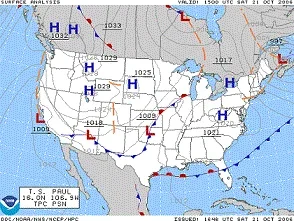 Students explore weather conceptsCopyright U.S. National Oceanic and Atmospheric Administration. Wikimedia Commons https://commons.wikimedia.org/wiki/File:Surface_analysis.gif
Students are introduced to some essential meteorology concepts so they more fully understand the impact of meteorological activity on air pollution control and prevention. First, they develop an understanding of the magnitude and importance of air pressure. Next, they build a simple aneroid barometer to understand how air pressure information is related to weather prediction. Then, students explore the concept of relative humidity and its connection to weather prediction. Finally, students learn about air convection currents and temperature inversions. In an associated literacy activity, students learn how scientific terms are formed using Latin and Greek roots, prefixes and suffixes, and are introduced to the role played by metaphor in language development. Note: Some of these activities can be conducted simultaneously with the air quality activity, What Color Is Your Air Today?.
It is essential for engineers to have an in-depth understanding of air pressure, temperature and humidity (which all play a role in the weather) to minimize and prevent air pollution. Weather and general atmospheric conditions can affect how a pollutant moves through the air or how it is transferred to soil or water (pollutant transport).
After this lesson, students should be able to:
- Define and explain the following terms: air pressure, barometer, humidity, saturation, convection currents and temperature inversions.
- Describe how interactions of air masses in the atmosphere result in weather changes.
- Explain how weather affects air pollution.
- Explain the purpose of the Air Quality Index.
- Explain how engineers use meteorological information.
- Develop and communicate an evidence-based scientific explanation for changes in weather conditions
Grade 5
Do you agree with this alignment?
- STEL-3D Explain how various relationships can exist between technology and engineering and other content areas.
Grades 3-5
Do you agree with this alignment?
- MS-ESS2-5 Collect data to provide evidence for how the motions and complex interactions of air masses results in changes in weather conditions.
Grades 6-8
This resource focuses on the following Three Dimensional Learning aspects of NGSS:
Science & Engineering Practices- Collect data to produce data to serve as the basis for evidence to answer scientific questions or test design solutions under a range of conditions.Do you agree with this alignment?
Disciplinary Core Ideas- The complex patterns of the changes and the movement of water in the atmosphere, determined by winds, landforms, and ocean temperatures and currents, are major determinants of local weather patterns.Do you agree with this alignment?
- Because these patterns are so complex, weather can only be predicted probabilistically.Do you agree with this alignment?
Crosscutting Concepts- Cause and effect relationships may be used to predict phenomena in natural or designed systems.Do you agree with this alignment?
Do you agree with this alignment? - Collect data to produce data to serve as the basis for evidence to answer scientific questions or test design solutions under a range of conditions.
In this lesson, students are introduced to some concepts of meteorology. It is essential for engineers to have an in-depth understanding of air pressure, temperature and humidity (which all play a role in the weather) in order to control and prevent air pollution. Weather and general atmospheric conditions can affect how a pollutant moves through the air or how it is transferred to the land or water (pollutant transport). For example, wind carries air pollution hundreds of miles away from its source, and precipitation washes air pollution out of the air and transfers it to the soil and bodies of water. Meteorological conditions can also affect the ease with which the pollutant is removed from the air (treatment/prevention options). See the Associated Activities (Refer to Dripping Wet or Dry as a Bone? and Turning the Air Upside Down) for more detailed background in each area. For more information on weather, see the attached Weather and Air Quality Reading (PDF).
Ask students to share whether they have ever read, watched or heard a weather report. What kind of information is provided in a weather report? How does this information affect their daily lives?
Ask students if they think the weather has any effect on air pollution. Can they give specific examples? Daily weather conditions definitely affect the quality of the air. Wind can move air pollutants from one location to another. Stagnant air can result in increased concentrations of harmful pollutants.
Weather systems typically are defined as being either high- or low-pressure systems. High-pressure systems are air masses with unique properties, such as warm or cool, or moist or dry. Low-pressure systems are pockets of air masses located between high-pressure systems. (Refer to the associated activity Air Pressure Experiments: I Can't Take the Pressure! for students to expand their understanding of air-pressure). Since several weather systems (high- and low-pressure systems) occur at the same time over North America, air masses are constantly colliding. When this occurs, weather fronts form, which often leads to some form of precipitation. Precipitation (rain, snow, etc.) washes pollutants from the air and onto the ground. Although this cleanses the air, it may create land and surface water pollution. (Students can refer to the design associated activity Barometric Pressure: Good News – We're on the Rise! to build and observe a simple aneroid barometer to learn about changes in barometric pressure and weather forecasting.)
Engineers, scientists and weathermen use the Air Quality Index (AQI) as a standardized index to classify and measure air pollution. The AQI is used to report air pollution levels to the public. Informing citizens about air pollution levels alerts people who may be susceptible to air pollution (such as young children, senior citizens and anyone with breathing problems). These people may need to modify their behavior and take precautionary measures to protect themselves when air pollution is severe. Once air-monitoring data is collected, the AQI is used to convert the data to a scale that ranges from zero to 100+. The scale intervals indicate the potential health effects of measured daily levels of major air pollutants, including carbon monoxide, nitrogen dioxide, sulfur dioxide, particulate matter and ozone.
Why is it important for engineers to be able to predict the weather? (Answer: It helps predict the wind, which affects pollutant transport and concentrations. The amount of water in the air affects how difficult/easy it is to remove pollutants from the air. The water in the air can wash out pollutants from the air.) Following the lesson refer to the associated activity Word Origins & Metaphors: Take Their Word for It! where students learn how scientific terms are formed using Latin and Greek roots, prefixes and suffixes, and on that basis, learn to make an educated guess about the meaning of a word.
Discuss the barometric pressure and humidity concepts with the students. Write the day's barometric pressure, relative humidity, temperature and dew point on the board. Ask the students to use this information to describe what they expect the weather to be like now and in the near future.
- aneroid barometer
- A device for measuring atmospheric pressure without the use of fluids.
- absolute humidity
- The ratio of the mass of water vapor contained per volume of moist air (this gives the density of the water vapor component).
- altimeter
- An aneroid barometer designed to register changes in atmospheric pressure that accompany changes in altitude.
- altitude
- The vertical elevation of an object above sea level.
- ambient air
- The air all around us.
- barometer
- A special instrument, of which there are many types, used to determine the atmospheric pressure.
- barometric pressure
- The atmospheric pressure measured by a barometer.
- convection current
- The movement of air in a circular fashion, as warm air rises and cool air sinks.
- dew
- Water droplets condensed from the air, usually at night, onto cool surfaces.
- dew point
- The temperature to which air must be cooled to reach saturation, and thus condense and produce dew. It varies little within an air mass.
- humidity
- Amount of water vapor in the air.
- meteorologist
- A scientist who studies meteorology (the atmosphere, weather and weather forecasting).
- meteorology
- A science that deals with the atmosphere, weather and weather forecasting.
- partial pressure
- A portion of the total pressure exerted by one component of a gaseous mixture. The partial pressures of all the components add up to the total pressure.
- pressure
- The amount of force applied per unit area or the ratio of force to area (P = F/A). Air pressure decreases with altitude.
- relative humidity
- The ratio between the partial pressure of water in the air and the maximum possible vapor pressure of water at a particular temperature. It is dimensionless. Usually what the media actually mean when they say "humidity" and useful in determining conditions for human comfort. But, it can be confusing because its value varies with air temperature.
- saturation
- A condition in which air at a specific temperature contains all the water vapor it can hold; 100% relative humidity.
- temperature inversion
- When a blanket of cold air is trapped beneath a thick layer of warm air.
- vapor pressure
- The partial pressure of water vapor in the atmosphere.
Pre-Lesson Assessment
Discussion Questions: Ask the students and discuss as a class:
- Have you ever read, watched or heard a weather report? What kind of information is provided in a weather report? (Possible answers: Temperature, humidity, precipitation, cloudiness, wind, sun, air quality, etc.)
- How does this information affect your daily lives? (Possible answers: How we dress for the day [coat, umbrella, etc.], what activities we plan.)
- Do you think the weather has any effect on air pollution/ Can you give specific examples? (Possible answers: Windy days move air pollution, acid rain, etc.)
Post-Introduction Assessment
Voting: Ask a true/false question and have students vote by holding thumbs up for true and thumbs down for false. Count the votes, and write the totals on the board. Give the right answer. Ask the students:
- True or False: It is important for engineers to be able to predict the weather. (Answer: True. Meteorology is important to engineers because [1] It helps predict the weather, which affects pollutant transport and concentrations, [2] The amount of water in the air affects how difficult/easy it is to remove pollutants from the air, and [3] The water in the air can wash out pollutants from the air.)
Lesson Summary Assessment
Air Pressure Demo: Submerge a drinking glass in a large container of water, so that the glass is completely filled with water. Lift up the glass, with the mouth facing downward, until the glass is nearly out of the water. Ask the students to explain, in their own words, why the water does not run out of the glass. (Answer: There is no air pressure on the water at the closed end of the glass forcing the water out.) Note: Some self-feeding pet feeders work the same as this demo; if possible, use one of these feeders to make the idea more relevant.
Class Discussion: Discuss barometric pressure and humidity concepts with the students. First, write the day's barometric pressure, relative humidity, temperature and dew point on the board. Then, ask the students to use this information to describe what they expect the weather to be like now and in the near future. It may be helpful to review recent weather events (large storms) and the pressure conditions leading up to the events.
Diagramming: Ask the students to illustrate the concept of weather through drawing. First, ask the students: Why do engineers care about meteorology? (Answer: Meteorology is important to engineers because [1] It helps predict the weather, which affects pollutant transport and concentrations, [2] The amount of water in the air affects how difficult/easy it is to remove pollutants from the air, and [3] The water in the air can wash out pollutants from the air.) With these thoughts in mind, have them draw pictures of how one or more types of weather (rain, wind, pressure, etc.) may affect air pollution. (Show students Figure 1, which illustrates how hurricanes form: high pressure pushes air towards a low pressure area in a circular motion.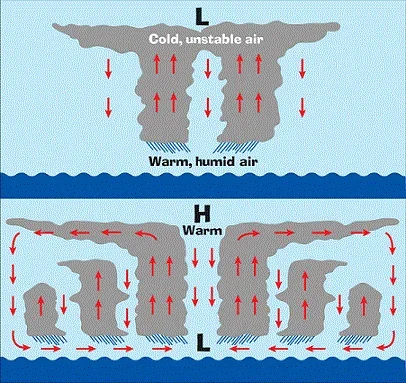 Figure 1. Formation of a hurricaneCopyright NASA http://scijinks.nasa.gov/_media/en/site/hurricane/hurricane_diagram_large.gif
Homework
Internet Search: Assign students one vocabulary term each and have them research it on the Internet. Lead a small discussion of student findings during the next class period.
Return to the air quality activity What Color Is Your Air Today?. Were there other trends that correlated with the changes in air quality? For example, did the barometric pressure change considerably? What about the wind speed or direction? How about the humidity? What was the temperature?
Invite a local meteorologist to speak to the class.
Cunningham, J. and Herr, N. Hands-on Physics Activities with Real-Life Applications. West Nyack, NY: The Center for Applied Research in Education, 1994, pp. 188-210.
Felder, Richard and Rousseau, Ronald. Elementary Principles of Chemical Processes. New York, NY: John Wiley & Sons, 1986.
Fraser, Alistair B. Bad Clouds. Bad Meteorology. www.ems.psu.edu. Accessed July 13, 2004.
Laying Some Groundwork-2: Humidity – Suite 101.com. Creative Marketeam Canada Ltd. www.suite101.com. Accessed July 13, 2004.
Perry, Robert and Green, Don. Perry's Chemical Engineer's Handbook. Sixth Edition. New York, NY: McGraw-Hill Book Company, 1984.
UNESCO. 700 Science Experiments for Everyone. New York, NY: Doubleday, 1958.
Walpole, Brenda. 175 Science Experiments to Amuse and Amaze Your Friends. Random House Children's Books, 1988.
What is a temperature inversion? WeatherQuestions.com, Video Weather & Weather Street. www.weatherquestions.com. Accessed September 13, 2006.
Contributors
Amy Kolenbrander; Janet Yowell; Natalie Mach; Malinda Schaefer Zarske; Denise Carlson
Supporting Program
Integrated Teaching and Learning Program, College of Engineering, University of Colorado Boulder
Acknowledgements
The contents of this digital library curriculum were developed under a grant from the Fund for the Improvement of Postsecondary Education (FIPSE), U.S. Department of Education and National Science Foundation GK-12 grant no. 0338326. However, these contents do not necessarily represent the policies of the Department of Education or National Science Foundation, and you should not assume endorsement by the federal government.
Copyright
2004 by Regents of the University of Colorado.