
What to Wear and Drink? Weather Patterns & Climatic Regions
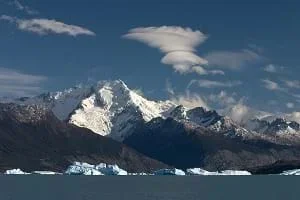 Students examine characteristics that define climatic regions.Copyright 2005 Luca Galuzzi - www.galuzzi.it, Wikimedia Commons https://commons.wikimedia.org/wiki/File:Lake_Argentino_northern_arm_Lago_Argentino_Brazo_Norte_Patagonia_Argentina_Luca_Galuzzi_2005.JPG
Students explore characteristics that define climatic regions. They learn how tropical, desert, coastal and alpine climates result in different lifestyles, clothing, water sources and food options for the people who live there. They learn that a location's latitude, altitude, land features, weather conditions and distance from large bodies of water, determines its climate. Students discuss how engineers help us adapt to all climates by designing clothing, shelters, weather technologies and clean water systems.
Weather and climate conditions affect humans in fundamental ways. Throughout history, individuals and families devised ways to protect themselves from the weather. They were ingenious in making clothing and shelter to keep warm in cold regions, stay cool in hot regions and stay dry in rainy areas, as well as secure clean drinking water in locations with little water or salt. More recently, engineers develop technologies that advance our ability to predict and be protected from weather and climate. Solving basic survival challenges are at the heart of what engineering is all about.
After this lesson, students should be able to:
- List several climatic regions in the world.
- Compare and contrast the characteristics of different climatic regions.
- Explain why engineers must take into account climate and weather patterns when designing materials to protect people and systems to provide clean drinking water.
- Create and evaluate models of the flow of nonliving components or resources through an ecosystem
Grade 4
Do you agree with this alignment?
- Students will develop an understanding of the effects of technology on the environment.
Grades K-12
Do you agree with this alignment? - STEL-2H Identify the resources needed to get a technical job done, such as people, materials, capital, tools, machines, energy, and time.
Grades 3-5
Do you agree with this alignment?
- 3-ESS2-2 Obtain and combine information to describe climates in different regions of the world.
Grade 3
This resource focuses on the following Three Dimensional Learning aspects of NGSS:
Science & Engineering Practices- Obtain and combine information from books and other reliable media to explain phenomena.Do you agree with this alignment?
Disciplinary Core Ideas- Climate describes a range of an area's typical weather conditions and the extent to which those conditions vary over years.Do you agree with this alignment?
Crosscutting Concepts- Patterns of change can be used to make predictions.Do you agree with this alignment?
Do you agree with this alignment? - Obtain and combine information from books and other reliable media to explain phenomena.
Tropical Climates
Tropical climates mainly occur in the tropical zone, which is the region of the earth between the Tropic of Cancer and the Tropic of Capricorn. Every point within this region receives perpendicular rays of the sun for at least one day of the year. The entire zone receives sunshine more directly than other areas, which results in a higher average annual temperature and less-drastic seasonal changes than other zones. Instead of temperature changes, seasons are marked by rain changes, such as monsoon rains.
The tropic region also contains other climates, since other factors affect climate. This region also contains the largest tropical rain forests: the Amazon and Congo. These forests have high amounts and variety of vegetation due largely to monsoon rains. High temperatures and rainfall make rubber, tea, coffee, cocoa, spices, bananas, pineapples, oils, nuts and lumber abundant for use and export.
Some cities with tropical climates are: Bombay, India; Dhaka, Bangladesh; Nairobi, Kenya; and Rio de Janeiro, Brazil
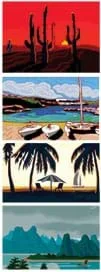 Copyright 2004 Microsoft Corporation, One Microsoft Way, Redmond, WA 98052-6399 USA. All rights reserved.
Desert Climates
Desert climates generally refer to regions that receive little precipitation. Even so, they often have a wealth of life. Some of this life remains hidden during the daylight to preserve moisture. Soil in a desert region is often composed of sand, sand dunes, rocky terrain, and sometimes contains valuable mineral deposits. Desert classification is based upon a combination of the number of days of rainfall, total annual rainfall, temperature and humidity. In the currently accepted system, extremely arid (dry) lands have at least 12 consecutive months without rainfall, arid lands have less than 250 mm (10 inches) of annual rainfall, and semiarid lands have a mean annual precipitation of 250-500 mm (10-20 inches). Arid and extremely arid lands are deserts, whereas semiarid grasslands are called steppes.
However, some places recognized as deserts do not quite fall into these categories. This difference is described by a term called "potential evapotranspiration." This refers to the combination of water loss through atmospheric evaporation, combined with the evaporative loss of water through the life process of plants. Thus, evapotranspiration refers to the amount of water that could evaporate in any given region. We also differentiate between different forms of deserts. Cold deserts can be covered in snow; these regions do not receive much precipitation and what falls remains frozen. These climates are often referred to as tundra. Lastly, deserts can be classified by their geographical location and dominant weather patterns.
Nearly all of desert surfaces are plains where eolian deflation has occurred, which means that the removal of fine-grained material by the wind has exposed loose gravel. The remaining surfaces are composed of bedrock outcrops, desert soils, fluvial deposits, playas and desert lakes. Within deserts, oases may exist; these are vegetated areas that are moistened by springs, wells or irrigation.
Most desert plants are drought- or salt-tolerant. Some of these plants store water in their leaves, roots and stems. Others have long taproots that penetrate the water table, anchor the soil and control erosion. Rain falls occasionally in deserts, and storms are often violent.
Examples of deserts and desert climates are Moab, Utah; and the Rajasthan Desert, India.
Alpine Climates
Alpine climates are generally above tree line, which is the altitude at which trees stop growing. At these high elevations, the climate becomes colder. This is described by the lapse rate of air, which refers to the phenomena of air getting colder as it rises, since it expands. The dry adiabatic lapse rate, which is temperature change that occurs over elevation, is 10 °C per km of elevation or altitude. However, this relationship is approximate as other factors can also modify the climate.
Biotemperature refers to the mean annual temperature, where all temperatures below 0 °C are treated as 0 °C. If the mean biotemperature is between 1.5-3 °C, then the climate is quantified as alpine. Alternatively, it is classified as subpolar if the low temperature is caused by latitude.
Examples of alpine climates are the Tibetan Plateau and Vail, Colorado.
Oceanic (Coastal) Climates
The oceanic (or coastal) climate is typically found along west coasts at the middle latitudes of all of the continents, and in southeastern Australia. Similar climates are also found at higher elevations in the tropics. These climates are characterized by a narrower range of temperatures and receive significant amounts of precipitation in the summer. Thus, precipitation is adequate and reliable at all times of the year. They are also usually classified as humid with respect to precipitation, except for Patagonia. Examples of oceanic climates are Barbados and the Galapagos Islands.
Groundwater
Groundwater simply refers to water that comes from the ground. Its source is any precipitation that soaks into the ground, including rain, snow, sleet and hail. Gravity moves this water down into the ground, eventually reaching a depth at which the ground is filled with water. The top of this zone is called the water table. Groundwater is stored in the ground within materials such as gravel or sand. An aquifer is an area that holds a lot of water and can be pumped with a well. People use wells to pump groundwater from the aquifer to cities, houses and crops.
Surface Water
Surface water refers to water in lakes, rivers and oceans. Sometimes groundwater and surface water trade places as groundwater moves through the ground into a lake or stream. Alternatively, water in a lake can soak down into the ground and become groundwater.
Preparation: In advance of the lesson, print the Clothing & Food Note Cards (PDF) (see Figure 1) on card stock and cut out the individual note cards, omitting the climate titles. Or, print the attachment on regular-weight paper and attach the cut-out paper slips to heaver paper or note cards. Make enough cards for each team of five or six students to have one.
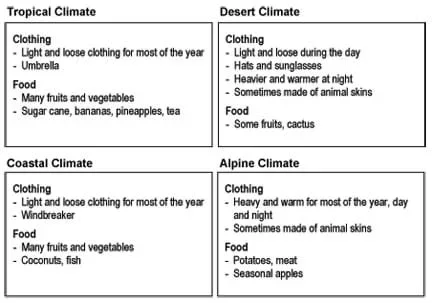 Example family scenarios, as provided on the Clothing & Food Note Cards attachment.Copyright 2005 Jay Shah, ITL Program, College of Engineering, University of Colorado Boulder
(Divide the class into teams of five or six students each.)
You represent separate families that live in very different parts of the world. Today, you are going to role play for a little while to figure out where your family lives. Your "family" gets all your clothing and food from the area near where you live (it is not imported from another location).
(Hand out to the teams the descriptions of their family situations as cut from the Clothing & Food Note Cards (PDF) [see Figure 1].) This card lists examples of clothing your families wear and foods your families eat.
Take a few minutes to consider the clothing and food items, and think about what weather and climate conditions they might indicate. Write on the back of the card a description of the weather and climate conditions where your family lives, and your best guess at what type of climate you live in.
(Give teams a few minutes.) Now, let's have one person from each family tell the class what characteristics they wrote down, while another person from that family writes them on the board (or on large-size chart paper). (Wait for students to list all of their characteristics.) Do you know in what climate your family lives? (Add more adjectives to the lists, as necessary. For example, tropical: warm and moist year round, lush, lots of precipitation; desert: little precipitation, hot days, cold nights; coastal: near large bodies of water, cool temperatures, winds; alpine: low temperatures, high altitude, winds, short growing seasons.) (Leave the student lists on the board or save if on chart paper, for further climate, water and weather study.)
These are just some characteristics of a climate. Conditions change throughout the year as impacted by weather and seasons.
Why do you think that different climates exist? (Answer: Various different factors contribute to making different climates, including weather and seasons.) Would you find an alpine climate on the beach? Would you find a coastal climate on top of a mountain? Why not? Well, because different factors determine the climate of different places. What are the different factors? Five main factors determine climate. Let's learn a little more about them. (Start a list on the classroom board with the heading, Factors that Affect Climate.)
- First, where are tropical climates mostly present? That's right, around the equator. That means that a region's location on our planet, or latitude , is one factor. (Write latitude on the board.)
- Are alpine climates found high or low above the earth's surface? They are found on mountains, so they are high above the earth's surface. The higher you go, the colder it gets, so the elevation or height is a factor that affects the temperature. This is an example of altitude, so altitude also affects climate. (Write this on the board.)
- What about hills, sand dunes, lakes, forests, even buildings? Do they affect the climate or temperature? Yes, they do. These are all land features and they also affect the environment. (Write this on the board.)
- Next, the movement of air from high to low pressure is called wind. The movement of the earth's winds starts at the equator, where it is hottest. The air here rises (creating low pressure) and then cools and falls (creating high pressure). The air then moves back to the low pressure area. Wind is another factor that affects climate. (Write this on the board)
- And the final factor is distance from large bodies of water such as oceans, lakes and ocean currents. This distance (nearness to water) affects the environment and climate. (Write this on the board.)
Which of these five factors relates to water? What about drinking water? Depending on the type of climate in which people live, from where might they get their water? Which factors relate to weather temperature and precipitation? How do people keep warm or cool? Dry? Where might people get clothing? How do different types of clothing help protect people from the weather? These are all things that we are going to think about today.
Do you think climatic regions and weather patterns affect how people live their lives? Yes, they do! While some people have found ways to engineer artificial climates (such as air conditioning the space inside buildings), people all over the world still need to plan for the weather. We have already learned a little bit about how different climatic regions affect the types of clothes people might wear and their water sources, but what types of clothes work the best in different climates and how can they be made? From where do you get drinking water if you live in the desert? Did you know that engineers help people get clean drinking water? Engineers design water systems for cities and countries that are not located near fresh water sources. Students can act as engineers with the activity Designing Ways to Get and Clean Water where they design ways to either clean a water source or find a new water source, depending on hypothetical scenarios. Did you know that engineers also help design clothing and fabrics? They develop clothing materials that help keep people warm or cool, depending on their climates. Engineers also develop new technologies to predict daily weather and protect people from weather elements such as rain, temperature changes and storms.
Every day, climate and weather influence us. From precipitation and temperature, weather affects the way we live our lives. Weather can affect what we wear as well as our daily activities, such as travel to school. In what kind of climate do we live? Is it usually hot? Cold? Rainy? Windy? How did our climate and weather have an effect on what we wore to school today? How did our climate and weather have an effect on the design of our school building and our homes? Our climate also affects what we drink and how we get our water. Why do engineers need to know about climate and weather? Engineers design materials to protect people and technologies to provide clean drinking water. Engineers also design technologies that make our lives better by predicting weather, so we have advance notice of weather changes and storms.
- alpine climate
- A climate characterized by low temperatures, high altitude, winds and short growing seasons.
- altitude
- The height above a reference level, especially above sea level or above the earth's surface.
- climate
- The meteorological conditions (weather), including temperature, precipitation and wind that characteristically prevail in a particular region. Sometimes described as "averaged weather." A region of the earth having particular meteorological conditions (she lives in a cold climate).
- coastal climate
- A climate near large bodies of water and characterized by cool temperatures and winds. AKA oceanic climate.
- desert climate
- A climate characterized by little precipitation, hot days and cold nights.
- elevation
- The height to which something is elevated above a point of reference such as the ground.
- equator
- The imaginary great circle around the earth's surface, equidistant from the poles and perpendicular to the earth's axis of rotation. It divides the earth into the Northern Hemisphere and the Southern Hemisphere.
- latitude
- The angular distance of any point on the surface of the earth north or south of the equator. A region of the earth considered in relation to its distance from the equator; for example, temperate latitudes.
- season
- A natural division of the year (spring, summer, fall and winter) in the north and south temperate zones. Each season, beginning astronomically at an equinox or solstice, is characterized by specific meteorological or climatic conditions. Two divisions of the year (rainy and dry) in some tropical regions.
- tropical climate
- A climate characterized by being warm and moist year round, lush and with lots of precipitation.
- weather
- The state of the atmosphere at a given time and place, with respect to variables such as temperature, moisture, wind velocity and barometric pressure.
- wind
- Moving air, especially a natural and perceptible movement of air parallel to or along the ground.
Pre-Lesson Assessment
Brainstorming: As a class, have students engage in open discussion. Remind them that in brainstorming, no idea or suggestion is "silly." All ideas should be respectfully heard. Take an uncritical position, encourage wild ideas and discourage criticism of ideas. Have students raise their hands to respond. Write their ideas on the board. Ask the students:
- Do different climatic regions (such as tropical or desert climates) and weather patterns affect how people live their lives? How?
The Inflatable Globe Exercise: This exercise requires an inflatable globe. Toss the globe around the room and ask students to say the name of the country and/or city that their right index finger lands on. Ask each student what sort of weather patterns s/he might expect at this location and what climates might be observed there and why. After each student is finished, s/he tosses the globe to another student, to do the same. To review and show the variety around the world, have another student write the countries/cities on the classroom board along with the predicted weather and climates.
Post-Introduction Assessment
Drawing: Randomly assign groups of students different climatic regions. Ask them to draw the following (or research online and find images), illustrating the specific regional characteristics and features:
- A person who lives in this climatic region.
- The prevailing weather patterns in the region.
- Area land features that contribute to the creation of the specific climatic region.
- A table laden with the types of food available in the region.
- A shelter built from the types of raw materials in the region.
- A person dressed in clothing that is the most comfortable for the weather of the region and protects them from typical weather patterns. Show the material sources of the clothing.
Lesson Summary Assessment
Follow the Monsoon: Johnny Monsoon is a materials engineer from South Africa. The monsoon season in most of the world has ended, but a sudden, unexpected seasonally shift in wind patterns has caused a monsoon rain that has taken shape in much of the world. Mr. Monsoon has been called upon to help people respond to protecting themselves from the increase in torrential rains in the hot and humid regions of the world. Unfortunately, the rains have also influenced global travel and while Mr. Monsoon needs to follow the monsoon all over the world to help people, he finds himself all over the place, not quite knowing where he is. Help him to get back on track by following the clues:
- Destination 1: Bombay, India. Johnny Monsoon steps off the plane to a humid, rainy, highly-populated and lush city. In what kind of climate is he? Will his expertise in monsoon-related materials engineering be of use here? (Answer: Since the rains will increase in the hot and humid areas of the world, as mentioned above, this tropical climate is a good place for Mr. Monsoon. His expertise would be useful here.)
- Destination 2: Ulaanbaatar, Mongolia. Johnny Monsoon steps off the plane to a dry, yet cold, sparsely populated, sparsely vegetated land. In what kind of climate has he arrived? Should he have come here? Why not? (Answer: Mongolia is mostly high, cold and dry, corresponding mostly to a desert climate. It has an extreme continental climate with long, cold winters and short summers. Not much of a monsoon season happens in Mongolia, so Mr. Monsoon may be of little use here. He goes back to the airport.)
- Destination 3: Darwin, Australia. Johnny Monsoon steps off the plane to a hot and wet city in Australia that has just two seasons: wet and dry. Today he is dressed in his yak wool coat from Mongolia. Does he feel comfortable in it? Why or why not? Will Mr. Monsoon be able to assist in clothing options for the people here, right now? (Answer: Darwin, Australia, is in the north of Australia and the climate is best described as tropical. Mr. Monsoon's yak wool coat from Mongolia is probably uncomfortable, as it does not keep out the rain and the temperatures are too warm for the coat. His expertise as a materials engineer, however, would come in handy in Darwin.)
- Destination 4: Dhaka, Bangladesh. Once again Johnny Monsoon steps off the plane to a wet and flooded capital city. Is Johnny Monsoon in the right place? Why? (Answer: Dhaka, Bangladesh, can be classified as tropical and oceanic. Dhaka receives a lot of precipitation, so Mr. Monsoon has landed in the right place this time.)
- Destination 5: La Paz, Bolivia. Johnny Monsoon has landed at the highest airport in the world. The climate, though typically dry, warm and sunny with a year-round average temperature between 75-77 °F, is in the 90s and humid today, but no torrential rains are present. Would Mr. Monsoon be of any assistance here? Why or why not? (Answer: With little precipitation, especially in the form of rain, in the alpine and dry climate of La Paz, Bolivia, Mr. Monsoon's expertise is of little use, although some of his knowledge about materials in humid weather may be come in handy.)
Have students research specific locations and develop projects that take into consideration the location's climate, weather, people, food clothing, water, etc.
Create a data collection activity that requires students visit NOAA, GLOBE, etc., websites to find comparative temperatures and precipitation statistics for different climatic regions.
Expand the contrast and comparison exploration of climates to include other climates, such as steppe, mid-latitude and tundra.
Alpine Climate. Last modified September 18, 2020. Wikipedia Online Free Encyclopedia. Accessed September 22, 2020. (Source of teacher background Information on alpine climates) http://en.wikipedia.org/wiki/Alpine_climate
Desert. Last modified September 18, 2020. Wikipedia Online Free Encyclopedia. Accessed September 22, 2020. (Source of teacher background Information on desert climates) http://en.wikipedia.org/wiki/Desert_climate
Dictionary.com. Lexico Publishing Group, LLC. Accessed September 22, 2020. (Source of some vocabulary definitions, with some adaptation) http://www.dictionary.com
Oceanic Climate. Last modified September 18, 2020. Wikipedia Online Free Encyclopedia. Accessed September 22, 2020. (Source of teacher background Information on oceanic climates) http://en.wikipedia.org/wiki/Oceanic_climate
Tropics. Last modified September 21, 2020. Wikipedia Online Free Encyclopedia. Accessed September 22, 2020. (Source of teacher background Information on tropical climates) https://en.wikipedia.org/wiki/Tropics
- Weather & Climate
- What's Air Got to Do with It? Properties & Quality
- Weather Watchers
- What to Wear and Drink? Weather Patterns & Climatic Regions
Contributors
Jay Shah; Malinda Schaefer Zarske; Denise W. Carlson
Supporting Program
Integrated Teaching and Learning Program, College of Engineering, University of Colorado Boulder
Acknowledgements
The contents of this digital library curriculum were developed under grants from the Fund for the Improvement of Postsecondary Education (FIPSE), U.S. Department of Education and National Science Foundation (GK-12 grant no. 0338326). However, these contents do not necessarily represent the policies of the DOE or NSF, and you should not assume endorsement by the federal government.
Copyright
2006 by Regents of the University of Colorado