
Cleaning Air Like a Vacuum Cleaner: Let's Bag It
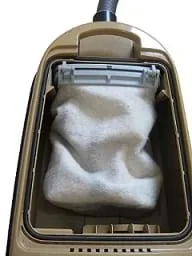 Students examine a vacuum cleaner model of a baghouseCopyright 2010 Albin Olsson, Wikimedia Commons https://commons.wikimedia.org/wiki/File:Vacuum_cleaner_bag_in_vacuum_cleaner.jpg
Students observe and discuss a vacuum cleaner model of a baghouse to better understand how this pollutant recovery method functions in cleaning industrial air pollution.
Environmental and mechanical engineers are continually inventing new techniques to remove the air pollutants in industrial emissions. Baghouses capture more than 99% of the particulate air pollutants from steel mills, foundries and other industrial furnaces. They work very much like a giant vacuum cleaner: Heavy dirt particles fall out and are removed, and smaller particulates are trapped in filters (bags) made of cloth or paper. Engineers design home vacuum cleaners, too.
After this activity, students should be able to:
- Describe and explain how a baghouse works to control air pollution.
- Describe how engineers create technology to help industry clean up their air pollution.
- Develop, communicate, and justify a procedure to separate simple mixtures based on physical properties
Grade 5
Do you agree with this alignment?
- Students will develop an understanding of the effects of technology on the environment.
Grades K-12
Do you agree with this alignment? - The use of technology affects the environment in good and bad ways.
Grades 3-5
Do you agree with this alignment? - STEL-4I Explain why responsible use of technology requires sustainable management of resources.
Grades 3-5
Do you agree with this alignment?
- 5-ESS3-1 Obtain and combine information about ways individual communities use science ideas to protect the Earth's resources and environment.
Grade 5
This resource focuses on the following Three Dimensional Learning aspects of NGSS:
Science & Engineering Practices- Obtain and combine information from books and/or other reliable media to explain phenomena or solutions to a design problem.Do you agree with this alignment?
Disciplinary Core Ideas- Human activities in agriculture, industry, and everyday life have had major effects on the land, vegetation, streams, ocean, air, and even outer space. But individuals and communities are doing things to help protect Earth's resources and environments.Do you agree with this alignment?
Crosscutting Concepts- A system can be described in terms of its components and their interactions.Do you agree with this alignment?
- Science findings are limited to questions that can be answered with empirical evidence.Do you agree with this alignment?
Do you agree with this alignment? - Obtain and combine information from books and/or other reliable media to explain phenomena or solutions to a design problem.
For a class demonstration:
- vacuum cleaner with a clean filter bag
- 1 cup soil (or something dirty to vacuum up)
- scissors
- How a Baghouse Cleans Polluted Air Diagram (PDF), a PDF suitable for an overhead projector transparency or student handout
Environmental and mechanical engineers are continually inventing new techniques to remove the air pollutants in industrial emissions. In this lesson, we have examined the use of water, static electricity and circular motion to help remove even tiny particles from polluted air. Can you think of any other ways to remove particles from the air? Another method designed by environmental engineers is a type of technology called a baghouse. A baghouse works a lot like a vacuum cleaner. Can you explain how a vacuum cleaner works?
Baghouses are used to control air pollutants from steel mills, foundries and other industrial furnaces, and can collect more than 99% of the particulates. Baghouses work very much like a giant vacuum. Heavy dirt particles fall out and are removed, and smaller particulates are trapped in filters (bags) made of cloth, paper or similar materials. Particles are shaken or blown from the filters down into a collection hopper. Refer to Figure 1 or the attached How a Baghouse Cleans Polluted Air Diagram (PDF).
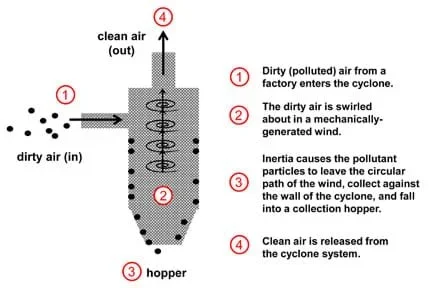 Figure 1: Diagram of a baghouse.
Imagine a large vacuum cleaner suctioning particles out of the air. Would you want the bag material to be a loose weave or a tight weave? In a class demonstration today, we are going to look at how a baghouse works.
Before the Activity
- Gather materials.
- Clear an area suitable for dirt to be spread and vacuumed.
With the Students
- Brainstorm with the students. Do you know how a vacuum cleaner works? What happens to the dirt once it is vacuumed up? Where does it go? Write student ideas on the chalkboard, paying particular attention to what they think happens to the suctioned materials.
- Ask the students if they think we could use some kind of vacuum cleaner to clean up polluted air. What would be needed for it to work? (Answer: A very fine filter.)
- Remove the clean filter bag from the vacuum cleaner so the students can see that it is clean. (Depending on the type of bag, you may need to open it for viewing and then reseal it.)
- Ask the students to record their observations during the activity.
- Sprinkle some soil on the floor and use the vacuum cleaner to clean up the mess.
- Remove the vacuum bag and cut it open to show the inside of the bag (see Figure 2).
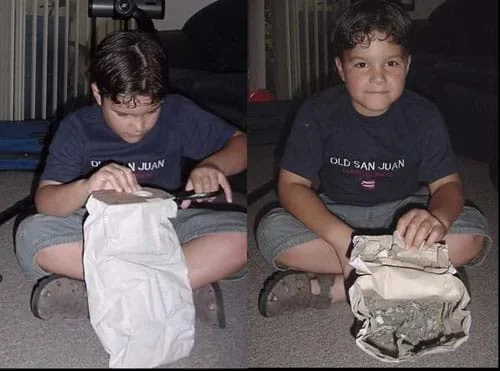 Figure 2. Examining the inside of a vacuum cleaner bag, as part of understanding how a pollutant recovery baghouse works.Copyright 2003 Sharon Perez, ITL Program, College of Engineering, University of Colorado Boulder
- Discuss student observations. Explain to the students that a baghouse is simply a fine filter that polluted (dirty) air is forced through as a way to capture the pollutants. This is similar to the vacuum cleaners used in their homes.
- In conclusion, ask the students the following questions and discuss as a class:
- Does the baghouse remove all of the particulates? (Answer: No, not all of them. Baghouses are 99% efficient.)
- How does this compare to the efficiency of a wet scrubber? Which one is better? (Answer: A wet scrubber is 95% efficient, so baghouses are more efficient).
- If baghouses are more efficient, why would you ever want to use a wet scrubber? (Answer: It depends on the type of air pollution. Wet scrubbers work better on gases.)
Pre-Activity Assessment
Brainstorming: As a class, have the students engage in open discussion. Remind students that in brainstorming, no idea or suggestion is "silly." All ideas should be respectfully heard. Take an uncritical position, encourage wild ideas and discourage criticism of ideas. Have students raise their hands to respond. Write their ideas on the board. Ask the students:
- Do you know how a vacuum cleaner works?
- What happens to the dirt once it is vacuumed up? Where does it go?
Discussion Question: Ask the students if they think we could use some kind of vacuum cleaner to clean polluted air. What would be needed for it to work? (Answer: A very fine filter.)
Activity Embedded Assessment
Observations: Have students pay close attention and record their observations of the activity, explaining to them that this is what real scientists and engineers do. Instruct them to record anything that seems important.
Post-Activity Assessment
Observations: Discuss student observations.
Drawing/Journaling: Depending on the students' skill level, have them draw a picture or write in their own words a description of how a baghouse works to clean polluted air. Ask for volunteers to share their descriptions with the class.
- Make sure students do not stick their hand or other large objects in the path of the vacuum cleaner.
- Remind students to be careful with the scissors.
If bringing the vacuum cleaner machine to the classroom is problematic, simplify the activity by bringing in two vacuum cleaner bags, one clean and one dirty, and cutting them open.
Find local examples of baghouses and arrange a field trip. What pollutants does this baghouse remove? What do they do with the collected particulates?
- This activity is appropriate for all age levels.
- For upper grades, add a math component. Give students a number of particulates and have them calculate how many are cleaned out of the air using baghouses with 99% efficiency. (For example, if 100,000 particulates went through a baghouse, about 100,000 x 0.99 = 99,000 would be removed and 1,000 would remain.
Markle, Sandra. The Kids' Earth Handbook. Atheneum, NY: John Wiley & Sons, Inc, 1991.
Contributors
Amy Kolenbrander; Sharon Perez; Janet Yowell; Natalie Mach; Gwendolyn Frank; Malinda Schaefer Zarske; Denise W. Carlson
Supporting Program
Integrated Teaching and Learning Program, College of Engineering, University of Colorado Boulder
Acknowledgements
The contents of this digital library curriculum were developed under a grant from the Fund for the Improvement of Postsecondary Education (FIPSE), U.S. Department of Education and National Science Foundation GK-12 grant no. 0338326. However, these contents do not necessarily represent the policies of the Department of Education or National Science Foundation, and you should not assume endorsement by the federal government.
Copyright
2004 by Regents of the University of Colorado