
Traveling Sound
Students explore how sound waves move through liquids, solids and gases in a series of simple sound energy experiments. Understanding the properties of sound and how sound waves travel helps engineers determine the best room shape and construction materials when designing sound recording studios, classrooms, libraries, concert halls and theatres.
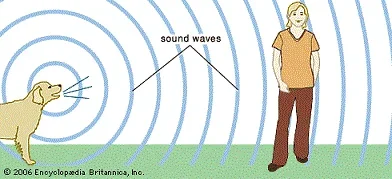 Students explore how sound waves travel.Copyright 2006 Encyclopedia Britannica, Inc. http://media.web.britannica.com/eb-media/75/92775-004-B750F543.gif
Sound and acoustic engineers know that the shape of a room and its materials greatly impact how sound waves travel. Recording studios are designed in soundproof booths so that the recorded music does not contain any unwanted external noise. Libraries are designed to reduce any introduced noises, to assure a quiet, non-distracting learning environment. Concert halls are designed so that sound generated on the stage travels to the back of the space without being distorted.
After this activity, students should be able to:
- Explain that sound can move through solids, liquids and gases.
- Describe how sound needs molecules to move and that changing the medium that it travels through changes the sound.
- Describe how engineers use sound energy when designing spaces, such as movie theaters.
- Identify and describe the variety of energy sources
Grade 4
Do you agree with this alignment? - Identify the state of any sample of matter
Grade 3
Do you agree with this alignment?
- Energy comes in different forms.
Grades 3-5
Do you agree with this alignment?
- 4-PS3-2 Make observations to provide evidence that energy can be transferred from place to place by sound, light, heat, and electric currents.
Grade 4
This resource focuses on the following Three Dimensional Learning aspects of NGSS:
Science & Engineering Practices- Make observations to produce data to serve as the basis for evidence for an explanation of a phenomenon or test a design solution.Do you agree with this alignment?
Disciplinary Core Ideas- Energy can be moved from place to place by moving objects or through sound, light, or electric currents.Do you agree with this alignment?
- Energy is present whenever there are moving objects, sound, light, or heat. When objects collide, energy can be transferred from one object to another, thereby changing their motion. In such collisions, some energy is typically also transferred to the surrounding air; as a result, the air gets heated and sound is produced.Do you agree with this alignment?
- Light also transfers energy from place to place.Do you agree with this alignment?
- Energy can also be transferred from place to place by electric currents, which can then be used locally to produce motion, sound, heat, or light. The currents may have been produced to begin with by transforming the energy of motion into electrical energy.Do you agree with this alignment?
Crosscutting Concepts- Energy can be transferred in various ways and between objects.Do you agree with this alignment?
Do you agree with this alignment? - Make observations to produce data to serve as the basis for evidence for an explanation of a phenomenon or test a design solution.
Each group needs:
- large bowl (metal works best)
- water
- 2 metal objects, such as spoons, to knock together
- Traveling Sound Worksheet (PDF), one per student
A basic understanding of the phases of matter: liquids, solids and gases.
Sound engineers are especially interested in the way sound travels. Can you hear as well when you sit in the back of the class as when you sit in the front? What about in the assembly hall or gymnasium? On the playground? Can you think of other times when you cannot hear as well as someone else? What happened? How about in a movie theater? What do engineers do so that the sound quality is good for everyone in a movie theater? (Possible answers: Add speakers around the room, curtains, carpet the walls, cone-shaped theaters act like a megaphone and help to direct sound waves further.)
Which is louder—walking on carpet or on tile? It is quieter on carpet because the carpet absorbs the sound energy. Sound energy, light energy and other types of energy, need molecules to travel through and vibrate, but sometimes sound energy is absorbed by an object or material. Engineers use this idea when designing rooms that are meant to be quiet. Have you ever noticed how the walls of a movie theater are covered with carpet or fabric? This is to prevent echoing of the sound system. Sometimes when you are in an empty room, your voice echoes or sounds hollow. This is because an empty room has no materials in it that might absorb the sound energy, so the sound bounces off the hard walls, back at you. This makes it hard to hear clearly.
Do you think sound energy can travel through air? Of course it can! That is how sound energy travels when you talk to a friend. How about water? Can you hear sound travel under water? How about a solid? Can sound move through a solid object? Engineers want to know if sound can travel through solids, liquids and gases so they can develop ways to send messages to people all over the world. Can you imagine how great sound would be if it could travel anywhere?
Understanding the properties of sound and how sound waves travel helps engineers determine the best room shape and construction materials when designing libraries, classrooms, sound recording studios, concert halls and theatres. Room shape and materials can impact how sound waves travel since sound waves bounce off different object in different ways. In this activity, we are going to study how sound waves travel through liquids, solids and gases, and think about how engineers might use this information.
Before the Activity
- Gather materials and make copies of the Traveling Sound Worksheet (PDF).
- Divide the class into teams of two students each.
With the Students
- Ask the students to predict if sound can move through solids, liquids and gases.
- Have the students complete the worksheet, which leads them through traveling sound wave activities.
- Can sound energy travel through solids? Students place their ears on a desk or table as they tap or scratch on the top. They compare that to the same sound made when their ear is not pressed to the table.
- Can sound energy traveling through liquids? Fill a large bowl or bucket (metal works best) with water. One student taps two spoons together under the water. Two other students observe and compare the tapping sound they hear, as heard through the air and as heard by placing an ear against the bowl.
- Can sound energy traveling through gases (air)? The students feel their throats gently during each of these tasks:
- Hum with your mouth and nose open.
- Hum with your mouth open and nose closed.
- Hum with your mouth closed and nose open.
- Hum with your mouth and nose closed.
- Discuss with the students what happened. Were their predictions correct? Can sound travel through air, water and solids? (Answer: Yes!) Sound needs molecules to move. Solids, liquids and gases are all made of molecules. The characteristics of the molecules (for example, the space between the molecules) determine whether the sound becomes muffled or changes in some way.
- How might engineers use the knowledge that sound travels through solids, liquids and gases? (Possible answers: Engineers create devices that send sound anywhere — through water to a submarine in the ocean, through wires to your TV, and through the air in surround sound movie theaters or emergency broadcast signals.)
- echo
- Repetition of a sound by reflection of sound waves from a surface.
- frequency
- The rate of vibrations in different pitches.
- pitch
- The highness or lowness of a sound.
- sound energy
- Audible energy that is released when you talk, play musical instruments or slam a door.
- sound wave
- A longitudinal pressure wave of audible or inaudible sound.
- vibration
- When something moves back and forth, it is said to vibrate. Sound is made by vibrations that are usually too fast to see.
- volume
- When sound becomes louder or softer.
- wave
- A disturbance that travels through a medium, such as air or water.
Pre-Activity Assessment
Prediction: Ask students if they think sound can move through solid, liquid, and gas. If so what are some examples? (Possible examples: Students may recall talking under water or using tin can and string telephones.)
Activity Embedded Assessment
Worksheet: Have students use the Traveling Sounds Worksheet (PDF) to guide them in the activity and as a place to record their observations. Review their answers to gauge their mastery of the subject.
Post-Activity Assessment
Toss-a-Question: Ask students to independently think of an answer to the question below and write it on a half sheet of paper. Have students wad up and toss the paper to another team member who then adds their answer idea. After all students have written down ideas, have them toss the paper wad to another team, who reads the answers aloud to the class. Discuss answers with the class.
- What is an example of something through which sound can travel?
Neighbor Check: Have the students compare their activity observations with a neighbor. Are they the same or different? Have each team report some of their similar and dissimilar observations to the rest of the class.
Engineering Design: The supply of air on Earth is running out! Several futuristic cities for human habitation are being designed either underwater or deep inside mountains. Have each student group become a city planning engineering team and draw a communication system for sending emergency messages between the new cities. Make sure to illustrate and describe how the sound energy (message) will move through air, water or solid rock.
This activity can be very loud. Ask students to not disturb others while they learn and have fun.
To bring some humor to the activity, ask each student to hum a small part of their favorite song while feeling their throat. Have each student alternate between having their nose and mouth open or closed while humming non-stop. Why does the sound change depending on whether you close your nose or mouth? What happens if you block your ears? What does this activity teach us about sound? (Answer: Sound vibrations must travel through air for us to hear them. Like a musical instrument [perhaps a recorder or flute], if you change the holes where sound escapes, it changes the pitch, but not the frequency/vibrations of the sound.)
If a metal bowl is used during the activity, the vibrations from the objects colliding underwater vibrate the bowl, creating the illusion that the bowl is being struck. Have students draw the vibrations in the bowl on a piece of paper. Do the vibrations change if the objects are tapped together increasing softly?
Have students think about different forms of communications. Does sound travel most often through solids, liquids or gases? Have students poll their friends, family and neighbors to solicit their ideas.
For lower grades, conduct the activities as a class instead of in teams. Younger students could also draw pictures of their observations instead of writing in sentence form.
Dictionary.com. Lexico Publishing Group, LLC. Accessed December 19, 2005. (Source of some vocabulary definitions, with some adaptation.) http://www.dictionary.com
Contributors
Sharon Perez; Natalie Mach; Malinda Schaefer Zarske; Denise W. Carlson
Supporting Program
Integrated Teaching and Learning Program, College of Engineering, University of Colorado Boulder
Acknowledgements
The contents of this digital library curriculum were developed under grants from the Fund for the Improvement of Postsecondary Education (FIPSE), U.S. Department of Education and National Science Foundation (GK-12 grant no. 0338326). However, these contents do not necessarily represent the policies of the Department of Education or National Science Foundation, and you should not assume endorsement by the federal government.
Copyright
2005 by Regents of the University of Colorado