
The Energy of Music
 Sound waves.Copyright Pixabay.com 2018. https://pixabay.com/illustrations/audio-sound-waves-sound-frequency-3540254/
Students are introduced to sound energy concepts and how engineers use sound energy. Through hands-on activities and demonstrations, students examine how we know sound exists by listening to and seeing sound waves. They learn to describe sound in terms of its pitch, volume and frequency. They explore how sound waves move through liquids, solids and gases. They also identify the different pitches and frequencies, and create high- and low-pitch sound waves.
Engineers use their knowledge of sound waves to create radio and sonar devices. Sound waves traveling through the air are collected by radio antennas. Sonar devices send ultrasound waves into an ocean and create images based on which waves are bounced back to the device. Ships use sonar to navigate and map the seabed by measuring water depth. Sonar is also used to search for undersea objects such as wrecks, submarines, rocks, icebergs, whales and fish. Engineers also design instruments that "listen" to ultrasound and infrasonic sound waves. Ultrasound can detect tiny flaws in materials used to make parts—from bridge bolts to aircraft wings.
After this lesson, students should be able to:
- Give several examples of engineering products that involve sound.
- Describe sound as a form of energy.
- Define volume, pitch and frequency as they relate to sound energy.
- Describe sound energy as traveling in waves.
- Explain sound as a form of communication.
- Energy comes in many forms such as light, heat, sound, magnetic, chemical, and electrical
Grade 4
Do you agree with this alignment? - Identify and describe the variety of energy sources
Grade 4
Do you agree with this alignment?
- Energy comes in different forms.
Grades 3-5
Do you agree with this alignment?
- 4-PS3-2 Make observations to provide evidence that energy can be transferred from place to place by sound, light, heat, and electric currents.
Grade 4
This resource focuses on the following Three Dimensional Learning aspects of NGSS:
Science & Engineering Practices- Use evidence (e.g., measurements, observations, patterns) to construct an explanation.Do you agree with this alignment?
Disciplinary Core Ideas- Energy can be moved from place to place by moving objects or through sound, light, or electric currents.Do you agree with this alignment?
- Energy is present whenever there are moving objects, sound, light, or heat. When objects collide, energy can be transferred from one object to another, thereby changing their motion. In such collisions, some energy is typically also transferred to the surrounding air; as a result, the air gets heated and sound is produced.Do you agree with this alignment?
Crosscutting Concepts- Energy can be transferred in various ways and between objects.Do you agree with this alignment?
Do you agree with this alignment? - Use evidence (e.g., measurements, observations, patterns) to construct an explanation.
Every sound, whether it is from a rubber band twanging or a loud speaker cone, is created by vibration. You cannot hear sound in a vacuum because sound reaches your ear as vibration, and there must be something to vibrate. Usually, the medium that vibrates is air. When the sound source vibrates back and forth, it pushes the air around it back and forth. The sound travels through the air as it is pushed back and forth in a chain reaction that is being alternately stretched and squeezed. This moving stretch and squeeze is called a sound wave.
Have the students close their eyes and sit quietly for 30 seconds. What did you hear? (Have a few students describe the different sounds they heard.) These are all sounds and we will be learning about sound energy today.
Now tap on your desk. How would you describe that sound? Can you tap on your desk louder? Now, really softly? What do we call this change in sound? We call this characteristic of sound, volume. Now, tap on your desk using a pencil. What is this sound like? Is it a higher sound? We call this characteristic of sound, pitch. You have just learned two of the three important characteristics of sound energy that we will discus today — sound volume and pitch.
Have you noticed how the noise of a speeding vehicle, like a motorcycle, car, train or plane, seems to be constant as it approaches you; then as it goes past, the noise drops or falls in pitch, to a lower note? As the vehicle moves toward you, it travels a small distance closer between sending out each sound wave. So for you, the sound waves are squashed closer together and make a high sound. As the vehicle passes, it travels a small distance away between sending each sound wave; so the sound waves are more stretched out, and make a lower sound (see Figure 1). This change is called the Doppler Effect after the man who first described it in 1842.
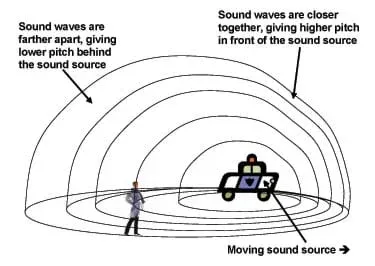 Figure 1. The Doppler Effect. The sound waves of a moving siren are closer together in front of the police car than they are behind the police car. The closer the sound waves are together, the higher the pitch.Copyright 2004 Natalie Mach, graduate fellow, ITL Program, College of Engineering, University of Colorado Boulder
To travel, sound energy must vibrate molecules. These molecules move in a sound wave. Sound frequency is how much a sound wave is vibrating. Frequency is the third characteristic of sound that we will discus today. Let's see what this looks like!
Classroom demonstration: Use a large spring or slinky to demonstrate the characteristic of frequency. Expand the slinky and have students hold each end. Make sure the students stand very still and do not shake the slinky.
- To describe longitudinal waves, grab a few coils of the spring and let go of them. As the students watch the waves travel through the spring, explain that these waves are longitudinal waves. Explain that the release of the coils represents the source of the sound vibration and that this sound is moving longitudinally across the slinky. Harmonic sound waves are usually longitudinal waves.
- To show transverse waves, strike the spring at right angles to its length. Have the students describe the up and down motion of the spring. Explain that this motion represents transverse waves. Radio waves are examples of transverse waves used by engineers to send messages over long distances. Transverse waves also travel on the strings of instruments, such as guitars and banjos.
- If possible, show Professor Dan Russell's excellent online animation of longitudinal and transverse waves at http://www.acs.psu.edu/drussell/Demos/waves/wavemotion.html.
What are our three characteristics of sound energy again? That's right, volume, pitch and frequency! Frequency, or the vibrating of sound waves, clearly shows us that sound is a form of energy. By moving molecules and making them vibrate, sound waves are doing work. How do we use sound energy? How do engineers use sound energy? Refer to the Pitch and Frequency activity to have students explore these properties by identifying the different pitches and frequencies created by a vibrating ruler and a straw kazoo.
We use sound to communicate, learn and express ideas, and to make plans, either face-to-face or with a telephone. Musical and natural sounds, such as a bird song, affect our emotions, influencing us to be happy or sad, worried or relaxed. We hear many sound frequencies, but because of the way our ears work, we do not hear all of the sounds around us. Our ears pick up a wide range of frequencies. However, some animals hear frequencies that are too high-pitched for our ears to detect. These frequencies are called ultrasounds. Other creatures detect frequencies known as infrasonic sounds that are too low for our ears to detect. Refer to the activities Seeing and Feeling Sound Vibrations and Traveling Sound to explore more about the properties of sound waves and their applications.
To detect what our ears cannot hear, engineers design instruments that are able to "listen" to ultrasound and infrasonic sounds. Ultrasound can detect tiny flaws in metals, plastics and other materials used to make parts—from bridge bolts to airplane wings. Ultrasound used in medical sensing equipment helps us "see" the development of a baby inside its mother's womb. Ships use sonar, a type of ultrasound, to search for undersea objects such as wrecks, submarines, rocks, icebergs, whales and shoals of fish. Sonar can also measure the water depth so it is useful for ocean navigation and mapping the seabed. Have students expand their understanding by gathering sensory evidence that sound travels in waves with the Sound Visualization Stations activity.
Some electronic equipment built by engineers turns ultrasound or infrasonic sound signals into electrical signals, and further into sounds of lower pitch, which we can hear as "pings," or into visual patterns of lines and colors that we can see on monitor screens.
What is sound energy? (Answer: It is the energy produced when sound is created.) What are three characteristics of sound energy? (Answer: Volume, pitch and frequency.) We may not be able to hear every sound that exists, but engineers use all types of sounds to create devices that help people. Engineers have designed instruments that can "hear" ultrasonic and infrasonic sound that humans cannot hear with their ears. Sound is a type of energy that we use every day, especially when our families, friends and our teachers talk to us.
- doppler effect
- A change in the observed frequency of a wave, as of sound or light, occurring when the source and observer are in motion relative to each other, with the frequency increasing when the source and observer approach each other and decreasing when they move apart. The motion of the source causes a real shift in frequency of the wave, while the motion of the observer produces only an apparent shift in frequency. Also called Doppler shift.
- frequency
- The rate of vibrations in different pitches.
- infrasonic sound
- Sound waves or vibrations with frequencies below that of audible sound (too low for human hearing).
- longitudinal wave
- In a longitudinal wave, the particle displacement is parallel to the direction of wave propagation. Each particle simply oscillates back and forth. The wave is seen as the motion of the compressed region that moves from left to right. See excellent animation at http://www.kettering.edu/~drussell/Demos/waves/wavemotion.html.
- molecule
- The particles that move in a sound wave. Sound needs molecules to move.
- pitch
- The highness or lowness of a sound.
- radio wave
- An electromagnetic wave within the range of radio frequencies.
- sonar
- A system using transmitted and reflected underwater sound waves to detect and locate submerged objects or measure the distance to the floor of a body of water. Sonar apparatus is installed on ships and submarines.
- sound
- Something that is heard.
- sound energy
- Audible energy that is released when you talk, play musical instruments or slam a door.
- sound wave
- A longitudinal pressure wave of audible or inaudible sound.
- transverse wave
- In a transverse wave, the particle displacement is perpendicular to the direction of wave propagation. Each particle simply oscillates up and down as the wave passes by. See excellent animation at http://www.kettering.edu/~drussell/Demos/waves/wavemotion.html.
- ultrasound
- Sound waves or vibrations with frequencies above that of audible sound (too high for human hearing).
- volume
- When sound becomes louder or softer.
- vibration
- When something moves back and forth, it is said to vibrate. Sound is made by vibrations that are usually too fast to see.
- wave
- A disturbance that travels through a medium, such as air or water.
Pre-Lesson Assessment
Know / Want to Know / Learn (KWL) Chart: Before the lesson, ask students to write down in the top left corner of a piece of paper (or as a group on the board) under the title, Know, all the things they know about sound. Next, in the top right corner under the title, Want to Know, ask students to write down anything they want to know about sound. After the lesson, ask students to list in the bottom half of the page under the title, Learned, all of the things that they have learned about sound.
Brainstorming: As a class, have the students engage in open discussion. Remind them that in brainstorming, no idea or suggestion is "silly." All ideas should be respectfully heard. Take an uncritical position, encourage wild ideas and discourage criticism of ideas. Ask the students:
- What do you know about waves?
- Have you seen waves at the ocean or in a pool?
- What are the differences and similarities of waves on a stormy day and waves on a calm day?
Post-Introduction Assessment
Vocabulary Review: Review the vocabulary terms with the students. Ask them:
- What did you learn about sound? (Possible answers: Three characteristics of sound are volume, pitch and frequency. Sound travels in waves. Sound needs molecules to travel.)
- What is the Doppler Effect? (Answer: It is what happens to how we hear sound if it is moving. For example, as a vehicle passes a person who is standing still. As the car travels a small distance away from a person between sending each sound wave, the sound waves are more stretched out, and the resulting pitch sounds lower.)
- Can our ears hear all sounds? (Answer: No. Some sounds are too high or too low for human hearing. Some animals hear ultrasounds — frequencies that are too high-pitched for our ears to detect. Other creatures detect infrasonic sounds — frequencies that are too low for our ears to detect.)
- How is sound a form of energy? (Answer: By moving molecules and making them vibrate, sound waves are doing work, which defines energy.)
- How is sound used? (Answer: We use sound to communicate, learn, warn others and express ideas. Engineers incorporate the principles of sound energy to make amazing medical devices, navigational instruments and electronic equipment.)
Lesson Summary Assessment
KWL Chart (Conclusion): After the lesson, ask students to list in the bottom half of the page under the title, Learned (or on the board), all of the things that they have learned about sound.
Wave Game: To determine whether the students understand the concepts, have each show you both types of waves (longitudinal and transverse) and demonstrate a high- or low-frequency wave (fast or slow vibrations). Turn this into a game. Pick a type of wave and have a student team demonstrate the wave. If the team demonstrates the wave appropriately they get a point. If not, the next team has an opportunity to demonstrate the wave type and earn a point.
Engineering Design: The local city wants a new theme park. Have student teams design a theme park around sound using what they have learned in this lesson.
Bingo: Provide each student with a sheet of paper containing a list of the lesson vocabulary terms. Have each student walk around the room and find a student who can define one vocabulary term. Students must find a different student for each word. When a student has all terms completed s/he shouts "Bingo!" Continue until two or three (or most) students have bingo. Ask the students who shouted "Bingo!" to give definitions of the vocabulary terms.
Conduct the attached Sound Lab: Simple Instruments (PDF) activity. Have the students make a variety of simple instruments, and explain how their instruments make the sounds they do and why. Have the students use their instruments to perform a song.
Ask students to research and prepare a descriptive poster on an electronic device or product that makes, stores or detects sound. Have them explain to the rest of the class how the device works. Possible devices include: CD player, tape cassette, microphone, phonograph, loudspeaker, etc.
Divide the class into pairs of students to create their own latitudinal and longitudinal waves using a slinky, string or their bodies. As you walk around the classroom, have each group show you a wave and tell you if it has a low or high frequency.
There is a tremendous amount of physics and engineering that goes into the design of a baseball or softball bat, especially the new high-tech aluminum and composite bats. Have students research the sound energy related to this topic, starting with Professor Dan Russell's Physics and Acoustics of Baseball and Softball Bats, http://www.acs.psu.edu/drussell/bats.html.
Dictionary.com. Lexico Publishing Group, LLC. Accessed October 3, 2005. (Source of vocabulary definitions, with some adaptation.)
Energy Quest, Energy Education, California Energy Commission. http://www.energyquest.ca.gov/index.html Accessed October 3, 2005.
Farndon, J., James, I., Johnson, J., Royston, A., Steele, P. and Walters, M. Giant Book of Questions and Answers. Italy: Dempsey Parr, 1998.
Graham, I., Taylor, B, Farndon, J. and Oxlade, C. Science Encyclopedia, 1999, pp. 78-90.
Kids Zone. U.S. Department of Energy. http://energy.gov/ Accessed October 3, 2005.
Lowery, L. The Everyday Science Sourcebook. CA: Dale Seymour Publications, 1985, pp. 232-233.
Russell, Daniel A. Longitudinal and Transverse Wave Motion, Acoustics and Vibrations Animations. Updated 2001. Applied Physics, Kettering University, Flint, MI. http://www.acs.psu.edu/drussell/Demos/waves/wavemotion.html Accessed October 3, 2005. (Excellent animations of wave motion)
Russell, Daniel A. Physics and Acoustics of Baseball and Softball Bats. Updated June 20, 2005. Applied Physics, Kettering University, Flint, MI. http://www.acs.psu.edu/drussell/bats.html Accessed October 3, 2005.
Contributors
Sharon Perez; Natalie Mach; Malinda Schaefer Zarske; Denise W. Carlson
Supporting Program
Integrated Teaching and Learning Program, College of Engineering, University of Colorado Boulder
Acknowledgements
The contents of this digital library curriculum were developed under grants from the Fund for the Improvement of Postsecondary Education (FIPSE), U.S. Department of Education and National Science Foundation (GK-12 grant no. DGE 0338326). However, these contents do not necessarily represent the policies of the Department of Education or National Science Foundation, and you should not assume endorsement by the federal government.
Copyright
2005 by Regents of the University of Colorado