
Sound Visualization Stations
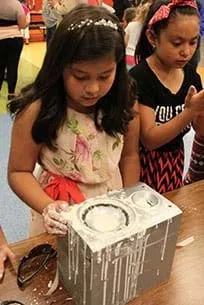 Figure 1. A student places oobleck on a speaker.
Students learn about sound and sound energy as they gather evidence that sound travels in waves. Teams work through five activity stations that provide different perspectives on how sound can be seen and felt. At one station, students observe oobleck (a shear-thickening fluid made of cornstarch and water) “dance” on a speaker as it interacts with sound waves (see Figure 1). At another station, the water or grain inside a petri dish placed on a speaker moves and make patterns, giving students a visual understanding of the wave properties of sound. At another station, students use objects of various materials and shapes (such as Styrofoam, paper, cardboard, foil) to amplify or distort the sound output of a homemade speaker (made from another Teach Engineering activity). At another station, students complete practice problems, drawing waves of varying amplitude and frequency. And at another station, they experiment with string (and guitar wire and stringed instruments, if available) to investigate how string tightness influences the plucked sound generated, and relate this sound to high/low frequency. A worksheet guides them through the five stations. Some or all of the stations may be included, depending on class size, resources and available instructors/aides, and this activity is ideal for an engineering family event.
Engineers must understand how sound behaves in order to design sound equipment such as stereos, speakers, phones and radios. In order to design hearing aids and implants for hearing-impaired people, biomedical engineers also require an excellent understanding of sound energy and how our brains perceive sound. In this activity, students learn about sound waves and sound energy. In the discussion following the activity, students relate their knowledge of sound waves to engineering applications.
After this activity, students should be able to:
- Provide evidence that sound is a wave.
- Define amplitude, wavelength and frequency.
- Explain how sound energy travels as waves, interacts with the eardrum and is perceived as sound.
- Energy comes in many forms such as light, heat, sound, magnetic, chemical, and electrical
Grade 4
Do you agree with this alignment?
- Energy comes in different forms.
Grades 3-5
Do you agree with this alignment? - STEL-3D Explain how various relationships can exist between technology and engineering and other content areas.
Grades 3-5
Do you agree with this alignment?
- 4-PS3-2 Make observations to provide evidence that energy can be transferred from place to place by sound, light, heat, and electric currents.
Grade 4
This resource focuses on the following Three Dimensional Learning aspects of NGSS:
Science & Engineering Practices- Make observations to produce data to serve as the basis for evidence for an explanation of a phenomenon or test a design solution.Do you agree with this alignment?
Disciplinary Core Ideas- Energy can be moved from place to place by moving objects or through sound, light, or electric currents.Do you agree with this alignment?
- Energy is present whenever there are moving objects, sound, light, or heat. When objects collide, energy can be transferred from one object to another, thereby changing their motion. In such collisions, some energy is typically also transferred to the surrounding air; as a result, the air gets heated and sound is produced.Do you agree with this alignment?
- Light also transfers energy from place to place.Do you agree with this alignment?
- Energy can also be transferred from place to place by electric currents, which can then be used locally to produce motion, sound, heat, or light. The currents may have been produced to begin with by transforming the energy of motion into electrical energy.Do you agree with this alignment?
Crosscutting Concepts- Energy can be transferred in various ways and between objects.Do you agree with this alignment?
Do you agree with this alignment? - Make observations to produce data to serve as the basis for evidence for an explanation of a phenomenon or test a design solution.
- 4-PS4-1 Develop a model of waves to describe patterns in terms of amplitude and wavelength and that waves can cause objects to move.
Grade 4
This resource focuses on the following Three Dimensional Learning aspects of NGSS:
Science & Engineering Practices- Develop a model using an analogy, example, or abstract representation to describe a scientific principle.Do you agree with this alignment?
- Science findings are based on recognizing patterns.Do you agree with this alignment?
Disciplinary Core Ideas- Waves, which are regular patterns of motion, can be made in water by disturbing the surface. When waves move across the surface of deep water, the water goes up and down in place; there is no net motion in the direction of the wave except when the water meets a beach. (Note: This grade band endpoint was moved from K-2.)Do you agree with this alignment?
- Waves of the same type can differ in amplitude (height of the wave) and wavelength (spacing between wave peaks).Do you agree with this alignment?
Crosscutting Concepts- Similarities and differences in patterns can be used to sort and classify natural phenomena.Do you agree with this alignment?
Do you agree with this alignment? - Develop a model using an analogy, example, or abstract representation to describe a scientific principle.
Following is a list of materials needed for an instructor-led demonstration and the five activity stations.
Teacher Class Demo
- clear plastic tub, ~1 x 1 ft (~30 x 30 cm) in size, although almost any size plastic tub will work to drop a pebble or marble into it to demonstrate waves
- access to water
- pebble or marble
- roll/stack of paper towels
Station 1: Oobleck Dance
- 0.4 cup (96 ml) water
- 0.6 cups (144 ml) cornstarch
- plastic spoon
- roll/stack of paper towels
- disposable bowl for mixing oobleck, such as a 20-oz (~590-ml) paper bowl; most store-bought disposable paper or foam bowls work well
- stereo with good bass output, such as the AXESS MSBT3907 2.1 Mini Entertainment System at Amazon; suitable stereos are often available at second-hand and thrift stores for low cost
- full-range or subwoofer speakers; often available at second-hand and thrift stores; note that the speaker will not be reusable after the activity since it will be covered with the oobleck mixture (see Figure 1); the previously mentioned example mini entertainment system from Amazon includes speakers
- (optional) plastic bag, to put over the speaker to help keep it clean, although this dampens the signal, resulting in less visual impact
- 1 lawn-and-leaf bag or plastic sheeting to cover the table (placed under the speaker and stereo), such as from this box of 18 39-gallon-size, extra strong trash bags at Amazon
- laptop or other music source device capable of playing low-frequency sound input; either downloaded or streaming, such as the 30-60-hertz bass tests on YouTube
- auxiliary cord, to connect music device and stereo, such as the RCA stereo audio Y adapter cable at Amazon; often available at second-hand and thrift stores
Station 2: Sound Visualization
- stereo or DVD player*; excellent options are often available at second-hand and thrift stores such as Goodwill for a few dollars; choose a stereo or DVD player intended for home entertainment systems; see note below; most phones and computers do not have good enough output for adequate sound wave visualization
- speaker; most sizes work for the activity, but larger speakers (larger than small computer speakers) provide better visualization; make sure the speakers have a connection type that is compatible with your stereo or DVD player
- CD with kid-friendly music
- roll/stack of paper towels
- 2 cups (480 ml) of uncooked long grain rice or bulgur wheat
- 1 cup (240 ml) of water
- 2 large plastic petri dishes with lids, such as 150-mm size, although smaller petri dishes or plastic plates also work fairly well; petri dishes with lids better contain any mess
Station 3: Testing Homemade Speakers
- yogurt cup speaker; either make one on your own, or have groups use the ones they created during the Yogurt Cup Speakers activity
- stereo or DVD player*; often available at second-hand and thrift stores such as Goodwill for a few dollars; see note below
- CD with kid-friendly music
- various objects of different materials and shapes, such as Styrofoam, paper and plastic plates, cups and/or bowls; cardboard; foil; students will use these materials to amplify or distort the yogurt cup speaker sound output
- 12 inches (30 cm) of masking tape
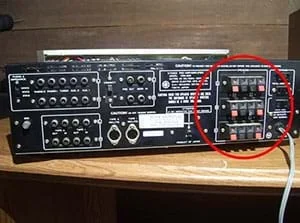 Figure 2. An example amplifier (not a stereo) with spring-loaded terminals (circled in red), which are common in older DVD players and stereo receivers and are very convenient for the Testing Homemade Speakers station.Copyright 2009 Daniel Christensen, Wikimedia Commons https://commons.wikimedia.org/wiki/File:Amp_back.jpg
*Note: It is possible to use one stereo or DVD player for two stations (Sound Visualization and Testing Homemade Speakers) by using the left output for one station and the right output for the other station. But, if available, use separate stereos/DVD players, which also helps to minimize crowding at those stations. If separate systems are used, it is easier for the Sound Visualization station to use a stereo or DVD player with plugs for the speaker cables. However, for the Testing Homemade Speakers station, it is easier to use a system with spring-loaded terminals (circled in red in Figure 2).
Station 4: Practice Problems
- Seeing Sound Worksheet (PDF), one per student; this worksheet guides students through all five stations, including providing the four practice problems for this station
Station 5: How Do Stringed Instruments Make Sound?
- 6 ft (183 cm) of cotton string, cut into 2-foot (61-cm) lengths
- roll/stack of paper towels
- 1 petri dish (with lid), filled halfway with water; a 150-mm diameter plastic petri dish works well
- (optional) 1 ft (~30 cm) guitar wire
- (optional) guitar or other stringed instrument
It is recommended that students complete the Yogurt Cup Speakers activity before conducting this activity so that they have their own homemade speakers to test, as well as a basic understanding of speakers.
How do we hear? (Ask the class for ideas.) When I speak, you can hear what I say, correct? Why is that? Well, let’s work backwards. When something around you makes a noise, your brain receives an electrical signal from your eardrum that you heard a sound (show Figure 3 or sketch it on the classroom board). Your eardrum sent that signal to your brain because the sound “tapped” on your eardrum, causing it to vibrate. But what caused your eardrum, many feet from the sound that came from my mouth, to start moving when I spoke? (Ask the class to share their ideas.)
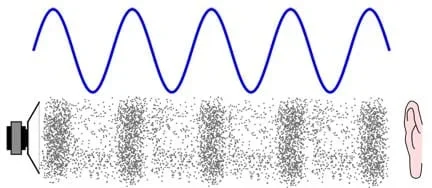 Figure 3. A speaker makes pulses in air, which travel as waves. When a wave arrives at the ear, it makes the eardrum vibrate.Copyright 2012 Pluke, Wikimedia Commons https://commons.wikimedia.org/wiki/File:CPT-sound-physical-manifestation.svg
Well, let’s visualize the concept. When I began to talk, a sound wave was created. (If possible, draw a simple illustration on the board showing waves, representing sound, coming from a mouth.) To understand what that means, let’s think of where we have seen waves before. Picture the waves you have seen on water: the ocean, a lake, a pool or even a puddle. What about when a rock hits the surface of water? (Demonstrate this by dropping a pebble or marble into a tub of water.)
When the rock hits the water, the water has to move out of the way of the rock. This disturbance around the rock moves in all directions as a wave of movement. In general, waves are caused when something starts to vibrate (a disturbance) and then causes the air, liquid or water around it to also vibrate (be disturbed).
Gently place your hand on your throat. Now speak or hum. Can you feel the vocal chords in your throat vibrating? When I start speaking, my vocal chords vibrate and make the air around them vibrate as well. This vibrating air has places with higher and lower pressure (identify these wave characteristics on the classroom board, as shown on Figure 4); the high pressure forms the crests of waves and the low pressure forms the troughs.
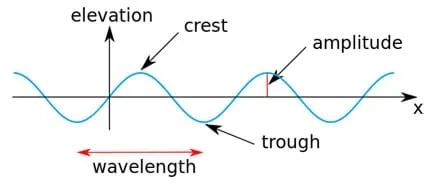 Figure 4. From a wave’s shape, we can calculate its amplitude and wavelength.Copyright 2008 Kraaiennest, Wikimedia Commons https://commons.wikimedia.org/wiki/File:Sine_wave_amplitude.svg
This sound wave travels through air and eventually reaches your eardrum—a membrane in the ear canal. The high pressure part of the sound wave taps more on your eardrum than the low pressure part. This pattern is transmitted to your brain, which interprets it as sound.
So although sound travels as a wave, you cannot see it in the air. It would be great to have proof of this in order to understand it better! How could we find evidence that sound is a wave? (Ask students for suggestions and discuss as a class.)
In today’s activity, we will have many opportunities to gain evidence that sound is a wave and to practice describing waves in terms of their amplitude, wavelength and frequency.
The purpose of today’s activity is to learn about sound and sound energy. Who else might need to understand sound? (Listen to student ideas.) Look around you—do you see any devices in the room that make noise or sounds? (Possible examples: Computers, tablets, stereos, phones, public address speakers, printers, fire alarms, TVs, school bells.) Who designed those devices? That’s right, engineers. Can you think of other inventions that would require engineers to have a good understanding of sound and sound energy? (Listen to student ideas.) There are many! For example, engineers design hearing aids for people who are deaf. Engineers also make ultrasound devices that doctors use to see organs and bones inside the human body. In order to design all these devices so they work as intended, engineers need to know a lot about sound energy and the way it travels as waves.
Background
Waves are all around us. Light travels as waves and so does sound. What is different about a sound wave from a low sound compared to the wave from a high sound? What is different about a loud sound compared with a quiet sound? It is all explained by the shape of the wave (see Figure 5).
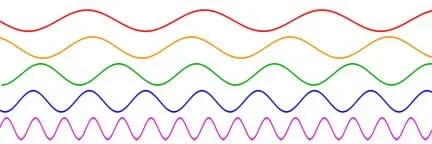 Figure 5. The frequency of a wave is the number of waves passing a point in a given time. Higher frequency waves have shorter wavelengths. In this diagram, the red wave has the lowest frequency and the purple wave has the highest frequency.Copyright 2007 LucasVB, Wikimedia Commons https://commons.wikimedia.org/wiki/File:Sine_waves_different_frequencies.svg
The height of a wave is its amplitude. What do you think of when you hear the word amplitude? Usually we think of volume. A loud sound wave has large amplitude, and a quiet sound wave has smaller amplitude. Wavelength and frequency are also important wave characteristics that determine what a sound wave sounds like. The wavelength is the distance before the wave repeats itself. You can measure wavelength between two crests or two troughs. (Ask students to use a ruler to measure the wavelength and amplitude of a wave drawn on the classroom board.)
Another way we describe waves is by their frequencies. The frequency is how fast a wave is waving or, how many wavelengths pass a certain point in a given time. Waves travel the same speed through air whether they have small or long wavelengths, high or low frequency. (Point to a drawn wave on the classroom board.) Let’s say we ask how many wavelengths will pass this point in 1 second. If a wave has very long wavelengths, only a few wave crests (or troughs) pass this point over that time period. So that wave has low frequency. If a wave has very small wavelengths, then many wave crests (or troughs) would pass this point in 1 second. So, this second wave has high frequency.
High- and low-frequency waves sound different. High-frequency sounds have a high pitch and low-frequency sounds have a low pitch. Low-frequency sounds that are still high enough for us to hear are in the range of 20-60 hertz; the lower the frequency, the lower the pitch of the sound (and longer the wavelength). Sound waves are how sound energy travels. Waves with higher frequency and amplitude have a larger amount of energy, which can be transferred to other objects (such as our eardrums).
Before the Activity
- Gather materials and make copies of the Seeing Sound Worksheet (PDF), which guides students through all five stations.
- The activity is flexible in that you may run all or just some of the five stations, depending on class size, resources and available adults for supervision. If it is not possible to set up all activity stations, modify the worksheet to exclude unused stations. Since groups of four students are ideal at each workstation, for large class sizes, you may want to make some duplicate stations (or have students work on other assignment tasks) so that you have the same number of groups as stations without having to increase the group size too much.
- Set up each activity station. Label each with a visible number. Refer to the station setup notes, below, including goals and procedures. Refer to the worksheet for station-specific questions to guide activity exploration.
- If students complete the Yogurt Cup Speakers activity, have them save their speakers (or just save several of the more well-made speakers) for use at the Testing Homemade Speakers station. Otherwise, create a yogurt cup speaker on your own to use at that station.
Station 1: Oobleck Dance
Background: Oobleck is a cornstarch and water mixture that is a shear-thickening fluid, which means that it spreads out like a fluid when at rest and firms up like a solid when subjected to a force. In this activity, the oobleck “dances” on the speaker as songs play because more intense sound pulses make the oobleck briefly behave more like a solid and take on interesting shapes, and then during less intense moments in the music, the oobleck relaxes. Oobleck responds best to low-frequency (30-60 hertz), loud sounds.
Tips
- This station is best managed by an adult to monitor the optimum selection of sound frequencies and speaker volume, and to manage/minimize the oobleck mess.
- The oobleck tends to dry out as it dances on the speaker, so periodically add water to it. Its state of hydration influences which (low) frequencies it responds to best. When you notice oobleck start to crumble and flake, add a small amount of water to the original mixture to restore its properties.
Learning Goals
- To understand that when a sound wave interacts with oobleck, the oobleck stiffens temporarily.
o If the sound wave has high frequency (short wavelengths), the oobleck does not have time to stiffen and relax; it stays stiff.
o If the oobleck meets a low-frequency sound, it has time to stiffen and then relax.
- To see standing wave patterns in the oobleck—when left on a repeating low-frequency tone.
Setup
- Cover the desk/table for this station with plastic.
- Remove the outer mesh that covers the speaker cone. If desired, protect the speaker by placing a plastic bag over it to help keep it clean, although this dampens the signal, resulting in less visual impact.
- Use an auxiliary cord to connect the laptop or other music source to the stereo.
- Oobleck requires a low-frequency tone in order to respond with interesting shapes (30-60-hertz tones), so choose a range of low-frequency sounds to play sequentially, ranging from 20-100 hertz, to be able to see differences in oobleck response to frequency. Find low-frequency tones online using search terms such as “30 hertz bass test” or “subwoofer test.”
Creation of Oobleck
- 1 cup of oobleck is sufficient for the entire class to complete this activity.
- Using a plastic spoon, mix 1 part water (0.4 cups) to 1.5 parts (0.6 cups) cornstarch.
Procedures—Make Oobleck Dance!
- Place a spoonful of oobleck on the speaker cone (see Figure 1). Expect the oobleck to first stiffen to show a standing wave pattern as it responds to a repeating low-frequency tone.
- If poked with a spoon or finger, the oobleck may creep and crawl into animal-like shapes. Advise students to use caution since the speaker cone is fragile and easily broken with a plastic spoon or finger.
- Direct students to experiment with the speaker volume to explore how varying the amplitude alters the oobleck response.
Station 2: Sound Visualization
Learning Goals
- To gain a visual understanding of the wave properties of sound. Although the movement of sound through air cannot be seen, when water (or grains) are placed on a petri dish (or plate) and positioned on top of a speaker, the resulting patterns provide some visual evidence.
- To see the effects of amplitude changes. When the volume is increased, the wave amplitude increases and the sound energy can be enough to make drops of water (or grains) leap.
- To see the effects of frequency (wavelength) changes. The patterns displayed by the water (or grains) change, depending on the sound frequency (and thus, wavelength).
Setup
- Attach a speaker to the stereo.
- Pour water in a large petri dish so it is about half full. Cover it with the petri dish lid. Place the petri dish on top of the speaker.
- Prepare a second, covered petri dish with grains inside.
Procedure
- Start the kid-friendly music and let the sound-visualization begin.
- Direct students to adjust the volume and observe the water (or grains). What do they notice?
Station 3: Testing Homemade Speakers
Learning Goals
- To use the student-created homemade speakers to aid in sound visualization. Doing this further cements their understanding of how speakers generate sound through vibration.
- To give students a chance to optimize a speaker’s output.
- To use assorted materials to amplify or distort the sound output of the homemade speaker.
Setup
- For each team, have an adult connect its yogurt cup speaker’s magnet wire to the stereo.
- Using masking tape, secure the magnet wire to the table to minimize the likelihood of wires pulling out from the stereo during the activity.
- Near the speaker, place a box of various objects of different materials and shapes.
- Place two pieces of masking tape across the stereo volume knob to prevent students from adjusting the volume.
Procedure
Direct students to experiment with the supplied materials to amplify or distort the sound output of the yogurt cup speaker. Do not permit them to adjust the stereo volume. If students need prompting, suggest they hold up different materials close to and on the speaker, turn them different ways and/or combine them to see what happens. (See the Seeing Sound Worksheet Answer Key (PDF) for examples of what students might discover.)
Station 4: Practice Problems
Learning Goals: To cement what students know about wave characteristics: frequency, wavelength, amplitude.
Setup: None required beyond labeling the station location.
Procedure: Direct students to complete the “Station 4: Practice Problems” on the worksheet, in which they draw waves of varying amplitude and frequency.
Station 5: How Do Stringed Instruments Make Sound?
Learning Goals:
- To use strings (and possibly stringed instruments) to explore the generation of sound.
- To further expand students’ understanding of wave amplitude, wavelength and frequency.
Setup
- Provide several 2-foot lengths of string.
- If available, also provide guitar wire and/or a guitar or other stringed instrument.
- Provide a petri dish and lid, half-filled with water.
Procedure:
- Guided by the worksheet questions, students experiment with the string and investigate how string tightness influences the sound produced, and relate this sound to high/low frequency.
- Students pluck the string on top of a petri dish of water, looking for visual evidence that sound is a wave.
- Have them do the same or similar experiments with the guitar wire and stringed instruments.
With the Students—Overall Procedure
- Ask students the pre-activity questions, as provided in the Assessment section. Then present to the class the Introduction/Motivation and Background sections, which include a quick class demonstration. (10 minutes)
- As a class, briefly preview each station. Discuss the learning goals and instructions on what to do at each station. (10 minutes)
- Divide the class into groups of four (ideally).
- Assign each group a different numbered station at which to begin the activity.
- Depending on class size, consider cycling the stations every 5-8 minutes. (25-30 minutes)
- If necessary, give students some extra time at activity end to finish answering the worksheet questions. (5 minutes)
- Close with a class discussion to relate the activity back to the real-world of engineering and the design work that some engineers do that requires them to understand sound waves. Refer to some suggested questions in the Assessment section.
- amplitude
- The height of a wave.
- frequency
- The number of waves passing a point in a certain time; related to the inverse of wavelength.
- hertz
- Unit of frequency (1/s).
- oobleck
- A cornstarch and water mixture that is a shear-thickening fluid, which means that it spreads out like a fluid when at rest and firms up like a solid when subjected to a force. Oobleck is an inexpensive and non-toxic example of a non-Newtonian fluid. If placed on a large subwoofer at sufficiently high volume, it thickens and forms standing waves in response to low-frequency sound waves from the speaker.
- pitch
- (music) The highness or lowness of a sound.
- wavelength
- The distance between two peaks or troughs of a wave.
Pre-Activity Assessment
Class Discussion/Questions: Ask students the following questions. Review their answers to gain an understanding of their base knowledge of sound.
- If I have a low-pitch sound that is very quiet, what can we say about its wavelength and amplitude? (Answer: The frequency is low and the amplitude is small. Draw this on the classroom board.)
- If I have a second sound that is also quiet, but high-pitch, what does this wave look like? (Answer: The frequency is high and the amplitude is small. Draw this on the board.)
- If I have a third wave that is high-pitch and loud, what does this wave look like? (Answer: The frequency is high and the amplitude is large. Draw this on the board.)
Activity Embedded Assessment
Worksheet: Have students use the Seeing Sound Worksheet (PDF) to guide them through the five stations, individually answering the questions as they go. Review their answers to gauge their engagement and comprehension.
Post-Activity Assessment
Class Discussion/Questions: At activity end, lead a class discussion so students can review and share what they learned at the five stations. Also ask them the following questions to relate the activity to the real-world of engineering applications that require an understanding of sound waves. Students’ answers reveal their depth of understanding. Ask the students:
- Why do engineers need to know about sound waves? (Possible answers: To design sound and music equipment such as stereos, speakers, amplifiers, phones and radios as well as hearing aids and implants for hearing-impaired people. Also public address systems, alarms and warning systems. Design of buildings and spaces to minimize or optimize sound such as libraries, recording studios and concert halls. Engineers design radar and sonar systems that use sound waves, too.)
- Waves are all around us and are not only produced by sound energy. What other kinds of energy travel as waves? (Guide the discussion towards the wider realization that waves are very common; light travels as waves, and other forms of non-visible electromagnetic radiation such as radio waves, microwaves or UV waves are all around us. We cannot hear ultrasound waves but engineers use them to create medical diagnostic tools like ultrasound machines, and even ultrasonic equipment to clean jewelry and to detect invisible flaws and cracks in metal such as airplanes and pipes.)
Make sure that students do not adjust the volume at the Testing Homemade Speakers station. If the volume is too loud on a powerful speaker it has the potential to cause the magnet wire to smoke. Also, if wires become unplugged between the speaker and the stereo, students must ask an adult to plug them back in correctly (with power turned off).
- Choose stereos with adequate bass output as well as a woofer or subwoofer speaker.
- If possible, place the oobleck station in an area without carpet to make any cleanup easier. Cover the table hosting this station with plastic to contain any mess.
- Keep paper towels at the stations with oobleck, water or grain, and encourage students to clean up messes immediately.
- Do not dispose of oobleck in a sink because it may clog the drain. Instead, dispose of it in the trash.
Assign student teams to use an app such as Explain EverythingTM Classic to create video presentations about sound waves (see https://itunes.apple.com/us/app/explain-everything-interactive/id431493086?mt=8). Have them film the “sound wave evidence” observed at the stations in this activity and then edit the videos to include audio and/or visual scientific explanations. Have students share their finished videos with the class or with other classes at school or during an engineering-focused family event.
This activity is also well-suited for an engineering family event. Consider completing this activity in class, and then at the family event have students be the facilitators (with adult support) at each station to explain the underlying science and related engineering relevance to their families.
- For lower grades, use one well-made yogurt cup speaker at the Testing Homemade Speakers station instead of having each group test its own.
- For higher grades, require students to create and then test their own speakers, as described in the Yogurt Cup Speakers activity.
Nave, Carl R. Transverse and Longitudinal Waves. 2012. HyperPhysics, Department of Physics and Astronomy, Georgia State University, Atlanta, GA. Accessed March 2016. http://hyperphysics.phy-astr.gsu.edu/hbase/sound/tralon.html
Science Mission Directorate. “Anatomy of an Electromagnetic Wave.” Last updated August 13, 2014. Mission: Science. National Aeronautics and Space Administration. Accessed March 2016. http://missionscience.nasa.gov/ems/02_anatomy.html
- Sound Energy
- The Energy of Music
- Seeing and Feeling Sound Vibrations
- Traveling Sound
- Pitch and Frequency
- Sound Visualization Stations
- The Energy of Music
Contributors
Chelsea Heveran
Supporting Program
Integrated Teaching and Learning Program, College of Engineering, University of Colorado Boulder
Acknowledgements
The contents of these digital library curricula were developed by the Integrated Teaching and Learning Program under National Science Foundation GK-12 grant no. DGE 0946502. However, these contents do not necessarily represent the policies of the National Science Foundation, and you should not assume endorsement by the federal government.
Copyright
2011 by Regents of the University of Colorado