
Corn for Fuel?!
In this activity, students examine how to grow plants the most efficiently. They imagine that they are designing a biofuels production facility and need to know how to efficiently grow plants to use in this facility. As a means of solving this design problem, they plan a scientific experiment in which they investigate how a given variable (of their choice) affects plant growth. They then make predictions about the outcomes and record their observations after two weeks regarding the condition of the plants' stem, leaves and roots. They use these observations to guide their solution to the engineering design problem. The biological processes of photosynthesis and transpiration are briefly explained to help students make informed decisions about planning and interpreting their investigation and its results.
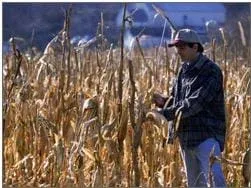 Figure 1. Biochemical engineers are finding ways to turn corn husks into fuel for your car.Copyright National Renewable Energy Laboratory, http://www.nrel.gov/learning/images/photo_bio_farmer.jpg
Many engineers work together to create alternative energies, such as the biofuel ethanol. Biochemical engineers work out the process for converting corn into ethanol. Bioengineers alter the genetic make-up of the plants themselves to make them more effective as raw materials for the facility. Mechanical engineers design the machines that harvest the plants and transform them into ethanol. Plants can be used in other ways besides biofuel production, too. Civil engineers may use plants to act as purifying agents in biological water treatment processes. Many treatment facilities rely on artificial or natural lagoons of plants and fauna for the removal of contaminants before release into the environment. Meanwhile, some environmental engineers are developing ways to seed the ocean with algae. Photosynthesis from the algae removes CO2 from the atmosphere, as a way to combat global warming. These are just a few ways that engineers use plants in professional applications to build technologies that make our lives more comfortable.
After this activity, students should be able to:
- Use vocabulary related to plants energy processes, including photosynthesis and transpiration.
- Plan an investigation to support their design project.
- Discuss the effect that an experimental variable (of their choice) has on plant growth.
- Apply their understanding of plant growth to design a biofuels plant.
- 6.3.1.d.ii.1 Report the number of observations.
Grade 6
Do you agree with this alignment? - 8.3.1.a Construct and interpret scatter plots for bivariate measurement data to investigate patterns of association between two quantities.
Grade 8
Do you agree with this alignment? - 6.3.1.d.ii.2 Describe the nature of the attribute under investigation, including how it was measured and its units of measurement.
Grade 6
Do you agree with this alignment?
- Gather, analyze, and interpret data regarding the basic functions of photosynthesis and cellular respiration
Grade 7
Do you agree with this alignment? - Research and evaluate data and information to learn about the types and availability of various natural resources, and use this knowledge to make evidence-based decisions
Grade 6
Do you agree with this alignment?
- CCSS.Math.Content.6.SP.B.5a Reporting the number of observations.
Grade 6
Do you agree with this alignment? - CCSS.Math.Content.6.SP.B.5b Describing the nature of the attribute under investigation, including how it was measured and its units of measurement.
Grade 6
Do you agree with this alignment? - CCSS.Math.Content.8.SP.A Investigate patterns of association in bivariate data.
Grade 8
Do you agree with this alignment? - CCSS.Math.Content.8.SP.A.1 Construct and interpret scatter plots for bivariate measurement data to investigate patterns of association between two quantities. Describe patterns such as clustering, outliers, positive or negative association, linear association, and nonlinear association.
Grade 8
Do you agree with this alignment?
- Students will develop an understanding of the attributes of design.
Grades K-12
Do you agree with this alignment? - Students will develop an understanding of engineering design.
Grades K-12
Do you agree with this alignment? - Students will develop an understanding of the relationships among technologies and the connections between technology and other fields of study.
Grades K-12
Do you agree with this alignment? - Biotechnology applies the principles of biology to create commercial products or processes.
Grades 6-8
Do you agree with this alignment? - STEL-3G Explain how knowledge gained from other content areas affects the development of technological products and systems.
Grades 6-8
Do you agree with this alignment? - STEL-7Q Apply the technology and engineering design process.
Grades 6-8
Do you agree with this alignment?
- MS-ETS1-4 Develop a model to generate data for iterative testing and modification of a proposed object, tool, or process such that an optimal design can be achieved.
Grades 6-8
This resource focuses on the following Three Dimensional Learning aspects of NGSS:
Science & Engineering Practices- Develop a model to generate data to test ideas about designed systems, including those representing inputs and outputs.Do you agree with this alignment?
Disciplinary Core Ideas- Models of all kinds are important for testing solutions.Do you agree with this alignment?
- The iterative process of testing the most promising solutions and modifying what is proposed on the basis of the test results leads to greater refinement and ultimately to an optimal solution.Do you agree with this alignment?
Do you agree with this alignment? - Develop a model to generate data to test ideas about designed systems, including those representing inputs and outputs.
- MS-LS1-5 Construct a scientific explanation based on evidence for how environmental and genetic factors influence the growth of organisms.
Grades 6-8
This resource focuses on the following Three Dimensional Learning aspects of NGSS:
Science & Engineering Practices- Construct a scientific explanation based on valid and reliable evidence obtained from sources (including the students' own experiments) and the assumption that theories and laws that describe the natural world operate today as they did in the past and will continue to do so in the future.Do you agree with this alignment?
Disciplinary Core Ideas- Genetic factors as well as local conditions affect the growth of the adult plant.Do you agree with this alignment?
Crosscutting Concepts- Phenomena may have more than one cause, and some cause and effect relationships in systems can only be described using probability.Do you agree with this alignment?
Do you agree with this alignment? - Construct a scientific explanation based on valid and reliable evidence obtained from sources (including the students' own experiments) and the assumption that theories and laws that describe the natural world operate today as they did in the past and will continue to do so in the future.
- MS-LS1-6 Construct a scientific explanation based on evidence for the role of photosynthesis in the cycling of matter and flow of energy into and out of organisms.
Grades 6-8
This resource focuses on the following Three Dimensional Learning aspects of NGSS:
Science & Engineering Practices- Construct a scientific explanation based on valid and reliable evidence obtained from sources (including the students' own experiments) and the assumption that theories and laws that describe the natural world operate today as they did in the past and will continue to do so in the future.Do you agree with this alignment?
- Science knowledge is based upon logical connections between evidence and explanations.Do you agree with this alignment?
Disciplinary Core Ideas- Plants, algae (including phytoplankton), and many microorganisms use the energy from light to make sugars (food) from carbon dioxide from the atmosphere and water through the process of photosynthesis, which also releases oxygen. These sugars can be used immediately or stored for growth or later use.Do you agree with this alignment?
- The chemical reaction by which plants produce complex food molecules (sugars) requires an energy input (i.e., from sunlight) to occur. In this reaction, carbon dioxide and water combine to form carbon-based organic molecules and release oxygen.Do you agree with this alignment?
Crosscutting Concepts- Within a natural system, the transfer of energy drives the motion and/or cycling of matter.Do you agree with this alignment?
Do you agree with this alignment? - Construct a scientific explanation based on valid and reliable evidence obtained from sources (including the students' own experiments) and the assumption that theories and laws that describe the natural world operate today as they did in the past and will continue to do so in the future.
Each group needs:
- 2 planting containers; e.g., plastic cups
- 6 seeds (e.g., lima beans, peas, broad beans, etc.)
- 2 cups soil
- a glass bottle or jar
- options for experimental variables (e.g., 2 different kinds of soil, fertilizer, sunlight filters, heat lamps)
- one copy of the Designing a Biofuels Plant Worksheet for each student
- one copy of the Corn for Fuel?! Datasheet (PDF) for each student
To share with the entire class:
- a dark area and a bright area – a box will work for the dark area
- a glass bottle or jar
- computer access, with an internet connection to watch an online video
- Designing a Biofuels Plant Worksheet (docx)
- Designing a Biofuels Plant Worksheet (pdf)
- Observation Sheet-What do Plants Need? (docx)
- Observation Sheet-What do Plants Need? (pdf)
- Hypothesis Sheet – What do plants need? (docx)
- Hypothesis Sheet – What do plants need? (pdf)
- Corn for Fuel?! Datasheet (docx)
- Corn for Fuel?! Datasheet (pdf)
Environmental engineers design products that are friendly to the Earth. Today we are going to design a way to provide energy for cars without using environmentally harmful fossil fuels. What are some possible alternative energy sources we could use? (Possible answers: solar, wind, hydropower, nuclear, or biomass) Okay, let's focus on solar power. Some engineers have worked on creating cars that use solar panels that generate electricity to power the car. Unfortunately, it's hard to get enough energy out of those solar panels to provide the kind of power that we typically use on ordinary cars. Does anyone have another idea for how we could harness the sun's energy to use in a car? I'll give a hint: it uses a natural way of storing the sun's energy, and we can put it into the car just like gasoline. The answer is biofuels!
Biofuels are a renewable form of fuel that biochemical engineers have created. These engineers figured out a way to turn the starch and sugar of corn and other plants into fuel called ethanol. With current technology, ethanol can only be made from the edible part of corn. However, biochemical engineers are currently trying to find a way that we can also use the nonedible parts, such as the husks. This would be a great way to use all of the biomass that is left over after we harvest the corn.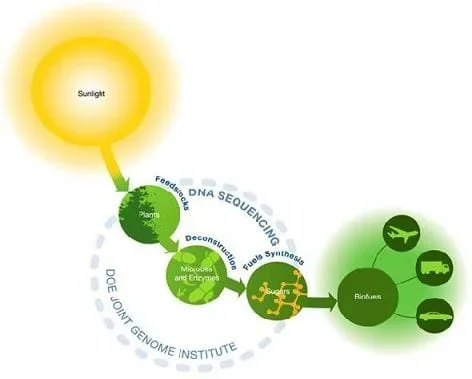 Figure 2. From photosynthesis to biofuel for cars?Copyright DOE Joint Genome Institute, http://www.jgi.doe.gov/education/
Now, you may be wondering what this has to do with solar energy. Well, a plant is basically just nature's version of the photovoltaic cells that make up a solar panel. As you learned in the previous lesson, the plant converts solar energy into chemical energy that can be stored through a process called photosynthesis. The chlorophyll in the plant leaves use the sun's energy to turn carbon dioxide and water into glucose and oxygen. Later, in a biorefinery, the glucose is turned into ethanol, which provides the chemical energy that your car uses.
In this activity, you explore how to get the best results from growing plants. Your understanding of photosynthesis helps you understand your results. At the end of the activity, you will apply the information you gather to a biochemical engineering problem related to making biofuels.
Fossil Fuel and Plants Background
Fossil fuels are derived from the decomposed remains of plants and animals that lived over 300 million years ago (before the time of dinosaurs). Natural gas, coal and oil are the three main types of fossil fuels. About 85% of the energy used in the United States comes from fossil fuels. Because our supply of fossil fuels is limited, they are considered nonrenewable sources of energy.
The parts of a plant, similar to the body parts of a human, each have a function in order to help plants to attain the necessities of survival, food water and sunlight. The main components of the plant are the roots, the stem/trunk, branches and the leaves. The pores on the leaves of the plant are called the stomata, and they are the parts of the plants that take in sunlight. Plants begin their lives as seeds, which turn into roots. They eventually expand to leaves, flowers and even fruit, in many cases, to complete a cycle. Plants make their own food using the chlorophyll inside the cells of the leaves. Plants get their energy through a chemical process called photosynthesis. Sunlight reacts with the chlorophyll molecules in the leaves, creating Adenosine Triphosphate (ATP), a high-energy molecule, that is the chemical powerhouse that provides the energy to turn carbon dioxide and water into glucose. The glucose is the plant's "food." A byproduct of photosynthesis is oxygen, which is released into the atmosphere. See the associated lesson for this activity to learn more about photosynthesis.
Before the Activity
Day 1
1. Divide students into groups of 3-4.
2. Explain to students that they will be biochemical engineers today, designing a biofuels production facility to convert corn to ethanol. Explain that, like real engineers, they will use an iterative "design loop" to invent a biofuels facility. Handout the Designing a Biofuels Plant Worksheet, and point out that they will start with defining the problem. First, however, it is helpful to have some background information, which they can find in a video produced by the National Renewable Energy Laboratory (http://www.nrel.gov/learning/re_biofuels.html). As they watch the video, encourage students to think about what they would need to know to design a biofuels (ethanol) facility.
3. After watching the video, have students complete the first part of the Designing a Biofuels Plant Worksheet (PDF), where they write down what they would need to know in order to make a facility that would create ethanol. They can revise the list that they made during the Pre-Assessment.
4. After a few minutes, explain that today's design problem will focus on how to grow the most corn possible for their biofuels production facility. To gather information about this design problem, students will plan a controlled experiment with plants. As a result of this investigation, they should learn what conditions result in the greatest plant growth so that they can apply these findings to their engineering design problem. In addition, provide two different species of plant so that students can see how different species of plant can respond differently to the same environmental factors. Give the students another minute to write down an investigating question. On the back of their paper, they should write down their control and experimental groups. It may help to give them a list of some of the equipment you have that allows them to create varying growing conditions (e.g., two different kinds of soil, fertilizer, sunlight filters, heat lamps.)
Distribute different species to different groups so that the groups can compare their results to determine whether one growing condition affected one plant species more than the other. For instance, two groups can have sunlight as their experimental variable, but each group can test a different species of plant. With this approach, each group can not only draw conclusions about the impact on sunlight on growth for their particular plant species; they can also compare their results to determine if one plant species responded more strongly to changes in sunlight than the other. Alternatively, students could keep all of the growing conditions constant, and vary the species of plant.
Note: If they have never done this before, it may help to have them fill in the blanks for a prepared question (e.g., "How does ________ affect how the plants grow?). Examples to fill in could include "sunlight," "water," "soil composition," etc. The control and experimental groups should be consistent with their question. For example, if they choose sunlight, then the control group should be in the sun, and the other plants should be in the dark.
Check student's answers before they continue. You could have groups write their questions and control/experimental groups on the board, and give feedback as a class, so that everyone gets more practice with these investigation skills.
5. Once their investigation plans have been approved, have each group plant their seeds for both their control and experimental groups. Ideally, each group will have 6 seeds each, so that they can plant 3 control plants and 3 experimental plants for repeatability of results. Inform students they will keep track of the plant growth for each plant using the Corn for Fuel?! Datasheet.
6. As a closure activity for the day, have students write down their hypothesis for this experiment on separate sheet of paper. Collect their Designing a Biofuels Plant Worksheet.
7. Gather the class back together for a simple, short demonstration. Take a seedling that has been set aside for this demonstration, and place it in a bright place. Place a clear bottle or jar, turned upside down, on top of it. Explain that over the next week, they should look at the plant and observe what happens to the jar. Overnight, condensation should collect on the inside of the bottle or jar. This is the water vapor that is emitted by the plant when it exchanges oxygen for carbon dioxide — called transpiration. Start the next class (1 week later) by returning to this demonstration.
End of Day 1`
For the next week: Keep the seeds in their respective places for a week, or slight longer, watering them when the soil gets dry. If water was the experimental variable for the group, water according to their plan.
Day 2 (1 week later)
1. As a whole class, observe the demonstration plant that had the jar over it. Point out that they should see evidence of transpiration. Ask students to explain to their group what transpiration is and what evidence they see that it occurred. Gather the class back together to share their answers.
2. Give Designing a Biofuels Plant Worksheets back to students. Have them compare the seeds from the control and experimental group. Ask students to record what they see under the "observations" section of their worksheet. Next, students should separate one seedling away from each container and compare the root systems. Again, have the students record what they see on the observations section of their worksheet.
3. Have students measure the plant growth for each plant and record their results in the Corn for Fuel?! Datasheet.
4. Have a class discussion on the reasons for the observed differences in growth, above and below soil. Ask the class to tell what they know about photosynthesis. Use their responses to explain photosynthesis. (Basic definition: Plants use light to make food for themselves.)
5. Students should draw conclusions from their observed results and write down how they think they could apply this result to design a biofuels production plant.
6. Hold a class discussion for each group share their results and discuss how what they have learned could be applied to the design project. The Post-Activity Assessment has students return to the design problem to find a solution.
- biofuel
- Fuel derived from biological sources; common examples are ethanol, which comes from the starch and sugar of plants (usually corn), and biodiesel, which combines alcohol with a fat, such as recycled frying oil.
- fossil fuel
- Fuel derived from the decomposed remains of plants and animals that lived over 300 million years ago.
- photosynthesis
- The process of using energy in sunlight to convert water and carbon dioxide into carbohydrates and oxygen.
- transpiration
- Water vapor that is emitted by a plant when it exchanges oxygen for carbon dioxideFossil Fuel and Plants Background
Pre-Activity Assessment
Define the Problem: If you were an engineer designing a biofuels refinery, you would need to know where to plant your crops to get the greatest yield of corn to turn into ethanol. With your group, make a list of things that you think you could do to grow your corn the most efficiently. (If students get stuck, ask them probing questions, like "Where would you plant your corn?" "What part of the country do you think would be the best place to grow your corn? Why?" "How important will water be for your corn production?" "Will different species of corn grow differently under the same environmental conditions?")
Activity Embedded Assessment
Research & Investigation: Use the provided worksheet to have students record their hypothesis, method, observations, and conclusions for the investigation. They should also record how they think their experiment could be applied to the engineering design problem of building a biofuels production plant.
Post-Activity Assessment
Designing a Biofuels Plant Worksheet: Using the results of their experiment, have students complete the design process loop on the front of their Designing a Biofuels Plant Worksheet.
- First, they should brainstorm ideas for how to build a biofuels refinery plant that would turn corn into ethanol. The ideas should be focused on the topic of how to grow the most corn possible for their biofuels plant, based on what they learned from their experiment. Remind students that in brainstorming, no idea or suggestion is "silly." All ideas should be respectfully heard. Encourage wild ideas and discourage criticism of ideas.
- After brainstorming ideas, they should study the ideas, and choose the best one(s). This idea should be a solution to the engineering problem of how to grow the most corn possible for ethanol production. Have each group share their ideas with the class.
Corn for Fuel?! Datasheet: Using the results of their experiment, have students graph their data and answer the questions on their Corn for Fuel?! Datasheet (PDF).
- For upper grades, study the chemical reaction that takes place with ethanol production. Have them plan for how to handle the inputs and outputs of this reaction in their biofuels refinery design.
- For lower grades, define the investigation problem for the students. A good choice would be: "How does sunlight affect plant growth?" You could then have a class discussion about how to plan the method. Each group should then perform the same experiment, which would include placing half the plants in sunlight, and the others in the dark.
Benyus, Janine M. Biomimicry: Innovation Inspired by Nature. New York. 1997.
U.S. Department of Energy, Energy Information Administration, Energy Kids Page, Energy Facts, "BIOMASS -- Renewable Energy from Plants and Animals," November 2007. www.eia.gov/kids/index.cfm Accessed March 5, 2009.
U.S. Department of Energy, Joint Genome Institute, "Bioenergy," June 27, 2008. www.jgi.doe.gov/education Accessed March 30, 2009.
Contributors
Christopher Valenti; Karen King; Janet Yowell
Supporting Program
Integrated Teaching and Learning Program, College of Engineering, University of Colorado Boulder
Acknowledgements
The contents of this digital library curriculum were developed under a grant from the Fund for the Improvement of Postsecondary Education (FIPSE), U.S. Department of Education and National Science Foundation GK-12 grant no. 0338326. However, these contents do not necessarily represent the policies of the Department of Education or National Science Foundation, and you should not assume endorsement by the federal government.
Copyright
2009 by Regents of the University of Colorado.