
Photosynthesis – Life's Primary Energy Source
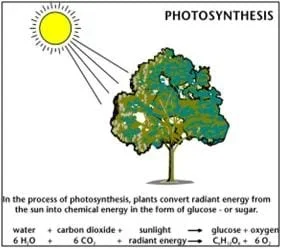 Students learn about photosynthesis.Copyright Energy Information Administration, U.S. Department of Energy, Energy http://www.eia.doe.gov/kids/energyfacts/sources/renewable/images/photosynthesis1.gif
This lesson covers the process of photosynthesis and the related plant cell functions of transpiration and cellular respiration. Students learn how engineers can view the natural process of photosynthesis as an exemplary model of a complex, yet efficient, process for converting solar energy to chemical energy or distributing water throughout a system.
Engineers are faced with the challenge of designing energy efficient systems for heating buildings, for example, or creating fuel-efficient vehicles. The photosynthetic process serves as an excellent model for highly efficient engineering design. Plants convert readily available resources (water, sunlight and carbon dioxide) into plant fuel (glucose). The only byproduct of the process is oxygen, which is an environmentally friendly product that is consumable by other organisms. Engineers who are working to optimize fuel efficiency and minimize hazardous emissions can look to the effective process of photosynthesis as an example.
- Describe how the relationship between photosynthesis and respiration sustain life on this planet.
- Explain the relationship between plants and animals in the oxygen-carbon dioxide cycle.
- Identify ways in which engineers could utilize knowledge of photosynthesis.
- Gather, analyze, and interpret data regarding the basic functions of photosynthesis and cellular respiration
Grade 7
Do you agree with this alignment? - Compare and contrast the flow of energy with the cycling of matter in ecosystems
Grade 6
Do you agree with this alignment?
- Energy can be used to do work, using many processes.
Grades 6-8
Do you agree with this alignment? - Biotechnology applies the principles of biology to create commercial products or processes.
Grades 6-8
Do you agree with this alignment?
- MS-LS1-6 Construct a scientific explanation based on evidence for the role of photosynthesis in the cycling of matter and flow of energy into and out of organisms.
Grades 6-8
This resource focuses on the following Three Dimensional Learning aspects of NGSS:
Science & Engineering Practices- Construct a scientific explanation based on valid and reliable evidence obtained from sources (including the students' own experiments) and the assumption that theories and laws that describe the natural world operate today as they did in the past and will continue to do so in the future.Do you agree with this alignment?
- Science knowledge is based upon logical connections between evidence and explanations.Do you agree with this alignment?
Disciplinary Core Ideas- Plants, algae (including phytoplankton), and many microorganisms use the energy from light to make sugars (food) from carbon dioxide from the atmosphere and water through the process of photosynthesis, which also releases oxygen. These sugars can be used immediately or stored for growth or later use.Do you agree with this alignment?
- The chemical reaction by which plants produce complex food molecules (sugars) requires an energy input (i.e., from sunlight) to occur. In this reaction, carbon dioxide and water combine to form carbon-based organic molecules and release oxygen.Do you agree with this alignment?
Crosscutting Concepts- Within a natural system, the transfer of energy drives the motion and/or cycling of matter.Do you agree with this alignment?
Do you agree with this alignment? - Construct a scientific explanation based on valid and reliable evidence obtained from sources (including the students' own experiments) and the assumption that theories and laws that describe the natural world operate today as they did in the past and will continue to do so in the future.
Background information on cells (eukaryotic and prokaryotic) may be helpful.
Photosynthesis is a biochemical process in which plants, algae, some types of bacteria and protistans utilize the sun's energy to produce sugar/glucose. At this point, they undergo cellular respiration, which converts the glucose into ATP (adenosine triphosphate), which is the fundamental fuel of all living things. This chemical reaction takes place within the structure of the cell (see Figure 2). Chlorophyll, the green pigment of the plant, makes the conversion of energy from the sun to chemical energy possible. Interestingly, during this process, the plant will consume water and release oxygen, which many organisms need to survive.
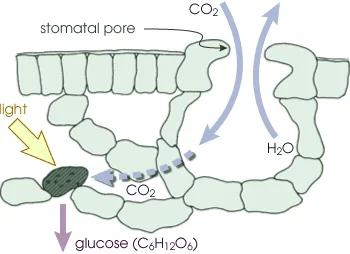 Copyright National Aeronautical and Space Administration, Earth Observatory http://earthobservatory.nasa.gov/Library/CarbonCycle/Images/photosynthesis.gif
The relationship of the food cycle is such that algae takes in sunlight to further its own growth and then becomes food for the brine fly and shrimp, for example, along with other water natives. In turn, the algae are dependent on the decomposable matter waste from the brine flies for their own nutrients.
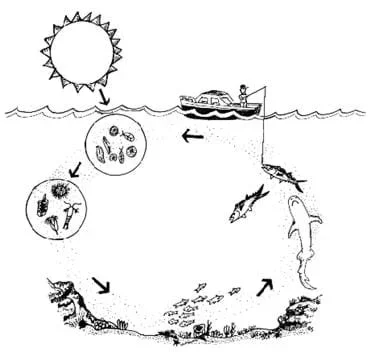 Figure 3. The nutrient cycle.Copyright National Oceanic and Atmospheric Administration, Gray's Reef National Marine Sanctuary http://graysreef.noaa.gov/
Imagine if you could simply stand in the sun, breath air, drink water and be able to produce all of your own food, never having to cook or go out to eat, never having to shop, and never having to decide what you will eat next. Technically, you would have to be green or, rather, your skin would have to contain chlorophyll—the substance that creates the green color in plants and some algae and protistans. We just described a process that uses chlorophyll; does anyone know the name of that process? (Answer: photosynthesis)
During the process of photosynthesis, a plant will make its own food, called glucose. How does it do this? Well, inside the plant cells, a chemical reaction takes place that uses sunlight to turn water and carbon dioxide into glucose and oxygen. The plant simply releases the oxygen, much in the same way that you and I breathe out carbon dioxide. The oxygen can then be breathed in by other organisms, like us! Plants and humans depend on each other by breathing in what others breathe out—precisely how most of the natural world works: the waste of one organism is the food of another.
It would be great if all of the products that engineers designed could produce such environmentally friendly and useful byproducts. In fact, engineers work to design highly efficient products with (and from!) reusable waste. For example, mechanical and chemical engineers who are working on developing hydrogen fuel cell cars have designed the new technology to give off water as its only byproduct. In addition, they are working to discover new means of fueling things, such as automobiles, and for heating and cooling systems for homes and buildings. Some engineers have employed the concept of biomimicry, whereby they attempt to model our designed energy systems after those that are naturally occurring, such as photosynthesis. What does it take to mimic nature to design something like biofuels? Following the lesson, students can help inform a design for a biofuel refinery by performing an experiment in the associated activity Corn for Fuel?! that studies the effect that a variable of their choice has on plant growth.
Photosynthesis is a great example of a highly efficient biological process that is good for the environment. Engineers can use a solid understanding of such biological processes to design more efficient and less environmentally damaging ways of meeting our needs.
- photosynthesis
- The process by which cells containing chlorophyll, such as green plants and algae, convert incident light to chemical energy; they create organic compounds from inorganic compounds, namely carbohydrates from carbon dioxide and water, accompanied by the simultaneous release of oxygen.
- transpiration
- The process by which plants give off water vapor into the atmosphere.
- adenosine triphosphate
- A high-energy phosphate molecule required to provide energy for cellular function. Abbreviated as ATP.
- cellular respiration
- The process in which the chemical bonds of energy-rich molecules such as glucose are converted into energy usable for life processes.
- byproduct
- A secondary product of a given process.
Pre-Lesson Assessment
Discussion Question: Solicit, integrate and summarize student responses.
Have you ever wondered how a plant eats? How do you think it gets its food? Tell the students that in this lesson, we will learn about the chemical process that allows plants to make their own food.
Post-Introduction Assessment
Question and Answer: Ask students the answers to the following questions:
- What are the byproducts/outputs of photosynthesis? (Answer: oxygen and water)
- What is it about these byproducts that are different from the byproducts of say an automobile? (Answer: The byproducts of photosynthesis are food/nutrients for other organisms, while the byproducts of an automobile are mostly toxic to the environment.)
- What are the inputs for photosynthesis? (Answer: carbon dioxide, water and soil nutrients)
Note: It might be helpful to write down the outputs on the right side of the board/overhead, inputs on the left and then draw a plant in the middle, showing the entire process. The students can also take part in posting parts of the process on the board.
Lesson Summary Assessment
Diagramming: Have students individually diagram the process of photosynthesis indicating inputs and outputs. If time permits, have them include this diagram in a food web, illustrating the sun's input and several levels of consumers that utilize the plant, not only as a producer of oxygen, but also as a direct food source; for example rabbits or mice and then foxes, etc.
"Ecology of Gray's Reef." Last updated March 11, 2009. Gray's Reef National Marine Sanctuary, National Oceanic and Atmospheric Administration. Accessed March 30, 2009. graysreef.noaa.gov
"BIOMASS---Renewable Energy from Plants and Animals." Last updated November 2007. Energy Kids Page, Energy Facts, Energy Information Administration, U.S. Department of Energy. Accessed March 5, 2009. www.eia.gov/kids/index.cfm
Contributors
Christopher Valenti; Janet Yowell; Karen King
Supporting Program
Integrated Teaching and Learning Program, College of Engineering, University of Colorado Boulder
Acknowledgements
The contents of this digital library curriculum were developed under grants from the Fund for the Improvement of Postsecondary Education (FIPSE), U.S. Department of Education and National Science Foundation (GK-12 grant no. 0338326). However, these contents do not necessarily represent the policies of the Department of Education or National Science Foundation, and you should not assume endorsement by the federal government.
Copyright
2009 by Regents of the University of Colorado