
Blow-and-Go Parachute
Students make a skydiver and parachute contraption to demonstrate how drag caused by air resistance slows the descent of skydivers as they travel back to Earth. Gravity pulls the skydiver toward the Earth, while the air trapped by the parachute provides an upward resisting force (drag) on the skydiver.
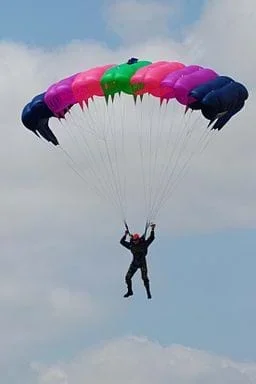 Drag slows down a skydiver's descent.Copyright Wikimedia Commons http://commons.wikimedia.org/wiki/File:Skydiver_-_AirExpo_Muret_2007_0240_2007-05-12.jpg
To design safe recreation and transportation vehicles, engineers take into account all forces acting on the object. Sometimes they use the drag force to slow down or control a moving object, for example, in designing a parachute, vehicle brakes or paper moving through a copy machine. Engineers modify their designs to make the forces of thrust, lift, weight and drag smaller or larger, which changes how the object behaves when moving through air or water.
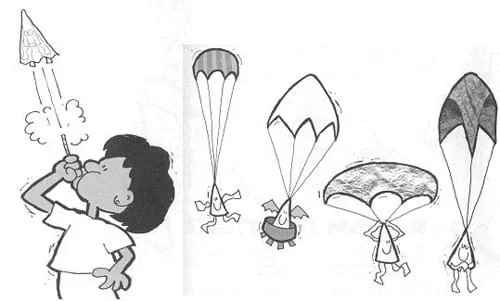 Launching the parachutes; how they fall.Copyright Hauser, Jill Frankel. Gizmos and Gadgets: Creating Science Contraptions that Work (and Knowing Why). Charlotte, VT: Williamson Publishing, 1999.After this activity, students should be able to:
- Describe which forces act on the skydiver as they are going up in the air and coming back down to the ground.
- Experimentally identify which geometric shapes most successfully reduce drag.
- Collect data from the experiment and interpret results.
- Characterize an engineer's need to identify the interactions between forces.
- Predict and evaluate the movement of an object by examining the forces applied to it
Grade 8
Do you agree with this alignment?
- STEL-3G Explain how knowledge gained from other content areas affects the development of technological products and systems.
Grades 6-8
Do you agree with this alignment?
- MS-PS2-2 Plan an investigation to provide evidence that the change in an object's motion depends on the sum of the forces on the object and the mass of the object.
Grades 6-8
This resource focuses on the following Three Dimensional Learning aspects of NGSS:
Science & Engineering Practices- Plan an investigation individually and collaboratively, and in the design: identify independent and dependent variables and controls, what tools are needed to do the gathering, how measurements will be recorded, and how many data are needed to support a claim.Do you agree with this alignment?
- Science knowledge is based upon logical and conceptual connections between evidence and explanations.Do you agree with this alignment?
Disciplinary Core Ideas- The motion of an object is determined by the sum of the forces acting on it; if the total force on the object is not zero, its motion will change. The greater the mass of the object, the greater the force needed to achieve the same change in motion. For any given object, a larger force causes a larger change in motion.Do you agree with this alignment?
- All positions of objects and the directions of forces and motions must be described in an arbitrarily chosen reference frame and arbitrarily chosen units of size. In order to share information with other people, these choices must also be shared.Do you agree with this alignment?
Crosscutting Concepts- Explanations of stability and change in natural or designed systems can be constructed by examining the changes over time and forces at different scales.Do you agree with this alignment?
Do you agree with this alignment? - Plan an investigation individually and collaboratively, and in the design: identify independent and dependent variables and controls, what tools are needed to do the gathering, how measurements will be recorded, and how many data are needed to support a claim.
Each group needs:
- paper
- 4 paper strips (for decoration) (size: approx. ¾ in. x 3 in.)
- plastic drinking straws, both jumbo- and regular-sized
- plastic grocery bag
- 32 inches of thread
Forces are invisible interactions that push and pull on things all the time. Even when you're sitting still in a chair, there are forces pushing and pulling on you. For example, the force of gravity pulls you down into the chair, and the force of air pressure helps you breathe. This activity is an investigation of forces — how forces interact, and what we can do to make forces larger and smaller. We'll use air blown through a straw to create forces called thrust and lift. Thrust and lift push our parachute up into the air, but at the same time, a force called weight is pulling the parachute down. Eventually, the parachute stops going up, and starts falling downward. Then the parachute opens up, and a force called drag slows the fall. While you're making your parachute, think about ways we can make the forces of thrust, lift, weight and drag smaller or larger. How will the interactions of these forces change the flight of the parachute?
Before the Activity
- Have the students bring plastic grocery bags from home.
- Pre-cut strips of paper for the students to use as paper arms and legs.
- Copy a Flying Forces Worksheet (PDF) for each student.
With the Students
- Ask the students: Has anyone ever seen a skydiver? How does skydiving work? Today we are going to learn more about this.
- Roll a quarter sheet of paper into a tight cone 4 inches long and 1½ inches across at its opening. Tape the cone together. Snip the bottom edge even.
- Decorate the cone with markers to look like a skydiver.
- Tape on folded paper-strip arms and legs.
- Seal off one end of a 2½ inch section of a jumbo-sized straw with tape. Tape the section to the inside of the cone with the open end facing outward.
- Cut an 8-inch square from the plastic bag to make the canopy.
- Cut four 8-inch lengths of thread, and tie or tape one to each corner of the square.
- Tie the other ends of the threads together and tape onto the top of the cone.
- Insert the narrow straw into the straw section already taped inside the cone. Set the point of the cone at the center of the canopy, so that the canopy drapes gently around the cone. Point the straw to the sky and blow sharply through it.
- Allow time for students to complete the activity worksheet.
- When they finish, have them check their answers with a peer, giving time for everyone to finish.
- Review the worksheets.
Pre-Activity Assessment
Discussion Question: Solicit, integrate and summarize student responses.
- Has anyone ever seen a skydiver? How does skydiving work? (Answer: When a parachute opens up, it slows the diver down. This is an illustration of drag force.)
Activity Embedded Assessment
Worksheet: Have the students complete the activity worksheet; review their answers to gauge their mastery of the subject.
Pairs Check: After students finish working individually on worksheets, have them compare answers with a peer, giving all students time to finish the worksheet.
Post-Activity Assessment
Worksheet Discussion: Review and discuss the worksheet answers with the entire class. Use the answers to gauge students' mastery of the subject.
Students need to be careful handling scissors.
Remember that the plastic bags can be a choking hazard.
Check the plastic bags to make sure they do not have large holes in them.
Be sure to wrap the parachutes around the cones well so they don't come unraveled on the ascent.
Have the students make different-shaped skydivers and ask them how it affects the flight. (The less aerodynamically shaped the skydiver, the more drag is exerted on the skydiver in flight, decreasing the duration and height of flight).
Hauser, Jill Frankel. Gizmos and Gadgets: Creating Science Contraptions that Work (and Knowing Why). Charlotte, VT: Williamson Publishing, 1999.
Contributors
Sabre Duren; Ben Heavner; Malinda Schaefer Zarske; Denise Carlson
Supporting Program
Integrated Teaching and Learning Program, College of Engineering, University of Colorado Boulder
Acknowledgements
The contents of this digital library curriculum were developed under a grant from the Fund for the Improvement of Postsecondary Education (FIPSE), U.S. Department of Education, and National Science Foundation GK-12 grant no 0338326. However, these contents do not necessarily represent the policies of the Department of Education or National Science Foundation, and you should not assume endorsement by the federal government.
Copyright
2004 by Regents of the University of Colorado.