
How Do Things Fall?
Students learn that it is incorrect to believe that heavier objects fall faster than lighter objects. By close observation of falling objects, they see that it is the amount of air resistance, not the weight of an object, which determines how quickly an object falls.
 How do things fall?Copyright http://upload.wikimedia.org/wikipedia/commons/d/da/Paratroopers_of_the_U.S._Army's_4th_Brigade_Combat_Team_(Airborne)_25th_Infantry_Division_parachute_over_the_Malemute_Drop_Zone_at_Joint_Base_Elmendorf-Richardson,_Alaska,_on_April_17,_2013_130417-F-LX370-462.jpg
Any difference in speed between two objects dropped at the same time is solely due to the resistance provided by air molecules hitting the objects as they fall. This drag factor is exploited by engineers as they design the aerodynamic shapes of race cars, bicycles, motorcycles, helmets, parachutes, boat paddles, scuba diving fins, darts, bullets, storm sensors and measurement devices, and medical devices, to name a few.
After this activity, students should be able to:
- Make predictions about weights and gravity.
- Understand that objects of differing weights fall with the same speed.
- Determining the velocity of an object based on time and height (V=D/T)
- Describe air resistance as counteracting the force of gravity.
- Understand how engineers use the drag factor as they design the aerodynamic shapes of race cars, helmets, parachutes and many other objects.
- Predict and evaluate the movement of an object by examining the forces applied to it
Grade 8
Do you agree with this alignment?
- CCSS.Math.Content.6.NS.B.4 Find the greatest common factor of two whole numbers less than or equal to 100 and the least common multiple of two whole numbers less than or equal to 12. Use the distributive property to express a sum of two whole numbers 1—100 with a common factor as a multiple of a sum of two whole numbers with no common factor.
Grade 6
Do you agree with this alignment? - CCSS.Math.Content.6.SP.B.5 Summarize numerical data sets in relation to their context, such as by:
Grade 6
Do you agree with this alignment? - CCSS.Math.Content.6.SP.B.5a Reporting the number of observations.
Grade 6
Do you agree with this alignment?
- Some technological problems are best solved through experimentation.
Grades 6-8
Do you agree with this alignment?
For the teacher demonstration:
- One Styrofoam or plastic cup
- Stopwatch
- Yard or Meter Stick
- Water
- 5-gallon bucket
- Drop cloth or tarp (or conduct demo outside)
Each group needs a variety of object pairs, such as:
- Balls of different sizes and weights
- A book and a sheet of cardboard of the same length and width as the book
- Objects that encounter more air resistance when dropped than the other objects (i.e., a feather or a sheet of paper)
- Other options for objects to drop: coins, plastic bag, play plastic army men, or other objects that are exactly the same.
This activity is a way to examine the effect of air resistance on a falling body. Until the 16th century, most people believed that heavier objects fell faster than lighter objects. In 1553, Benedetti Giambattista published the results of an experiment demonstrating that this Aristotlean belief was wrong — in fact, objects of different weights fall at the same speed. Later, in 1586, Simon Stevin, a Flemish engineer, also published results showing that objects of different weights fall at virtually the same rate. It is not clear whether Galileo, who was born in 1564, actually performed the famous experiment of dropping a cannonball and a wooden ball from the leaning tower of Pisa. However, Galileo had already observed that objects of differing weights are accelerated uniformly in Earth's gravitational field and thus fall at virtually the same speed. He also understood that any difference in speed between two objects that were dropped at the same time is solely due to the resistance provided by air molecules hitting on the objects as they fell. This resistance, called air resistance or drag, is very important in slowing the descent of a skydiver or parachutist.
Before the Activity
- A few weeks before doing the lesson, start gathering materials for the student activity.
- Gather materials for the demonstration.
- Puncture a small hole in the side of the cup near the bottom.
- Collect the objects for the student activity. Place the object pairs together on a table.
With the Students - Teacher Demonstration
- Place a drop cloth or tarp on the floor. Set the empty bucket in the middle of the cloth. Place a chair behind the bucket.
- Show students the cup. Then place your thumb over the hole and have a student fill the cup up to the line below the rim.
- Ask the students to predict what will happen if you pull your thumb away from the hole.
- Hold the cup over the bucket. Now briefly remove your thumb from the hole, allowing a small amount of water to stream into the bucket. Be careful to quickly place your thumb back over the hole. (Water streams out through the hole because gravity pulls down on the water, generating a pressure that forces the water out of the hole.)
- Have a student refill the cup to the line below the rim.
- Ask the students to predict what will happen if you drop the entire cup and contents.
- Hold the cup high over the bucket and let go.
- The water in the cup will not exit the hole as the cup falls towards the ground, because the water and cup are both in a free fall situation (i.e., weightless). With no weight, there is no pressure forcing water out of the hole.
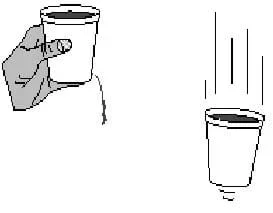 In the Earth's gravitational field, the liquid and the cup fall at the same speed.Copyright http://quest.arc.nasa.gov/space/teachers/liftoff/images/9.07a.gif.
With the Students - Student Activity
- Divide the class into teams of four. Distribute the activity worksheet. Have one student from each team collect a pair of objects from the table.
- Ask students to write down their prediction of which object will hit the ground first if both are dropped simultaneously from the same height. Have them write a brief explanation for their choice, using the activity worksheet to record their answers.
- Have students experiment with the object pair by dropping both items simultaneously. The student dropping the objects should stand on a chair or desk and hold them side-by-side before dropping them. Other students in the group should observe the objects as they fall. Does one object reach the floor first, or do they hit the floor at the same time? Have students record their results on their worksheet. Have students take turns dropping the objects before getting a new object pair.
- Record the time it took for the object to fall and the height at which it was dropped.
- Take the average time for each object dropped from the same height.
- Calculate the velocity of each object (Velocity=Distance/Time).
- Repeat steps 2 and 3 until each team has tested five object pairs.
- Have teams discuss their results. After everyone has finished, make a table on the board with the object pairs and a column for the results. Ask students for their results for which object in the pair hit the ground first. Ask the questions provided in the Assessment section.
- As a class, determine which objects fell the slowest and which ones fell the fastest.
- Conduct the Numbered Heads assessment from the Assessment section.
Pre-Activity Assessment
Predictions: Ask students to write on the worksheet their prediction for which object will hit the ground first if they are dropped simultaneously from the same height.
Activity Embedded Assessment
Worksheet: While one student is dropping objects, other students in the group should observe the objects as they fall. Does one object reach the floor first, or do they hit the floor at the same time? Have students record their results on their activity worksheet.
Post-Activity Assessment
Numbered Heads: Have the students on each team pick numbers (or number off) so each member has a different number. Ask the students a question (give them a time frame for solving it, if desired). The members of each team should work together on the question. Everyone on the team must know the answer. Call a number at random. Students with that number should raise their hands to answer the question. If not all the students with that number raise their hands, allow the teams to work a little longer. Ask the students:
- If you drop a heavy object and a light object of the same shape and size from the same height at the same time, which will hit the ground first? (Answer: Neither. They hit the ground at the same time.)
- If you drop a large ball and a small ball from the same height at the same time, which will hit the ground first? (Answer: The small ball, because it has less air resistance.)
- What would happen if you repeated this activity in a vacuum (an environment with no air)? (Answer: All the objects would hit the ground at the same time, regardless of their shape or size.)
- How can you make a sheet of paper fall faster? (Answer: Crumple it into a ball to reduce its air resistance.)
Students need to be cautious when standing on chairs or desks.
Students need to be mindful to drop both objects simultaneously. Sometimes it is difficult to drop objects of very different weights at the same time due to arm and hand fatigue.
Most importantly, to drop both objects from the same height, students need to hold the objects so the bottoms of the objects are at the same height. If they hold objects so their centers are at the same height, the larger object will touch the ground first. Understanding this difference is crucial to performing the activity correctly.
One way to increase the accuracy of measuring which item hits the floor first is to drop objects onto a cookie sheet. While it may be hard to measure very short times with a stop watch when relying on your eyes to determine which hits first, it is not hard to tell if things hit a cookie sheet at the same time or at slightly different times, because you can hear it. Other activity variations (i.e., dropping items onto clay to see which hits harder) can be found at: http://swift.sonoma.edu/program/witn_show/04-27-01.html.
Have students research Galileo's life and work. When, where and how did he live? What contributions did he make to understanding the physical world? Who influenced his thinking and whom did he influence?
Students can run a computer simulation of the leaning tower of Pisa experiment at: http://www.materialworlds.com/sims/Galileo/netscape.html.
Students can time how long it takes for each object to fall to the ground and compare with other groups. Do they all get the same time? Why or why not? (Possible answers: Experimental error, not identical objects, etc.)
Rent the HBO movie, "From the Earth to the Moon, Part 9," and show the students the clip about dropping the feather and the hammer at the same time on the moon.
- For younger students, pick in advance the pairs of objects for the students to drop.
Activity adapted from:http://www.thirteen.org/edonline/ntti/resources/lessons/gravity/
Activity adapted from: http://school.discoveryeducation.com/lessonplans/programs/invisibleforce/index.html
Contributors
Xochitl Zamora-Thompson; Ben Heavner; Malinda Schaefer Zarske; Denise Carlson
Supporting Program
Integrated Teaching and Learning Program, College of Engineering, University of Colorado Boulder
Acknowledgements
The contents of this digital library curriculum were developed under a grant from the Fund for the Improvement of Postsecondary Education (FIPSE), U.S. Department of Education, and National Science Foundation GK-12 grant no 0338326. However, these contents do not necessarily represent the policies of the Department of Education or National Science Foundation, and you should not assume endorsement by the federal government.
Copyright
2004 by Regents of the University of Colorado.