
What Makes Airplanes Fly?
Students begin to explore the idea of a force. To further their understanding of drag, gravity and weight, they conduct activities that model the behavior of parachutes and helicopters. An associated literacy activity engages the class to recreate the Wright brothers' first flight in the style of the "You Are There" television series.
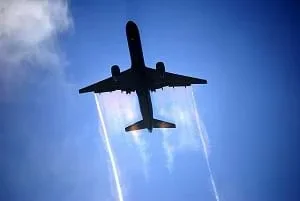 What makes airplanes fly?Copyright Flickr https://www.flickr.com/photos/wbaiv/6244691362/
Engineers of all disciplines use their knowledge of forces to design machines, structures and appliances. Aeronautical engineers build on their understanding of lift, weight, thrust and drag to design jets, helicopters, wind turbines, wind surfers and spacecraft — vehicles that move in air or space. Other engineers apply the same concepts to objects that travel on land and in water. Engineers design the shape of vehicles to be more aerodynamic to reduce drag force and thus reduce fuel consumption.
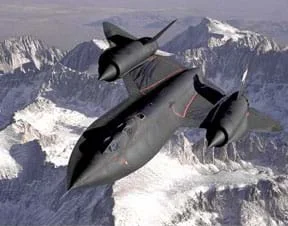 The SR-71 Blackbird was a high-altitude reconnaissance aircraft developed in the 1960s.Copyright http://www.dfrc.nasa.gov/Gallery/Photo/SR-71/HTML/EC94-42883-4.html
After this lesson, students should be able to:
- Understand the concept of forces.
- Identify what forces would make an airplane fly higher or land, and what would make an airplane speed up or slow down while moving through the air
- Recognize that engineers of all disciplines use their knowledge of forces to design machines, structures and appliances
- Predict and evaluate the movement of an object by examining the forces applied to it
Grade 8
Do you agree with this alignment?
- STEL-3G Explain how knowledge gained from other content areas affects the development of technological products and systems.
Grades 6-8
Do you agree with this alignment?
- MS-PS2-2 Plan an investigation to provide evidence that the change in an object's motion depends on the sum of the forces on the object and the mass of the object.
Grades 6-8
This resource focuses on the following Three Dimensional Learning aspects of NGSS:
Science & Engineering Practices- Plan an investigation individually and collaboratively, and in the design: identify independent and dependent variables and controls, what tools are needed to do the gathering, how measurements will be recorded, and how many data are needed to support a claim.Do you agree with this alignment?
- Science knowledge is based upon logical and conceptual connections between evidence and explanations.Do you agree with this alignment?
Disciplinary Core Ideas- The motion of an object is determined by the sum of the forces acting on it; if the total force on the object is not zero, its motion will change. The greater the mass of the object, the greater the force needed to achieve the same change in motion. For any given object, a larger force causes a larger change in motion.Do you agree with this alignment?
- All positions of objects and the directions of forces and motions must be described in an arbitrarily chosen reference frame and arbitrarily chosen units of size. In order to share information with other people, these choices must also be shared.Do you agree with this alignment?
Crosscutting Concepts- Explanations of stability and change in natural or designed systems can be constructed by examining the changes over time and forces at different scales.Do you agree with this alignment?
Do you agree with this alignment? - Plan an investigation individually and collaboratively, and in the design: identify independent and dependent variables and controls, what tools are needed to do the gathering, how measurements will be recorded, and how many data are needed to support a claim.
Aerodynamics, the study of flight, is founded on four basic forces — lift, weight, thrust and drag. The interaction of these forces explains the movement of objects as they soar through the sky. What seems like magic — a several ton object flying, like an airplane flying through the sky! — is actually based on the laws of physics and these four forces.
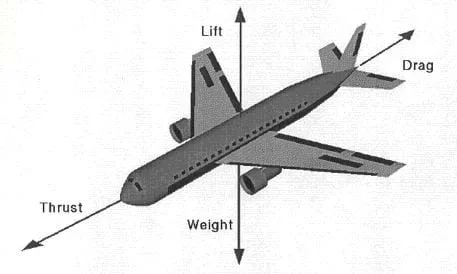 Diagram of an airliner showing vectors for lift, thrust, drag and weight.Copyright http://lerc.nasa.gov/www/k-12/airplane/forces.html
The first force, lift, pushes up on things that fly — airplanes, birds, helicopters and rockets. The shape of the wings on an airplane and the whirling blades of a helicopter create lift as they move through the air.
The second force is weight — the force of two masses being attracted to each other. Weight is the force that pulls us towards the center of the earth, and why things fall down.
The third force is thrust. Thrust is created by the jet engines or propellers of an airplane. Birds create thrust (and lift!) with their wings. Thrust pushes things that are flying.
The fourth force is drag. Drag pushes against things moving through the air. It is caused by air particles bumping into the object. An object that is going faster bumps into more air particles, and so experiences more drag. Similarly, an object with a large surface area bumps into more particles, and experiences more drag.
When the forces are not balanced, flying objects speed up, slow down or change direction. This is called acceleration. For example, when the thrust force is bigger than the drag force, an airplane speeds up. When the lift force is bigger than the weight force, the airplane goes up faster.
When forces are balanced, objects do not accelerate. An airplane that is flying in a straight line at a certain speed has balanced forces. An airplane can even be going up or down and have balanced forces. As long as the airplane is not turning, speeding up or slowing down (in any direction, even up and down!) the forces are balanced.
Sometimes, two of the forces may be the same thing. For example, a rocket engine pushes a rocket straight up, providing both lift and thrust. A parachute could be caught in an updraft, and then the drag force could also provide lift. Not all four forces need to be present, either — if there is no wind, a hot air balloon would not have any thrust acting upon it, only lift, drag and weight. This may seem confusing, but that's okay. The important thing to remember is that the interaction of forces (whatever they're called) is responsible for everything that speeds up, slows down, stays still or moves at a constant speed.
Have you ever wondered what makes things move? What makes a huge, heavy airplane fly in the air? Why do swings work when you pump your legs? Why do parachutes slow things down when they're falling? Why do trees sway in the wind? Why does wind happen, even?
The answer to all these questions is: forces. Engineers use physics to study forces, and then apply what they learn about forces to solve problems. Forces can make things speed up, and balanced forces can make things stay still or move at a constant speed.
In this lesson, we will learn about forces by examining airplanes and parachutes. We will learn that more than one force acts on things that fly, and we will see what we can do to change forces. In other words, we'll learn why airplanes can fly! Refer to the associated activities Heavy Helicopters and Blow-and-Go Parachute to help illustrate how these forces affect air craft flight!
After a winter of experimenting with an air tunnel (an enclosed space with a stationery object surrounded by moving air) to learn more about the forces of flight, Wilbur and Orville Wright flew the first airplane that could be controlled in the air in 1903. Today, more than 4,000 public airports in the U.S. provide convenient travel and exploration around the world. People ride in hot-air balloons and jump out of airplanes with parachutes for fun, trusting that a balance of forces will keep them from hitting the ground too hard. An understanding of forces allows aeronautical engineers to design all the different kinds of airplanes, hot-air balloons, and parachutes that have ever flown! Following the lesson refer to the associated activity You Are There... First Flight for students to learn the value of historical documents and eyewitness accounts, and recreate the Wright Brothers' first flight in the style of the "You Are There" television show.
Draw a diagram of an airplane on the board. Have the students identify where the four forces are located that make it possible for the airplane to fly. What force must be larger for the airplane to speed up? (Answer: Thrust) What force must be larger as the airplane takes off? (Answer: Lift) What force must be larger for the airplane to slow down? (Answer: Drag) What force must be larger for the airplane to begin descending? (Answer: Weight) Ask the students why it is important for engineers to understand these forces. How might engineers make airplanes better? (Example answer: Decrease drag by improving the shape of the plane.)
- force
- Something that acts from the outside to push or pull an object. For example, an adult pulling a child in a wagon exerts a force upon the wagon.
- weight
- The force of a mass being attracted to another mass. For example, the Earth's mass pulls you down a certain amount (sometimes called "the force of gravity"). When you stand on a scale, this force is measured as your weight.
- lift
- The force that pushes an airplane up into the air. Lift is caused by the shape of an airplane's wings.
- thrust
- The force that pushes an airplane forward. Thrust can be produced on airplanes by propellers or jet engines.
- drag
- The force that slows an airplane or parachute down. Drag is caused by air particles hitting against a moving object.
- acceleration
- A change in direction, or speeding up or slowing down. When you push the gas pedal on a car to start after a stop sign, the car accelerates.
- aeronautical engineer
- A person who studies the forces involved in flight. An aeronautical engineer might be responsible for designing new airplanes, spaceships or parachutes. An aeronautical engineer might also work with a biologist to learn about how birds or insects fly.
Pre-Lesson Assessment
Discussion Question: Solicit, integrate and summarize student responses.
- Have you ever wondered what makes an airplane fly in the air, instead of falling out of the sky? Tell the students that in this lesson, we will learn about the forces that make flight possible. Forces can make things speed up, and balanced forces can make things stay still or move at a constant speed.
Post-Introduction Assessment
Voting: Ask a true/false question and have students vote by holding thumbs up for true and thumbs down for false. Count the votes and write the totals on the board. Give the right answer.
- True or False: Forces only act on things that are moving. (Answer: False. Forces act on things sitting still as well, just like students sitting at their desks.)
- True or False: Wilbur and Orville Wright flew the first airplane that could be controlled in the air in 1903. (Answer: True)
- True or False: Chemical engineers design all the different kinds of airplanes, hot-air balloons and parachutes. (Answer: False. Aeronautical engineers do this type of work.)
- True or False: Forces can make things speed up and slow down. (Answer: True)
Lesson Summary Assessment
Drawing: Have the students draw a picture of a scene, maybe the classroom, the playground or their house. Then, ask them to draw arrows for all the forces at work in their picture and try to name as many of those forces as they can.
Bingo: Provide each student with a sheet of paper containing a list of the lesson vocabulary terms. Have each student walk around the room and find a student who can define one vocabulary term. Students must find a different student for each term. When a student has all terms completed they shout "Bingo!" Continue until two or three students have bingo. Ask the students who shouted "Bingo!" to give definitions of the vocabulary terms.
Ask the students to write a short story describing a situation that involves "balanced" forces (constant motion) versus "unbalanced" forces (when things accelerate).
How are the forces acting on an airplane flying similar to the forces acting on a boat moving through water? (Answer: Lift = buoyancy, thrust = thrust, weight = weight, drag = drag.) How are they different? (Answer: Caused by different things: sails instead of propellers for thrust, water instead of air for drag, etc.)
Have the students investigate the history of flight. What stories involve people wanting to fly (Greek myths)? Who were the first people to fly (successes and failures)? When did the first successful airborne experience occur? When was the first jet made? The first helicopter? The first rocket? When did humans first make a successful journey into space? Encourage the students to follow their own individual curiosity with respect to flight. Once the reports are written, have each student make a brief class presentation on what they learned.
Benson, Tom. Beginner's Guide to Aeronautics. June 4, 2002. Glenn Research Center, NASA. October 16, 2003.
Hauser, Jill Frankel. Gizmos and Gadgets: Creating Science Contraptions that Work (and Knowing Why). Charlotte, Vermont: Williamson Publishing, 1999.
Wolfson, Richard and Jay M. Pasachoff. Physics: For Scientists and Engineers. Reading, Massachusetts: Addison-Wesley Longman, Inc., 1999.
Browse the NGSS Engineering-aligned Physics Curriculum hub for additional Physics and Physical Science curriculum featuring Engineering.
Contributors
Sabre Duren; Ben Heavner; Malinda Schaefer Zarske; Denise Carlson
Supporting Program
Integrated Teaching and Learning Program, College of Engineering, University of Colorado Boulder
Acknowledgements
The contents of this digital library curriculum were developed under a grant from the Fund for the Improvement of Postsecondary Education (FIPSE), U.S. Department of Education and National Science Foundation GK-12 grant no. 0338326. However, these contents do not necessarily represent the policies of the Department of Education or National Science Foundation, and you should not assume endorsement by the federal government.
Copyright
2004 by Regents of the University of Colorado.