
Solar Sails: The Future of Space Travel
Working as if they were engineers, students design and construct model solar sails made of aluminum foil to move cardboard tube satellites through “space” on a string. Working in teams, they follow the engineering design thinking steps—ask, research, imagine, plan, create, test, improve—to design and test small-scale solar sails for satellites and space probes. During the process, learn about Newton’s laws of motion and the transfer of energy from wave energy to mechanical energy. A student activity worksheet is provided.
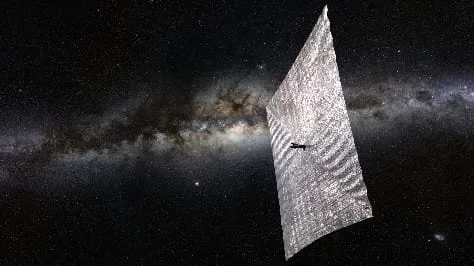 Figure 1. A solar sail.Copyright Josh Spradling, The Planetary Society, Creative Commons Attribution-Non Commercial 3.0 Unported License http://sail.planetary.org/gallery/lightsail.html https://creativecommons.org/licenses/by-nc/3.0/
Aerospace and mechanical engineers design spacecraft, satellites and rockets to travel into space. While rockets are the most common method of space propulsion, their weight and fuel capacity make them inefficient for long-range space travel. Thus, to enable exploration into far and unknown regions of space, engineers are challenged to create new propulsion methods that can more effectively move satellites and space probes over long distances. One emerging technology—the solar sail—transfers wave energy from light into mechanical energy to enable prolonged propulsion at high speeds for small satellites. In this activity, students experience the stages of the engineering design process as they design and test model solar sails to support deep space exploration goals.
After this activity, students should be able to:
- Explain the purpose and use of solar sails for satellite propulsion.
- Explain that solar sails transfer wave energy from light into mechanical energy for satellite motion.
- Discuss important considerations for solar sail design.
- Explain Newton’s three laws of motion.
- Use and describe the steps of the engineering design process.
- Predict and evaluate the movement of an object by examining the forces applied to it
Grade 8
Do you agree with this alignment? - Describe methods and equipment used to explore the solar system and beyond
Grade 8
Do you agree with this alignment?
- Students will develop an understanding of the attributes of design.
Grades K-12
Do you agree with this alignment? - Students will develop an understanding of engineering design.
Grades K-12
Do you agree with this alignment? - Students will develop abilities to apply the design process.
Grades K-12
Do you agree with this alignment? - Design involves a set of steps, which can be performed in different sequences and repeated as needed.
Grades 6-8
Do you agree with this alignment? - STEL-1J Develop innovative products and systems that solve problems and extend capabilities based on individual or collective needs and wants.
Grades 6-8
Do you agree with this alignment? - STEL-1L Explain how technology and engineering are closely linked to creativity, which can result in both intended and unintended innovations.
Grades 6-8
Do you agree with this alignment? - STEL-5F Analyze how an invention or innovation was influenced by its historical context.
Grades 6-8
Do you agree with this alignment? - STEL-7J Evaluate designs based on criteria, constraints, and standards.
Grades 3-5
Do you agree with this alignment? - STEL-7Q Apply the technology and engineering design process.
Grades 6-8
Do you agree with this alignment?
- MS-ETS1-4 Develop a model to generate data for iterative testing and modification of a proposed object, tool, or process such that an optimal design can be achieved.
Grades 6-8
This resource focuses on the following Three Dimensional Learning aspects of NGSS:
Science & Engineering Practices- Develop a model to generate data to test ideas about designed systems, including those representing inputs and outputs.Do you agree with this alignment?
Disciplinary Core Ideas- Models of all kinds are important for testing solutions.Do you agree with this alignment?
- The iterative process of testing the most promising solutions and modifying what is proposed on the basis of the test results leads to greater refinement and ultimately to an optimal solution.Do you agree with this alignment?
Do you agree with this alignment? - Develop a model to generate data to test ideas about designed systems, including those representing inputs and outputs.
- MS-PS2-1 Apply Newton's Third Law to design a solution to a problem involving the motion of two colliding objects.
Grades 6-8
This resource focuses on the following Three Dimensional Learning aspects of NGSS:
Science & Engineering Practices- Apply scientific ideas or principles to design an object, tool, process or system.Do you agree with this alignment?
Disciplinary Core Ideas- For any pair of interacting objects, the force exerted by the first object on the second object is equal in strength to the force that the second object exerts on the first, but in the opposite direction (Newton's third law).Do you agree with this alignment?
Crosscutting Concepts- Models can be used to represent systems and their interactions—such as inputs, processes and outputs—and energy and matter flows within systems.Do you agree with this alignment?
- The uses of technologies and any limitations on their use are driven by individual or societal needs, desires, and values; by the findings of scientific research; and by differences in such factors as climate, natural resources, and economic conditions.Do you agree with this alignment?
Do you agree with this alignment? - Apply scientific ideas or principles to design an object, tool, process or system.
- MS-PS2-2 Plan an investigation to provide evidence that the change in an object's motion depends on the sum of the forces on the object and the mass of the object.
Grades 6-8
This resource focuses on the following Three Dimensional Learning aspects of NGSS:
Science & Engineering Practices- Plan an investigation individually and collaboratively, and in the design: identify independent and dependent variables and controls, what tools are needed to do the gathering, how measurements will be recorded, and how many data are needed to support a claim.Do you agree with this alignment?
- Science knowledge is based upon logical and conceptual connections between evidence and explanations.Do you agree with this alignment?
Disciplinary Core Ideas- The motion of an object is determined by the sum of the forces acting on it; if the total force on the object is not zero, its motion will change. The greater the mass of the object, the greater the force needed to achieve the same change in motion. For any given object, a larger force causes a larger change in motion.Do you agree with this alignment?
- All positions of objects and the directions of forces and motions must be described in an arbitrarily chosen reference frame and arbitrarily chosen units of size. In order to share information with other people, these choices must also be shared.Do you agree with this alignment?
Crosscutting Concepts- Explanations of stability and change in natural or designed systems can be constructed by examining the changes over time and forces at different scales.Do you agree with this alignment?
Do you agree with this alignment? - Plan an investigation individually and collaboratively, and in the design: identify independent and dependent variables and controls, what tools are needed to do the gathering, how measurements will be recorded, and how many data are needed to support a claim.
Each group needs:
- 1 piece of writing paper and 1 pencil, for each student
- cardboard tube, 1-2 inches (2.5-5 cm) long x ~1 inch (~2.5 cm) in diameter; such as from toilet paper or paper towel rolls
- 6-8 standard-sized Popsicle sticks (4.5-inch long x 3/8-inch wide, or 11.43-cm long x .95-cm wide); exact quantity depends on the group’s design
- 12 inches (30 cm) of masking tape
- 1-2 rubber bands; exact quantity depends on the group’s design
- aluminum foil, at least a 12 x 12-inch (30 x 30-cm) square
- 2-4 standard plastic drinking straws; exact quantity depends on the group’s design
- scissors
- Solar Sails Worksheet (PDF), one per student
For a testing station that all groups use:
- 5-10 meters of fishing line, 20-50 g weight
- 2 chairs or desks, or other solid-surface on which to tie the fishing line
- large box fan or other strong fan
- tape measure
- Graphic of Solar Sail Designs (PDF), as an overhead transparency or handout
Space is humankind’s greatest mystery, and scientists and engineers want to learn more about the universe. So, how can we further explore the universe? How do we send things into space to collect data? How do we power and propel satellites and space probes? What are better ways we could travel through space?
To learn about the universe, we send astronauts, space shuttles, satellites and space probes to unknown regions of space to collect and send back information about the unknown. To send satellites and probes far into space, engineers design rockets to provide the thrust needed to escape the Earth’s gravitational pull. Unfortunately, rockets have limitations that restrict how far and how quickly we can send satellites into space.
Rockets are limited by the amount of fuel they can carry. Then, once their fuel runs out, they are unable to provide any more thrust to move the satellite or probe. The speeds that rockets can achieve are often not fast enough for scientists to explore far from Earth because it takes many months or even years for them to reach relatively close destinations. For example, sending a satellite to Mars takes 150-300 days, which is nearly a year. In order to send satellites beyond our solar system and even deeper into space, we need a way to provide prolonged propulsion throughout the entire space journey. (Point out that what was just discussed are examples of the first step in the engineering design process: Ask to define needs and constraints.)
One answer to this engineering problem is the solar sail. Developed by creative aerospace engineers, solar sails are reflective sheets similar to mirrors that open once a satellite has left the Earth’s atmosphere (see Figures 1 and 2). Light, carrying wave energy in the form of photons, reflects off of the solar sail and pushes a satellite through space (Newton’s third law of motion), transferring wave energy into mechanical energy. This provides satellites with extended propulsion through space, and at higher speeds than traditional rocket-powered flight. Solar sails reduce the amount of time it takes for satellites and probes to reach distant destinations because the crafts achieve much higher speeds as they travel. (Point out that this is an example of the third step in the engineering design process: Imagine—coming up with possible solutions that have never existed before, forming ideas, conceiving of plans.)
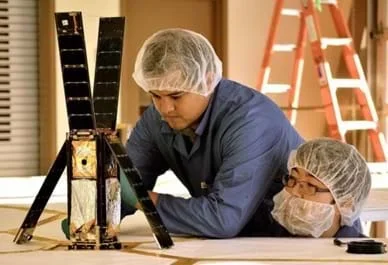 Figure 2. Two engineers work on a cube-satellite that will be launched into space to test the deployment mechanism for a solar sail—the silver folded sheet inside the satellite.Copyright 2015 The Planetary Society http://sail.planetary.org/
It is important to consider many things when designing satellites and solar sails, and we are going to learn about Newton’s laws of motion as we think about them. What do you think engineers need to consider when they design solar sails, and the satellites they send with them?
Newton’s third law of motion states that for every action, there is an equal and opposite reaction. If I punch the wall, I exert a force on the wall, but the wall also exerts an equal and opposite force on my hand—which is why it hurts! This law applies to solar sails, too, and it is how engineers designed them to move. When light (photons) hits the solar sail, a very small force is exerted on the sail and the satellite, but the sail exerts an equal and opposite reaction on the light (photons), reflecting them back. The force of many photons hitting the sail results in a small acceleration that slowly increases the speed of the satellite.
In baseball, why does the ball move so fast after the bat hits it? The bat has more mass (weight) than the ball, so it exerts a large force on the ball, making it travel quickly. But, what if you hit a bowling ball with a bat, would it travel as fast as a baseball? No. The bowling ball has more mass than a baseball, so it takes much more force to cause it to move. This illustrates Newton’s second law of motion: Force is equal to mass multiplied by acceleration (F = ma).
Let’s apply this physical principle to a solar sail. If we have a very heavy satellite and a very light satellite, which would move faster if the same amount of light hit it? The lighter satellite, of course. If the same force acts on an object with a small mass, it experiences a large acceleration (like the baseball). This means that the satellites we design for solar sails must be very light and small so that they travel quickly once the solar sail opens.
Sending satellites and probes into deep space is very expensive, so it is unlikely that any middle school class could do that! Instead, we will build models of solar sails and space probes, which represent the real things, so that we can understand how they work. When we build a model of something new we call it a prototype.
Because of air resistance on Earth, a couple of components in our experiment will be different than how solar sails work in space:
- Our sails cannot be pushed by light alone, so we will use a fan to represent light from the sun or another star.
- Our sails will eventually slow down and stop after they move away from the fan, while if they were in space, they would continue to move faster and faster.
Engineers often design models (that is, creating prototypes, the fifth step in the engineering design process) in order to gain an understanding of how things work so that they can develop better designs before they spend money on full-sized and fully functioning objects, structures and products. That is exactly what we what we are going to do today. We are creating solar sail models to understand how they work and discover important design constraints and considerations.
Newton’s first law of motion is the law of inertia. Inertia is the reason that objects in motion stay in motion and objects at rest tend to stay at rest. Have you ever had to push a car? At first, pushing the car is very difficult, because inertia causes it to tend to remain still. Once you get the car rolling, however, it is a lot easier to push. Also, once you stop pushing, it keeps going for a little while—until other forces make it stop, such as gravity, friction, and air resistance. Solar sails also follow the law of inertia. It is difficult to get them moving—but once they are moving, they are inclined to continue moving through space. Because space is a vacuum—no air or any other type of matter is present— no air resistance exists to slow down solar sails, so they continue to travel through space at high speeds towards interplanetary destinations.
Background
The Teach Engineering design thinking process is a variation on the familiar engineering design process: first define a problem and then implement solutions, all while keeping in mind the needs of the users or clients. By creating and testing something, you learn and improve upon your initial ideas. The essential elements of this design approach are listed below, and are helpful to point out to the class as you work through the activity, giving students a chance to reflect on the bigger process that is occurring.
- Ask: Learn about the user, client and/or problem to be solved via observation, interaction, investigation, and immersing yourself in pertinent information and experiences.
- Research: Talk to people from many different backgrounds and specialties to assist with researching what products or solutions already exist, or what technologies might be adaptable to your needs.
- Imagine: Work with a team to brainstorm ideas and develop as many solutions as possible. This is the time to encourage wild ideas and defer judgment! Build on the ideas of others! Stay focused on topic, and have one conversation at a time! Remember: good design is all about teamwork!
- Plan: Revisit the needs, constraints and research from the earlier steps, compare your best ideas, select one solution and make a plan to move forward with it.
- Create: Transform your ideas into a physical form so that you can experience and interact with them and, in the process, learn more.
- Test: Try out the prototype in order to gain observations and feedback to improve the next prototypes, learn more about the user/client, and refine your original point of view.
- Improve: Improve the prototypes and redesign until a successful solution is achieved.
See the Additional Multimedia Support section for additional resources about design thinking.
Before the Activity
- Gather materials and make copies of the Solar Sails Worksheet (PDF), one per student.
- Prepare a testing station for all teams to use. Setup instructions: Cut at least a 5-meter length of fishing line. Attach the ends of the fishing line to steady surfaces such as chairs or desks. Position one end of the line slightly higher (about a foot) than the other end. Then place the fan on the surface of the table or chair that is at the highest end of the fishing line. The fishing line track represents the “flight path” for the solar sailing probes.
- Alternatively, to speed up the testing process, consider setting up multiple testing stations, assuming the availability of duplicate materials (such as fans) and the teacher’s ability to move between testing setups.
- Prepare to show students the Graphic of Solar Sail Designs (PDF), perhaps as an overhead transparency or handout to pass around.
With the Students
- Conduct the pre-assessment pair-share activity, as described in the Assessment section, which leads into presenting the Introduction/Motivation content.
- To give students an idea of what a solar sail might look like, show them the graphic of three solar sail types (the same as Figure 3).
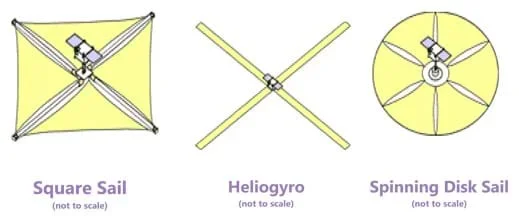 Figure 3. Three common designs for solar sails.Copyright 2006 JPL, NASA, Wikimedia Commons https://commons.wikimedia.org/wiki/File:Sail-design-types.gif
- To demonstrate to the class how a solar sail might work, show a 2:26-minute online light sail animation at https://www.youtube.com/watch?v=nZeFoO4zySw so they can see a visualization of a probe moved by light.
- Review Newton’s three laws of motion again, recapping them on the board. Ask students to watch for them during the activity.
- Divide the class into groups of three or four students each.
- As a class, review the available materials and tools (foil square, Popsicle sticks, drinking straws, cardboard tubes, rubber bands, tape, scissors) and explain the testing procedure (see below). Hand out the worksheet.
- Direct the groups to brainstorm solar sail ideas and then document the team’s agreed-upon design by drawing diagrams on their worksheets of the solar sail design, labeling the various materials they will use (prior to collecting materials). Direct students to list their desired building supplies in the space on their worksheets. (Point out that this is the third and fourth step in the engineering design process: Imagine—brainstorming, forming ideas, conceiving of plans and Plan -- select .)
- After groups present the teacher with sufficiently detailed design drawings, provide them with the materials and tools they need. (Point out that this moves them to the fifth step in the engineering design process: Prototype.) (See Figure 4 for an example student-created solar sail.)
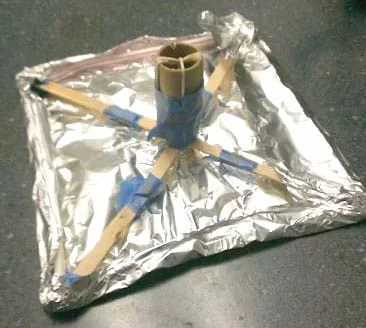 Figure 4. An example student-created solar sail.Copyright 2015 Matthew Bentley, College of Engineering and Applied Science, University of Colorado Boulder
- As teams complete construction, direct them to proceed to the testing station with their solar sail prototypes. (Point out that they have arrived at the sixth step in the engineering design process: Test.)
- Testing procedure:
- Unhook the higher end of the fishing line and slide on a group’s cardboard tube. Move the cardboard tube to the high side of the solar sail flight path (the fishing line) where the box fan sits.
- Have one student hold the solar sail, while another student is ready to turn on the fan, and another student is ready with the tape measure to measure how far the sail moves.
- Release the sail and turn on the fan to the maximum setting, blowing toward the sail, propelling it down the line.
- When the space probe stops moving, have students measure and then record on their worksheets how far the probe traveled.
- After a team finishes testing, direct those students to answer the questions on their worksheets and then begin brainstorming and redesigning their solar sail prototypes to make them more efficient. (Point out that this is the sixth, and eventually final, step in the engineering design process: Improve.)
- Oversee the first and second rounds of testing.
- After all groups have finished testing their solar sails (and redesigned and retested, as time permits), discuss as a class the answers to the worksheet questions. Which designs worked the best? How would you begin designing and testing a real solar sail if you were aerospace engineers?
- acceleration
- A change in speed (velocity) or direction of an object.
- aerospace engineer
- Engineers who design and develop aircraft and spacecraft.
- force
- The strength or energy of an action or movement.
- inertia
- The tendency of an object in motion to remain in motion, and an object at rest to stay at rest. The resistance of any object to any change in its state of motion.
- mass
- How much matter an object contains (measured in weight).
- model
- A small-scale representation of an object or structure.
- photon
- A particle that carries energy and makes up light.
- space probe
- An unmanned exploratory spacecraft used to gather and transmit information.
- propulsion
- The act of driving or pushing forward an object
- satellite
- A human-made device sent to orbit a planet or star for the purpose of gathering or transmitting information.
- solar sail
- A reflective sheet used for propulsion of probes and satellites in space. Also called light sails or photon sails.
Pre-Activity Assessment
Pair Share: Ask students to individually answer the following questions on a sheet of paper. Then, have them share their answers with a neighbor and/or the rest of the class.
- How can we learn about the universe? (Example answer: Scientists and engineers learn about the universe by sending satellites and space probes beyond the Earth’s atmosphere to collect data and send it back to Earth.)
- How do we send things into space? (Example answer: We usually use rockets to send space probes and satellites into space.)
- How do we power and propel satellites and probes? (Example answer: Satellites and space probes are propelled by rockets.)
- Can you think of any better or other ways to travel through space? (Example answer: Solar sails, slingshot propulsion, warp speed.)
Activity Embedded Assessment
Worksheet: During the activity, have students work through the Solar Sails Worksheet (PDF) while they complete their designs, prototypes and experiments. This includes making a labeled drawing and a materials list as well as documenting test results. Have students individually complete their own worksheets and all follow-up questions, but permit them to work together as a team to discuss them.
Post-Activity Assessment
Worksheet Review: At activity end, as a class discussion, have students raise their hands to share their answers to the Solar Sails Worksheet (PDF) questions. Alternatively, ask each group to present to the class its answer to a particular question. Students’ answers reveal their depth of understanding of the subject matter.
Have students design two types of solar sails, square and spinning disk (see Figure 3), and compare how far they travel. Additionally, have students make two different-sized sails, measure their areas, and compare the distance traveled. Expect larger sails (by area) to travel farther because they are able to catch more photons (air, in this activity).
Have students record distance measurements for different fan speed settings (1, 2, 3), and construct a scatter plot of the data (distance vs. fan speed). Expect students to observe that higher fan speeds, representative of a larger, brighter star, cause solar sails to travel farther.
Have students write brief descriptions of how solar sails work, or design advertisements for their sails to promote them as a space transportation method.
Have students decorate their spacecraft and then display them in the classroom or school hallway with their own descriptions so students in other classes can learn about solar sails and the future of space exploration.
- For lower grades, complete the worksheet as a class. If the design component is too difficult, pre-make different solar sails for groups to test and rotate around the room so each team can compare different solar sail sizes and designs. As a class, create a bar chart to compare the distances traveled by the solar sails.
- For higher grades, ask students to attempt to make solar sails without showing them any pictures or video. After they test their prototypes, show them the pictures and video materials and challenge them to redesign to achieve better solutions.
Early in the activity, show the class the light sail video (2:26 minutes) titled, Solar Sails Could Beat the “Rocket Equation” Animation at https://www.youtube.com/watch?v=nZeFoO4zySw.
Learn more about the Stanford University dschool’s design thinking process at these websites:
- Steps in a Design Thinking Process: https://dschool.stanford.edu/groups/k12/wiki/17cff/Steps_in_a_Design_Thinking_Process.html
- An Introduction to Design Thinking: Process Guide: https://dschool.stanford.edu/sandbox/groups/designresources/wiki/36873/attachments/74b3d/ModeGuideBOOTCAMP2010L.pdf?sessionID=68deabe9f22d5b79bde83798d28a09327886ea4b
- Virtual Crash Course in Design Thinking: http://dschool.stanford.edu/dgift/
The Design Thinking Process: Empathize > Define > Ideate > Prototype > Test. 2012. ReDesigning Theater, dschool, Stanford University Institute of Design, CA. Accessed September 8, 2016. http://dschool.stanford.edu/redesigningtheater/the-design-thinking-process/
Babauta, Daniel. FRAME: Engineering design thinking: eleventh grade lesson since feeling is first (EMPATHIZE). 2016. Environmental Stewardship by Design, Master Teacher lessons, BetterLesson.com. Accessed September 8, 2016. http://betterlesson.com/lesson/617373/since-feeling-is-first-empathize
- Space
- Space Travel
- Into Space!
- Solar Sails: The Future of Space Travel
- Life on the Moon
- Asteroids
- Space Travel
Contributors
Matthew Bentley
Supporting Program
Integrated Teaching and Learning Program, College of Engineering, University of Colorado Boulder
Acknowledgements
The contents of these digital library curricula were developed by the Integrated Teaching and Learning Program under National Science Foundation GK-12 grant no. 0946502. However, these contents do not necessarily represent the policies of the National Science Foundation, and you should not assume endorsement by the federal government.
Copyright
2011 by Regents of the University of Colorado