
Earth Impact
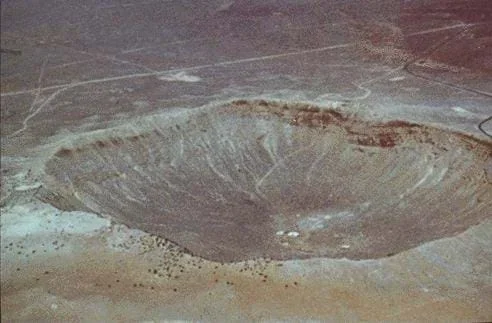 1-km wide Barringer Crater, located 38 miles east of Flagstaff, AZ.Copyright Near-Earth Object Program, National Aeronautics and Space Administration http://neo.jpl.nasa.gov/images/meteorcrater.jpg
This activity poses the question: What would happen if a meteor or comet impacted Earth? Students simulate an impact in a container of sand using various-sized rocks, all while measuring, recording and graphing results and conclusions. Then students brainstorm ways to prevent an object from hitting the Earth.
Engineers play a vital role in both the observation of what are called near-Earth objects (meteors, comets, asteroids, etc.) as well as any future destruction of them. All types of engineers, from mechanical engineers and aerospace engineers to chemical engineers, participate in designing, testing and building satellites that orbit any object in space, be it Earth or another planet. These satellites, in addition to telescopes, help scientists observe and document objects that have the potential to impact Earth. In the future, any plan to prevent an object from hitting the Earth will no doubt utilize engineers from a variety of disciplines.
After this activity, students should be able to:
- Explain the relationship between various-sized objects, impact speed and crater size (and have data to back it up).
- Describe at least one way to prevent a near-Earth object from impacting Earth.
- HS.3.1.a Summarize, represent, and interpret data on a single count or measurement variable.
Grades 9-12
Do you agree with this alignment? - 8.3.1.a Construct and interpret scatter plots for bivariate measurement data to investigate patterns of association between two quantities.
Grade 8
Do you agree with this alignment?
- Construct a scale model of the solar system, and use it to explain the motion of objects in the system such a planets, Sun, Moons, asteroids, comets, and dwarf planets
Grade 8
Do you agree with this alignment? - Describe methods and equipment used to explore the solar system and beyond
Grade 8
Do you agree with this alignment?
- CCSS.Math.Content.6.NS.B.3 Fluently add, subtract, multiply, and divide multi-digit decimals using the standard algorithm for each operation.
Grade 6
Do you agree with this alignment? - CCSS.Math.Content.6.SP.B.5 Summarize numerical data sets in relation to their context, such as by:
Grade 6
Do you agree with this alignment? - CCSS.Math.Content.6.SP.B.5a Reporting the number of observations.
Grade 6
Do you agree with this alignment? - CCSS.Math.Content.6.SP.B.5b Describing the nature of the attribute under investigation, including how it was measured and its units of measurement.
Grade 6
Do you agree with this alignment? - CCSS.Math.Content.6.SP.B.5c Giving quantitative measures of center (median and/or mean) and variability (interquartile range and/or mean absolute deviation), as well as describing any overall pattern and any striking deviations from the overall pattern with reference to the context in which the data were gathered.
Grade 6
Do you agree with this alignment? - CCSS.Math.Content.8.SP.A.1 Construct and interpret scatter plots for bivariate measurement data to investigate patterns of association between two quantities. Describe patterns such as clustering, outliers, positive or negative association, linear association, and nonlinear association.
Grade 8
Do you agree with this alignment? - CCSS.Math.Content.HSS-ID.B.6 Represent data on two quantitative variables on a scatter plot, and describe how the variables are related.
Grades 9-12
Do you agree with this alignment?
- STEL-1J Develop innovative products and systems that solve problems and extend capabilities based on individual or collective needs and wants.
Grades 6-8
Do you agree with this alignment?
Each group needs:
- 1 plastic container, ~2 ft2 x 2-5 inches high
- enough sand to fill the entire container, to at least 1.5 inches
- 4 different-sized, spherical-shaped rocks of equal density
- 12-inch ruler
- meter or yard stick
- 1 sheet of blank paper (or, use the reverse side of the worksheet if it is copied single sided)
- How Big is That Crater? Worksheet (PDF)
A basic understanding of measurement and graphing.
What would happen if a giant meteor hit the Earth? Would civilization as we know it continue to exist? Would the entire planet disintegrate as a result of the blast? (Ask students to share some of their thoughts that they recorded in their journals at the start of class; see the Assessment section.) According to scientists, an event like this is possible in the future. To be prepared for such a potential catastrophe, scientists are working with engineers to come up with solutions to prevent impact from happening.
The Earth already passes through the orbit of many comets and asteroids. Fortunately, no object of appreciable size has impacted the Earth in modern times. Our planet has been hit by these objects before however; evidence can be found in the craters that exist all over the world. It is thought that dinosaurs became extinct after a large meteor stuck Mexico millions of years ago. If another impact as large as that one hit the Earth today, it would be just as devastating as it was then.
How could you prevent an asteroid or comet from hitting Earth? Today you will come up with a design for such an Earth protector. To design a solution, engineers first learn more about the problem. For example, in 2005, NASA's deep impact probe intentionally slammed into a comet in order to help scientists understand the composition of comets first hand. In this activity, we will look at the devastating effects of falling objects (similar to what we would see if a meteor hit the Earth). This will help us make an informed design for a way to prevent a future catastrophe.
Before the Activity
- Pour sand into one container for each group.
- Make copies of the How Big is That Crater? Worksheet (PDF)(one per group).
With the Students
- Divide the class into groups of three students each.
- Pass out the worksheets to each group.
- Have students decide who will start in the following roles: data recorder, crater measurer, and meteoroid dropper. Direct students to take turns at each role throughout the activity.
- Have students carefully collect the container of sand for their group.
Experiment 1 (20 min)
In this experiment, students first observe the crater size made by meteoroids (rocks) of different sizes.
- Have teams make predictions in the first section of their worksheets, describing what they think will happen as they drop their three meteoroids (rocks) into the sand containers. Ask questions such as: Which rock will make the largest crater and why? Remind students that to drop the rocks from the exact same height (and have them record the reason for this on their worksheets).
- Once predictions are made, have students begin the experiment. Have them either start with the smallest rock and move up in size, or the largest rock and move down in size.
- Have students drop each rock three times and record the crater diameter, crater depth (after removing the rock from the container), as well as any other observations. Have them measure in inches or centimeters, depending on the class convention. Make sure they record on their worksheets the height they are dropping the rocks from.
- Have students complete the questions under Experiment 1 on the worksheets.
Experiment 2 (20 min)
In this experiment, students test the size of their craters in relationship to the speed of the impact of the rocks.
- Instruct students to choose only one of their rocks. Ask them why they should use the same rock as they collect data in the next experiment. (Answer: In controlled experiments, you should only change one variable at a time. Since the height — and therefore the impact velocity — will be increased in this experiment, the size of the rock should remain constant.)
- As in the first experiment, have students make predictions of what will happen with regards to the size of the craters if they increase their drop height. (Question #1 in the Experiment 2 section of the worksheet.)
- Encourage students to design this experiment themselves, using the guiding question, "As I increase the height that I drop the rock from, how will the crater size change?" Explain that by increasing the height, we are effectively increasing the impact velocity. Discuss why this is a better scientific strategy than just dropping the rock at varying speeds. (Answer: It is easier to have a systematic process that can reproducible from trial to trial; you are controlling your variables with a systematic approach).
- Give groups a few minutes to jot down their plan for the experiment and create a table for data collection (Question #2, Experiment 2 of the worksheet). Sign off on their work before they get started. The data table should be similar to the first experiment, with rock height replacing rock size. Have students choose three rock drop heights that will be easy to repeat, such as, knee height, waist height, shoulder height, etc.
- As before, if time permits, have students collect extra data and make a plot of crater diameter versus impact speed (height). Students need an extra sheet of paper for this step.
- Ask students to use their findings to make a prediction about what effect the velocity of a meteor would have on a crater it creates on the Earth.
Designing an Earth Protector (5 min)
Students generate ideas for how to prevent the catastrophe that would ensue if a large meteor hit the Earth.
- Have students reflect on their experimental results and consider what their new understanding of impact tells them about an actual meteor hitting the Earth. Have them jot down ways in which this knowledge could be applied to the design of an Earth Protector, a device that would prevent a meteor from damaging the Earth.
- Ask students to brainstorm ideas for designing an Earth Protector. In the designated space on their worksheets, instruct students to draw a diagram of their Earth Protectors, labeling the various components.
- Give teams a few minutes to discuss the advantages and disadvantages of various methods. Then have them pick a design and a spokesperson to communicate that design. Suggest they draw diagrams to help explain their ideas.
- asteroid
- A celestial body that orbits the Sun; ranges in size from 6 m to 933 km.
- comet
- A celestial body with a solid core and followed by a tail of debris; usually has a highly elliptical orbit.
- meteor
- A flash of light caused by particles from outer space entering the Earth's atmosphere; typically originates from asteroid collisions.
Pre-Activity Assessment
Prediction: Have students predict the outcome of the activity before the activity is performed. Have students record their predictions in the first section of the How Big is That Crater? Worksheet (PDF).
- Will a larger rock produce a large crater? If so, how much larger?
- Will a rock falling from a higher distance produce a larger crater? Why?
Class Discussion: Ask students to consider what the world would be like if a meteor were to hit Earth. What would be the impact on the environment? How would it affect our society?
Activity Embedded Assessment
Worksheet: Have students follow and complete the How Big is That Crater? Worksheet (PDF). Monitor the information they are recording to gauge their understanding of the subject matter and of the importance of a well-thought-out and -performed experiment.
Group Question: During the activity, ask the teams:
- How could this experiment help you design a way to prevent a meteor from destroying the Earth? What information does this test give you that would be helpful in the design stage?
Post-Activity Assessment
Prediction Analysis: Have students compare their initial predictions with their test results, as recorded on their worksheets. Ask the students to explain why faster and larger objects leave larger craters. Challenge them to consider how their findings impact their design process for an Earth Protector.
Class Presentation: Have student teams present their Earth protectors to the rest of the class.
Voting: When all of the presentations are completed, have the class vote for the best design.
- Watch that students do not throw the rocks at each other or around the classroom.
Remind students to drop — not throw — the rocks, as this might skew their data.
For accuracy in measurements, remind students to be careful when removing their rocks from the sand so as to not alter the crater depth.
The design component of this activity could be greatly expanded, depending on how much time can be allotted to the project. Students could write a design proposal, sketch their idea, make a poster presentation, build a scale model, etc. To promote interest, watch the movie "Armageddon," which shows a fictionalized account of scientists and engineers trying to prevent an asteroid from colliding with Earth. To help students gather information about what real engineers are doing to ward off meteor collisions, point them to this article on "gravity tractors" (http://www.cnn.com/2006/TECH/space/02/09/asteroid.tractor/index.html).
In the NOVA special "Einstein's Big Idea" (http://www.pbs.org/wgbh/nova/einstein/), Émilie du Châtelet, a French aristocratic woman of the early 18th century performs an experiment similar to Experiment 2 in this activity. She argued for the idea that energy is proportional to velocity squared. Have students use the evidence from their experiment to support or refute her claims. (The experiment should support it. Dropping a rock from twice the initial height should result in a crater depth that is four times as great. This can be proven from work-energy equations PE = mgh, KE=1/2mv2 and Work = Fd).
- For lower grades, eliminate the graphing portion of the activity. If students struggle with taking measurements, have them make qualitative (rather than quantitative) observations of the crater size.
- For grades 9-10, have students calculate the impact velocity for the second experiment. Either give them the relationship ( v=(2gh)1/2 ), or have them derive it from conservation of energy (PE = mgh; KE=1/2mv2 ). If time permits, have students investigate the crater made by differently-shaped rocks. They might also observe the craters created when rocks impact the sand from an angle by underhand tossing of them into the container. It is near impossible to make exactly-the-same angled throws into the sand in order to collect and analyze data, but at least students can observe some of the effects of this type of impact and compare it to the vertical drops done earlier.
Kohn, David. Popular Science on cnn.com, "Spaceship could help Earth avoid asteroid collision," February 9, 2006, accessed November 27, 2008. http://www.cnn.com/2006/TECH/space/02/09/asteroid.tractor/index.html
Near-Earth Object Program, National Aeronautics and Space Administration, accessed November 27, 2008. http://neo.jpl.nasa.gov/images/meteorcrater.jpg
WGBH Educational Foundation, Nova Science Programming On Air and Online, "Einstein's Big Idea," accessed November 27, 2008. http://www.pbs.org/wgbh/nova/einstein/
Contributors
Brian Kay; Karen King; Janet Yowell
Supporting Program
Integrated Teaching and Learning Program, College of Engineering, University of Colorado Boulder
Acknowledgements
The contents of this digital library curriculum were developed under a grant from the Fund for the Improvement of Postsecondary Education (FIPSE), U.S. Department of Education, and National Science Foundation GK-12 grant no 0338326. However, these contents do not necessarily represent the policies of the Department of Education or National Science Foundation, and you should not assume endorsement by the federal government.
Copyright
2008 by Regents of the University of Colorado.