
Does Your Chewing Gum Lose Its Sweetness?
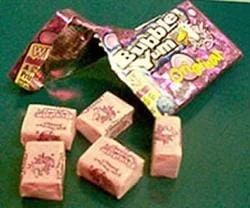 Packaged gum such as the type shown here works well for this activity.Copyright Los Alamos National Laboratories
In the first part of the activity, each student chews a piece of gum until it loses its sweetness, and then leaves the gum to dry for several days before weighing it to determine the amount of mass lost. This mass corresponds to the amount of sugar in the gum, and can be compared to the amount stated on the package label. In the second part of the activity, students work in groups to design and conduct new experiments based on questions of their own choosing. These questions arise naturally from observations during the first experiment, and from students' own experiences with and knowledge of the many varieties of chewing and bubble gums available.
With bubble gum to capture their interest, students learn to design and conduct controlled experiments to answer their own questions about the amounts of sugar (or artificial sweetener) in bubble or chewing gum. When students design experiments to test their hypotheses, they are acting like scientists and engineers who continually research and devise new creations, everything from new devices to new cleaning products designed and tested in laboratories.
After this activity, students should be able to:
- Describe why a control is important in a scientific experiment.
- Distinguish between variables and controls in a scientific experiment.
- Describe an experiment to determine whether sugarless gum loses as much mass after chewing as regular gum.
- CCSS.Math.Content.6.EE.C Represent and analyze quantitative relationships between dependent and independent variables.
Grade 6
Do you agree with this alignment? - CCSS.Math.Content.6.EE.C.9 Use variables to represent two quantities in a real-world problem that change in relationship to one another; write an equation to express one quantity, thought of as the dependent variable, in terms of the other quantity, thought of as the independent variable. Analyze the relationship between the dependent and independent variables using graphs and tables, and relate these to the equation.
Grade 6
Do you agree with this alignment? - CCSS.Math.Content.6.NS.B.3 Fluently add, subtract, multiply, and divide multi-digit decimals using the standard algorithm for each operation.
Grade 6
Do you agree with this alignment? - CCSS.Math.Content.6.RP.A.3c Find a percent of a quantity as a rate per 100 (e.g., 30% of a quantity means 30/100 times the quantity); solve problems involving finding the whole, given a part and the percent.
Grade 6
Do you agree with this alignment? - CCSS.Math.Content.6.SP.B.5b Describing the nature of the attribute under investigation, including how it was measured and its units of measurement.
Grade 6
Do you agree with this alignment? - CCSS.Math.Content.7.RP.A.2a Decide whether two quantities are in a proportional relationship, e.g., by testing for equivalent ratios in a table or graphing on a coordinate plane and observing whether the graph is a straight line through the origin.
Grade 7
Do you agree with this alignment? - CCSS.Math.Content.7.RP.A.3 Use proportional relationships to solve multistep ratio and percent problems.
Grade 7
Do you agree with this alignment? - CCSS.Math.Content.8.SP.A.1 Construct and interpret scatter plots for bivariate measurement data to investigate patterns of association between two quantities. Describe patterns such as clustering, outliers, positive or negative association, linear association, and nonlinear association.
Grade 8
Do you agree with this alignment? - CCSS.Math.Content.HSS-ID.A Summarize, represent, and interpret data on a single count or measurement variable
Grades 9-12
Do you agree with this alignment?
- Some technological problems are best solved through experimentation.
Grades 6-8
Do you agree with this alignment?
- MS-PS1-2 Analyze and interpret data on the properties of substances before and after the substances interact to determine if a chemical reaction has occurred.
Grades 6-8
This resource focuses on the following Three Dimensional Learning aspects of NGSS:
Science & Engineering Practices- Analyze and interpret data to determine similarities and differences in findings.Do you agree with this alignment?
- Science knowledge is based upon logical and conceptual connections between evidence and explanations.Do you agree with this alignment?
Disciplinary Core Ideas- Each pure substance has characteristic physical and chemical properties (for any bulk quantity under given conditions) that can be used to identify it.Do you agree with this alignment?
- Substances react chemically in characteristic ways. In a chemical process, the atoms that make up the original substances are regrouped into different molecules, and these new substances have different properties from those of the reactants.Do you agree with this alignment?
Crosscutting Concepts- Macroscopic patterns are related to the nature of microscopic and atomic-level structure.Do you agree with this alignment?
Do you agree with this alignment? - Analyze and interpret data to determine similarities and differences in findings.
- CCSS.Math.Content.6.EE.C Represent and analyze quantitative relationships between dependent and independent variables.
Grade 6
Do you agree with this alignment? - CCSS.Math.Content.6.EE.C.9 Use variables to represent two quantities in a real-world problem that change in relationship to one another; write an equation to express one quantity, thought of as the dependent variable, in terms of the other quantity, thought of as the independent variable. Analyze the relationship between the dependent and independent variables using graphs and tables, and relate these to the equation.
Grade 6
Do you agree with this alignment? - CCSS.Math.Content.6.NS.B.3 Fluently add, subtract, multiply, and divide multi-digit decimals using the standard algorithm for each operation.
Grade 6
Do you agree with this alignment? - CCSS.Math.Content.6.RP.A.3c Find a percent of a quantity as a rate per 100 (e.g., 30% of a quantity means 30/100 times the quantity); solve problems involving finding the whole, given a part and the percent.
Grade 6
Do you agree with this alignment? - CCSS.Math.Content.6.SP.B.5b Describing the nature of the attribute under investigation, including how it was measured and its units of measurement.
Grade 6
Do you agree with this alignment? - CCSS.Math.Content.7.RP.A.2a Decide whether two quantities are in a proportional relationship, e.g., by testing for equivalent ratios in a table or graphing on a coordinate plane and observing whether the graph is a straight line through the origin.
Grade 7
Do you agree with this alignment? - CCSS.Math.Content.7.RP.A.3 Use proportional relationships to solve multistep ratio and percent problems.
Grade 7
Do you agree with this alignment? - CCSS.Math.Content.8.SP.A.1 Construct and interpret scatter plots for bivariate measurement data to investigate patterns of association between two quantities. Describe patterns such as clustering, outliers, positive or negative association, linear association, and nonlinear association.
Grade 8
Do you agree with this alignment? - CCSS.Math.Content.HSS-ID.A Summarize, represent, and interpret data on a single count or measurement variable
Grades 9-12
Do you agree with this alignment?
- aluminum foil, a few sheets (or small plastic weighing boats, if available)
- permanent markers, a few
- packaged bubble gum, one piece of gum per student (such as Bubble Yum or Bubblicious brands, use only one brand and flavor of gum for the entire class, those containing sugar work best for the initial experiment)
- triple-beam balances, several, accurate to 0.1 g (or electronic balances)
- cafeteria tray or box, to contain the drying gum for a few days
- additional gum for the second set of student-devised experiments (amount and types depend on what students choose to investigate)
Ability to use a balance to find the mass of an object to at least the nearest 0.1 gram. It is helpful, but not essential, for students to be able to calculate percentages, for example, 4.2 is what percent of 14?
(Present the same Introduction/Motivation as is provided in the associated lesson, which is reproduced below.)
Have you ever wonder why gum loses its sweetness so quickly? Why is that? Does it seems like the gum gets smaller after you chew it? (Listen to a few ideas from students.) I would like you to do an experiment to test a hypothesis I have. This is my hypothesis: Sugar contributes to gum's flavor, and during chewing, the sugar is lost, which makes the gum get smaller as it loses sweetness.
I will provide you with bubble gum and you will conduct the experiment. Are you ready? (Proceed to conduct the experiment.)
Initial Experiment Procedure
- Have each student make a small weighing boat out of a few square inches of foil. This can be made by folding two or three layers of aluminum foil into a 1-2 inch square, and then turning the edges up to make sides about ¼-½ inch high. Have students use permanent markers to label their boats with their names or initials, and the date.
- Hand out one piece of gum to each student; save for later the outer packaging with the nutritional information on it.
- Have each student use their weighing boat to find the mass of an unwrapped but unchewed piece of gum. Have them measure to the nearest 0.1 g, and tell them not to discard the weighing boats. Remember to record the measured mass.
- Then have students chew their pieces of gum for exactly 15 minutes. By this time the gum should have little or no sweetness left in its flavor.
- Have students each put the gum back on their weighing boats. Collect all the chewed gum pieces in their boats on a cafeteria tray and leave them in a dry place for at least two full days, and preferably three or four days.
- A few days later, have students find and record the mass of their pieces of dried, chewed gum.
- Have students compared unchewed and chewed masses to determine the amount of mass lost due to chewing, and calculate the percent of mass lost.
Initial Experiment Discussion
- Direct students to compare their results with those of other students. Then show them the original gum outer packaging that lists the ingredients and gives nutritional information. Have students calculate the percentage of sugar in the gum based on the package information. Compare this "theoretical" percentage to the "experimental" percentages. Expect the two to be fairly close for most students.
- Discuss sources of error for the experiment. Then ask if there was a control for the experiment. The answer is no, and this is an important point to make. How do we know that an unchewed piece of gum wouldn't lose just as much mass by sitting and drying for the same amount of time in the same place that a chewed piece did? (We don't.) What should the control have been? Give students time to think about this. Expect some to suggest that a piece of gum could have been removed from its wrapper, weighed for its mass, and then left on the tray (unchewed) to dry with the rest of the chewed pieces of gum. Then, it could have been re-weighed a few days later when the chewed pieces were re-weighed to find out if its mass changed.
- Which variables were controlled and which were not? Everyone chewed for the same amount of time, but did everyone chew at the same rate or with the same vigor? Did some students chew less because they spent a lot of time blowing bubbles? Did everyone chew the same type of gum? Might some people have more or "stronger" saliva than others?
Designing the Next Experiment
- Expect questions that can be answered through experimentation to arise naturally from the discussion of the first experiment, and expect students to welcome the opportunity to chew gum in class again.
- Working in groups of four, have students make a written proposal that answers the following questions:
- What is the question you are asking?
- How will you try to answer it?
- How many trials will you do?
- How will you report your results quantitatively?
- What will be your control(s)?
- What is your hypothesis?
- Model answering these questions by applying them to the initial gum experiment. Ask students for the answers to each of the questions as they apply to the first experiment. They may need time to think about some of the questions, but they should be able to respond as follows:
- The question we were trying to answer was: Can we find out how much sugar is in bubble gum?
- We tried to answer it by weighing gum, then chewing it until it lost its sweetness, then letting it dry, and then weighing it again to see how much weight it lost. (Ideally, students will also realize that it is an assumption that sugar is was what was actually lost, since the experiment did not provide a way to know this for sure, although an observed loss of sweetness makes this a reasonable assumption. A better experiment would delve deeper. What contributes to the gum's flavor? Perhaps sweetners and perhaps the presence of other flavoring ingredients, including aromas. What are students actually measuring in the experiment? If both sweetness and flavor diminish, what is in the weight loss measured? All sweetener? All flavor, some portions of each?)
- The number of trials is equal to the number of students who chewed gum for the experiment.
- The results were reported as the differences in weight of the gum before and after chewing, and as the percentage of sugar calculated from the weight loss. The weight changes could also have been reported in the form of a bar graph, with one bar depicting the unchewed weight, and another bar depicting the chewed weight.
- In the initial experiment, no control was included, but there should have been at least one unchewed piece of gum that was otherwise treated the same way as the rest of the gum.
- The hypothesis was: Sugar contributes to gum's flavor, and during chewing, the sugar is lost (swallowed), which makes the gum get smaller as it loses its sweetness.
- Make sure students understand the questions, and the answers that apply for the first experiment. Then give students time (20 minutes or so) to agree within their groups on answers to the questions as they apply to their proposed experiments. Write down the answers. Direct groups to come up with their own questions and experiments, although some groups may independently generate the same ones. The following are examples of group questions and their corresponding hypotheses that were successful experiments in the past:
- How will the weight losses compare in sugared gum vs. sugarless gum? Hypothesis: Since sugarless gum is supposed to be better for people, it won't contain as much sweetener, so the sugarless gum will lose less mass than sugared gum.
- Would gum chewed in saliva lose more mass than gum chewed in water? Hypothesis: Saliva will cause more sugar, and thus more mass, to be lost than water. Note: After a discussion of controls and variables, this group wisely changed its question to: Will gum mashed in water in a small beaker lose as much mass as gum mashed in an equal volume of saliva in a beaker?
- Do different flavors of the same brand of gum contain different amounts of sugar? Hypothesis: Fruit-flavored gum tastes sweeter than cinnamon- or mint-flavored gum, so the fruit flavors will lose more mass.
- Does the amount of mass lost depend on how long you chew the gum? Hypothesis: The longer you chew, the more sugar will dissolve and the more mass will be lost. Note: These students quickly realized that there was a time limit – the length of a class period – for the maximum amount of time they could test. They decided to chew gum for various lengths of time: 5 minutes, 10 minutes, 20 minutes and 40 minutes, to test their hypothesis. In order to get an adequate sample size, each student in the group needed to chew a fresh piece of gum for each of the time lengths. Creatively, hey were able to obtain permission from a few other teachers to chew gum during their classes, so that all the gum could be chewed on the same day.
- Do some brands have more sugar than others? Hypothesis: Sweeter gum tastes better, so the most popular brands will lose more mass.
- After teams get teacher approval, have them submit their shopping lists, including brand names and number of pieces required. Obtain the gum (or ask student to provide the gum) and conduct the experiements during the next class period.
- After students have completed their experiments, have them graph and analyze their data, and present their results and conclusions in poster format to share with the rest of the class, as described in the Lesson Closure section of the associated lesson.
Poster Presentations: Have teams graph and analyze their experimental data, and present their results and conclusions in poster format to share with the rest of the class, as described in the Lesson Closure section of the associated lesson. Review their posters to gauge their comprehension of the material and concepts.
Written Wrap-Up: As a concluding assignment, ask students to write answers to the following questions:
- Explain why a control should have been used in the initial gum experiment.
- Describe an experiment to determine whether sugarless gum loses as much mass after chewing as regular gum does.
- Gum can be a choking hazard. Try to avoid student-designed experiments that involve chewing large quantities (more than 12 grams) of gum at a time, since large wads of gum provide more potential for choking.
- Chewing gum can induce headaches in some people, or interfere with dental work. Thus, participation in the chewing aspect of these experiments should be voluntary.
Some students may want to compare chewing gum to bubble gum, or compare different types of bubble gum. Since chewing gum and some types of bubble gum come in smaller sizes than the bubble gum used in the initial experiment, students may need to chew more than one piece in order to accurately determine the amount of mass lost during chewing. Advise students to start with quantities of gum that weigh at least 6 grams. Avoid very large wads of gum, however (see the Safety Issues section).
Expect lots of unstructured time while students chew gum for 15 minutes, so have a reading assignment or some other short task planned for students to work on while they are chewing.
If new questions arise from their experiments, have students design and conduct new experiments to answer them.
- Younger students may need help in calculating the percentage of sugar in chewing gum.
- Students as Scientists
- How Many Drops?
- How Much Sugar Is in Bubble Gum?
- Does Your Chewing Gum Lose Its Sweetness?
Contributors
Mary R. Hebrank
Supporting Program
Engineering K-Ph.D. Program, Pratt School of Engineering, Duke University
Acknowledgements
This content was developed by the MUSIC (Math Understanding through Science Integrated with Curriculum) Program in the Pratt School of Engineering at Duke University under National Science Foundation GK-12 grant no. DGE 0338262. However, these contents do not necessarily represent the policies of the NSF, and you should not assume endorsement by the federal government.
This lesson and its associated activity were originally published, in slightly modified form, by Duke University's Center for Inquiry Based Learning (CIBL). Please visit http://www.ciblearning.org/ for information about CIBL and other resources for K-12 science and math teachers.
The basic idea and method of this lesson and activity, although much modified here, originated in an article by high school teacher Louis Gotlib that was published in a newsletter of the NC Science Teachers Association. "Finding the Percentage of Sugar in Gum" first appeared in NCSTA Teaching Notes #5, 1997.
Copyright
2013 by Regents of the University of Colorado; original © 2004 Duke University