
Wet Pennies
Students conduct a simple test to determine how many drops of each of three liquids—water, rubbing alcohol, vegetable oil—can be placed on a penny before spilling over. Because of their different surface tensions, more water can be piled on top of a penny than either of the other two liquids. However, the main point of the activity is for students to come up with an explanation for their observations about the different amounts of liquids a penny can hold. To do this, they create hypotheses that explain their observations, and because middle school students are not likely to have prior knowledge of the property of surface tension, their hypotheses are not likely to include this idea. Then they are asked to come up with ways to test their hypotheses, although they do not need to actually conduct these tests as part of this activity.
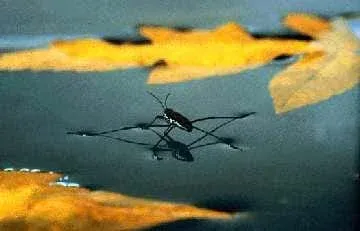 The same phenomenon that lets a water strider walk on water also allows students to place an astonishing number of drops of water on a penny.Copyright Robert Suter, Vassar College http://faculty.vassar.edu/suter/1websites/bejohns/mateselection/files/female.htm
Chemical engineers apply their understanding of natural scientific properties, such as surface tension, as they design experiments to create new materials and products that behave as they desire.
After this activity, students should be able to:
- Give an example of a hypothesis that is based on an observation of a natural phenomenon.
- Give an example of an experiment designed to address a specific hypothesis.
- CCSS.Math.Content.6.SP.B.4 Display numerical data in plots on a number line, including dot plots, histograms, and box plots.
Grade 6
Do you agree with this alignment? - CCSS.Math.Content.7.RP.A.2a Decide whether two quantities are in a proportional relationship, e.g., by testing for equivalent ratios in a table or graphing on a coordinate plane and observing whether the graph is a straight line through the origin.
Grade 7
Do you agree with this alignment? - CCSS.Math.Content.HSS-ID.A Summarize, represent, and interpret data on a single count or measurement variable
Grades 9-12
Do you agree with this alignment?
- STEL-8L Interpret the accuracy of information collected.
Grades 6-8
Do you agree with this alignment?
- 5-PS1-3 Make observations and measurements to identify materials based on their properties.
Grade 5
This resource focuses on the following Three Dimensional Learning aspects of NGSS:
Science & Engineering Practices- Make observations and measurements to produce data to serve as the basis for evidence for an explanation of a phenomenon.Do you agree with this alignment?
Disciplinary Core Ideas- Measurements of a variety of properties can be used to identify materials. (Boundary: At this grade level, mass and weight are not distinguished, and no attempt is made to define the unseen particles or explain the atomic-scale mechanism of evaporation and condensation.)Do you agree with this alignment?
Crosscutting Concepts- Standard units are used to measure and describe physical quantities such as weight, time, temperature, and volume.Do you agree with this alignment?
Do you agree with this alignment? - Make observations and measurements to produce data to serve as the basis for evidence for an explanation of a phenomenon.
- CCSS.Math.Content.6.SP.B.4 Display numerical data in plots on a number line, including dot plots, histograms, and box plots.
Grade 6
Do you agree with this alignment? - CCSS.Math.Content.7.RP.A.2a Decide whether two quantities are in a proportional relationship, e.g., by testing for equivalent ratios in a table or graphing on a coordinate plane and observing whether the graph is a straight line through the origin.
Grade 7
Do you agree with this alignment? - CCSS.Math.Content.HSS-ID.A Summarize, represent, and interpret data on a single count or measurement variable
Grades 9-12
Do you agree with this alignment?
- 8.P.1 Understand the properties of matter and changes that occur when matter interacts in an open and closed container.
Grade 8
Do you agree with this alignment? - Chm.1.2 Understand the bonding that occurs in simple compounds in terms of bond type, strength, and properties.
Grades 9-12
Do you agree with this alignment? - Phy.1.2.4 Explain the effects of forces (including weight, normal, tension and friction) on objects.
Grades 9-12
Do you agree with this alignment?
- 3 small beakers (50-100 ml) or plastic cups (about 4 to 8 ounces) per group
- 1 disposable pipette per student, plus a few extras
- 1 penny per student
- rubbing (isopropyl) alcohol, two 16-ounce bottles
- vegetable oil, one 32-ounce bottle
- paper towels, several per student
- water
Students should be able to calculate the average of four numbers less than 50.
This activity engages students' attention very quickly and thus requires little or no introduction. Simply divide the class into teams of four students each, provide the materials and written instructions for students, and let them proceed with the activity.
Before the Activity
- Gather materials and make copies of the Wet Pennies Handout (PDF).
- As indicated in the student instructions, each team needs three containers (beakers or cups) of liquid: one containing water, one containing rubbing alcohol, and one containing vegetable oil. For each liquid, use about 2 ounces (about one-half inch of liquid height). Label the containers.
With the Students
- Divide the class into groups of four students each.
- Pass out the materials and handouts. Emphasize the need to follow the instructions carefully, especially in regard to the order of the liquids they test on their pennies.
- After the experiment is done, lead a concluding class discussion, as described in the handout and Assessment section. Ask the Investigating Questions.
- hypothesis
- A tentative explanation for a fact or set of observations, which can be tested objectively.
Concluding Discussion: As outlined in the Wet Pennies Handout (PDF), lead a class discussion so students can share and compare results and conclusions. Ask the Investigating Questions. Listen to students' discussion contributions and answers to gauge their level of comprehension.
Some students may get the mistaken idea that the water-dropping activity is some sort of contest that they can win by getting the most drops, of any liquid, on the penny. Try to avoid giving students this idea, and if they come up with it on their own, explain that the point is for them to be able to fairly and accurately compare the numbers of drops of each liquid a penny can hold -- not to compare how many drops each student can get a penny to hold. To fairly and accurately compare the number of drops of each liquid a penny can hold, students need only try to use the same dropping technique (same squeezing pressure on the pipette bulb, same height it is held above the penny) for each liquid.
Students may want to immediately test the hypotheses they develop as part of this activity. If time allows, some of the ideas they are likely to generate can be quickly and easily tested, and it is a good idea to encourage their enthusiasm by letting them do so. See the Lesson Closure and Lesson Extension Activities sections of the How Many Drops? associated lesson or more information.
Contributors
Mary R. Hebrank
Supporting Program
Engineering K-PhD Program, Pratt School of Engineering, Duke University
Acknowledgements
This content was developed by the MUSIC (Math Understanding through Science Integrated with Curriculum) Program in the Pratt School of Engineering at Duke University under National Science Foundation GK-12 grant no. DGE 0338262. However, these contents do not necessarily represent the policies of the NSF, and you should not assume endorsement by the federal government.
This activity was originally published, in slightly modified form, by Duke University's Center for Inquiry Based Learning (CIBL). Please visit http://ciblearning.org/ for information about CIBL and other resources for K-12 science and math teachers.
Copyright
2013 by Regents of the University of Colorado; original © 2004 Duke University