
Students as Scientists
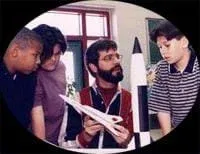 It's not rocket science! Kids can conduct scientific inquiry with materials as ordinary as pennies and bubble gum.Copyright NASA
In the first lesson and its associated activity, students conduct a simple test to determine how many drops of each of three liquids can be placed on a penny before spilling over. Because of the different surface tensions of the three liquids—water, rubbing alcohol and vegetable oil—more water can be piled on top of a penny than either of the other two liquids. However, this is not the main point of the activity. Instead, students are asked to come up with an explanation for their observations about the different amounts of liquids a penny can hold. In other words, they are asked to make hypotheses that explain their observations, and because middle school students are not likely to have prior knowledge of the property of surface tension, their hypotheses are not likely to include this idea. Then, they are asked to come up with ways to test their hypotheses, although they do not need to conduct these tests. The important points for students to realize are that 1) the tests they devise must fit their hypotheses, and 2) the hypotheses they come up with must be testable in order to be useful.
In the second lesson, students chew bubble gum until it loses its sweetness, and after allowing the chewed gum to dry for several days, they determine the amount of mass lost. From the mass lost, they calculate the percentage of sugar that was in the gum originally. This teacher-led activity causes students to generate new questions about the varieties of chewing gums and their ingredients, and it also points out the need for controls. Students then design and execute new, controlled experiments based on their own questions. When students ask their own questions and devise ways to answer them scientifically, they begin to truly understand and appreciate the scientific method.
Designing experiments to test hypotheses is an act of engineering creativity. Scientists practice engineering whenever they design new experiments to test hypotheses. In addition chemical engineers spend time in laboratories creating products that have never existed before, everything from adhesives to cleaners to shampoos and fertilizers.
- CCSS.Math.Content.7.RP.A.2a Decide whether two quantities are in a proportional relationship, e.g., by testing for equivalent ratios in a table or graphing on a coordinate plane and observing whether the graph is a straight line through the origin.
Grade 7
Do you agree with this alignment?
- Day 1: How Many Drops? lesson
- Day 2: Wet Pennies activity
- Day 3-4: How Much Sugar Is in Bubble Gum? lesson
- Day 5-10: Does Your Chewing Gum Lose Its Sweetness? activity
Contributors
Mary R. Hebrank
Supporting Program
Engineering K-Ph.D. Program, Pratt School of Engineering, Duke University
Acknowledgements
This content was developed by the MUSIC (Math Understanding through Science Integrated with Curriculum) Program in the Pratt School of Engineering at Duke University under National Science Foundation GK-12 grant no. DGE 0338262. However, these contents do not necessarily represent the policies of the NSF, and you should not assume endorsement by the federal government.
Copyright
2013 by Regents of the University of Colorado; original © 2004 Duke University