
Yeast Cells Respire, Too (But Not Like Me and You)
Students set up a simple way to indirectly observe and quantify the amount of respiration occurring in yeast-molasses cultures. Each student adds a small amount of baking yeast to a test tube filled with diluted molasses. Then a second, smaller test tube is placed upside-down inside the solution. As the yeast cells respire, the carbon dioxide they produce is trapped inside the inverted test tube, producing a growing bubble of gas that is easily observed and measured. Students are presented with the procedure for designing an effective experiment; they learn to think critically about experimental results and indirect observations of experimental events.
 Bubbles floating.Copyright http://webs.wichita.edu/facsme/elecbub.htm
Concepts covered in this activity are used in biomedical, chemical and environmental engineering. This activity also includes elements of biotechnology, applications of experimental and analytical techniques in living systems, food processing and processes of nature.
After this activity, students shouuld be able to:
- Compare and contrast cellular respiration in yeast vs. plant and animal cells.
- Describe the role of yeasts in the production of bread and alcoholic beverages.
- CCSS.Math.Content.6.SP.B.4 Display numerical data in plots on a number line, including dot plots, histograms, and box plots.
Grade 6
Do you agree with this alignment? - CCSS.Math.Content.HSS-ID.A Summarize, represent, and interpret data on a single count or measurement variable
Grades 9-12
Do you agree with this alignment?
- Chemical technologies are used to modify or alter chemical substances.
Grades 6-8
Do you agree with this alignment? - Biotechnology applies the principles of biology to create commercial products or processes.
Grades 6-8
Do you agree with this alignment? - Biotechnology has applications in such areas as agriculture, pharmaceuticals, food and beverages, medicine, energy, the environment, and genetic engineering.
Grades 9-12
Do you agree with this alignment?
- MS-LS1-7 Develop a model to describe how food is rearranged through chemical reactions forming new molecules that support growth and/or release energy as this matter moves through an organism.
Grades 6-8
This resource focuses on the following Three Dimensional Learning aspects of NGSS:
Science & Engineering Practices- Develop a model to describe unobservable mechanisms.Do you agree with this alignment?
Disciplinary Core Ideas- Within individual organisms, food moves through a series of chemical reactions in which it is broken down and rearranged to form new molecules, to support growth, or to release energy.Do you agree with this alignment?
- Cellular respiration in plants and animals involve chemical reactions with oxygen that release stored energy. In these processes, complex molecules containing carbon react with oxygen to produce carbon dioxide and other materials.Do you agree with this alignment?
Crosscutting Concepts- Matter is conserved because atoms are conserved in physical and chemical processes.Do you agree with this alignment?
Do you agree with this alignment? - Develop a model to describe unobservable mechanisms.
- CCSS.Math.Content.6.SP.B.4 Display numerical data in plots on a number line, including dot plots, histograms, and box plots.
Grade 6
Do you agree with this alignment? - CCSS.Math.Content.HSS-ID.A Summarize, represent, and interpret data on a single count or measurement variable
Grades 9-12
Do you agree with this alignment?
- 7.L.1 Understand the processes, structures and functions of living organisms that enable them to survive, reproduce and carry out the basic functions of life.
Grade 7
Do you agree with this alignment? - 8.L.5 Understand the composition of various substances as it relates to their ability to serve as a source of energy and building materials for growth and repair of organisms.
Grade 8
Do you agree with this alignment? - Bio.4.2 Analyze the relationships between biochemical processes and energy use in the cell.
Grades 9-12
Do you agree with this alignment? - Bio.4.2.1 Analyze photosynthesis and cellular respiration in terms of how energy is stored, released, and transferred within and between these systems.
Grades 9-12
Do you agree with this alignment?
- large test tubes, about 15 cm long and 20 mm in diameter; one per student
- small test tubes, about 10 cm long and 8 mm in diameter; one per student
- squares cut from plastic wrap, about 8 cm on a side; one per student
- several rubber or cork stoppers, size 2
- test tube racks to hold large test tubes
- several dropping pipettes
- five 300-ml beakers
- 1-liter flask
- 1-liter graduated cylinder
- lab thermometer
- package dry baking yeast (available in grocery stores)
- 12-ounce bottle molasses (unsulphured)
Students should be aware that yeasts respire anaerobically by breaking down molecules of glucose to provide energy for cellular activities, and producing carbon dioxide and ethyl alcohol as by-products.
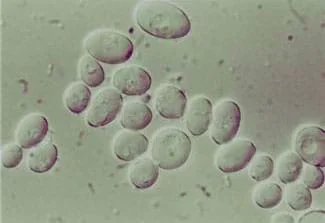 Yeast cells.Copyright 2004 Microsoft Corporation, One Microsoft Way, Redmond, WA 98052-6399 USA. All rights reserved. http://office.microsoft.com/en-us/images/results.aspx?qu=yeast&ex=1#ai:MP900390217|
Can you see respiration occur in yeasts? (Listen to student answers. Some students may suggest that with a good microscope someone might be able to see it. As necessary, remind students that yeast cells are microscopic and that cellular respiration involves individual molecules of glucose, carbon dioxide and ethyl alcohol.) The yeast cells convert glucose, the food source, to carbon dioxide and ethyl alcohol through a process called cellular respiration. Energy is also produced during this process, which the yeast cells use to grow and reproduce. Can the individual molecules be seen with a microscope? (Listen to student answers.) No, molecules are too small to be seen with a microscope.
If molecules are too small to be seen, how could we tell if a beaker full of well-fed yeasts living in some nice, warm, water were respiring or not? (Listen to student answers. Give them some time to reason out an answer.) Carbon dioxide is produced by respiring yeasts, and since it is a gas, it should bubble up to the surface of the water. Energy is also produced during cellular respiration, but it is more difficult to measure than carbon dioxide.
So our experimental challenge is to try to determine if yeast cells are respiring or not. (If students seem disinterested, continue on.) What else do respiring yeast cells produce? In the process of observing yeast respiration, you may be interested to know that you will be making a "forbidden" substance—ethyl alcohol. If the experiment works, that is, if you are able to provide the conditions necessary for yeast respiration, the classroom may begin to smell somewhat "beery" after a few days. I hope the principal doesn't decide to drop in! (Laugh; at this point, expect your seventh-graders to be more interested to participate!)
Overall Schedule
- On the first day of the activity, students set up the yeast-molasses respiration chambers. It is best to start this activity on a Monday, so it can be monitored throughout the week.
- For the next 3-4 days, students take a few minutes of class time to observe their chambers and measure the heights of the carbon-dioxide bubbles within.
- On the last day, when most of the bubbles are at the maximum measurable height, students make graphs that show how the heights of the gas bubbles changed over the duration of the experiment.
Before the Activity
- Make sure test tubes, stoppers, pipettes and beakers are clean. If at all possible, fill a large pot with water, put all the glassware in, and boil for 10 minutes; then allow them to drain and air dry. This can be done up to several days in advance, as long as the clean, dry materials are kept in a clean, sealed container until ready for use.
- Prepare 1 liter of 10% molasses solution in the flask, by combining 100 ml of molasses with 900 ml of tap water and swirling gently for several minutes.
- Divide this mixture among four of the 300-ml beakers. Students will use these to prepare their "yeast respiration chambers."
- Just before class starts, use the remaining 300-ml beaker to prepare the yeast solution. Put about 200 ml of warm water (about 43-48 ºC) in the beaker and stir in 1 teaspoon yeast. Keep this mixture warm until students are ready to use it. Placing the beaker in a slightly larger container filled with water that is about 5 ºC warmer than the yeast solution works well. Check the temperature of the yeast solution every 5-10 minutes, though, and replace the surrounding water with warmer water as necessary.
- Practice demonstrating how to set up the yeast respiration chambers; this is best done while working over a sink or basin:
- Fill one of the large test tubes with water to within about 3 cm from the top. Then fill one of the small test tubes by pouring in some of the water from the large test tube.
- With one in each hand, hold the two test tubes angled toward each other with their tops touching. In one smooth motion, tip the small test tube up and into the large tube. The small tube should now be upside down inside the large tube. Expect to see an air bubble trapped in the small tube.
- Remove the air bubble by capping the large tube with a rubber stopper or cork. (Do not try for a very tight fit; forcing the stopper in too far may break the test tube.) Then slowly tilt the large tube so it is slightly past horizontal, which usually allows the air bubble to escape from the small tube. Slowly return the large tube to vertical and check to make sure the air bubble is completely gone from the small tube. Repeat this step if necessary.
With the Students - Day 1
- Give a simple explanation of how the class will try to indirectly observe yeast respiration by providing molasses as a source of sugar, and devising a way to try to capture the carbon dioxide gas that is given off as the yeast cells respire. Emphasize that the molasses is the food source that the yeast cells will convert to energy.
- Demonstrate how to set up the yeast respiration chambers, first using water to show how to remove air bubbles from the small test tube. Be sure to ask students why no air should be present at the onset. Next, demonstrate the same thing, using the 10% molasses solution instead of water. Caution students about pressing too hard on the stoppers.
- Show students the warm yeast solution, and demonstrate how to add yeast cells to the test chamber. This is done by first gently stirring the solution, then filling the pipette with some of it. (Since the yeast cells settle to the bottom of the beaker, it is important to stir the solution first.) Gently squeeze exactly 6 drops of the yeast solution down the side of the large test tube. Do not put the tip of the pipette into the molasses solution. Advise students to practice dropping 6 drops back into the beaker of yeast solution before attempting to add them to their test tubes. The drops should be uniform in size and not contain air bubbles.
- Demonstrate how to place a square of plastic wrap over the top of the chamber and smooth it around the tube's circumference. Point out that this keeps out insects and other airborne contaminants. Also demonstrate how to mark their chambers with initials or some other identification system. (This can be done at the onset if you prefer.)
- Give students some time to practice with water before they set up their test chambers. As students finish preparing their test tubes, have them carefully wipe any liquid from the outside of the tubes with damp paper towels, and place plastic wrap over the tops. Then, place the completed chambers in a test tube rack.
- When all students have finished, place the racks where they will not be disturbed. Avoid very warm or very cool locations.
With the Students - Days 2, 3 and 4 (and 5, if necessary)
Have students examine their test tubes to see if anything happened. Depending largely on temperature (but don't tell students that!) only small bubbles may be present in the smaller tube or it may be nearly filled. It is okay if the smaller tubes float up as they fill with carbon dioxide and dislodge the plastic wrap. Be sure to avoid calling the bubbles produced "air" bubbles, since they are not filled with air. Ask students what the difference is between the composition of air and the bubbles produced by their yeast cells. If they do not know the composition of air, make it an assignment to find out.
Each day, have students measure the heights of the gas bubbles (to the nearest millimeter) and record this data. Continue daily until nearly all of the small tubes are completely filled with carbon dioxide. Then have students graph their results in a bar graph or x-y scatter plot, with time on the x-axis (dependent variable) and height of gas bubble on the y-axis (independent variable). Give students a few minutes to compare their graphs with those of their classmates.
With the Students - Concluding Discussion
Ask students to describe what happened physically in their test tubes. Expect students to explain that carbon dioxide was produced, which is one byproduct of cell respiration. Then ask them to describe how what physically happened gives evidence for what was happening with the yeast cells in their tubes.
Some students may have noticed the tiny bubbles floating upward from the bottom of the tubes, but seen that not all of these were trapped inside the smaller, inverted test tube. Some of the tiny bubbles escaped outside the smaller tube and rose to the surface of the molasses solution, where they were released into the air at the top of the chamber. So is the size of the gas bubble inside the smaller test tube an accurate representation of the amount of yeast respiration that occurred? It isn't, but it is safe to assume that the ratio of gas trapped to the gas that escaped is consistent across all the test chambers. This is because the yeast cells, which are denser than the molasses solution, sank to the bottom of the large test tubes when they were first added. The curved bottom of the tube caused them to occupy the center of the tube, where their population was visible, and where most of the carbon dioxide they produced would rise into the smaller inverted tube.
Students might also notice (from their graphs or the bubbles themselves) that during the first 24-48 hours (again, depending on ambient temperature), most of the bubbles grew relatively slowly in height, but then suddenly grew much bigger on subsequent days. Give students some time to think about why that might be. If they need help, ask them how yeasts reproduce. If they do not make the connection, explain that one cell buds a new one to make two cells, those two become four, those four become eight, etc. A diagram sketched on the board helps. Also sketch a graph of a theoretical population size, with time on the x-axis and population sizes of 2, 4, 8, 16 and 32 on the y-axis. Ask if this graph is similar in shape to the graphs of the gas bubble heights. Make sure students make the connection that not only were the yeasts respiring in their test chambers, but because they had an adequate food supply (glucose from the molasses), they were also reproducing.
Ask students how they know that the bubbles produced were made of carbon dioxide produced by the yeasts. Without a chemical analysis of the gas, they do not know. Also ask them how they know that if they created an identical test chamber of molasses solution, but without adding the yeast cells, they wouldn't get the same result - a gas bubble that grew over time. Until they've done the experiment they don't know.
These unknowns are why researchers use controls when they do experiments; controls enable them to rule out other explanations of their results. In this case, the control would be an identical test chamber set up without the addition of yeast cells, and placed alongside the experimental chambers in the rack for the duration of the experiment. If a gas bubble appeared and grew over the next few days, it could not be concluded that the gas bubbles in the test chambers were due to yeast respiration. Instead, it would be more likely that a chemical reaction within the molasses solution produced the bubbles. But if no gas bubble appeared in the control chamber, the most likely explanation for the growing bubble in the test chambers would be the production of carbon dioxide by respiring yeast cells.
Concluding Discussion: Once the activity is done, lead a class discussion to share and compare results and conclusions. See details in the Procedure and Investigating Questions sections. Listen to student answers to gauge their level of comprehension.
Writing Problem: At activity end, present to students the following scenario and ask them to write and turn in their responses for grading. Review their answers to assess their depth of comprehension.
Several loaves of bread that a baker made this morning did not rise as they should have. The result was flat, dense loaves that he cannot sell. He suspects a problem with the yeast, since he knows that it is the yeast that makes the bread dough rise. All of the yeast he used came from his one large supply. How can you help the baker determine if his yeasts are functioning properly?
- As students set up their respiration chambers, remind them not to push too hard on the rubber stoppers. If the test tube breaks, it could cut their fingers or hands. Be sure to have rubber gloves and clean paper towels on hand in case of accidents. Follow the First Aid procedures in place at your school.
- Do not allow students to taste the yeast-molasses solution at experiment end since it could be contaminated with other microbes.
If materials are prepared correctly and procedures are followed as instructed, expect all of the test tubes to show clear signs of yeast respiration. If gas bubbles are not produced, any of the following may have occurred:
- A student forgot to add yeast to his or her chamber. The yeast population should be visible as an opaque, tan-colored mass settled at the bottom of the large test tube.
- The yeast solution got too hot during the set-up procedures. If this happens, repeat the activity, carefully monitoring the temperature of the yeast solution during the preparation and setup procedures.
- The yeasts were stored or transported at extreme temperatures and killed prior to purchase. This is very unlikely. Nevertheless, you can test the yeast in advance. Simply follow the instructions for making the yeast solution; after 5-10 minutes you should see froth appearing on the surface of the solution. If not, try again with some new yeast. Be sure to discard any test solutions and start with fresh yeast solution on the day of the activity.
Make Yogurt: Like yeasts, some bacteria respire anaerobically. Yogurt is produced when bacteria break down lactose, the sugar contained in milk, to obtain energy for their cellular activities. Lactic acid is produced as a by-product, and this is what gives plain yogurt its tart taste. Plain yogurt is easy to make and does not require a lot of class time, although it does require a warm (about 40 ºC or 100 ºF) location for several hours. Have students conduct an Internet search to find a recipe that the class could make. Afterwards, students might enjoy bringing in flavorings and toppings for when they taste the finished product.
Assign students to research the difference between sourdough and conventional bread.
- Cellular Respiration and Population Growth
- What Do Bread and Beer Have in Common?
- Yeast Cells Respire, Too (But Not Like Me and You)
- Population Growth in Yeasts
- What Do Bread and Beer Have in Common?
Contributors
Mary R. Hebrank
Supporting Program
Engineering K-PhD Program, Pratt School of Engineering, Duke University
Acknowledgements
This content was developed by the MUSIC (Math Understanding through Science Integrated with Curriculum) Program in the Pratt School of Engineering at Duke University under National Science Foundation GK-12 grant no. DGE 0338262. However, these contents do not necessarily represent the policies of the NSF, and you should not assume endorsement by the federal government.
Copyright
2013 by Regents of the University of Colorado; original © 2004 Duke University