
How to Make Yeast Cells Thrive
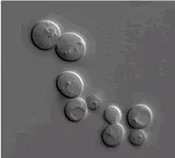 Yeast cells seen through a microscope.Copyright genetics.med.harvard.edu/~winston/
Students set up and run the experiments they designed in the Population Growth in Yeasts associated lesson, using simple yeast-molasses cultures in test tubes. Population growth is indicated by the amount of respiration occurring in the cultures, which in turn is indicated by the growth of carbon dioxide bubbles trapped within the culture tubes. Using this method, students test for a variety of environmental influences, such as temperature, food supply and pH.
This activity contains biomedical, chemical and environmental engineering and covers elements of biotechnology, applications of experimental and analytical techniques in living systems, food processing and processes of nature. Also included is a section on the interpretation of experimental data versus the interpretation of observations and the importance of using controls in any experiment.
- Students will demonstrate an understanding that several environmental factors can contribute to the population growth of simple organisms such as yeasts; these can include food supply, temperature and pH.
- CCSS.Math.Content.6.SP.B.4 Display numerical data in plots on a number line, including dot plots, histograms, and box plots.
Grade 6
Do you agree with this alignment? - CCSS.Math.Content.HSS-ID.A Summarize, represent, and interpret data on a single count or measurement variable
Grades 9-12
Do you agree with this alignment?
- Design forecasting techniques to evaluate the results of altering natural systems.
Grades 9-12
Do you agree with this alignment? - Artificial ecosystems are human-made complexes that replicate some aspects of the natural environment.
Grades 6-8
Do you agree with this alignment? - STEL-8N Use various approaches to communicate processes and procedures for using, maintaining, and assessing technological products and systems.
Grades 9-12
Do you agree with this alignment? - STEL-8Q Synthesize data and analyze trends to make decisions about technological products, systems, or processes.
Grades 9-12
Do you agree with this alignment?
- MS-LS1-5 Construct a scientific explanation based on evidence for how environmental and genetic factors influence the growth of organisms.
Grades 6-8
This resource focuses on the following Three Dimensional Learning aspects of NGSS:
Science & Engineering Practices- Construct a scientific explanation based on valid and reliable evidence obtained from sources (including the students' own experiments) and the assumption that theories and laws that describe the natural world operate today as they did in the past and will continue to do so in the future.Do you agree with this alignment?
Disciplinary Core Ideas- Genetic factors as well as local conditions affect the growth of the adult plant.Do you agree with this alignment?
Crosscutting Concepts- Phenomena may have more than one cause, and some cause and effect relationships in systems can only be described using probability.Do you agree with this alignment?
Do you agree with this alignment? - Construct a scientific explanation based on valid and reliable evidence obtained from sources (including the students' own experiments) and the assumption that theories and laws that describe the natural world operate today as they did in the past and will continue to do so in the future.
- CCSS.Math.Content.6.SP.B.4 Display numerical data in plots on a number line, including dot plots, histograms, and box plots.
Grade 6
Do you agree with this alignment? - CCSS.Math.Content.HSS-ID.A Summarize, represent, and interpret data on a single count or measurement variable
Grades 9-12
Do you agree with this alignment?
- 7.L.1 Understand the processes, structures and functions of living organisms that enable them to survive, reproduce and carry out the basic functions of life.
Grade 7
Do you agree with this alignment? - 8.L.5 Understand the composition of various substances as it relates to their ability to serve as a source of energy and building materials for growth and repair of organisms.
Grade 8
Do you agree with this alignment? - Bio.4.2.1 Analyze photosynthesis and cellular respiration in terms of how energy is stored, released, and transferred within and between these systems.
Grades 9-12
Do you agree with this alignment?
This lesson requires the same materials as were needed for the previous activity, Yeast Cells Respire, Too (But Not Like Me and You):
- large test tubes, about 15 cm long and 20 mm in diameter; one per student
- small test tubes, about 10 cm long and 8 mm in diameter; one per student
- squares cut from plastic wrap, about 8 cm on a side; one per student
- several rubber or cork stoppers, size 2
- test tube racks to hold large test tubes
- several dropping pipettes
- five 300-ml beakers
- 1-liter flask
- 1-liter graduated cylinder
- lab thermometer
- package dry baking yeast (available in grocery stores)
- 12-ounce bottle molasses (unsulphured)
- Depending on what experiments students elect to do, you may need several extra flasks (100-300 ml), graduated cylinders (10 and 100 ml), and test tube racks. You may also need a refrigerator and an incubator or other warm location, such as a sunny window sill.
- If students decide to test the effects of pH, you will need litmus paper, lemon juice or vinegar as a safe means of lowering pH, and sodium carbonate ("washing soda") as a safe means of raising pH. If using any of these chemicals, students will also need eye protection.
- You will probably also need a few more large and small test tubes for controls, and in order to have adequate sample sizes for the student experiments.
Students should demonstrate ability to meet the learning objectives of the previous lessons and activity of this curricular unit.
Read and comment on the written proposals submitted by each group at the end of the preceding lesson. Combine any groups that proposed similar experiments. Any combined groups need to agree on the details of the procedures they will follow to set up their experiment, and all groups need to organize themselves so everyone knows his or her role. When you are satisfied that the class is ready, have the groups set up and start their experiments.
Students will:
- set up their experiments
- make daily observations of the respiration chambers and measurements of the gas bubbles collected in the inverted test tubes
- after 3-4 days, determine mean daily bubble sizes for each test condition and graph the results
- present their results and conclusions to the rest of the class
Body of Activity:
Day 1
Working in their teams, have students set up their test chambers according to the plans they made earlier. It is best to set up the experiment early in the week, so there will be several consecutive days for students to make observations and measurements.
Days 2, 3 and 4
Allow time each day for students to observe their test chambers and record the heights of the gas bubbles.
On the last day, have student groups pool their data (within their groups) in order to calculate mean bubble sizes each day for each test condition. Then have them prepare graphs of these data, in the same manner as was done in Lesson 1. Establish a set of scales for the y-axes (bubble height) of the graphs that everyone in the class will use, and provide identical graph paper for everyone. This way the effects of the different environmental conditions can be easily compared between groups.
Have a spokesperson from each group give a very brief presentation to the rest of the class. The presentation should state what environmental factor was tested, and what the results were.
Then ask students what they can conclude about the most and least favorable conditions for yeast population growth. Make sure the data really do support their conclusions; it is not uncommon for students to conclude that what they expected to happen did happen, even if the data suggest otherwise. Also, be sure to ask students how what happened in their control chambers supports, or doesn't support, their hypotheses.
If students tested the effects of different molasses concentrations, they probably expected that the greater food supply available at higher concentrations would favor population growth. Instead, they most likely found that high concentrations were not favorable for yeast growth. Ask them for ideas on why that might have happened. The answer is probably due to the very high concentration gradient between the internal environment of the cells and the molasses solution. This would cause too much water to leave the yeast cells, and then cell death. The concepts of diffusion and osmosis are rather complicated for seventh graders, but you can give a simple explanation such as, "When there is too much sugar surrounding the cells, water leaks out of them and they shrivel up and die." The idea is the same as people putting salt on slugs that are garden pests. It is also why jams and jellies, which are made from fruits but contain large amounts of sugar, rarely spoil in a refrigerator, but plain fruits eventually will.
Present the following situation to students, and ask them to write down their responses:
Since she knew that humans need to have some salt in their diets, a student wanted to find out if adding salt to the molasses solution would result in faster population growth in yeast cells. She set up her experiment the same way she had done in class, using 10% molasses solution. She added ordinary table salt to the test chambers as follows:
- one-half gram of salt was added to each of three test tubes;
- 1 gram of salt was added to each of three test tubes;
- 2 grams of salt were added to each of three test tubes;
- 4 grams of salt were added to each of three test tubes; and
- no salt was added to each of three test tubes.
Starting the next day, the student recorded her data in the table below:

Based on these observations, what do you think the student concluded about the effects of salt on yeast cell populations?
- As students set up their respiration chambers, remind them not to push too hard on the rubber stopper. If the test tube breaks, it could cut into a student's fingers or hand. Be sure to have rubber gloves and clean paper towels on hand in case of accidents. Follow whatever first aid procedures are in place at your school.
- Do not allow students to taste the yeast-molasses solution at experiment end, since it could be contaminated with other microbes.
Some yeasts and other types of fungi are pathogenic to humans. Ask students what environmental conditions they think would favor such pathogens. They should be able to realize that such yeasts and other fungi would be adapted to thrive at human body temperature (about 37º C). If a student has ever had athlete's foot, he or she might recognize that a warm, moist environment favors growth of the fungus. Have students do some library or internet research to find out what some common fungal infections are, how they are treated, and how they can sometimes be prevented.
Contributors
Mary R. Hebrank
Supporting Program
Engineering K-PhD Program, Pratt School of Engineering, Duke University
Acknowledgements
This content was developed by the MUSIC (Math Understanding through Science Integrated with Curriculum) Program in the Pratt School of Engineering at Duke University under National Science Foundation GK-12 grant no. DGE 0338262. However, these contents do not necessarily represent the policies of the NSF, and you should not assume endorsement by the federal government.
Copyright
2013 by Regents of the University of Colorado; original © 2004 Duke University