
Surface Tension Lab
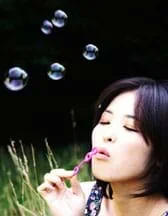 Surface tension in soap film causes the characteristic spherical shape of soap bubbles.Copyright 2004 Microsoft Corporation, One Microsoft Way, Redmond, WA 98052-6399 USA. All rights reserved.
Students extend their understanding of surface tension by exploring the real-world engineering problem of deciding what makes a "good" soap bubble. Student teams first measure this property, and then use this measurement to determine the best soap solution for making bubbles. They experiment with additives to their best soap and water "recipes" to increase the strength or longevity of the bubbles. In a math homework, students perform calculations that explain why soap bubbles form spheres.
Engineers design inkjet printers by exploiting the tendency of a continuous stream of water to break apart and form droplets. Surface tension must be finely adjusted, both for the ink to form droplets of the desired size and for the ink to adhere to the paper surface without smearing or bleeding, so part of the chemical engineering includes the "ink" formulation. Inkjet printers are also especially designed for many industrial applications, such as automotive coatings, decoration of curved and irregularly-shaped surfaces, printing conductive patterns with metallic particles, replacing screen printing on everything from ceramics to textiles, and creating rapid 3D prototypes.
After this activity, students should be able to:
- Describe the procedure developed to test the bubble mixtures, and explain how the procedure could be improved.
- Describe the criteria used to determine whether a solution created a "better" bubble, and explain how the criteria could be improved.
- CCSS.Math.Content.HSG-GMD.A.3 Use volume formulas for cylinders, pyramids, cones, and spheres to solve problems.
Grades 9-12
Do you agree with this alignment? - CCSS.Math.Content.HSN-Q.A Reason quantitatively and use units to solve problems.
Grades 9-12
Do you agree with this alignment?
- STEL-3G Explain how knowledge gained from other content areas affects the development of technological products and systems.
Grades 6-8
Do you agree with this alignment?
- HS-ETS1-2 Design a solution to a complex real-world problem by breaking it down into smaller, more manageable problems that can be solved through engineering.
Grades 9-12
This resource focuses on the following Three Dimensional Learning aspects of NGSS:
Science & Engineering Practices- Design a solution to a complex real-world problem, based on scientific knowledge, student-generated sources of evidence, prioritized criteria, and tradeoff considerations.Do you agree with this alignment?
Disciplinary Core Ideas- Criteria may need to be broken down into simpler ones that can be approached systematically, and decisions about the priority of certain criteria over others (trade-offs) may be needed.Do you agree with this alignment?
Do you agree with this alignment? - Design a solution to a complex real-world problem, based on scientific knowledge, student-generated sources of evidence, prioritized criteria, and tradeoff considerations.
- HS-PS2-6 Communicate scientific and technical information about why the molecular-level structure is important in the functioning of designed materials.
Grades 9-12
This resource focuses on the following Three Dimensional Learning aspects of NGSS:
Science & Engineering Practices- Communicate scientific and technical information (e.g. about the process of development and the design and performance of a proposed process or system) in multiple formats (including orally, graphically, textually, and mathematically).Do you agree with this alignment?
Disciplinary Core Ideas- Attraction and repulsion between electric charges at the atomic scale explain the structure, properties, and transformations of matter, as well as the contact forces between material objects.Do you agree with this alignment?
Crosscutting Concepts- Investigating or designing new systems or structures requires a detailed examination of the properties of different materials, the structures of different components, and connections of components to reveal its function and/or solve a problem.Do you agree with this alignment?
Do you agree with this alignment? - Communicate scientific and technical information (e.g. about the process of development and the design and performance of a proposed process or system) in multiple formats (including orally, graphically, textually, and mathematically).
- CCSS.Math.Content.HSG-GMD.A.3 Use volume formulas for cylinders, pyramids, cones, and spheres to solve problems.
Grades 9-12
Do you agree with this alignment? - CCSS.Math.Content.HSN-Q.A Reason quantitatively and use units to solve problems.
Grades 9-12
Do you agree with this alignment?
- PSc.2.1.3 Compare physical and chemical properties of various types of matter.
Grades 9-12
Do you agree with this alignment?
Each group needs:
- paper cups
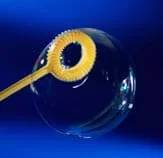 A bubble wand.Copyright 2004 Microsoft Corporation, One Microsoft Way, Redmond, WA 98052-6399 USA. All rights reserved.
 - liquid soap (variation idea: give different brands to different groups for students to compare)
- bubble wand (available at discount, toy and dollar stores)
- water
- measuring cups
- spoons
- ruler
- stopwatch
- safety goggles or glasses for eye protection
- Bubble Surface Tension Lab Handout (PDF), one per person
- Why Do Liquid Jets Form Droplets? (PDF) (homework), one per person
(Begin with the associated lesson, and its Introduction/Motivation talk, to set the stage for conducting this activity with students. The lesson provides photos, short videos and background information on surface tension, adhesive forces and engineering applications.)
What do we know about surface tension? What have we observed by closely examining falling water (such as from a faucet or hose)? (Listen to student answers; recap with points below, as necessary):
- Water in a stream or jet starts out in a cylindrical column, and ends up as droplets. This also happens to ink ejected from the nozzles of inkjet printers.
- Water molecules really like to stick together and that causes water to act the way it does. Intermolecular (cohesive) forces cause liquid molecules to be attracted to each other and they pull liquid molecules towards each other. At the liquid/air interface, without these forces from the air side, the outer layer of the liquid acts like a stretched membrane and moves to minimize the surface energy, creating what we call surface tension.
- So at the surface, the liquid molecules move to create the least surface area possible, as a way to minimize the stretching of the skin, and lower the amount of energy in tension on the surface. And so falling water (and the sprayed ink in inkjet printers) forms into spheres.
- The water forms into round drops (not cubes or any other shape) because spheres are the shape with the least amount of surface area for a given volume of liquid.
- Mixing soap (a surface-active agent or surfactant) with water lowers surface tension, and that's how we can create soap bubbles. With a lower surface tension, the air/liquid surface is more "stretchy." By contrast, high surface tensions encourage liquids to bead rather than spread evenly across surfaces.
- (Continue by asking the pre-activity discussion questions, as provided in the Assessment section.)
Have you ever tried to make your own soap bubble solution? How well did it work? (Usually, some students have done this. Let them describe whether or not the solutions worked, and how well they worked.) Getting the surface tension just right to make a really good soap bubble can be tricky. Today we are going to try to figure out the perfect recipe for making soap bubbles.
Background
Droplets form due to the surface tension of the liquid—a larger surface area requires more energy to maintain due to the molecular forces associated with surface tension. When water transitions from a column into droplets, the same volume of water requires a smaller surface area and therefore requires less energy. These are suggested procedures, which you may need to alter, depending on student level, time constraints, and material availability.
Before the Activity
- Gather materials and organize lab stations.
- Make copies of Bubble Surface Tension Lab Handout (PDF) and Why Do Liquid Jets Form Droplets? (PDF) math homework.
With the Students
- Divide the class into lab groups, and send them to lab stations.
- Have students use the lab handout to conduct all four parts of the lab, answering questions as they go.
- Part 1: What makes a good soap bubble? Students decide how to measure whether a soap bubble is "good" or not. For example, they might measure how large the bubble is, how long it lasts, or how far it floats once it leaves the wand.
- Part 2: Soap and Water Bubbles: Students describe procedures for testing mixtures of soap (surfactant) and water for their bubble-making abilities, record their results, and indicate which mixture performed best.
- Part 3: Additional Additives: Students refine their recipes by adding a third additive to the best mixture from Part 2, in varying amounts, to improve their solutions.
- Part 4: Analysis and Reflection: Students describe their best soap bubble recipes and assess how their measurements and procedures could be improved.
- Conclude with team-to-team presentations and discussions of lab techniques, procedures and results, and have students create summary documents. This post-activity assessment is described in the Assessment section.
- Assign the math homework, as described in the Assessment section.
Pre-Activity Assessment
Discussion Questions: Ask the students and discuss as a class:
- How do water bugs walk on the surface of the water? (Answer: They are light enough that they do not overcome the attraction of the molecules on the surface of the water.)
- Why do soap bubbles form spheres instead of cubes? (Students will learn the answer to this question during the activity. Answer: The soap bubble acts like a rubber band and takes on the smallest shape it can with the air still trapped inside.)
- What happens when a soap bubble pops? (Answer: The air is no longer trapped inside and the soap surface acts like a snapped rubber band and quickly contracts.)
- Why do you need soap to create a soap bubble? (Answer: The soap lowers the surface tension and makes the surface more "stretchy.")
Activity Embedded Assessment
Activity Questions: In this activity, students extend their understanding of surface tension to the real-world engineering problem of deciding what makes a "good" soap bubble and how to measure this property; they use this measurement to determine the best soap solution for creating bubbles. By answering the questions on the Bubble Surface Tension Lab Handout (PDF), students demonstrate their thought processes. Gauge student comprehension by circulating throughout the classroom, asking students how they answered different questions.
Post-Activity Assessment
Present to Others: After all groups are finished, or during the following class period, assign students from different lab groups to different "discussion" groups. Within each group, direct the members to describe their measurement techniques, procedures and results. Have each discussion group create a document that:
- Summarizes the measurement techniques used and the strengths and weaknesses of each.
- Describes an example procedure that includes lessons learned from performing the experiment.
- Summarizes the results found by each member of the discussion group.
- Uses the combined results to suggest further experiments to improve the bubble solution.
Homework
Why Does a Liquid Jet Form Droplets? In this homework assignment (see attachment (PDF)), students calculate the surface area for the same volume taking three different shapes. They see that the shape that creates the least amount of surface area is spherical drops. Note to teacher: Although not discussed in the homework, the liquid droplets must have a certain minimum radius before they are preferable to the cylindrical column in terms of surface area. If the liquid broke up into water droplets with radii smaller than the radius of the cylinder, for example, that would actually increase the surface area of the water. The larger the radius of a liquid jet, then the larger droplets the jet forms in order to decrease surface area.
- Use eye protection during this activity.
Be aware of the two most common problems in this lab, which students may discover on their own and include in their own assessment of their procedures:
- Not thoroughly rinsing cups before reusing
- Not rinsing bubble wands between uses
Have teams test and compare different brands of liquid soap.
If this activity is used in a physics class, modify the soap bubble portion to include the diffraction of light and the colors of the soap bubble. These colors depend on the thickness of the soap film. This is similar to the colors produced by a thin film of oil on water.
Contributors
Jean Stave; Chuan-Hua Chen
Supporting Program
NSF CAREER Award and RET Program, Mechanical Engineering and Material Science, Pratt School of Engineering, Duke University
Acknowledgements
This digital library content was developed under an NSF CAREER Award (CBET- 08-46705) and an RET supplement (CBET-10-09869). However, these contents do not necessarily represent the policies of the National Science Foundation, and you should not assume endorsement by the federal government.
Copyright
2013 by Regents of the University of Colorado; original © 2011 Duke University