
Surface Tension
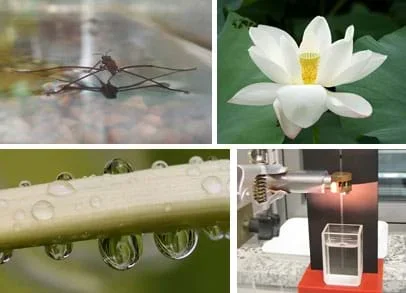 Surface tension can be seen in a variety of placesCopyright (left to right) Tim Vickers, Jakub Halun, Michael Krahe, Muhmmad Mahdi Karim, Wikimedia Commons http://commons.wikimedia.org/wiki/File:Water_strider.jpg http://commons.wikimedia.org/wiki/File:20090809_Lotus_flower_2736.jpg http://commons.wikimedia.org/wiki/File:Oberfl%C3%A4chenspannung_Kapillareffekt.jpg http://commons.wikimedia.org/wiki/File:Flower_reflections_in_raindrop.jpg
Lesson 1: The first lesson introduces surface tension and adhesive forces and explores the question of why liquid jets break into water droplets rather than remaining in continuous streams. In the associated activity, students use common household materials to explore surface tension phenomena and surfactants; they determine their own best soap solutions for making bubbles and experiment with additives. Calculations from a math homework explain why soap bubbles form into spheres.
Lesson 2: The second lesson builds on the first by introducing cohesive forces and demonstrating how the combination of adhesive forces and cohesive forces cause capillary motion. By studying the capillary motion of a liquid, its surface tension can be measured. Two activities are associated with this lesson: in the first, students study different effects of capillary motion; in the second, for more advanced students, they use capillary motion to measure the surface tension of water.
Lesson 3: The third lesson introduces the concepts of wetting and hydrophobic and hydrophilic surfaces. These phenomena also depend on the surface tension of the liquid and the strength of a liquid's attraction to the surface. In the associated activity, students explore how water's behavior changes when a surface is treated with different coatings.
Lesson 4: The fourth and final lesson in this unit introduces superhydrophobic surfaces with the lotus leaf being a natural example. Superhydrophobic surfaces are covered with tiny protrusions that trap a thin layer of air between a water droplet and the surface, and the air cushion gives rise to the water-repellent, self-cleaning property of the lotus leaf. In the associated activity, students examine the lotus effect on natural leaves and human-made superhydrophobic surfaces (an example of biomimicry), and explore how the lotus leaf repels dewy water through vibration.
Understanding the effects of surface tension has implications in a wide variety of engineering fields. For example, the functioning of the widely-used inkjet printer depends on the surface tension of the ink turning a jet of liquid into droplets that can be deployed into position. Environmental and chemical engineers study the interactions between surface tension and chemicals as they develop technologies to remove pollutants from our water and air resources. The surface tension of paints and other surface coatings is carefully designed to ensure that the coating spreads easily while maintaining a desired film thickness. Another consequence of surface tension, the wetting or beading of a liquid on a surface, is important in the design of coatings that to improve visibility through vehicle windows by helping water to shed quickly on the outside of windows while avoiding the formation of tiny droplets of condensation that create a "foggy" appearance on the inside of windows. Integrating the scientific understanding of capillarity and wetting, chemical engineers have created modern materials and coatings so that clothing and other surfaces repel water and are self-cleaning.
- Knowledge gained from other fields of study has a direct effect on the development of technological products and systems.
Grades 6-8
Do you agree with this alignment?
- HS-PS1-3 Plan and conduct an investigation to gather evidence to compare the structure of substances at the bulk scale to infer the strength of electrical forces between particles.
Grades 9-12
This resource focuses on the following Three Dimensional Learning aspects of NGSS:
Science & Engineering Practices- Plan and conduct an investigation individually and collaboratively to produce data to serve as the basis for evidence, and in the design: decide on types, how much, and accuracy of data needed to produce reliable measurements and consider limitations on the precision of the data (e.g., number of trials, cost, risk, time), and refine the design accordingly.Do you agree with this alignment?
Disciplinary Core Ideas- The structure and interactions of matter at the bulk scale are determined by electrical forces within and between atoms.Do you agree with this alignment?
Crosscutting Concepts- Different patterns may be observed at each of the scales at which a system is studied and can provide evidence for causality in explanations of phenomena.Do you agree with this alignment?
Do you agree with this alignment? - Plan and conduct an investigation individually and collaboratively to produce data to serve as the basis for evidence, and in the design: decide on types, how much, and accuracy of data needed to produce reliable measurements and consider limitations on the precision of the data (e.g., number of trials, cost, risk, time), and refine the design accordingly.
- HS-PS2-6 Communicate scientific and technical information about why the molecular-level structure is important in the functioning of designed materials.
Grades 9-12
This resource focuses on the following Three Dimensional Learning aspects of NGSS:
Science & Engineering Practices- Communicate scientific and technical information (e.g. about the process of development and the design and performance of a proposed process or system) in multiple formats (including orally, graphically, textually, and mathematically).Do you agree with this alignment?
Disciplinary Core Ideas- Attraction and repulsion between electric charges at the atomic scale explain the structure, properties, and transformations of matter, as well as the contact forces between material objects.Do you agree with this alignment?
Crosscutting Concepts- Investigating or designing new systems or structures requires a detailed examination of the properties of different materials, the structures of different components, and connections of components to reveal its function and/or solve a problem.Do you agree with this alignment?
Do you agree with this alignment? - Communicate scientific and technical information (e.g. about the process of development and the design and performance of a proposed process or system) in multiple formats (including orally, graphically, textually, and mathematically).
- Day 1: Surface Tension Basics lesson
- Day 2: Surface Tension Lab activity
- Day 3: Capillarity—Measuring Surface Tension lesson
- Day 4: Exploring Capillary Action activity
- Day 5-6: Measuring Surface Tension activity
- Day 7: Wetting and Contact Angle lesson
- Day 8: Investigating Contact Angle activity
- Day 9: Superhydrophobicity — The Lotus Effect lesson
- Day 10: Exploring the Lotus Effect activity
Contributors
Jean Stave; Chuan-Hua Chen; Jonathan Boreyko
Supporting Program
NSF CAREER Award and RET Program, Mechanical Engineering and Material Science, Pratt School of Engineering, Duke University
Acknowledgements
This digital library content was developed under an NSF CAREER Award (CBET- 08-46705) and an RET supplement (CBET-10-09869). However, these contents do not necessarily represent the policies of the National Science Foundation, and you should not assume endorsement by the federal government.
Copyright
2013 by Regents of the University of Colorado; original © 2011 Duke University