
Investigating Contact Angle
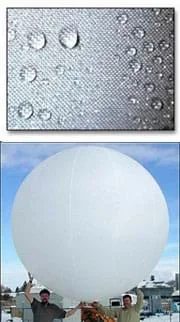 The water repellent treatment on this tight-weave fabric causes water to bead up and roll off. NOAA uses this tough material for its "smart balloons," which are launched into the atmosphere for hurricane research and weather measurement tasks.Copyright NOAA http://www.noaa.inel.gov/capabilities/smartballoon/smartballoon.htm
Students observe how water acts differently when placed on hydrophilic and hydrophobic surfaces. They determine which coatings are best to cause surfaces to shed water quickly or reduce the "fogging" caused by condensation.
Engineers who design liquids and/or whose products come in contact with liquids must understand the science of contact angles—a liquid's tendency to either bead or sheet on a solid surface—which is determined by the properties of both the surface and the liquid. The resulting hydrophilic ("water loving") and hydrophobic ("water hating") surfaces have important applications in all types of engineering, including chemical, automotive, nautical, industrial and civil engineering. A hydrophilic anti-fog coating on glass causes condensation to form into a thin, even layer of water instead of droplets, so the glass remains transparent. On a windshield with a hydrophobic rain-repellent glass treatment, water beads and rolls off the surface, improving visibility (and safety). Hydrophobic surfaces are also important in protecting surfaces from water damage and stains.
After this activity, students should be able to:
- Describe the behavior of water on hydrophobic and hydrophilic surfaces and explain in general terms what causes the differences in behavior.
- Discuss situations in which applying a hydrophilic or hydrophobic surface would be advantageous.
- Chemical technologies provide a means for humans to alter or modify materials and to produce chemical products.
Grades 9-12
Do you agree with this alignment? - STEL-3G Explain how knowledge gained from other content areas affects the development of technological products and systems.
Grades 6-8
Do you agree with this alignment? - STEL-4S Develop a solution to a technological problem that has the least negative environmental and social impact.
Grades 9-12
Do you agree with this alignment?
- HS-PS1-3 Plan and conduct an investigation to gather evidence to compare the structure of substances at the bulk scale to infer the strength of electrical forces between particles.
Grades 9-12
This resource focuses on the following Three Dimensional Learning aspects of NGSS:
Science & Engineering Practices- Plan and conduct an investigation individually and collaboratively to produce data to serve as the basis for evidence, and in the design: decide on types, how much, and accuracy of data needed to produce reliable measurements and consider limitations on the precision of the data (e.g., number of trials, cost, risk, time), and refine the design accordingly.Do you agree with this alignment?
Disciplinary Core Ideas- The structure and interactions of matter at the bulk scale are determined by electrical forces within and between atoms.Do you agree with this alignment?
Crosscutting Concepts- Different patterns may be observed at each of the scales at which a system is studied and can provide evidence for causality in explanations of phenomena.Do you agree with this alignment?
Do you agree with this alignment? - Plan and conduct an investigation individually and collaboratively to produce data to serve as the basis for evidence, and in the design: decide on types, how much, and accuracy of data needed to produce reliable measurements and consider limitations on the precision of the data (e.g., number of trials, cost, risk, time), and refine the design accordingly.
- Phy.1.2.4 Explain the effects of forces (including weight, normal, tension and friction) on objects.
Grades 9-12
Do you agree with this alignment? - PSc.2.1.3 Compare physical and chemical properties of various types of matter.
Grades 9-12
Do you agree with this alignment?
Each group needs:
- 3-5 pre-treated microscope slides
- beaker
- pipette
- magnifying glass
- stopwatch
- hot plate
- tongs
- lab gloves
- eye protection
- Investigating Contact Angle Worksheet (PDF), one per student
To share with the entire class:
- 2-4 types of water-repellent products with which to pre-treat glass slides for each team, such as Rain-X® Glass Treatment ($9), Rain-X® Anti-Fog™ ($8), Rain-X® 2-in-1 Glass Cleaner and Rain Repellent ($7), and G-Glass® Totally Green Hydrophobic Rain Repellent ($7)
- marker or wax pencil to label glass slides
- (optional) paper towels, sponge, mop, in case of spills
Familiarity with surface tension, cohesive forces and adhesive forces, as explored in previous lessons in this unit.
(Begin with the associated lesson, and its Introduction/Motivation talk, to set the stage for conducting this activity with students. The lesson provides images and background information on contact angle, wetting, hydrophilic or hydrophobic surfaces. As necessary, refresh with the following questions to students:)
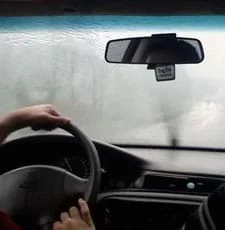 While driving, visibility can be reduced by the rain falling outside and the condensation forming on the windshield inside. Visibility can be improved by changing the surface properties of the windshield.Copyright Malinaccieri, Wikimedia Commons http://commons.wikimedia.org/wiki/File:Rain_on_windscreen.jpg
The way water interacts with the surface of an object influences the shape of the water droplets and can have important consequences. In today's lab, you will learn more about different surface coatings and their uses. First, let's review:
- What causes fog to be hard to see through? ...Either fog in the atmosphere, or fogging that you see on glass or mirrors or goggles? (Even though they're not the same thing, both atmospheric fog and "window" fog are made of tiny droplets of water. In both cases, the tiny droplets scatter light in all directions rather than allowing light to pass straight through.)
- Would increasing or decreasing the attraction of the water for the glass improve visibility on the inside of a car window? What could you do to make visibility better? (If you caused the water to spread out and form a layer of water rather than droplets [increased the attraction], it would get rid of the fogginess and improve visibility because you can see through a very thin layer of water. You want the surface to be hydrophilic, or "water loving." You could apply a hydrophilic anti-fog coating to the glass so that any condensation forms into a thin, even layer of water instead of droplets and the glass remains transparent.)
- To see better through a windshield being pounded with rain, how would you want the water to behave? Do you want the water to stick to the surface or roll off of it? What could you do to make visibility better? (With so much water, you want it to form droplets, not spread out. You want the surface to be hydrophobic or "water-hating," so the water moves off the glass as quickly as possible. You could apply a hydrophobic rain-repellant glass treatment to the outside of the windshield to cause water to bead and roll off the surface easily.)
- And what do contact angles have to do with it? (A contact angle is a liquid's tendency to either bead or sheet on a solid surface and is determined by the properties of both the surface and the liquid.)
- So, when would it be advantageous to use a hydrophobic material? When would it be advantageous to use a hydrophilic material? (See pre-assessment activity in the Assessment section.)
Today, we will explore the differences between water-loving (hydrophilic) and water-hating (hydrophobic) surfaces and how we can use this information to create products that make driving safer.
Background
These are suggested procedures, which you may need to alter, depending on student level, time constraints, and availability of materials.
Before the Activity
- For each team, coat a set of 3-5 glass slides, each with different surface treatments. Label them A-E. (Note: only A, B and C are necessary for this lab.) For example: A = Untreated glass, B = Rain-X® Glass Treatment, C = Rain-X® Anti-Fog™, D = Rain-X® 2-in-1 Glass Cleaner, and Rain Repellent E = G-Glass® Totally Green Hydrophobic Rain Repellent.
- Gather materials and organize the lab stations.
- Make copies of the Investigating Contact Angle Worksheet (PDF) and The Charges of Water Worksheet (PDF).
With the Students
Divide the class into lab groups and send them to the lab stations. To guide their lab investigations, hand out the worksheets, which include instructions and procedures, tables to record data and observations, and questions to answer as they go.
A. Observing Surface Coatings
- Have students place a water droplet on each slide and make observations about its appearance (see Figure 1).
- Tilt each slide and observe the motion of the water droplet. Make observations and sketches.
- Record the type of surface behavior (hydrophilic or hydrophobic) for each slide.
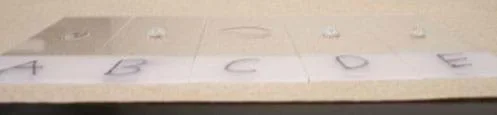 Figure 1. Water droplets on microscope slides with different coatings. A and C are hydrophilic and spread out to cover more area; B, D and E are hydrophobic and reduce the area of glass they cover.Copyright 2010 Jean Stave
B. Increasing Visibility in a Rainstorm
- Have students make predictions about which type of surface treatment will allow water to flow off the slide the fastest.
- Fill a small beaker with water.
- Pour water down the side of each slide and record observations.
- Decide which surface treatment was best for shedding rain during a storm.
C. Anti-Fogging Properties
- Fill a beaker with water and place it on a hot plate. Turn heat to medium.
- Once water is hot, but not boiling, hold each glass slide above the beaker for 30 seconds. Note whether the slide has collected condensation and whether visibility has been reduced by the slide becoming foggy (see Figure 2).
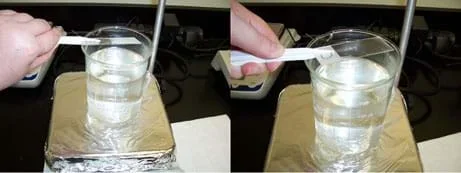 Figure 2. Testing the anti-fogging properties of glass coatings. The "fog" that forms when water condenses on glass is formed by many tiny water droplets. If the glass surface is hydrophobic (left) the droplets remain separate and scatter light. If the glass surface is hydrophilic (right) the droplets coalesce into a thin, uniform layer of water that does not scatter much light.Copyright 2010 Jean Stave
Conclusion
- After the lab is finished, lead a class discussion comparing results and answers.
- Have students guess which coating came from which product. Once students have decided, reveal the product on each slide to see if they were right.
- Assign students to do a web search for hydrophobic and hydrophilic products and report on their findings, as described in the Assessment section.
Pre-Activity Assessment
Opening Questions: Have students write on note cards their answers to the questions, below. They can answer individually or work with a partner.
- When would it be advantageous to use a hydrophobic material? (Hydrophobic surfaces protect objects from water and stains, think of rain coats, outdoor furniture cushions, self-cleaning fabrics, paper cups and plates, boat hulls and decks, table and kitchen surfaces, and automobile waxes.)
- When would it be advantageous to use a hydrophilic material? (Hydrophilic surfaces help with minimizing fogging, items such as water hoses that need to allow liquids to flow easily and surfaces to be painted so they will accept the coating better.)
Activity Embedded Assessment
Activity Questions: Students demonstrate their thought processes during the activity by answering the questions on the Investigating Contact Angle Worksheet (PDF). Students extend their learning to real-world engineering problems, such as:
- Predicting and testing how changing the contact angle between water and glass changes the visibility of glass in a rainstorm.
- Predicting and testing how changing the contact angle between water and glass changes the fogging properties of glass.
Gauge student comprehension by circulating throughout the classroom, asking students how they answered certain worksheet questions.
Post-Activity Assessment
The Charges of Water Worksheet: To compare the strength of electrical forces between particles to the structure of substances at the bulk scale, have students complete The Charges of Water Worksheet, either in class or as homework. For more information on how the molecules in Rain-X® repel water, visit: "The Science of Rain-X" at http://hydrophobicsam.blogspot.com/2012/03/science-of-rain-x.html.
Web Search: Either in class or for homework, assign students to look online for products that claim to be either hydrophobic or hydrophilic. For each product found, answer the following questions:
- What is the product name?
- What company manufactures it?
- Where is it sold?
- How does its hydrophobic or hydrophilic properties improve the product? (benefits)
- How much does the product cost?
- Are any safety precautions suggested for when using this product?
- Wear gloves when handling coated glass slides.
- Inform students of proper procedures for disposal of broken glass.
- Have paper towels and a mop handy in case of water spills.
- For Part A, remind students that when they pour water down the slides, to do it over a sink.
- For Part C: Hot plates should not be turned up to full power. The water should be hot, but not boiling.
- For Part C: Remind students that hot glass may not look hot.
- Especially for Part C, wear safety goggles.
It is best to wear gloves when handling coated glass. The oils from your hands eventually destroy the surface coating effects.
Study the self-cleaning lotus effect using a piece of lotus leaf (dried lotus can be purchased in Asian grocery stores), another type of superhydrophobic leaf, or a self-cleaning fabric such as Nano-Tex™. Find information and lab activities for superhydrophobic surfaces in the Superhydrophobicity - The Lotus Effect lesson.
Assign a student group to research new polymers created by chemical engineers that result in super slick surfaces useful for a multitude of medical, technical and industrial applications. Start with the National Science Foundation's website, "New Non-Stick? Many Uses Possible From "Squeezed" Molecules," at https://www.nsf.gov/od/lpa/news/press/00/pr0095.htm.
de Gennes, Pierre-Gilles. "Wetting—Statics and Dynamics." Reviews of Modern Physics, American Physical Society. 57 (1985): 827-863. Accessed September 1, 2010. http://rmp.aps.org/abstract/RMP/v57/i3/p827_1
de Gennes, Pierre-Gilles, et al. Capillarity and Wetting Phenomena: Drops, Bubbles, Pearls, Waves. New York, NY: Springer, 2004. (Engineering connections.)
Contributors
Jean Stave; Professor Chuan-Hua Chen; Jonathan Boreyko
Supporting Program
NSF CAREER Award and RET Program, Mechanical Engineering and Material Science, Pratt School of Engineering, Duke University
Acknowledgements
This digital library content was developed under an NSF CAREER Award (CBET- 08-46705) and an RET supplement (CBET-10-09869). However, these contents do not necessarily represent the policies of the National Science Foundation, and you should not assume endorsement by the federal government.
Copyright
2013 by Regents of the University of Colorado; original © 2011 Duke University