
Race to the Top! Modeling Skyscrapers
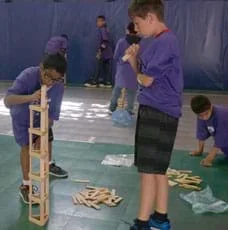 Students use a set number of Kapla blocks to make the tallest, weight-bearing towers possible.Copyright 2015 Elementary MESA Day Competition, University of California Davis
Working individually or in pairs, students compete to design, create, test and redesign free-standing, weight-bearing towers using Kapla® wooden blocks. The challenge is to build the tallest tower while meeting the design criteria and minimizing the amount of material used—all within a time limit. Students experiment with different geometric shapes used in structural designs and determine how design choices affect the height and strength of structures, becoming comfortable with the concepts of structural members and modeling. This activity is part of a unit in which multiple activities are brought together for an all-day school/multi-school concluding “engineering field day” competition.
Every day, engineers encounter challenges, perhaps to design the newest gadget or the tallest skyscraper or other large structures—but always with specific design constraints. The taller the skyscraper or the larger the structure, the more material required to support it. However, engineers are able to design large structures that minimize the material used, while maximizing the size. In this activity, students act as structural engineers as they design, build and test models of free-standing, weight-bearing towers that meet design objectives within limitations.
After this activity, students should be able to:
- Describe and design models for free-standing weight-bearing towers.
- Identify effective geometric shapes used in tower design.
- List several factors that engineers consider when designing tall structures.
- 5.G.B Classify two-dimensional figures into categories based on their properties.
Grade 5
Do you agree with this alignment? - 3.G.A Reason with shapes and their attributes.
Grade 3
Do you agree with this alignment?
- 3-5-ETS1-1 Define a simple design problem reflecting a need or a want that includes specified criteria for success and constraints on materials, time, or cost.
Grades 3-5
Do you agree with this alignment? - 3-5-ETS1-2 Generate and compare multiple possible solutions to a problem based on how well each is likely to meet the criteria and constraints of the problem.
Grades 3-5
Do you agree with this alignment? - 3-5-ETS1-3 Plan and carry out fair tests in which variables are controlled and failure points are considered to identify aspects of a model or prototype that can be improved.
Grades 3-5
Do you agree with this alignment?
- CCSS.Math.Content.3.G.A Reason with shapes and their attributes.
Grade 3
Do you agree with this alignment? - CCSS.Math.Content.5.G.B Classify two-dimensional figures into categories based on their properties.
Grade 5
Do you agree with this alignment?
- Students will develop an understanding of the attributes of design.
Grades K-12
Do you agree with this alignment? - Students will develop an understanding of engineering design.
Grades K-12
Do you agree with this alignment? - Students will develop abilities to apply the design process.
Grades K-12
Do you agree with this alignment? - Models are used to communicate and test design ideas and processes.
Grades 3-5
Do you agree with this alignment? - Design involves a set of steps, which can be performed in different sequences and repeated as needed.
Grades 6-8
Do you agree with this alignment? - STEL-4N Analyze examples of technologies that have changed the way people think, interact, and communicate.
Grades 6-8
Do you agree with this alignment? - STEL-7C Explain that design is a response to wants and needs.
Grades -1-2
Do you agree with this alignment? - STEL-7M Evaluate the strengths and weaknesses of existing design solutions, including their own solutions.
Grades 3-5
Do you agree with this alignment?
- 3-5-ETS1-1 Define a simple design problem reflecting a need or a want that includes specified criteria for success and constraints on materials, time, or cost.
Grades 3-5
This resource focuses on the following Three Dimensional Learning aspects of NGSS:
Science & Engineering Practices- Define a simple design problem that can be solved through the development of an object, tool, process, or system and includes several criteria for success and constraints on materials, time, or cost.Do you agree with this alignment?
Disciplinary Core Ideas- Possible solutions to a problem are limited by available materials and resources (constraints). The success of a designed solution is determined by considering the desired features of a solution (criteria). Different proposals for solutions can be compared on the basis of how well each one meets the specified criteria for success or how well each takes the constraints into account.Do you agree with this alignment?
Crosscutting Concepts- People's needs and wants change over time, as do their demands for new and improved technologies.Do you agree with this alignment?
Do you agree with this alignment? - Define a simple design problem that can be solved through the development of an object, tool, process, or system and includes several criteria for success and constraints on materials, time, or cost.
- 3-5-ETS1-2 Generate and compare multiple possible solutions to a problem based on how well each is likely to meet the criteria and constraints of the problem.
Grades 3-5
This resource focuses on the following Three Dimensional Learning aspects of NGSS:
Science & Engineering Practices- Generate and compare multiple solutions to a problem based on how well they meet the criteria and constraints of the design problem.Do you agree with this alignment?
Disciplinary Core Ideas- Research on a problem should be carried out before beginning to design a solution. Testing a solution involves investigating how well it performs under a range of likely conditions.Do you agree with this alignment?
- At whatever stage, communicating with peers about proposed solutions is an important part of the design process, and shared ideas can lead to improved designs.Do you agree with this alignment?
Crosscutting Concepts- Engineers improve existing technologies or develop new ones to increase their benefits, to decrease known risks, and to meet societal demands.Do you agree with this alignment?
Do you agree with this alignment? - Generate and compare multiple solutions to a problem based on how well they meet the criteria and constraints of the design problem.
- 3-5-ETS1-3 Plan and carry out fair tests in which variables are controlled and failure points are considered to identify aspects of a model or prototype that can be improved.
Grades 3-5
This resource focuses on the following Three Dimensional Learning aspects of NGSS:
Science & Engineering Practices- Plan and conduct an investigation collaboratively to produce data to serve as the basis for evidence, using fair tests in which variables are controlled and the number of trials considered.Do you agree with this alignment?
Disciplinary Core Ideas- Tests are often designed to identify failure points or difficulties, which suggest the elements of the design that need to be improved.Do you agree with this alignment?
- Different solutions need to be tested in order to determine which of them best solves the problem, given the criteria and the constraints.Do you agree with this alignment?
Do you agree with this alignment? - Plan and conduct an investigation collaboratively to produce data to serve as the basis for evidence, using fair tests in which variables are controlled and the number of trials considered.
Each group needs:
- 75 Kapla® blocks; classroom sets of these reusable construction plank blocks are available from Amazon.com, such as a 200-block set for $60 and a 1,000-block set for $300, ~30¢ per block; also see kaplaus.com
- stable chairs, for students to stand on
- Pre-Activity Quiz (PDF), one per student
- Race to the Top! Worksheet (PDF), one per student
- Post-Activity Quiz (PDF), one per student
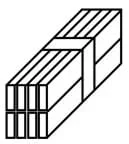 Figure 1. Schematic of test weight made from eight Kapla blocks and tape.Copyright 2015 Elementary MESA Day Competition, University of California Davis
To share with the entire class:
- test weight, made of eight Kapla® blocks held together with masking tape (see Figure 1)
- tape measure or meter stick
- Pre-Activity Quiz (docx)
- Pre-Activity Quiz (pdf)
- Pre-Activity Quiz Answer Key (docx)
- Pre-Activity Quiz Answer Key (pdf)
- Competition Rules (docx)
- Competition Rules (pdf)
- Race to the Top! Worksheet (docx)
- Race to the Top! Worksheet (pdf)
- Race to the Top! Worksheet Answer Key (docx)
- Race to the Top! Worksheet Answer Key (pdf)
- Post-Activity Quiz (docx)
- Post-Activity Quiz (pdf)
- Post-Activity Quiz Answer Key (docx)
- Post-Activity Quiz Answer Key (pdf)
A basic understanding of gravity, the engineering design process, and how to use a ruler or tape measure.
Today, you are going to be creative and well-respected structural engineers. You have been asked by the mayor of San Francisco to design and build the tallest skyscraper to beat the height of the Burj Khalifa in Dubai (~830 m; see Figure 2) and bring the title of tallest skyscraper in the world back to the U.S. However, the mayor also wants you to use the fewest number of structural members so as to reduce the cost of materials since the city wants to save as much money as possible.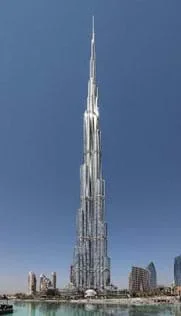 Figure 2. At 829.8 meters high, the Burj Khalifa in Dubai has been the tallest skyscraper in the world since 2010.Copyright 2012 Donaldytong, Wikipedia—The Free Encyclopedia https://en.wikipedia.org/wiki/File:Burj_Khalifa.jpg
Engineers use small-scale models to design and evaluate structures every day. Why might it be important for engineers to use models? (Lead students to discuss the various steps of the engineering design process, which involve testing and revising designs many times.) Engineers use models to save time and resources, including materials and money. To test your design ideas for the tallest skyscraper in the world, you will use Kapla® blocks to create skyscraper models.
In addition to using the fewest materials, skyscrapers and towers must meet two other very important design criteria in order to be safe: they need to be free-standing and weight-bearing.
Raise your hand if you know what weight-bearing means. (Wait to see if any hands are raised; if none, call on a student to share what s/he thinks it might mean.) Weight bearing means that a structure is capable of supporting weight other than the weight of its members (its own structural materials, such as the columns and beams that compose the structure). This means that the structure is able to support people, furniture, bathtubs, refrigerators, many feet of snow, and any other things that the engineer thinks might go into or onto the structure.
Raise your hand if you know what free-standing means. Free-standing means that a structure does not require any additional support to keep it standing and this includes guy wires. (You may have seen guy wires used to help hold up utility poles, radio towers, ship masts and tents.)
So this is your engineering challenge: Your structure needs to be as tall as possible and must be able to support additional weight besides its members and be able to stand up by itself.
Overview
Students are challenged to design and build the tallest possible free-standing tower using Kapla® wooden blocks. Working alone or in pairs, they are given 75 blocks and 30 minutes to build the towers. During this construction time, they may rebuild the tower any number of times, but no work may occur after the time limit. Students may stand on chairs to aid in construction. After 30 minutes, or as often as a team indicates it is ready before the time limit, the tower height is tested and measured.
To test, one team member places a test weight of eight blocks held together with masking tape (see Figure 1) on the tower in any orientation. Once the instructor judges that the tower is stable, s/he measures the perpendicular distance from the foundation surface to the highest block that is completely below the test weight, and counts the number of unused blocks. Towers made from 75 Kapla® blocks can reach heights greater than 175 cm (69 inches). To break a tie for the tallest tower, the structure made with the fewest blocks wins.
Background
Constructing Kapla® block towers requires patience, balance and forethought. Encourage students to redesign many times during the activity as they attempt to construct the tallest tower using the fewest number of blocks.
Since all the blocks have the exact same geometries, with a set ratio of 1:3:15, the most efficient approach to constructing the tallest tower is to make use of the block's longest length in the vertical rise. Successful towers use both vertical and horizontal members to increase the height and the weight-bearing potential of the structure. For every block added to increase the vertical height, a block should be placed to span a horizontal distance between at least two other blocks to ensure stability as the tower increases height. This helps spread the load of the weight to several members, as well provide stability for any potential horizontal loads, such as a brief touch by a student when stacking another piece on top.
By establishing a strong, solid base, a tower is able to extend vertically since it is able to maintain balance. In general, the most successful designs use either three or four columns as the structure base. To maintain the structure's balance and reduce the possibility of collapse, it helps to place each subsequent block on top of an already-stacked block such that the center of gravity of the new block is fully supported underneath.
Before the Activity
- Gather materials and make copies of the Pre-Activity Quiz (PDF), Race to the Top! Worksheet (PDF) and Post-Activity Quiz (PDF).
- Review and refer to the Competition Rules (PDF)—a one-page summary of the event rules, materials needed, competition rules and scoring.
- Count out piles of 75 blocks for each group.
- Prepare a test weight by taping together eight blocks (see Figure 1).
- Practice stacking a tower using only 75 blocks in order to understand how the blocks stack on top of each other and become aware of any limitations students may encounter.
With the Students
- Administer the pre-activity quiz, as described in the Assessment section.
- Present the Introduction/Motivation content to the class.
- Lead a class discussion, covering the following points:
- In as much or little detail as time permits, review the steps of the engineering design process (see Figure 3), especially the cyclical nature of the process. These are the steps all engineers use when they create new structures, products and processes. Working as structural engineers in this challenge, students identify the needs and limitations of the problem; think of tower-building ideas that use the provided materials; plan, sketch, build and test their best ideas; make improvements and test again and again to make the tallest tower they can.
- Verify that students are aware of the competition rules, which are the "needs" (objectives and limitations) engineers keep in mind when designing something like a skyscraper. Ask them to recap the rules: as tall as possible, use no more than 75 blocks (materials limit), be able to stand by itself (be free-standing), not break when a test weight is added (be weight-bearing), practice and revise the design as often as you want, take no more than 30 minutes to finish (time limit). In case of a tie for the tallest height that can hold the test weight, the tower using the fewest blocks wins.
- Ask students: Why is it important to make sure tall towers are weight-bearing?
- Discuss the importance of horizontal (beams) and vertical (columns) members in towers and how using both can increase tower height.
- Talk about formulating ideas for building a tall tower by stacking the blocks.
- Before any construction begins, have students individually sketch a picture on their worksheets of what they would like to build.
- Talk about what makes a good sketch. Why is making plans, sketches and calculations an important step in the design process?
- Mention that engineers use many different design strategies to build tall towers. Be experimental and creative!
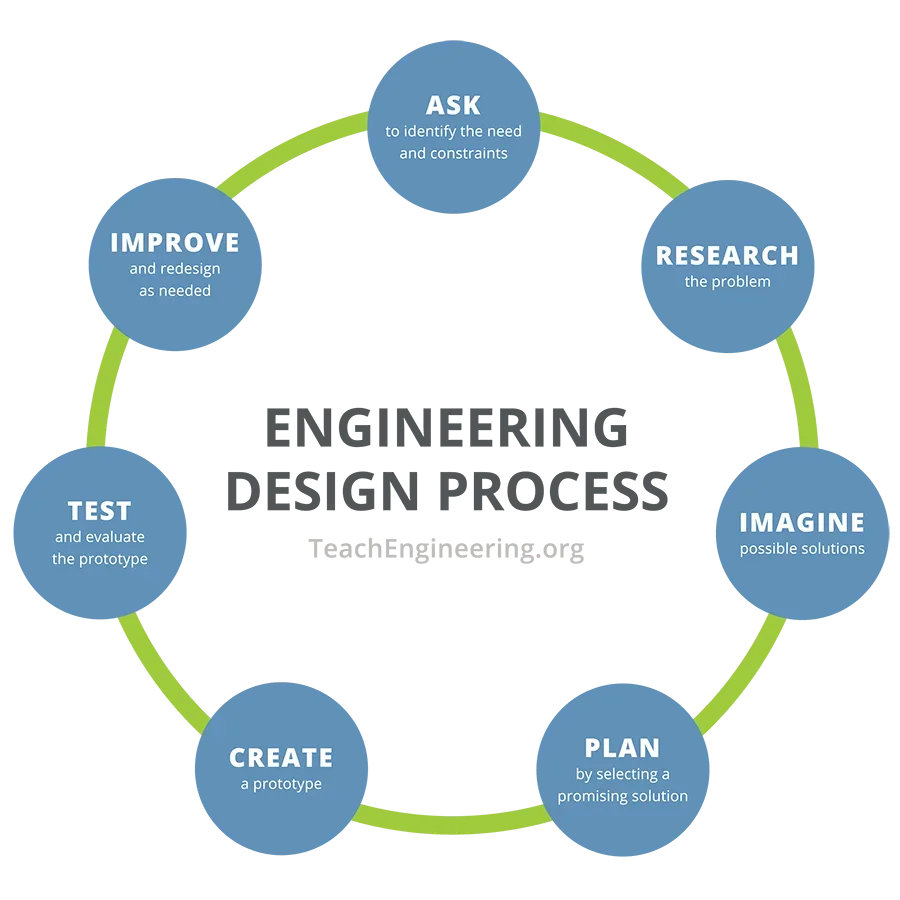 Figure 3. The steps of the engineering design process.Copyright 2014 TeachEngineering.org. All rights reserved.
- Divide the class into groups of two students each.
- Distribute 75 blocks to each group. Have teams count their blocks to verify that they have exactly 75 of them.
- Direct students to discuss within their groups the design strategies they want to use to create their towers based on their sketches.
- Remind students they do not have to use all of their blocks to construct the tallest tower. In the case of a tie for the tallest structure that can hold the test weight, the tower with the fewest blocks wins.
- Announce to students that they have 30 minutes to build their towers and test their strength—starting now! Observe the teams as they construct their towers. Encourage students to practice stacking blocks on top of each other and to rebuild if the tower falls down. Guide students to use the worksheet for sketches, calculations, data collection and reflection.
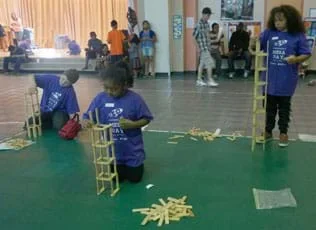 Students create their own designs for stacking Kapla blocks to make the tallest, weight-bearing towers possible.Copyright 2015 Elementary MESA Day Competition, University of California Davis
 - Once a group has built its tallest towers, have students raise their hands to indicate that they are ready test its strength with the test weight. To test, give students the test weight for them to place on top of the tower, using a stable chair if necessary. Measure and record the height of the tower and the number of blocks used.
- Permit teams to redesign, rebuild and retest their towers as many times as they wish in order to achieve a design that gives them the tallest height possible.
- Announce to the class when five minutes remain and then when one minute remains in the build and test phase.
- When 30 minutes are up, halt the competition and announce the winning team—the one with the tallest tower that was stable under the test load (that used the fewest blocks).
- Conclude with a class discussion to review what students learned, the best design strategies and the importance of redesign, and help students extrapolate to real-world examples as mentioned in the Introduction section.
- Have students complete and hand in their worksheets.
- Administer the post-activity quiz.
- free-standing
- Not supported by another structure. For example, a structure that is able to support itself without assistance from other structures or supports such as guy wires.
- guy wire
- A tensioned cable that adds stability to a free-standing structure. To provide external support, one end of the cable is attached to the structure and the other is anchored to the ground or some point at a distance from the structure's base. Often used for ship masts, radio antenna towers, wind turbines, utility poles and tents.
- members
- The support pieces that compose a structure or building, such as the beams (horizontal), columns (vertical), joists, etc., used in construction.
- model
- (noun) A representation of something to show its construction or appearance, or for imitation, comparison or analysis; often at a smaller scale. (verb) To make something to help learn about something else that is difficult or costly to be directly observed or experimented upon.
- weight-bearing
- Able to support weight without breaking. For example, a structure that is able to support additional weight besides the weight of its members. Also called load-bearing.
Pre-Activity Assessment
Pre-Quiz: Before starting the activity, administer the five-question Pre-Activity Quiz (PDF) to gauge students' depth of prior knowledge about models, geometric shapes used in tower designs and the meaning of related terminology (member, weight-bearing, free-standing). Students answer two fill-in-the-blank questions and three multiple choice questions related to the activity's learning objectives.
Activity Embedded Assessment
Worksheet: During the activity, have students complete the Race to the Top! Worksheet (PDF) as they practice design and redesign skills via sketches, calculations, data collection and pattern recognition, as well as apply concepts learned about constructing weight-bearing towers. Review students' worksheets to see if sketches are labeled and represent students' tower designs. Also review students' answers to assess whether they were able to apply the steps of the engineering design process to improve their tower designs and explain why their iterative design modifications improved the designs.
Post-Activity Assessment
Post-Quiz: At activity end, administer the eight-question Post-Activity Quiz (PDF) to determine how well students learned and are able to meet the activity learning objectives. Students answer five fill-in-the-blank questions and three multiple choice questions; five of the questions are the same as the pre-activity quiz. Compare students' pre/post answers to assess changes in comprehension of the activity topics, as well tall structure requirements, the importance of plans and sketches, and their own design tower-building design experiences.
Expect students to need to reach heights above their heads to 1) test tower strength, 2) measure tower height and 3) add more blocks to increase tower height. Carefully supervise students as they stand on stable chairs to reach taller heights.
For younger students, spend more time introducing the activity, showing students different ways they can stack the blocks to give them some ideas, and then spend more time with each group to guide them as they build to point out what is working and not working.
Contributors
Sara Pace
Supporting Program
RESOURCE GK-12 Program, College of Engineering, University of California Davis
Acknowledgements
The contents of this digital library curriculum were developed by the Renewable Energy Systems Opportunity for Unified Research Collaboration and Education (RESOURCE) project in the College of Engineering under National Science Foundation GK-12 grant no. DGE 0948021. However, these contents do not necessarily represent the policies of the National Science Foundation, and you should not assume endorsement by the federal government.
Special thanks to Travis Smith for his contributions and leadership, as well as to Jean S. Vander Gheynst and Alisa Lee's for their continual guidance and support at every step.
Copyright
2015 by Regents of the University of Colorado; original © 2015 University of California Davis