
Design and Fly a Kite
Students learn how to use wind energy to combat gravity and create lift by creating their own tetrahedral kites capable of flying. They explore different tetrahedron kite designs, learning that the geometry of the tetrahedron shape lends itself well to kites and wings because of its advantageous strength-to-weight ratio. Then they design their own kites using drinking straws, string, lightweight paper/plastic and glue/tape. Student teams experience the full engineering design cycle as if they are aeronautical engineers—they determine the project constraints, research the problem, brainstorm ideas, select a promising design and build a prototype; then they test and redesign to achieve a successful flying kite. Pre/post quizzes and a worksheet are provided.
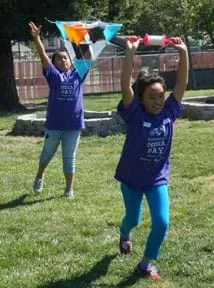 Students get a running start to launch their tetrahedron kite.Copyright 2015 Denise Jabusch, University of California Davis
Since the early days of flight, ideas for flying machines and their wing structures have been extensively tested. The aeronautical engineers of today continue to design new wing structures, now using computers and wind tunnels. To test early wing designs that used the tetrahedron shape, small and inexpensive kites were used. Alexander Graham Bell was one engineer and inventor who designed flying machines and found that generating lift was a problem. To increase lift, which often came at the expense of added weight or lack of structure, he experimented with the tetrahedrons to create structures that were both strong and lightweight. Use of the tetrahedral shape resulted in large kite structures of minimal weight with enough lift to achieve flight, even with passengers and eventually powered flying machines. Kites proved to be a great testing ground for the design and construction of Bell's tetrahedron-based flying machines. The tetrahedron also had the advantage of being a modular design; the tetrahedral "cell" shapes could be stacked and manipulated for more lift and repurposed into many different designs for flight. In this activity, students work as if they are aeronautical engineers, designing, and redesigning wing prototypes.
After this activity, students should be able to:
- Describe the concepts of lift and force.
- Explain and apply the steps of the engineering design process.
- 3-5-ETS1-1 Define a simple design problem reflecting a need or a want that includes specified criteria for success and constraints on materials, time, or cost.
Grades 3-5
Do you agree with this alignment? - 3-5-ETS1-2 Generate and compare multiple possible solutions to a problem based on how well each is likely to meet the criteria and constraints of the problem.
Grades 3-5
Do you agree with this alignment? - 3-5-ETS1-3 Plan and carry out fair tests in which variables are controlled and failure points are considered to identify aspects of a model or prototype that can be improved.
Grades 3-5
Do you agree with this alignment?
- 5.4.2 Geometric figures can be described by their attributes and specific locations in the plane.
Grade 5
Do you agree with this alignment?
- Students will develop an understanding of the attributes of design.
Grades K-12
Do you agree with this alignment? - Students will develop an understanding of engineering design.
Grades K-12
Do you agree with this alignment? - Students will develop an understanding of the role of troubleshooting, research and development, invention and innovation, and experimentation in problem solving.
Grades K-12
Do you agree with this alignment? - Students will develop abilities to apply the design process.
Grades K-12
Do you agree with this alignment? - Test and evaluate the solutions for the design problem.
Grades 3-5
Do you agree with this alignment? - STEL-7H Illustrate that there are multiple approaches to design.
Grades 3-5
Do you agree with this alignment? - STEL-7I Apply the technology and engineering design process.
Grades 3-5
Do you agree with this alignment?
- 3-5-ETS1-1 Define a simple design problem reflecting a need or a want that includes specified criteria for success and constraints on materials, time, or cost.
Grades 3-5
This resource focuses on the following Three Dimensional Learning aspects of NGSS:
Science & Engineering Practices- Define a simple design problem that can be solved through the development of an object, tool, process, or system and includes several criteria for success and constraints on materials, time, or cost.Do you agree with this alignment?
Disciplinary Core Ideas- Possible solutions to a problem are limited by available materials and resources (constraints). The success of a designed solution is determined by considering the desired features of a solution (criteria). Different proposals for solutions can be compared on the basis of how well each one meets the specified criteria for success or how well each takes the constraints into account.Do you agree with this alignment?
Crosscutting Concepts- People's needs and wants change over time, as do their demands for new and improved technologies.Do you agree with this alignment?
Do you agree with this alignment? - Define a simple design problem that can be solved through the development of an object, tool, process, or system and includes several criteria for success and constraints on materials, time, or cost.
- 3-5-ETS1-2 Generate and compare multiple possible solutions to a problem based on how well each is likely to meet the criteria and constraints of the problem.
Grades 3-5
This resource focuses on the following Three Dimensional Learning aspects of NGSS:
Science & Engineering Practices- Generate and compare multiple solutions to a problem based on how well they meet the criteria and constraints of the design problem.Do you agree with this alignment?
Disciplinary Core Ideas- Research on a problem should be carried out before beginning to design a solution. Testing a solution involves investigating how well it performs under a range of likely conditions.Do you agree with this alignment?
- At whatever stage, communicating with peers about proposed solutions is an important part of the design process, and shared ideas can lead to improved designs.Do you agree with this alignment?
Crosscutting Concepts- Engineers improve existing technologies or develop new ones to increase their benefits, to decrease known risks, and to meet societal demands.Do you agree with this alignment?
Do you agree with this alignment? - Generate and compare multiple solutions to a problem based on how well they meet the criteria and constraints of the design problem.
- 3-5-ETS1-3 Plan and carry out fair tests in which variables are controlled and failure points are considered to identify aspects of a model or prototype that can be improved.
Grades 3-5
This resource focuses on the following Three Dimensional Learning aspects of NGSS:
Science & Engineering Practices- Plan and conduct an investigation collaboratively to produce data to serve as the basis for evidence, using fair tests in which variables are controlled and the number of trials considered.Do you agree with this alignment?
Disciplinary Core Ideas- Tests are often designed to identify failure points or difficulties, which suggest the elements of the design that need to be improved.Do you agree with this alignment?
- Different solutions need to be tested in order to determine which of them best solves the problem, given the criteria and the constraints.Do you agree with this alignment?
Do you agree with this alignment? - Plan and conduct an investigation collaboratively to produce data to serve as the basis for evidence, using fair tests in which variables are controlled and the number of trials considered.
Each group needs:
- 24-96 (or more!) disposable plastic drinking straws with a minimum 7-inch (18-cm) length and all of equal length; 6 straws per tetrahedron cell, which are combined to make up the tetrahedron kite; the number of straws needed depends on the complexity of the kite; for example, a simple kite made from 4 tetrahedral cells requires 4 cells x 6 straws = 24 straws, a 10-celled kite requires 10 x 6 = 60 straws, a 16-celled kite requires 16 x 6 = 96 straws, etc.
- lightweight sheet material, such as paper, plastic film, cloth etc., for covering the two sides of each tetrahedron cell; this is approximately one 8.5 x 11-inch (22 x 28-cm) sheet per tetrahedron cell
- string, yarn or rope, for connecting and creating the tetrahedron cells; about 45 inches (114 cm) per tetrahedron cell
- Design and Fly a Kite Pre/Post Quiz (PDF), two per student
- Construction and Competition Rules (PDF), one per group
- Guidelines for Running Tetrahedron Kites (PDF), one per group
- Engineering Design with Application to Unpowered Flight Worksheet (PDF), one per student
- paper and pencil, as needed, for sketching designs and drawing templates
- computer with internet access, for research
To share with the entire class:
- kite string, 25-30 feet (7-9 meters) per kite being flown; can be repurposed between kites if tests are not at the same time; rolls of kite string usually come in 500-foot (152-m) lengths
- scissors
- glue or tape
- kite handle
- a wide-open outdoor area on a windy day, such as a playground or field, for kite testing
- Design and Fly a Kite Pre/Post-Quiz (docx)
- Design and Fly a Kite Pre/Post-Quiz (pdf)
- Design and Fly a Kite Pre/Post-Quiz Answer Key (docx)
- Design and Fly a Kite Pre/Post-Quiz Answer Key (pdf)
- Construction and Competition Rules (docx)
- Construction and Competition Rules (pdf)
- Engineering Design with Application to Unpowered Flight Worksheet (docx)
- Engineering Design with Application to Unpowered Flight Worksheet (pdf)
- Engineering Design with Application to Unpowered Flight Worksheet Answer Key (docx)
- Engineering Design with Application to Unpowered Flight Worksheet Answer Key (pdf)
- Guidelines for Running Tetrahedron Kites (docx)
- Guidelines for Running Tetrahedron Kites (pdf)
Knowledge of shapes, such as triangles (2D) and tetrahedrons (3D).
Kites may seem like toys, but they were once an integral part of weather forecasting, communication and war. Over time, kites have been replaced by airplanes, but their use has taught us a great deal about flight.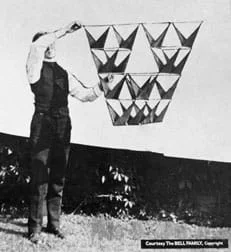 This early tetrahedron kite design by Alexander Graham Bell shows how the shape can be stacked for flight to use a kite as a test instrument.Copyright c. 1905 Alexander Graham Bell, The Bell Family via Wikimedia Commons {PD} https://commons.wikimedia.org/wiki/File:Early_design_of_a_Tetrahedron_kite_cell,_by_Alexander_Graham_Bell.jpg
You may be familiar with Alexander Graham Bell for his invention of the telephone, but are probably less familiar with his great interest in achieving flight. One of his first "flying machines" was made using a kite-like design. One of the most interesting shapes he used for his kites was a tetrahedron—a solid-triangular pyramid. This tetrahedron shape can be stacked upon itself to create larger tetrahedrons, much like LEGO pieces can be stacked and combined into a bigger whole.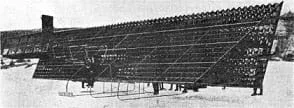 In 1909, Alexander Graham Bell designed this early flying machine composed of 3,393 tetrahedron cells.Copyright 1909 Unknown photographer, Wikimedia Commons https://commons.wikimedia.org/wiki/File:AEA_Cygnet_II.jpg
What is a tetrahedron shape? (Listen to student ideas.) The tetrahedron is a three-dimensional shape made of four equilateral triangles. It is a triangular pyramid. It has four triangular faces, six straight edges and four vertex corners. (If available, show students a tetrahedral block or an animation of one at https://commons.wikimedia.org/wiki/File:Tetrahedron.gif.)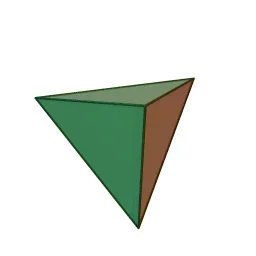 A rotating tetrahedron.Copyright 2005 Cyp via Kjell André, Wikimedia Commons https://commons.wikimedia.org/wiki/File:Tetrahedron.gif

The tetrahedron shape is popular for its advantageous strength-to-weight ratio, which means that for a given weight of a structure, in this case tetrahedrons, a large amount of force can be supported, which we call strength. This characteristic is derived from the geometry of the tetrahedron itself.
Background
Engineering never has one answer and no perfect design exists. Engineers research all information accessible to them and identify multiple design strategies (in our situation, kites) that may work for their needs. Then engineers select the most promising design to build and test. Testing is a key step to enable engineers to learn vital information about their designs and helps them to identify unforeseen problems and weaknesses. For instance, in this activity, if a kite does not fly, then students examine potential reasons why it failed. Or if a kite breaks mid-flight, then students may seek to find a sturdier design. It is vital for students to understand that new designs do not have to work the first time, and even if they do, there is usually room for improvement.
In the activity, students start with a basic tetrahedral shape. Tetrahedrons are both strong and lightweight, which is key for achieving flight. Covering two sides of the tetrahedron shape can help create lift. Lift is the upward force on the tetrahedron created when wind hits the tetrahedron cell and is redirected downward. Multiple sets of smaller tetrahedrons can be connected into one larger tetrahedral kite, and the combined lift acting on each of the smaller tetrahedrons can overcome the weight of the entire kite. This usually enables the kite to take flight.
Consult the Building Tetrahedral Kites activity for details on how to fabricate a basic design for working tetrahedral kites with the potential for further manipulation.
Wind is a force. When it is blowing, you can feel it push you around. If the wind's force can be redirected downwards, you create what is called lift. Lift is a force that causes an object to rise in height, or fly/hover. Lift has a natural "enemy" known as gravity. Gravity is a force that brings things back towards the ground. If not enough lift is created by redirecting the wind and overcoming the force of gravity, an object won't fly. The problem may be rectified by either reducing the mass of the object being lifted (this reduces the force of gravity acting on the object) or increasing the lift to overcome gravity.
Before the Activity
- Gather materials and make copies of the Design and Fly a Kite Pre/Post Quiz (PDF), two per student; the Engineering Design with Application to Unpowered Flight Worksheet (PDF), one per student, and the Construction and Competition Rules (PDF) and Guidelines for Running Tetrahedron Kites (PDF), one each per group.
- Use straws and string to make an example six-sided basic tetrahedron cell shape to show to students.
- Decide how you will enable students to access the Internet for the "research the problem" step of the activity, perhaps by using in-classroom computers, at-home computers (homework) or reserving a computer lab. Alternatively, screen a few online sources to find a variety of good designs and print out sheets to hand out to the groups.
- Arrange for the testing portion of the activity to take place outside on a windy day.
With the Students
- Administer the pre-quiz, as described in the Assessment section.
- Present to the class the Introduction/Motivation content.
- Divide the class into groups of three students each and pass out the supplies, including the handouts.
- Guide groups through the steps of the engineering design process as they design, test and refine their tetrahedron kites. Refer to Figure 1 for a flowchart of the steps, which are often performed in different sequences and repeated as necessary; review with the class, as necessary.
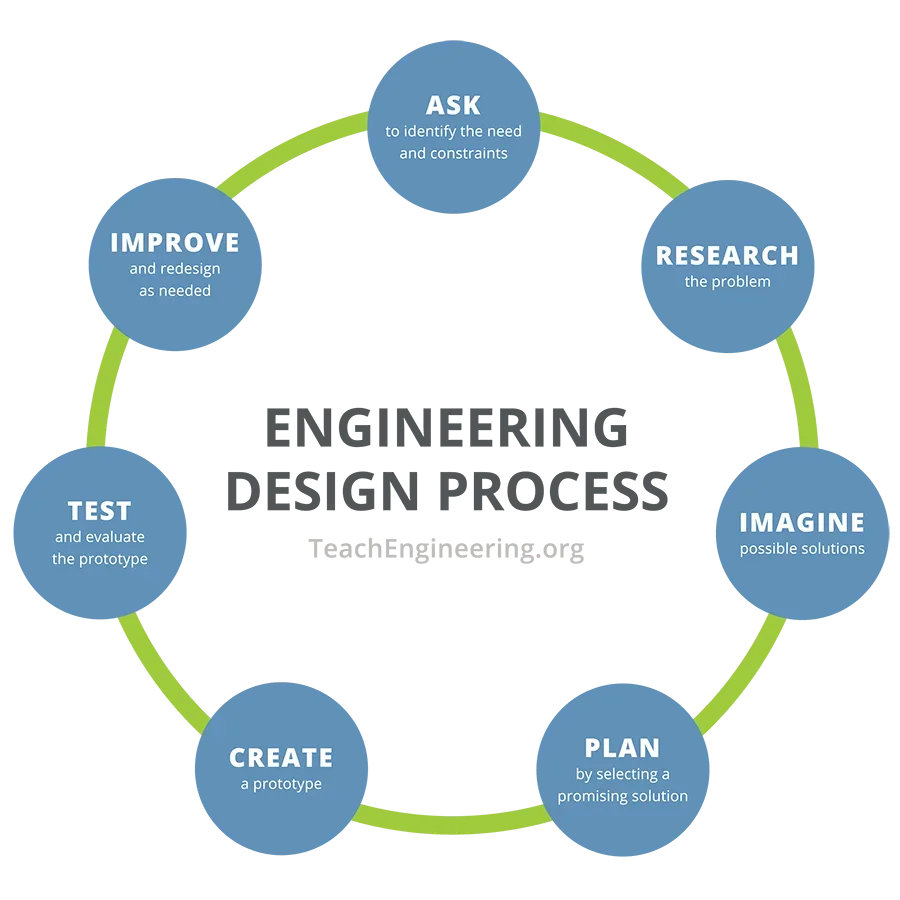 Refer to the steps of the engineering design process to help students visualize the overall cyclical process. The steps can be performed in different sequences and repeated as needed.Copyright 2014 TeachEngineering.org. All rights reserved.
 - Ask: Identify the Needs and Constraints: (5 minutes) Read the tetrahedron kite construction rules and ask students to identify the design constraints, which are the project requirements and limitations. Have students create on their worksheets checklists of these constraints for their kite designs. Expect the checklist to look similar to this list:
- Needs to be able to fly in the wind.
- Each tetrahedron MUST use six disposable plastic drinking straws. (Show an example.)
- Each tetrahedron MUST be covered on two sides.
- Tetrahedrons may only be connected at the corners.
- Research the Problem: (15-30 minutes) After students have completed their own checklists, they learn more about the problem and research possible designs.
- Discuss with students how a tetrahedron kite redirects the wind downwards to generate lift. See Figure 2.
- To give students an initial starting point for designing their own tetrahedron kites, have them research online to find a variety of different existing designs and examine them for whether or not they meet the activity design constraints and/or give them ideas for their own designs.
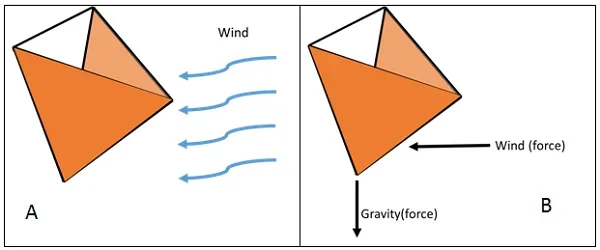 Figure 2. A) The shape of a tetrahedron kite minimizes drag from the incoming wind when the kite is in flight. B) The forces acting on the kite while it is in flight include wind—the force that has the ability to lift and move the kite sideways, and gravity—the force pulling the kite to the ground.Copyright 2015 RESOURCE GK-12, University of California Davis
- Imagine: Develop Possible Solutions: (20-30 minutes) Once students have spent some time researching different designs, have them brainstorm and sketch ideas for their own kite designs. Require each group member to create at least one sketch. Encourage students to be creative and consider all possible ideas.
- Plan: Select a Promising Solution: Once multiple sketches have been generated, have student groups discuss the pros/cons of each design. Specifically, have students compare each sketch to their worksheet checklists. The selected kite design must meet all the design constraints. While it may not be clear if some constraints are met by the design until it is constructed and tested (for example, if it flies!), direct students to do their best to determine if the designs meet the identified constraints. It is okay to repeat the brainstorming, sketching and discussion process several times since exploring different ideas is part of the process of determining a final best design. Upon settling on a design, students begin construction.
- Create: Construct a Prototype: (60 minutes plus drying time) Since the tetrahedron kite is modular (much like LEGO pieces, but with pyramidal shapes), take a moment to discuss the benefits of modular construction and how each team member can build a tetrahedron cell(s) that contributes to the whole. Once students finish constructing the cells, team members can start putting together the full design according to the original sketch. Expect construction to be a team effort.
- Test and Evaluate Prototype: (30 minutes) Once the full kites are constructed, begin testing. It is best to wait for a windy day for testing since the lack of wind can yield false negative results (kite would fly in wind, but does not fly in the absence of wind). Review the guidelines.
- Improve: Redesign and Retest: (60-90 minutes plus drying time as needed) Have each group share with the class its kite design and test results. Suggest that students look for common themes in successful kites. Have students think about why the other kites were not successful. For groups with successful, flying kites, have students consider ways to add more cells so that the kites are still able to fly. For groups with kites that did not fly, have students redesign how their tetrahedron cells are connected and re-attempt to fly. Re-confirm that the redesigned kites meet all constraints as outlined in the rules. Retest all groups' kites and expect to see an increase in successful kites.
- Post-activity discussion: (10 minutes) At activity (or competition) end, lead a class discussion of the redesign results, as described in the Assessment section.
- Administer the post-quiz, as described in the Assessment section
- brainstorming
- A group problem-solving method in which each person in a group presents his or her ideas in an open forum, with the purpose to come up with a great number of different ideas.
- constraint
- A limitation or restriction. For engineers, constraints are the requirements and limitations that the final design solutions must meet.
- drag
- A force that opposes the motion of an object traveling through fluid (including air).
- force
- The act of pushing, pulling or applying pressure.
- lift
- A force, opposite to gravitational force, created by fluid (air) flowing past an object.
- modular
- A system (such as a tetrahedral kite) that consists of multiple subunits that complete the whole design.
- tetrahedron
- A three-dimensional shape made of four equilateral triangles. A triangular pyramid. It may also be described has having four triangular faces, six straight edges and four vertex corners.
Pre-Activity Assessment
Pre-Quiz: Administer the four-question Design and Fly a Kite Pre/Post-Quiz (PDF) to assess students' prior knowledge of forces acting on kites in flight and the engineering design process.
Activity Embedded Assessment
Engineering Design with Application to Unpowered Flight: Students create a constraints checklist, make sketches and explain their design changes on the Engineering Design with Application to Unpowered Flight Worksheet (PDF). Look for evidence that students are thinking through their ideas and designs before construction begins. Encourage students to discuss and share test results of their initial kite designs; pay attention for thoughtful comments. The redesign step of the activity provides an opportunity for further assessment on how students evaluate and improve on their initial designs.
Post-Activity Assessment
Class Discussion: At activity (or competition) end, lead a class discussion in which students share their redesign results and gain practice in technical communication. Take note of students' discussion contributions to gauge their engagement and depth of comprehension.
Post-Quiz: Administer the four-question Design and Fly a Kite Pre/Post-Quiz (PDF) again. Compare pre/post answers to assess individual student learning about forces acting on kites in flight and the engineering design process.
It helps with construction if students create a template shape for covering the tetrahedrons, such as the covered planes illustrated in the orange color in Figure 2.
An animation of a tetrahedral so as to comprehend its shape: https://commons.wikimedia.org/wiki/File:Tetrahedron.gif.
Building Tetrahedral Kites. (A middle school activity in which student teams construct tetrahedral kites following specific instructions and using specific materials in a limited time period, paying attention to basic manufacturing systems while aiming for team efficiency and product quality. A good source for a basic initial tetrahedral kite design.) TeachEngineering.org.
Illustrated online instructions for making a tetrahedral kite: https://boyslife.org/hobbies-projects/projects/1732/build-it/.
Contributors
Joshua T. Claypool
Supporting Program
RESOURCE GK-12 Program, College of Engineering, University of California Davis
Acknowledgements
The contents of this digital library curriculum were developed by the Renewable Energy Systems Opportunity for Unified Research Collaboration and Education (RESOURCE) project in the College of Engineering under National Science Foundation GK-12 grant no. DGE 0948021. However, these contents do not necessarily represent the policies of the National Science Foundation, and you should not assume endorsement by the federal government.
The author acknowledges the support and help from UC Davis RESOURCE advisors Alisa Lee, Travis Smith and Jean VanderGheynst. He also thanks the RESOURCE fellows for their helpful comments during the writing of the activity.
Copyright
2015 by Regents of the University of Colorado; original © 2015 University of California Davis