
Wind-Powered Sail Cars
Student pairs design and construct small, wind-powered sail cars using limited quantities of drinking straws, masking tape, paper and beads. Teams compete to see which sail car travels the farthest when pushed by the wind (simulated by the use of an electric fan). Students learn about wind and kinetic and renewable energy, and follow the seven steps of the engineering design process to ask, research, imagine, plan, create, test, and improve their sail cars. This activity is part of a unit in which multiple activities are brought together for an all-day school/multi-school concluding “engineering field day” competition.
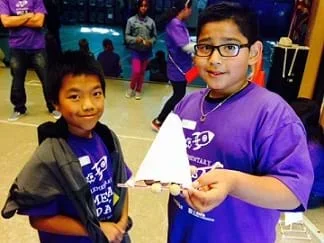 Two sail car competitors.Copyright 2015 Eric Anderson, University of California Davis
Humans have been harnessing wind energy for thousands of years. Wind-powered devices convert kinetic energy in the wind into other more useful forms of energy. Sailboats convert the wind's kinetic energy to kinetic energy for transportation. Wind turbines convert the wind's kinetic energy to electrical energy that can be used to power our homes and devices. Today's engineers follow the steps of the engineering design process and apply their understanding of physics to design highly efficient wind turbines to make wind energy a viable source of renewable energy. In this activity, students follow the steps of the engineering design process to create small-size wind-powered sail cars that convert the wind's kinetic energy to kinetic energy that moves the sail cars.
After this activity, students should be able to:
- Build a small-scale wind-powered sail car.
- Explain that energy is transferred from the wind to the sail car.
- Explain that the energy in the wind and the energy in the movement of the car are forms of kinetic energy.
- Explain how they used experimentation and testing to iteratively revise their designs.
- 3-5-ETS1-1 Define a simple design problem reflecting a need or a want that includes specified criteria for success and constraints on materials, time, or cost.
Grades 3-5
Do you agree with this alignment? - 3-5-ETS1-2 Generate and compare multiple possible solutions to a problem based on how well each is likely to meet the criteria and constraints of the problem.
Grades 3-5
Do you agree with this alignment? - 3-5-ETS1-3 Plan and carry out fair tests in which variables are controlled and failure points are considered to identify aspects of a model or prototype that can be improved.
Grades 3-5
Do you agree with this alignment? - 4-PS3-4 Apply scientific ideas to design, test, and refine a device that converts energy from one form to another.
Grade 4
Do you agree with this alignment?
- Energy comes in many forms such as light, heat, sound, magnetic, chemical, and electrical
Grade 4
Do you agree with this alignment?
- Students will develop an understanding of the attributes of design.
Grades K-12
Do you agree with this alignment? - Students will develop an understanding of engineering design.
Grades K-12
Do you agree with this alignment? - Students will develop an understanding of the role of troubleshooting, research and development, invention and innovation, and experimentation in problem solving.
Grades K-12
Do you agree with this alignment? - Students will develop abilities to apply the design process.
Grades K-12
Do you agree with this alignment? - STEL-7I Apply the technology and engineering design process.
Grades 3-5
Do you agree with this alignment? - STEL-7P Illustrate the benefits and opportunities associated with different approaches to design.
Grades 6-8
Do you agree with this alignment? - STEL-7Q Apply the technology and engineering design process.
Grades 6-8
Do you agree with this alignment?
- 3-5-ETS1-1 Define a simple design problem reflecting a need or a want that includes specified criteria for success and constraints on materials, time, or cost.
Grades 3-5
This resource focuses on the following Three Dimensional Learning aspects of NGSS:
Science & Engineering Practices- Define a simple design problem that can be solved through the development of an object, tool, process, or system and includes several criteria for success and constraints on materials, time, or cost.Do you agree with this alignment?
Disciplinary Core Ideas- Possible solutions to a problem are limited by available materials and resources (constraints). The success of a designed solution is determined by considering the desired features of a solution (criteria). Different proposals for solutions can be compared on the basis of how well each one meets the specified criteria for success or how well each takes the constraints into account.Do you agree with this alignment?
Crosscutting Concepts- People's needs and wants change over time, as do their demands for new and improved technologies.Do you agree with this alignment?
Do you agree with this alignment? - Define a simple design problem that can be solved through the development of an object, tool, process, or system and includes several criteria for success and constraints on materials, time, or cost.
- 3-5-ETS1-2 Generate and compare multiple possible solutions to a problem based on how well each is likely to meet the criteria and constraints of the problem.
Grades 3-5
This resource focuses on the following Three Dimensional Learning aspects of NGSS:
Science & Engineering Practices- Generate and compare multiple solutions to a problem based on how well they meet the criteria and constraints of the design problem.Do you agree with this alignment?
Disciplinary Core Ideas- Research on a problem should be carried out before beginning to design a solution. Testing a solution involves investigating how well it performs under a range of likely conditions.Do you agree with this alignment?
- At whatever stage, communicating with peers about proposed solutions is an important part of the design process, and shared ideas can lead to improved designs.Do you agree with this alignment?
Crosscutting Concepts- Engineers improve existing technologies or develop new ones to increase their benefits, to decrease known risks, and to meet societal demands.Do you agree with this alignment?
Do you agree with this alignment? - Generate and compare multiple solutions to a problem based on how well they meet the criteria and constraints of the design problem.
- 3-5-ETS1-3 Plan and carry out fair tests in which variables are controlled and failure points are considered to identify aspects of a model or prototype that can be improved.
Grades 3-5
This resource focuses on the following Three Dimensional Learning aspects of NGSS:
Science & Engineering Practices- Plan and conduct an investigation collaboratively to produce data to serve as the basis for evidence, using fair tests in which variables are controlled and the number of trials considered.Do you agree with this alignment?
Disciplinary Core Ideas- Tests are often designed to identify failure points or difficulties, which suggest the elements of the design that need to be improved.Do you agree with this alignment?
- Different solutions need to be tested in order to determine which of them best solves the problem, given the criteria and the constraints.Do you agree with this alignment?
Do you agree with this alignment? - Plan and conduct an investigation collaboratively to produce data to serve as the basis for evidence, using fair tests in which variables are controlled and the number of trials considered.
- 4-PS3-4 Apply scientific ideas to design, test, and refine a device that converts energy from one form to another.
Grade 4
This resource focuses on the following Three Dimensional Learning aspects of NGSS:
Science & Engineering Practices- Apply scientific ideas to solve design problems.Do you agree with this alignment?
Disciplinary Core Ideas- Possible solutions to a problem are limited by available materials and resources (constraints). The success of a designed solution is determined by considering the desired features of a solution (criteria). Different proposals for solutions can be compared on the basis of how well each one meets the specified criteria for success or how well each takes the constraints into account.Do you agree with this alignment?
- Energy can also be transferred from place to place by electric currents, which can then be used locally to produce motion, sound, heat, or light. The currents may have been produced to begin with by transforming the energy of motion into electrical energy.Do you agree with this alignment?
- The expression "produce energy" typically refers to the conversion of stored energy into a desired form for practical use.Do you agree with this alignment?
Crosscutting Concepts- Science affects everyday life.Do you agree with this alignment?
- Energy can be transferred in various ways and between objects.Do you agree with this alignment?
- Engineers improve existing technologies or develop new ones.Do you agree with this alignment?
- Most scientists and engineers work in teams.Do you agree with this alignment?
Do you agree with this alignment? - Apply scientific ideas to solve design problems.
Each group needs:
- 10 disposable plastic drinking straws without bends, for the sail car frame
- 4 wooden macramé beads, such as those with 3/8-inch inner diameter and 7/8-inch outer diameter (like the one shown in Figure 1), for sail car wheels; any round bead works, as long as the inner diameter is larger than the straw diameter
- 1 sheet 8.5 x 11-inch (A4) copy paper, for the sail
- 40 cm masking tape, to hold the car together
- scissors, for modifying the straws and paper
- Wind-Powered Sail Cars Pre-Quiz (PDF), one per person
- Wind-Powered Sail Cars Rules Sheet (PDF), one per person
- Wind-Powered Sail Cars Scoring Sheet (PDF), one per person
- Wind-Powered Sail Cars Post-Quiz (PDF), one per person
Materials note: Depending on the number and extent of design modifications teams go through during the design-build-test-refine process on Day 1, they may require more straws, paper and tape than the amounts listed above (which are amounts for one design iteration), plus teams will each require one fresh set of supplies for competition day (Day 2).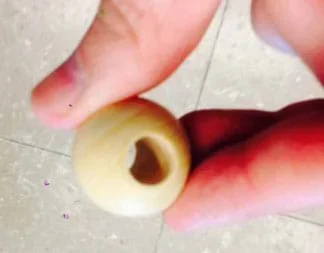 Figure 1. An example macramé bead.Copyright 2015 Eric Anderson, University of California Davis
To share with the entire class:
- capability to show the class a short online video
- masking tape, to mark the competition course
- 9-inch electric fan (like the one shown in Figure 2), to provide the wind energy to push the sail cars, almost any fan will work as the wind source; having multiple fans may speed up the testing process
- measuring tape, to measure how far the sail cars travel
- gram scale or kitchen scale, to weigh cars in case of a tie; since the sail cars do not weigh much, typically less than 100 grams (~3.5 ounces) each, make sure the scale has a relatively small resolution; a gram scale or kitchen scale is best; a bathroom scale will not work
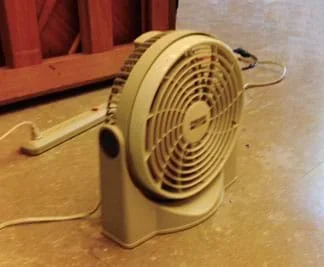 Figure 2. An electric fan serves as the wind source.Copyright 2015 Eric Anderson, University of California Davis
- Wind-Powered Sail Cars Pre-Quiz (docx)
- Wind-Powered Sail Cars Pre-Quiz (pdf)
- Wind-Powered Sail Cars Pre-Quiz Answer Key (docx)
- Wind-Powered Sail Cars Pre-Quiz Answer Key (pdf)
- Wind-Powered Sail Cars Rules Sheet (docx)
- Wind-Powered Sail Cars Rules Sheet (pdf)
- Wind-Powered Sail Cars Scoring Sheet (docx)
- Wind-Powered Sail Cars Scoring Sheet (pdf)
- Wind-Powered Sail Cars Post-Quiz (docx)
- Wind-Powered Sail Cars Post-Quiz (pdf)
- Wind-Powered Sail Cars Post-Quiz Answer Key (docx)
- Wind-Powered Sail Cars Post-Quiz Answer Key (pdf)
It is helpful, but not absolutely necessary, for students to have an understanding of the following concepts:
- Energy
- Any object in motion has kinetic energy.
- Wind has kinetic energy.
- Energy has many forms.
- Energy can be transferred from one form to another, or transferred from one object to another
Who thinks they could design a car that doesn't need gas to make it go—a car that uses a clean pollution-free energy source instead? Who thinks they could design a car that is powered by an energy source that we could find outside and use for free? Raise your hand if you think you could design a car like that.
Let's start by watching a short video. (Show the following two-minute video about the 2014 land sailing world championship.)
Today we're going to design and build wind-powered sail cars. They won't be as big as the ones we saw in the video; we're going to build smaller, model-sized sail cars. They won't be able to carry you or go 90 plus miles per hour like the guy with the hat said at the beginning of the video, but they are going to be really cool. They're going to be really cool because you will design your own sail cars, then test them and tweak and revise them until you have created the best, highest performance sail cars you can make. Then, we will hold a class competition to see who designed the best sail car.
A typical car uses gasoline to make it go. Gas is the energy source that powers the car. What is the energy source that powers a sail car? That's right; wind is the energy source that powers a sail car. Wind is a renewable source of energy that people have been using for a very long time. Sail were the first devices used to capture and harness wind energy. We don't know exactly when the first sails were used, but historians have found ancient Egyptian artifacts that show sailboats and some evidence indicates that sailing was in use thousands of years before the Egyptians. We also know that windmills were used at least 1,200 years ago to grind grain and pump water. Today we use wind turbines to generate clean, inexpensive electricity that can, in turn, be used for many purposes.
Wind is moving air. Does anyone know the type of energy that moving objects have? It is called kinetic energy. Kinetic energy is motion energy. Anything moving has kinetic energy. When the sail car is moving, it has energy. What kind of energy does a moving sail car have? That's right; the moving sail car also has kinetic energy. When we see the wind pushing a sail car, we can think of that process as a transfer of energy. Kinetic energy in the wind is being transferred to kinetic energy in the sail car. As we do this activity and hold our class competition, I want you to pay attention to and think about that transfer of energy.
(Write the following rules on the classroom board as you read aloud the next section.)
Here are the competition rules:
- Everyone will work in teams of two.
- Each team gets 10 drinking straws, four beads, one sheet of paper and 40 cm of tape. The beads are the wheels. You must create your sail car using only these materials.
- You will also be given a pair of scissors so you can cut the paper and straws.
- On the floor I've marked the course for our competition. The winner will be the car that travels the farthest from the start line before it either stops or goes off course.
This activity is going to take two days. Today, we are going to focus on designing the best sail car possible. I encourage you to try as many different designs as you want and test your cars as many times as you want. As you test and evaluate your sail car designs, pay attention to why you are making the design choices you are making. Notice what works and what does not work and how you might improve your design so it works better. When I talk to you as you are building your sail cars, be ready to explain to me why you think this sail car might work better than the last one you built.
Tomorrow we will hold the competition. On race day, you can only build one sail car—the sail car based on your best design from today—and you will only have one run on the course.
Okay, let's get to work. Let's build some sail cars!
Background
Humans have been using wind as an energy source for thousands of years. Historians know that ancient Egyptians built sailboats in 3,000 BC and windmills were developed in the Middle Ages to grind grain and pump water. Today, humans use wind turbines to generate clean, inexpensive electricity.
In this activity, students use wind (simulated by the use of an electric fan) as an energy source to propel their model-sized sail cars. Students are challenged to design and build sail cars that are structurally sound with sails that efficiently capture the wind—all while using the limited supplies available to them. The competition rules and the provided materials serve as the engineering "constraints"—the design requirements and limitations. Use your discretion to determine how much direction to provide students to assist in the design process. For example, you may want to expose the class to historic sail shapes and configurations such as the square rig and fore-and-aft rig (see Wikipedia for good definitions of these sail types). An example student sail car design is shown in Figure 3.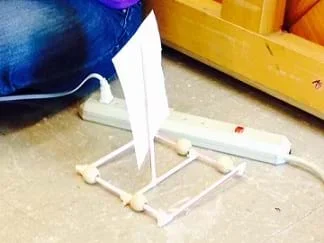 Figure 3. An example sail car design.Copyright 2015 Eric Anderson, University of California Davis
Through this activity, students experience the universal steps of the engineering design process (see Figure 4). The steps may be performed in different sequences and repeated as necessary. Teams generate and consider multiple possible solutions, aiming to best meet the problem's needs and constraints. They evaluate their testing efforts in order to make improvements to their designs.
Wind is caused by differences in atmospheric pressure. When a difference in atmospheric pressure exists, air flows from areas of high atmospheric pressure to areas of low atmospheric pressure. Globally, the main factors that cause differences in atmospheric pressure (and thus wind) are the rotation of the Earth and uneven heating of the Earth's surface. The rotation of the Earth causes the Coriolis Effect. The Coriolis Effect is what causes hurricanes to rotate counter-clockwise in the northern hemisphere and clockwise in the southern hemisphere. When the Earth's surface is heated unevenly, the air above the hottest regions heats up, expands and becomes lower in density. As a result, that hot air rises, leaving areas of low pressure. Cooler air rushes to fill in areas of low pressure, resulting in what we observe as wind. Locally, wind can be affected by a variety of other factors such as geography (mountains, canyons), human-made structures (buildings), vegetation (trees, forests) and large bodies of water.
Kinetic energy is the energy of motion. Anything that has mass and is moving, including moving air, has kinetic energy. The amount of power (expressed in watts or joules per second) contained in wind is equal to (½)ρAν3, where ρ is the density of air (1.2 kg/m3 at sea level and 68 °F), A is the area the wind is blowing through (expressed in m2), and ν is the speed of the wind (expressed in m/s). Since power is a measure of energy per unit time, the energy of the wind passing through a given area (such as the area of a fan) can be calculated by multiplying the power by how long the wind lasts (such as how long the fan is turned on). The kinetic energy of the sail car (expressed in joules) is approximately equal to (½)mν2, where m is the mass of the sail car (in kg) and ν is the speed of the sail car (in m/s). A small amount of kinetic energy is also present in the spinning of the sail car wheels.
Timing note: Plan on approximately one hour for the competition, while the timeline for the sail car activity—consisting of design, testing, and refinement—is flexible. To conduct the activity as an afterschool program, have students spend time improving their designs over several months leading up to the final competition. When condensed to serve as a classroom project, give students at least a one-hour class period dedicated to developing their sail car designs before holding the competition.
Before the Activity
- Make copies of the Wind-Powered Sail Cars Pre-Quiz (PDF), Wind-Powered Sail Cars Rules Sheet (PDF), Wind-Powered Sail Cars Scoring Sheet (PDF) and Wind-Powered Sail Cars Post-Quiz (PDF).
- Gather materials. Each group needs: 10 straws, 4 macramé beads, 1 sheet of paper, 40 cm of masking tape and a pair of scissors. During Day 1, groups may need additional straws, paper and tape as they modify and improve their designs. Then each group needs one fresh set of the supplies on Day 2, competition day.
- Review the rules sheet and scoring sheet so as to understand all aspects and requirements of the activity and competition.
- For Day 1 testing and Day 2 competition, lay out the race course as described in R.4 on the rules sheet and in the sketch on the scoring sheet. Use masking tape to mark a course in a classroom with a smooth floor that is six-feet wide and as long as possible. Place the fan behind the starting line facing towards the race course.
With the Students—Day 1: Sail Car Design, Testing and Refinement
- Administer the pre-quiz, as described in the Assessment section.
- Present to the class the Introduction/Motivation content or introduce the activity in your own way. Once students understand the activity, divide the class into groups of two students each and hand out the supplies.
- Guide groups through the steps of the engineering design process as they research, design, test, and refine their model sail car prototypes. Refer to Figure 4 for a flowchart of the steps.
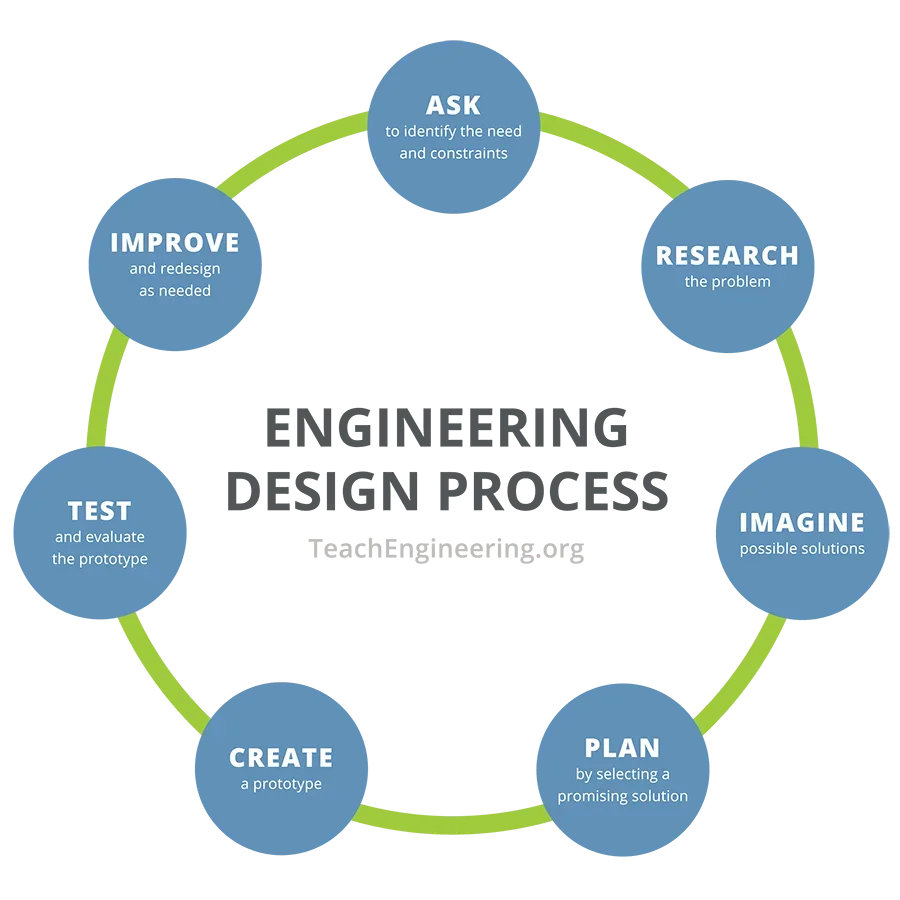 Figure 4. The steps of the engineering design process.Copyright 2014 TeachEngineering.org. All rights reserved.
 - Ask: Identify the need and constraints: (5 minutes) Ask students to identify the needs and constraints involved in this activity. An example of need: "We need a car that can travel a long distance using energy in the wind." The constraints include limitations such as time and materials.
- Research the Problem: (10 minutes) Ask students to investigate and experiment to determine the fundamental properties of the provided materials.
- In which ways are the straws strongest? Expect students to find that the straws are very strong in tension (pulling), pretty strong in compression (pushing along the length of the straw), and pretty weak in bending. Expect them to realize that the straws are very weak in bending if they have been previously bent.
- Which shapes built with straws are strong? Expect students to discover that triangles and pyramids are very strong shapes. Rectangles and cubes can also be strong.
- How can the paper catch the wind? By holding the paper in front of the blowing fan, students can generate ideas about the size and shape of sails that best catch the wind, as well as how to best orient sails with respect to the fan.
- Imagine: Develop possible solutions: (2 minutes) Have student groups discuss what they learned in the previous step and brainstorm how they can use that information in the design of their sail cars.
- Plan: Select a promising solution: (8 minutes) Ask student groups to plan their initial sail car designs before they start building. They can do this by drawing their designs or by discussing and agreeing with their partners on exactly how to make the sail cars. Optionally, require students to produce a written plan of their sail car designs and approve each teams' design before permitting them to start construction. If you approve the designs, check to make sure they are complete, with all components labeled and within the supplies limitation, but do not check to make sure the car will perform well since a big part of this activity is allowing students to come up with their own designs and then iteratively improve those designs after testing. Learning and improving from failure is part of the process. As an example, Figure 5 shows a sail car that worked reasonably well, but could be improved upon. The pyramid shape that supported the sail was strong and held the sail in place. However, some of the wheels did not spin freely, which caused the car to turn and veer off course during the competition.
 Figure 5. Another sail car design.Copyright 2015 Denise Jabusch, University of California Davis
 - Create: Build a prototype: (15 minutes) Groups construct initial prototypes of their model sail cars.
- Test prototype: (2 minutes) Groups place their sail cars on the course starting line and turn on the fan; refer to the scoring sheet "starting configuration" diagram. When a sail car stops or leaves the course, use a measuring tape to determine how far it went; refer to the scoring sheet "ending configuration" for measuring guidelines.
- Evaluate prototype: (2 minutes) Direct students to evaluate the performance of their sail cars. Did they run into any unexpected problems? (For example, perhaps the car did not travel in a straight line, the sail bent, or part of the car's frame bent.) How could the design be changed to fix the problems encountered? If the car performed well, what design changes might make it perform even better? (For example, perhaps the car could be made lighter, the sail made less floppy, the wheels to roll better.)
- Improve: Redesign as needed: (16 minutes) After testing and evaluating their prototype sail cars, direct groups to return to an earlier step in the design process—Imagine: Develop possible solutions (step 6)—and repeat the process of designing, building, testing and evaluating their sail cars. Permit groups to continue this iterative design process as time allows.
With the Students—Day 2: Sail Car Competition
- Review the rules and hand out materials: (5 minutes) As a class, review the competition rules. Once you are sure students understand the rules, hand out a new set of materials to each group.
- Build sail cars: (30 minutes) Give groups 30 minutes to construct their best sail cars based on what they learned during the previous day's design, testing and refinement process.
- Competition: (15 minutes) Collect all the sail cars and consistently test them, one at a time. Refer to the rules sheet and scoring sheet for guidance.
- Place the back axle of the sail car on the starting line, directly in front of the fan.
- Turn on the fan.
- Once the sail car stops or begins to cross the side borders of the course, turn off the fan.
- Measure the distance from the starting line to the rear axle of the sail car; refer to the scoring sheet "ending configuration" diagram.
- Record on the scoring sheet the distances achieved by each team and sail car weights.
- The winning sail car is the one that travels the farthest. In case of a tie, the lightest car wins the tie.
- Post-activity discussion: (10 minutes) At competition end, lead a class discussion of the results, as described in the Assessment section, including some question suggestions.
- Administer the post-quiz, as described in the Assessment section.
- constraint
- A limitation or restriction. For engineers, constraints are the requirements and limitations that the final design solutions must meet.
- energy
- The ability to make things happen. Motion, heat, light and sound are clues that energy is present.
- energy transfer
- When energy changes from one form to another, or when energy is transferred from one object to another.
- kinetic energy
- The energy of moving objects. Anything in motion has kinetic energy.
- prototype
- A first attempt or early design of a new creation or product. May be revised many times.
- wind energy
- The energy contained in moving air. Wind energy is a form of kinetic energy.
Pre-Activity Assessment
Pre-Quiz: Administer the four-question Wind-Powered Sail Cars Pre-Quiz (PDF) to test student knowledge of the activity vocabulary. Refer to the Wind-Powered Sail Cars Pre-Quiz Answer Key (PDF) and review student answers to gauge their base understanding. The post-quiz asks students about the same vocabulary words.
Activity Embedded Assessment
Circulate and Check-In: As students are working, walk around and talk to groups about their sail cars. Expect students to be able to explain why they designed their sail cars the way they did and how previous sail car designs and testing results influenced their revised designs.
Post-Activity Assessment
Class Discussion: At competition end, lead a class discussion of the results, which reveals students' engagement and understanding. Start with a broad discussion, asking students to share their observations from the design process and the competition. Then focus the discussion as needed, asking questions such as:
- What did the best performing sail cars have in common?
- When you were designing your sail cars, which design choices worked particularly well or poorly? Why do you think they worked well/poorly?
- When during the design process did you notice something wasn't working well and changed your design to make it work better? Describe that process to the class.
Post-Quiz: Administer the eight-question Wind-Powered Sail Cars Post-Quiz (PDF). The first part of the survey is identical to the pre-quiz. Compare pre- and post-quiz answers to determine how much students have learned about the activity vocabulary. The next three questions test students' understanding of the energy concepts involved in sail cars. To conclude, students are asked to describe their design process and final designs. Refer to the Wind-Powered Sail Cars Post-Quiz Answer Key (PDF) and review student answers to assess their depth of comprehension.
For lower grades, expect all of the fundamental concepts and activity steps to be understandable. However, expect sail car designs to be simpler and student justifications for engineering design choices to be less detailed and less logical. For example, a student might be able to explain which sail car design performed better, but might not be able to fully explain which design changes contributed to the improvement and which did not contribute. Students might also be unable to logically justify all of the design changes from one design to another. In addition, students may have less skill at building structures. If possible, give lower grade students additional time for sail car construction.
For higher grades, all the concepts and activity steps remain the same, however raise the expectations for how detailed and logically students carry out the engineering design process. Encourage groups to experiment with changing only a single design element at a time so they can identify how each design choice impacts performance. In addition, expect more detailed and logical justifications of final sail car designs; require students to clearly and logically justify each design decision.
During the Introduction/Motivation content presentation, show students the following mini yacht racing video about the 2014 land sailing world championship (2:16 minutes) at: https://youtu.be/tKqoYj_LoHU?list=FLKqJHJ2yH8UtL89rICpofSA.
Contributors
Eric Anderson
Supporting Program
RESOURCE GK-12 Program, College of Engineering, University of California Davis
Acknowledgements
The contents of this digital library curriculum were developed by the Renewable Energy Systems Opportunity for Unified Research Collaboration and Education (RESOURCE) project in the College of Engineering under National Science Foundation GK-12 grant no. DGE 0948021. However, these contents do not necessarily represent the policies of the National Science Foundation, and you should not assume endorsement by the federal government.
The author thanks the UC Davis RESOURCE team, in particular Travis Smith, for help and guidance while developing this activity.
Copyright
2015 by Regents of the University of Colorado; original © 2015 University of California Davis