
Wired to Think: Exploring the Brain as an Electrical Circuit
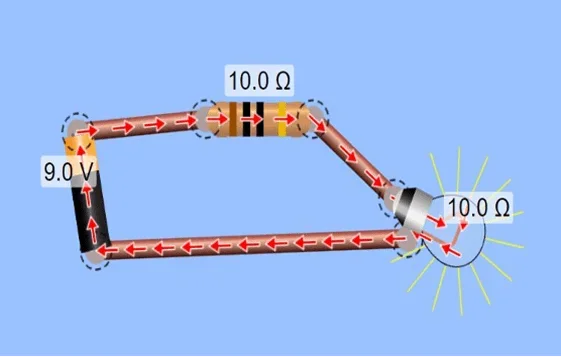 A diagram showing the energy flow through a simple circuit with a battery, a resistor, and a lightbulb.Copyright Alishia Hill
The brain is a complex computer with its own hardware and ‘software.’ Students are introduced to the brain’s function as an electrical circuit by exploring the similarities between neurons and electrical circuits. Students first learn about neurons, their structure, and how they transmit signals using electrical impulses, much like wires in a circuit. Through interactive activities, they build and analyze simple electrical circuits, drawing parallels to neural pathways in the brain. By understanding how the brain processes information and learns fear, students connect neuroscience concepts to real-world applications such as neuroplasticity, brain-machine interfaces, and biomedical engineering.
Neural engineers, biomedical engineers, and cognitive engineers apply principles from both biology and engineering to design, analyze, and optimize systems related to the brain and neural circuits. Neural engineers focus on developing technologies to interact with the brain, such as neural interfaces and brain-computer interfaces. Biomedical engineers work on systems that interface with biological systems, such as creating devices or tools for studying brain activity. Cognitive engineers, particularly those in fields like human-computer interaction, apply knowledge of the brain's response to stimuli to design systems or tools that adapt based on learning and behavior. These engineers often use similar principles—such as circuits, systems modeling, and adaptation—to create technologies that can respond to biological or cognitive inputs.
After this activity, students should be able to:
- Draw a neuron, accurately labeling its major parts and describing the function of each.
- Explain how electrical impulses travel through a simple circuit, demonstrating an understanding of energy flow.
- Describe how neurons communicate by transmitting action potentials (electrical impulses) to other neurons.
- CCSS.Math.Content.HSF-BF.A.2 Write arithmetic and geometric sequences both recursively and with an explicit formula, use them to model situations, and translate between the two forms.
Grades 9-12
Do you agree with this alignment?
- HS-LS1-1 Construct an explanation based on evidence for how the structure of DNA determines the structure of proteins which carry out the essential functions of life through systems of specialized cells.
Grades 9-12
This resource focuses on the following Three Dimensional Learning aspects of NGSS:
Science & Engineering Practices- Construct an explanation based on valid and reliable evidence obtained from a variety of sources (including students' own investigations, models, theories, simulations, peer review) and the assumption that theories and laws that describe the natural world operate today as they did in the past and will continue to do so in the future.Do you agree with this alignment?
Disciplinary Core Ideas- Systems of specialized cells within organisms help them perform the essential functions of life.Do you agree with this alignment?
- All cells contain genetic information in the form of DNA molecules. Genes are regions in the DNA that contain the instructions that code for the formation of proteins, which carry out most of the work of cells.Do you agree with this alignment?
Crosscutting Concepts- Investigating or designing new systems or structures requires a detailed examination of the properties of different materials, the structures of different components, and connections of components to reveal its function and/or solve a problem.Do you agree with this alignment?
Do you agree with this alignment? - Construct an explanation based on valid and reliable evidence obtained from a variety of sources (including students' own investigations, models, theories, simulations, peer review) and the assumption that theories and laws that describe the natural world operate today as they did in the past and will continue to do so in the future.
For each student:
- a computer or tablet with access to the internet; if not available, one computer with the ability to project to the whole class will suffice
- Pre-Assessment Worksheet (PDF)
- Post-Assessment Worksheet (PDF)
- paper or notebook to sketch
- pen or pencil
For the whole class to share:
- laptop or computer with projector to display the PowerPoint presentation and access to the internet to show videos
- What Is a Neuron? Pre-Assessment (docx)
- What Is a Neuron? Pre-Assessment (pdf)
- What Is a Neuron? Pre-Assessment Answer Key (docx)
- What Is a Neuron? Pre-Assessment Answer Key (pdf)
- What Is a Neuron? Post-Assessment (docx)
- What Is a Neuron? Post-Assessment (pdf)
- What Is a Neuron? Post-Assessment Answer Key (docx)
- What Is a Neuron? Post-Assessment Answer Key (pdf)
- What Is a Neuron? Presentation (pptx)
- What Is a Neuron? Presentation (pdf)
Students should have a basic understanding of cells, electrical circuits, and fundamental concepts of computer programming.
Have you ever wondered how your brain processes everything around you? How do you hear my words, understand them, and respond almost instantly? Let’s take a baseball player as an example. The average Major League Baseball fastball takes only half a second to reach home plate. In that tiny fraction of time, the batter’s brain has to see the ball, calculate its speed and direction, decide how to swing, send signals to the muscles, and actually hit the ball—all in just about the time it takes to blink! That’s how fast and powerful your brain is.
Now, take a moment to think—what are some other things your brain does? (Let students brainstorm ideas such as processing sights, smells, touch, temperature, emotions, and movement.) On the other hand, what are some examples of electrical circuits you see in everyday life? (Encourage students to think about car wiring, cell phones, computers, and the circuits that turn lights on in a house.) Although these may seem like two completely different topics, by the end of these lessons, you’ll see that your brain and electrical circuits actually work in very similar ways!
Think of the brain like a supercomputer—it’s made up of tiny units called neurons, which act like wires connecting every part of your body. These neurons form neural circuits, which work just like the electrical circuits in a car, phone, or any other device. In this unit, we’re going to focus on one fascinating function of the brain—how we learn fear. More than a century ago, a scientist named Ivan Pavlov made groundbreaking discoveries about how we form habits and reactions, earning a Nobel Prize in 1904. We’re going to take his research and examine it the way a neuroscientist or neural engineer would—by understanding how neural circuits create and control our emotions.
This is the first of three activities where we will explore the basics of the brain. We’ll start with the building blocks—neurons, like individual LEGO pieces, and then see how they connect to form powerful circuits that allow us to think, move, feel, and react. By the time we’re done, you’ll see that your brain is one of the most powerful circuits in the world! Let’s get started!
Background
To help students understand that the brain functions as an electrical circuit, it is crucial to first build a solid foundation in biological cells and neurons, as well as the basics of electrical circuits.
Neurons are the specialized cells that make up the brain’s vast communication network, transmitting electrical and chemical signals that control everything from movement to thought. Each neuron consists of dendrites, which receive incoming messages; a cell body that processes information; and an axon that carries signals away to other neurons or muscles. These signals travel through neural circuits, forming pathways that control reflexes, sensory perception, decision-making, and learning. Although neurons operate biologically, their ability to transmit signals mirrors the way electrical circuits function, making it important to help students recognize this connection.
Electrical circuits, which students encounter daily in the form of light switches, phone chargers, and household wiring, operate on a simple principle: an energy source (voltage) pushes electrons through conductive materials, creating an electric current. Components such as resistors control the flow of electricity, and switches allow circuits to be turned on or off. Similarly, the brain’s neurons rely on ion movement to generate action potentials, where positively charged sodium and potassium ions move across cell membranes, creating an electrical impulse. At synapses, neurotransmitters act like switches, determining whether a signal continues to the next neuron. By comparing these processes, students can see how the biological world of neurons and the physical world of circuits share fundamental principles of electrical transmission.
A key distinction between traditional electrical circuits and the brain’s neural circuits is that the brain is highly adaptive and dynamic. Though most electrical circuits are fixed once built, the brain’s neuroplasticity allows it to rewire and strengthen pathways based on learning and experience. This adaptability is why practicing a skill repeatedly makes it easier over time—neuronal connections become more efficient. It also explains how stroke patients can regain lost functions by forming new neural pathways. Teaching students that their brains actively change based on how they use them reinforces the importance of learning, problem-solving, and mental challenges in strengthening their own neural circuits.
Before the Activity
- Ensure the circuit website is accessible: https://phet.colorado.edu/en/simulations/circuit-construction-kit-dc. (Note: There are probably other sites with similar activities if this isn’t accessible. Or you can develop paper-and-pencil activities to mimic this, if needed.)
- Make copies of the Pre-Assessment Worksheet (PDF) (1 per student).
- Make copies of the Post-Assessment Worksheet (PDF) (1 per student).
- Make sure the What Is a Neuron? Presentation (PPTX) can be projected for the class to view.
During the Activity
Pre-Assessment
- Hand out one Pre-Assessment Worksheet (PDF) to each student.
- Give students 10 minutes to answer the Pre-Assessment Worksheet (PDF) questions.
- Collect each student’s completed Pre-Assessment Worksheet (PDF).
Activity 1: Designing Circuits
- Display the What Is a Neuron? Presentation (PPTX).
- Slide 1:
- State the following: “This is an introduction to the basics of neuroscience. We will be talking about how the brain works on everything from a cellular level to how your body learns fear. This three-part activity is the introduction to circuitry and how it applies to neuroscience. If this is your first time learning about neuroscience, it could be confusing how making a light bulb turn on is similar to how your brain works, but the goal of these activities will be to combine these two concepts and show how they are much more similar than it may appear.”
- Slide 2: Activity 1.1
- Ask: “If you were to go to Lowes or Home Depot to make a circuit, what would be on your shopping list?” (Answers: wires, a lightbulb, a resistor, a battery)
- Write these items on the board.
- Say: “To make a circuit for a lightbulb, there are five things we need: wire, a battery, a resistor, a lightbulb, and a switch. What order should they go in?” (Let students offer answers.)
- First, wires connect all the items. Next, we need a power source that goes to a switch, then to a resistor, and then into the lightbulb. Once we have these three components in a wire loop, we can add a ground anywhere in the circuit in order to make sure the circuit can function properly.
- Draw the circuit diagram on the board and show the symbols used in circuitry for each item.
- State the challenge: “Go into the University of Colorado Phet website and click the play button to design the circuit on your own.”
- Help students get to the University of Colorado Phet website and create their own circuit diagram.
- Give students time to play with the Phet site.
- Optional: After everyone completes their CU Phet circuit, show them the breadboard circuit – battery, wire, resistor, and light bulb or LED. Explain how that works, to consolidate their understanding of a circuit or pathway.
- Slide 3: Solution for Activity 1.1: Electrical Circuit to Light a Bulb
- Optional: This is the Phet answer. It can be omitted in the presented version.
- Slide 4: What is a neuron? What is a neural pathway/circuit?
- This slide goes into the introduction of a neuron. A comparison can be made between neurons and Legos in that they are both fundamental building blocks for a larger system and that there are many different kinds. It’s important to emphasize that a Lego set would look very boring if all pieces were the same, and the human nervous system is the same.
- When it comes to neurons, it’s important to emphasize that they take information from one place and send it to another. Neurons start with their dendrites, which receive inputs from many different sources. There can be up to 100,000 inputs that these dendrites take in, and it can be compared to receiving 100,000 text messages. The message is then taken into the soma, which summarizes these inputs into one output. This output is then propagated down the axon and toward its final destination.
- Show the video at https://www.youtube.com/watch?v=6qS83wD29PY (1:47 minutes).
- Read through the slide with the class.
- Show the video at https://www.youtube.com/watch?v=Vf8Ooyzkj_s (4:39 minutes).
- Optional: Show the videos https://www.youtube.com/watch?v=FssFyeKRCic (3:10 minutes) and/or https://www.youtube.com/watch?v=HZh0A-lWSmY (5:14 minutes).
- Slide 5: Receiving Inputs
- Read through the slide with the class.
- Slide 6: Producing an Output
- Read through the slide with the class. This slide talks about what these inputs and outputs are—action potentials. The axon is mentioned again, along with the myelin sheath, which can be mentioned as an aside.
- Slide 7: Connecting to another neuron and passing on the electrical impulse
- Read through the slide with the class. This slide shows what happens at the end of the axon, where one neuron can lead to another. These synapses are the connection points that turn into the inputs of the dendrites of other neurons.
- Slide 8: Brain has lots of circuits/pathways
- Read through the slide with the class.
- This slide is the part where we transition back into the general goal of the activity about circuitry and pathways.
- It’s important to emphasize that all of the circuits and pathways and parts of the brain and spinal cord are all just simply different neurons put together that use action potentials to communicate with one another.
- Slide 9: Concept of firing rate in cycles/second or Hertz
- This slide shows some different methods of how to explain the concept of Hertz.
- Because Hertz will be a very important concept, it is vital to demonstrate one or two of these concepts for the class. This slide is not necessary when presenting it to the class, but it should be done while showing the next slide. On top of these concepts, you also should introduce the formula for converting between cycles and Hertz. (Number of Cycles)/(Time in seconds)=Frequency(Hertz). There should be multiple practice problems given by providing any two of the three above and asking for the third unknown.
- Another potential demonstration requires three students: The first claps, the second counts the claps, and the third times the claps. For 15 seconds, the first student claps as many times as they want while the other students time and count. Once the 15 seconds are over, the frequency can be calculated by dividing the number of claps by 15 seconds.
- Slide 10: Firing Rates
- Using the previous slide’s demonstrations, another important point to emphasize is how the brain uses firing rates to communicate. Frequency and the unit Hertz are vital to understand because it’s the language used by the brain.
- It’s also important to suggest how responses to things like fear cause a higher firing rate than calming senses. This difference in firing rates will be used in future exercises for understanding how fear is learned.
- Slide 11: Where else are neurons/pathways located?
- This slide re-emphasizes how the nervous system can send action potentials and signals all throughout the body, with two-way streets that can send senses to the brain and impulses back to muscles. For example, walking outside in the morning in winter sends an impulse to the brain of feeling cold, and the brain then sends an impulse to muscles to shiver as a response. Note: The next slide provides a specific example.
- Slide 12: Now let’s look at a neural pathway or neural circuit
- This slide provides an example of a pathway for sight. It’s not necessary for the students to remember this exact pathway, but it should show how these pathways define how humans respond to stimuli.
- Slide 13: Activity 1.2 - Sketching a Neuron
- Have students complete Activity 1.2.
- This sub activity combines the concepts learned in this activity. Students should create a drawing similar to the light circuit, but that shows how music comes from a speaker, goes into the ear, through the cochlear nerve, and into the brain.
- Slide 14:
- Have students complete Activity 1.3.
- This sub activity combines the concepts learned in this activity. Students should create a drawing similar to the light circuit, but that shows how music comes from a speaker, goes into the ear, through the cochlear nerve, and into the brain.
- Slide 15: Vocabulary
- Students should be able to define all of these terms and understand how they relate to one another in the big picture.
- Slide 16:
- Optional: This slide provides the answers to Activities 1.2 and 1.3. It can be omitted in the presented version.
Post Assessment
- Hand out one Post-Assessment Worksheet (PDF) to each student.
- Give students 10 minutes to answer the Post-Assessment Worksheet (PDF) questions.
- Collect and grade each student’s completed Post-Assessment Worksheet (PDF).
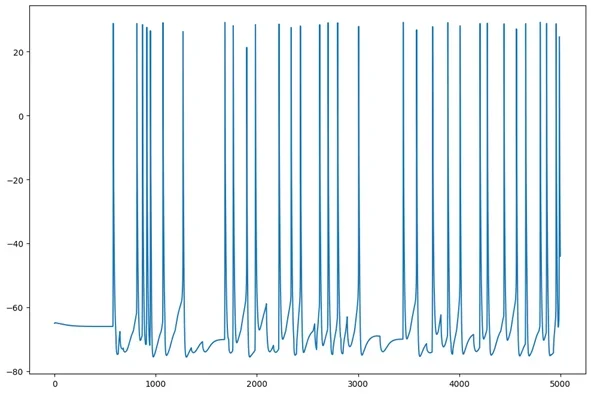 The solution to a neuron firing for 4.5 seconds at 7Hz is approximately 32 spikes (y-axis is voltage, and each line is a spike). Start time is 0.5 sec.Copyright Alishia Hill
- neuron
- The basic building block of the nervous system.
- nervous system
- The circuitry that sends messages back and forth between the brain and the body.
- soma
- The part of the neuron that functions as the computational center.
- axon
- The part of the neuron where an action potential is sent down.
- dendrite
- The part of the neuron where signals are received.
- action potential
- A signal generated by a neuron to be sent to other neurons.
- classical conditioning
- The pairing of two different stimuli to create learning in an animal.
- amygdala
- The part of the brain responsible for learning fear.
Pre-Activity Assessment
Pre-Assessment Worksheet: Before the activity begins, students answer general questions about the brain and electrical functions in the Pre-Assessment Worksheet (PDF).This will give you a general idea of the students’ knowledge.
Activity Embedded (Formative) Assessment
Concept Map: Students create a concept map that connects neurons, neural circuits, and electrical circuits. They include key terms (i.e., dendrites, axons, action potentials, resistors, switches, circuits) and illustrate how these concepts relate to one another. This will help assess their ability to draw parallels between biological and electrical systems.
Post-Activity (Summative) Assessment
Post-Assessment Worksheet: The Post-Assessment Worksheet (PDF) includes questions based on the activity to gauge student learning.
To scale down the activity for younger students, or those with limited background knowledge, consider simplifying concepts and focusing on hands-on learning:
- Hands-On Circuit Building: Replace the PhET simulator with physical materials such as batteries, wires, and light bulbs, so students can physically assemble a working circuit and see cause-and-effect relationships more clearly.
- Basic Neural Pathway Models: Have students act out a neural circuit by passing a ball (signal) down a line, showing how neurons communicate without discussing ion movement or action potentials.
- Reduce Technical Vocabulary: Instead of detailed neuron anatomy, focus on the basic idea that the brain sends signals like a circuit and controls movement, reflexes, and learning.
- Shorten the Activity: Break it into one or two simple steps—such as drawing a neuron and comparing it to a wire circuit—rather than covering all aspects of neural communication and engineering.
This activity can be scaled up in several ways to deepen students’ understanding and incorporate more advanced engineering concepts:
- Incorporate Real-World Biomedical Applications: Introduce case studies of brain-computer interfaces (BCIs), prosthetic limbs controlled by neural signals, or neurostimulation therapies. Students could explore how biomedical engineers develop devices that interface with the nervous system to restore movement or treat conditions such as Parkinson’s disease.
- Advanced Circuit and Coding Integration: Use microcontrollers such as Arduino or Raspberry Pi to simulate neural signals and decision-making processes. Students could program a circuit to mimic a neural response, such as detecting a stimulus (light or sound) and triggering an action (a motor or LED).
- EEG or Brain-Computer Interface Exploration: If resources allow, students could work with electroencephalography (EEG) devices to record brainwave activity and analyze how different stimuli affect brain signals, bridging neuroscience and electrical engineering.
- Engineering Design Challenge: Assign students an open-ended engineering problem, such as designing a wearable neural interface or a prosthetic controlled by muscle signals. They can use the engineering design process to brainstorm, prototype, and refine solutions, mirroring real-world biomedical engineering challenges.
- Collaboration with Neuroscientists or Engineers: Bring in guest speakers from biomedical or neural engineering fields to discuss current research and applications, inspiring students to see the impact of engineering on healthcare and technology.
- Exploring Our Brain’s Learning Process
- Wired to Think: Exploring the Brain as an Electrical Circuit
- Learning Fear: Exploring Pavlovian Conditioning and Neural Pathways
- Connecting the Circuits of Fear: Understanding Neural Pathways and Conditioning
Contributors
Alisha Hill (Biology Teacher, St. Louis); Harmon Colvett; Sachin Nair; Gregory Glickert; Hend Rasheed (Computer Science Teacher); Satish S Nair
Supporting Program
Research Experience for Teachers (RET), University of Missouri Columbia
Acknowledgements
This work is based on work supported in part by the National Science Foundation under grant no. EEC-1801666—Research Experiences for Teachers at the University of Missouri. Any opinions, findings and conclusions or recommendations expressed in this material are those of the authors and do not necessarily reflect the views of the National Science Foundation.
Copyright
2025 by Regents of the University of Colorado; original © 2024 University of Missouri