
Connecting the Circuits of Fear: Understanding Neural Pathways and Conditioning
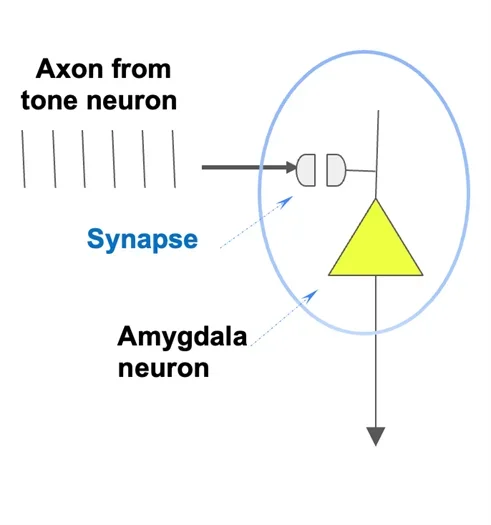 The presynaptic neuron sends signals into the neurons of the amygdala to help generate the fear circuit.Copyright Alisha Hill
Students dive deeper into fear conditioning by exploring the neural pathways involved in tone and shock responses. They review the basics of synapses and neural pathways before using a virtual lab simulation to connect tone and shock pathways in the amygdala, aiming to create a circuit that results in fear conditioning. Throughout the process, students experiment with different firing rates and configurations, troubleshooting through trial and error to find the correct values that activate the neurons. The task culminates in a more advanced exploration of calcium ion plasticity, enhancing students' understanding of how fear conditioning works at multiple levels in the brain.
Neural engineers, biomedical engineers, and cognitive engineers apply principles from both biology and engineering to design, analyze, and optimize systems related to the brain and neural circuits. Neural engineers focus on developing technologies to interact with the brain, such as neural interfaces and brain-computer interfaces. Biomedical engineers work on systems that interface with biological systems, such as creating devices or tools for studying brain activity. Cognitive engineers, particularly those in fields like human-computer interaction, apply knowledge of the brain's response to stimuli to design systems or tools that adapt based on learning and behavior. These engineers often use similar principles—such as circuits, systems modeling, and adaptation—to create technologies that can respond to biological or cognitive inputs.
After this activity, students should be able to:
- Identify and illustrate the neural circuits involved in processing tone and shock stimuli.
- Explain how separate neural pathways for tone and shock interact to enable fear learning in the brain.
- Describe the role of the amygdala in integrating these pathways to produce learned emotional responses.
- CCSS.Math.Content.HSF-BF.A.2 Write arithmetic and geometric sequences both recursively and with an explicit formula, use them to model situations, and translate between the two forms.
Grades 9-12
Do you agree with this alignment?
- HS-LS1-1 Construct an explanation based on evidence for how the structure of DNA determines the structure of proteins which carry out the essential functions of life through systems of specialized cells.
Grades 9-12
This resource focuses on the following Three Dimensional Learning aspects of NGSS:
Science & Engineering Practices- Construct an explanation based on valid and reliable evidence obtained from a variety of sources (including students' own investigations, models, theories, simulations, peer review) and the assumption that theories and laws that describe the natural world operate today as they did in the past and will continue to do so in the future.Do you agree with this alignment?
Disciplinary Core Ideas- Systems of specialized cells within organisms help them perform the essential functions of life.Do you agree with this alignment?
- All cells contain genetic information in the form of DNA molecules. Genes are regions in the DNA that contain the instructions that code for the formation of proteins, which carry out most of the work of cells.Do you agree with this alignment?
Crosscutting Concepts- Investigating or designing new systems or structures requires a detailed examination of the properties of different materials, the structures of different components, and connections of components to reveal its function and/or solve a problem.Do you agree with this alignment?
Do you agree with this alignment? - Construct an explanation based on valid and reliable evidence obtained from a variety of sources (including students' own investigations, models, theories, simulations, peer review) and the assumption that theories and laws that describe the natural world operate today as they did in the past and will continue to do so in the future.
Each student needs:
- a computer or tablet with access to the internet; if not available, one computer with the ability to project to the whole class will suffice
- Pre-Assessment Worksheet (PDF)
- Post-Assessment Worksheet (PDF)
- paper or notebook to sketch
- pencil or pen
For the whole class to share:
- laptop or computer with projector to display the What Are Tone and Shock? Presentation (PPTX) and access to the internet to show videos.
Note: All of the code is hosted at Cyneuro.org. If needed, the code can be downloaded to the user’s computer and then run from there. Thus, this activity is not dependent on the cyneuro.org site.
- Plasticity Pre-Assessment (docx)
- Plasticity Pre-Assessment (pdf)
- Plasticity Pre-Assessment Answer Key (docx)
- Plasticity Pre-Assessment Answer Key (pdf)
- Plasticity Post-Assessment (docx)
- Plasticity Post-Assessment (pdf)
- Plasticity Post-Assessment Answer Key (docx)
- Plasticity Post-Assessment Answer Key (pdf)
- What Are Tone and Shock? Presentation (pptx)
- What Are Tone and Shock? Presentation (pdf)
Students should have a basic understanding of cells, electrical circuits, and fundamental computing concepts. This includes knowing how to run programs in a web browser using Google Colab and having a general idea of how computer programs work.
You already know that your brain can learn to be afraid of something, but have you ever wondered how exactly that happens? Let’s dive into that today. Picture this: You're watching a movie and suddenly hear a strange noise right before a large, poisonous snake slithers through the leaves and bites a character. The next time you hear that same noise—maybe while walking outside in the fall—your heart races, and you feel fear before you even know why. What’s going on? Why does that sound suddenly trigger fear? How does your brain make that connection? Today, we’re going to uncover just how your brain links sounds and experiences to emotions such as fear.
We’ll dive into the world of neurons and synapses, exploring how certain connections in your brain strengthen through something called "associative conditioning." Just like Pavlov’s dogs learned to associate a bell with food, your brain can learn to connect a sound with fear. This helps you learn from your experiences and respond quickly—even before you consciously realize it.
Before we get started, let’s quickly refresh what we’ve learned so far. Can anyone explain how neurons communicate? (Let students share ideas such as action potentials and synapses.) Now, think about how electrical circuits work—how they transfer energy to light up a bulb or power your phone. (Allow students to give examples.) By the end of today, you’ll see how your brain’s emotional responses, like fear, work in a way that’s very similar to how electrical circuits operate—transmitting signals through pathways to create reactions.
In this activity, we’re going to look at how different neural circuits, like those for tone and shock, interact and strengthen through repetition. Remember when we reviewed how neurons work, and how they form circuits? Today, we’ll connect this to Pavlov’s conditioning and see how your brain links separate pathways, such as sound and shock, to create stronger synapses, help you learn, and shape the way you react to things in your world. Ready to find out how fear gets wired into your brain?
Background
Understanding how the brain processes information requires knowledge of neurons, neural circuits, and synapses. Neurons, the building blocks of the nervous system, transmit electrical signals that allow the brain to process sensory data, control movement, and coordinate behaviors. These signals travel through neural circuits—interconnected networks of neurons that relay and process information throughout the brain. Synapses, the junctions between neurons, enable communication by transmitting signals via neurotransmitters. Together, these structures allow the brain to respond to stimuli and organize coordinated actions.
Neurons and their connections also play a crucial role in memory formation and learning. When we experience new information or events, the neural circuits involved change—a process known as synaptic plasticity. This allows the brain to adapt, form new memories, and adjust to new experiences. Synaptic plasticity is vital for learning through repetition and conditioning, helping the brain rewire itself in response to what we learn.
One key part of the brain involved in processing emotions, especially fear, is the amygdala. The amygdala evaluates emotional stimuli and triggers appropriate behavioral and physiological responses. It interacts with other brain areas to process sensory input and generate emotional reactions. This understanding is crucial for explaining how the brain processes fear and why certain stimuli, such as a tone or a shock, can trigger a fear response.
In Pavlovian conditioning, a neutral stimulus becomes associated with a naturally occurring stimulus, producing a similar response. In Ivan Pavlov’s classic experiment, dogs were conditioned to salivate at the sound of a bell after it was repeatedly paired with food. This type of learning demonstrates how organisms—humans included—can develop emotional and physiological responses through associations between stimuli. Pavlovian conditioning shows how behaviors and responses can be learned, forming connections between experiences and reactions.
Synaptic plasticity is central to Pavlovian conditioning. It allows synapses to strengthen or weaken in response to activity, enabling the brain to form new associations over time. In the case of fear conditioning, for example, a neutral stimulus, like a tone, is paired with a fear-inducing stimulus, like a shock, leading to a learned fear response. This ability to adjust neural communication is fundamental to learning and memory, and it helps explain how repeated experiences lead to conditioned emotional responses.
By understanding these concepts of neural structure, emotional processing, and synaptic plasticity, teachers can help students grasp how the brain learns and processes information. This knowledge is essential for explaining how learning, memory, and emotional responses work—concepts that are central to many educational activities and lessons.
Before the Activity
- Make sure Google Colab works on the students' computers. Colab is a free, browser-based tool that allows students to run Python code and install necessary packages directly in the browser, without needing to download anything to their computers. It has been widely used and supported by educators for years. There are several tutorial videos available to help students learn how to use Colab on any browser. For example, the What is Python? activity on Teach Engineering includes guidance on using Colab. This eliminates the need for students to worry about downloads or installations, making it easy to use in class.
- Confirm that the University of Colorado’s circuit website is accessible to students. This site has been reliable, but if there are any issues, other websites with similar interactive physics activities can also be used. Alternatively, if needed, you can create paper-and-pencil activities that replicate the same concepts without relying on online tools.
- The code used to model a neuron is available on an open-access GitHub repository, a widely recognized and reliable platform used globally, including in academic and K-12 settings.
- Review the What Are Tone and Shock? Presentation (PPTX) to ensure familiarity with its content and to tailor the material to your students’ needs.
- Make copies of the Pre-Assessment Worksheet (PDF)(1 per student).
- Make copies of the Post-Assessment Worksheet (PDF)(1 per student).
- Make sure the What Are Tone and Shock? Presentation (PPTX) can be projected for the class to view.
During the Activity
Pre-Assessment
- Hand out one Pre-Assessment Worksheet (PDF)to each student.
- Give students 10 minutes to answer the Pre-Assessment Worksheet (PDF)questions.
- Collect each student’s completed Pre-Assessment Worksheet (PDF).
Activity 3: What Are Tone and Shock?
- Display the What Are Tone and Shock? Presentation (PPTX).
- Slide1: What Are Tone and Shock?
- Introduce the activity to the students: This is the final activity in our series on fear conditioning. It’s the most technically challenging one, so we’ll need to go through it carefully, but don't worry—it’s definitely manageable. So far, we've explored Pavlov's research and learned about fear conditioning. Now, we’re going to take that knowledge and apply it to some new, hypothetical situations. Ready to dive in? Let's go!
- Note: Students should already understand Pavlov's research and the concept of fear conditioning. Now, we will apply this knowledge to new hypothetical scenarios.
- Slide 2: Neurons connect to each other via synapses
- Read through the slide with the class.
- Note: The students should have a strong understanding of how neurons are wires in the circuitry example, and they connect many different neurons together through synapses.
- Optional: Have students use web resources to learn more about synapses.
- Slide 3: What is the neural pathway for the tone – reward and fear cases?
- Read through slide with class.
- Note: Students should be familiar with these pathways and be able to draw them independently.
- Slide 4: Putting both pathways together in the overall simplified fear circuit
- Review the pathways for the tone and shock that the mice experience.
- Optional: Have students draw the paths.
- Note: At this point, students should be able to draw this on their own from notes or memory without needing the slides, but this is the time to make sure all students are at that point.
- Slide 5: Activity 3.1
- Instruct students to go into the virtual lab (https://phet.colorado.edu/en/simulations/circuit-construction-kit-dc and click on the play button to get started.
- Using the simulator, ask students to put the tone and shock pathways together using the same amygdala neuron.
- Slide 6: REVIEW. How does the tone-only configuration work?
- State the following: Now, our goal is to connect the two pathways. In the previous activities, we created two separate pathways, but just having two separate pathways doesn’t result in fear conditioning. In this activity, your task is to link these pathways together, like how it happens in the amygdala, to create a circuit that leads to learning.
- Note: This slide is a review of the first Google Colab from the last unit but with a new spin. Now that students are starting to understand the differences between tone, tone and shock, and the next tone, they should be able to change the firing rates in the neuron models properly. The students should be answering the questions on their own as they trial and error the simulation. Students might need to adjust certain values to get the lightbulb to light up, and this may require some trial and error.
- Slide 7: REVIEW. How does the tone-only configuration work? (continued)
- This slide is similar to the previous. Students should continue to generate different scenarios for the neuron model that result in different frequencies that represent different states of emotion and conditioning.
- Encourage students to predict the results as they experiment with the neuron models.
- Slide 8: Activity 3.2
- Activity 3.2 goes more in depth with models and response to different stimuli. This more complex activity will reinforce students' understanding but may present challenges.
- Slide 9: How do tone and shock cause plasticity in amygdala? (continued)
- Let students know that this activity boils down to trial and error for finding the right values for the tone to create neurons to fire.
- Slide 10: Activity 3.3 - Tone and shock cause plasticity via Ca2+ learning rule
- State: “This sub activity is the final exercise of the unit. It takes all that we have learned and seeks to add one more component with calcium ion plasticity.”
- Note: If students have no experience with chemistry or ions, this activity will take longer and might be omitted, but it is an excellent ending to the unit to show how there are many levels to neuroscience and many different careers for those interested.
- (optional) Slide 11: Answer Key
- This slide is the conclusion for the units. Students should now be able to understand there are many circuits that make up the nervous system in their body and every animal. They should believe and have an understanding of how the nervous system is similar to an electric circuit. Lastly, they should understand how fear conditioning works at multiple different levels.
- (optional) Slide 12: Answer Key
- This slide shows the solution to the circuitry exercise. Note how the two circuits join together.
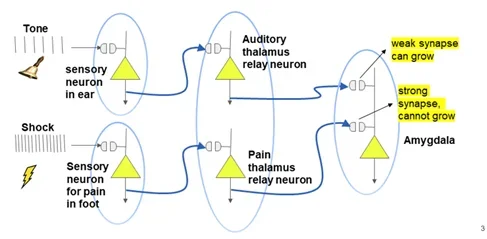 The complete fear circuit can be seen here, with the pathways between the tone and shock all the way to where they converge in the amygdala.Copyright Alisha Hill
- This slide shows the solution to the circuitry exercise. Note how the two circuits join together.
Post Assessment
- Pass out one Post-Assessment Worksheet (PDF) to each student.
- Give students 10 minutes to answer the Post-Assessment Worksheet (PDF) questions.
- Collect each student’s completed Post-Assessment Worksheet (PDF)and grade them.
- neuron
- The basic building block of the nervous system.
- nervous system
- The circuitry that sends messages back and forth between the brain and the body.
- soma
- The part of the neuron that functions as the computational center.
- axon
- The part of the neuron where an action potential is sent down.
- dendrite
- The part of the neuron where signals are received.
- action potential
- A signal generated by a neuron to be sent to other neurons.
- classical conditioning
- The pairing of two different stimuli to create learning in an animal.
- amygdala
- The part of the brain responsible for learning fear.
Pre-Activity Assessment
Pre-Assessment Worksheet: Before the activity begins, students answer general questions about the brain and plasticity in the Pre-Assessment Worksheet (PDF). This will give teachers a general idea of the students’ knowledge.
(optional) Class Discussion: Ask students to describe how the brain processes stimuli such as sounds or shocks, and how these might lead to an emotional response like fear. Have them provide examples of similar experiences (e.g., hearing a loud noise and feeling startled). Then, ask students to explain or sketch a basic neural or electrical circuit to gauge their understanding of connections between neurons and circuits. This will give insight into how well they grasp the foundational concepts before moving into more complex pathways.
Activity Embedded (Formative) Assessment
Google Colab Exercises: Students use Google Colab (Activities 3.1-3.3) to understand how the amygdala fires in response to sound. To determine how deep their understanding goes, you can provide different situations for the students to model.
Post-Activity (Summative) Assessment
Post-Assessment Worksheet: The Post-Assessment Worksheet (PDF) includes questions based on the activity to gauge student learning.
(optional) Assessment Question: Ask students to draw the neural circuit that connects tone and shock pathways to create a fear response. They should also explain how the amygdala plays a role in linking these pathways. This final task ensures they can visualize and explain how separate circuits integrate to form learned behaviors. You can also incorporate the concepts of frequency and action potentials by asking the students how action potentials and frequencies would be affected in a fear state.
The IT department in a school may not permit Colab on student computers. It is important to try to access the website well in advance to contact IT and give them time to possibly unblock the website or prepare an alternative plan of projecting your screen. As mentioned, students can run these on their personal computers, either in school or at home.
- Exploring Our Brain’s Learning Process
- Wired to Think: Exploring the Brain as an Electrical Circuit
- Learning Fear: Exploring Pavlovian Conditioning and Neural Pathways
- Connecting the Circuits of Fear: Understanding Neural Pathways and Conditioning
Contributors
Alisha Hill (Biology Teacher, St. Louis); Harmon Colvett; Sachin Nair; Gregory Glickert; Hend Rasheed (Computer Science Teacher); Satish S Nair
Supporting Program
Research Experience for Teachers (RET), University of Missouri Columbia
Acknowledgements
This work is based on work supported in part by the National Science Foundation under grant no. EEC-1801666—Research Experiences for Teachers at the University of Missouri. Any opinions, findings and conclusions or recommendations expressed in this material are those of the authors and do not necessarily reflect the views of the National Science Foundation.
Copyright
2025 by Regents of the University of Colorado; original © 2024 University of Missouri