
Learning Fear: Exploring Pavlovian Conditioning and Neural Pathways
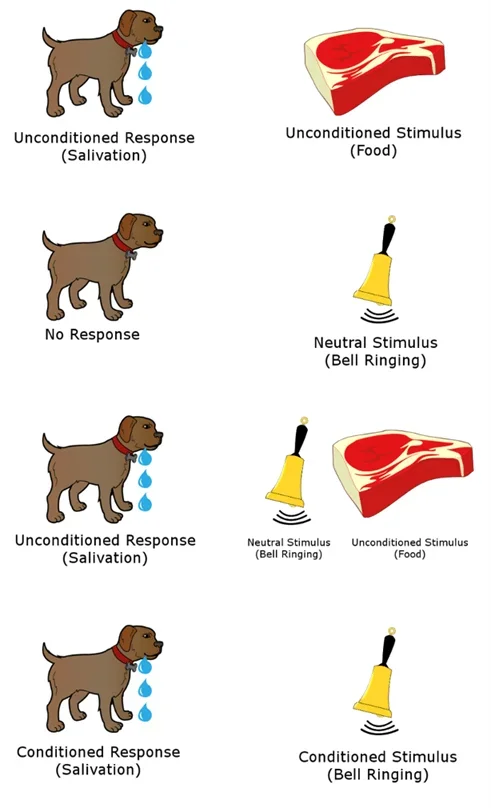 This diagram shows the development of Pavlov’s experiments and how they can condition a dog to salivate just to a tone without any primary stimulus.Copyright https://cleverism.com/how-the-conditioned-stimulus-works-in-classical-conditioning/
Students build on their understanding of how the brain uses circuits to respond to external stimuli, learning about Pavlovian conditioning through the lens of neural circuits. By exploring Pavlov’s dog experiment, students connect their knowledge of neurons and neural pathways to understand how animals, including humans, learn through association. The lesson emphasizes the concept of learning and synaptic plasticity, which are key to understanding how neural circuits control behavior. Students engage in hands-on activities, such as drawing circuits, discussing the Pavlov experiment, and using tools such as Google Colab to explore fear learning and the role of the amygdala. With the help of videos and group discussions, they examine the neural pathways involved in both reward and fear conditioning.
Neural engineers, biomedical engineers, and cognitive engineers apply principles from both biology and engineering to design, analyze, and optimize systems related to the brain and neural circuits. Neural engineers focus on developing technologies to interact with the brain, such as neural interfaces and brain-computer interfaces. Biomedical engineers work on systems that interface with biological systems, such as creating devices or tools for studying brain activity. Cognitive engineers, particularly those in fields like human-computer interaction, apply knowledge of the brain's response to stimuli to design systems or tools that adapt based on learning and behavior. These engineers often use similar principles—such as circuits, systems modeling, and adaptation—to create technologies that can respond to biological or cognitive inputs.
After this activity, students should be able to:
- Describe the basic principles of classical conditioning, such as how an animal can learn to associate a stimulus (e.g., a tone) with a reward (food) or a punishment (foot shock) after repeated exposure.
- Describe how neurons and neural circuits change to create learned associations in both the dog and the mouse experiments.
- Predict the outcome of a different stimulus-response pairing by applying their understanding of classical conditioning.
- CCSS.Math.Content.HSF-BF.A.2 Write arithmetic and geometric sequences both recursively and with an explicit formula, use them to model situations, and translate between the two forms.
Grades 9-12
Do you agree with this alignment?
- HS-LS1-1 Construct an explanation based on evidence for how the structure of DNA determines the structure of proteins which carry out the essential functions of life through systems of specialized cells.
Grades 9-12
This resource focuses on the following Three Dimensional Learning aspects of NGSS:
Science & Engineering Practices- Construct an explanation based on valid and reliable evidence obtained from a variety of sources (including students' own investigations, models, theories, simulations, peer review) and the assumption that theories and laws that describe the natural world operate today as they did in the past and will continue to do so in the future.Do you agree with this alignment?
Disciplinary Core Ideas- Systems of specialized cells within organisms help them perform the essential functions of life.Do you agree with this alignment?
- All cells contain genetic information in the form of DNA molecules. Genes are regions in the DNA that contain the instructions that code for the formation of proteins, which carry out most of the work of cells.Do you agree with this alignment?
Crosscutting Concepts- Investigating or designing new systems or structures requires a detailed examination of the properties of different materials, the structures of different components, and connections of components to reveal its function and/or solve a problem.Do you agree with this alignment?
Do you agree with this alignment? - Construct an explanation based on valid and reliable evidence obtained from a variety of sources (including students' own investigations, models, theories, simulations, peer review) and the assumption that theories and laws that describe the natural world operate today as they did in the past and will continue to do so in the future.
Each student needs:
- a computer or tablet with access to the internet; if not available, one computer with the ability to project to the whole class will suffice
- Pre-Assessment Worksheet (PDF)
- Post-Assessment Worksheet (PDF)
- paper or notebook to sketch
- pen or pencil
For the whole class to share:
- laptop or computer with projector to display the What Is Fear? PowerPoint Presentation (PPTX) and access to the internet to show videos
Note: All of the code is hosted at Cyneuro.org. If needed, the code can be downloaded to the user’s computer and then run from there. Thus, this activity is not dependent on the cyneuro.org site.
- Pavlov’s Dog Pre-Assessment (docx)
- Pavlov’s Dog Pre-Assessment (pdf)
- Pavlov’s Dog Pre-Assessment Answer Key (docx)
- Pavlov’s Dog Pre-Assessment Answer Key (pdf)
- Pavlov’s Dog Post-Assessment (docx)
- Pavlov’s Dog Post-Assessment (pdf)
- Pavlov’s Dog Post-Assessment Answer Key (docx)
- Pavlov’s Dog Post-Assessment Answer Key (pdf)
- What Is Fear? Presentation (pptx)
- What Is Fear? Presentation (pdf)
Students should have a basic understanding of cells, electrical circuits, and fundamental computing concepts. This includes knowing how to run programs in a web browser using Google Colab and having a general idea of how computer programs work.
How do our brains learn fear? Imagine you touch a hot stove for the first time. Your brain instantly learns not to do that again. But how does your brain actually learn fear? That’s what we’re about to explore.
We’ve already talked about neurons, the building blocks of the brain, and how they create circuits to help us think, move, and remember things. Now, we’re diving into how our brains build circuits for learning—especially fear learning.
We’ve mentioned Ivan Pavlov before, but let’s take a closer look at one of his famous experiments. On Day 1, Pavlov played a tone for a group of dogs. They did nothing special—just normal dogs hearing a sound. On Day 2, Pavlov played the same tone but this time, he gave the dogs a piece of steak every time they heard it. Then on Day 3, Pavlov played the tone again—but without the steak. The dogs still started drooling, as if they were expecting food. Their brains had learned to associate the tone with steak—without even thinking about it. This process is called classical conditioning, where two things (the tone and the steak) get linked together in the brain.
Now, let’s swap steak for something much less fun: a mild foot shock in a mouse experiment. Instead of salivating when hearing a tone, the mouse learns to fear the tone after experiencing the shock multiple times. Just like Pavlov’s dogs learned that tone = food, the mouse learns that tone = shock. This forms a fear circuit in the brain, which helps mammals—including humans—avoid danger in the future.
The amygdala, the brain’s fear center, plays a huge role in this process. When the brain connects a certain sound, sight, or experience with danger, the amygdala reacts quickly to help protect you. That’s why, after burning yourself once, you instinctively pull your hand away from heat without even thinking about it.
Understanding fear learning helps us see why we quickly learn to avoid painful experiences such as touching a hot stove. It also helps scientists study phobias, post-traumatic stress disorder (PTSD), and how to “unlearn” fears through therapy.
By the end of this activity, you’ll understand how our brains build fear circuits and why they’re important for survival.
Background
Understanding the structure and function of neurons, neural circuits, and synapses is essential for comprehending how the brain operates. Neurons, the building blocks of the nervous system, are responsible for transmitting electrical signals that enable the brain to process sensory information, control motor functions, and coordinate complex behaviors. Neural circuits, which consist of networks of interconnected neurons, play a crucial role in processing and relaying information throughout the brain. Synapses, the junctions between neurons, facilitate communication by transmitting signals via neurotransmitters. Together, these structures enable the brain to respond to stimuli and organize coordinated responses.
In addition to processing sensory information, neurons and their connections are integral to memory formation and learning. As individuals experience new information or events, the neural circuits involved undergo changes—a process known as synaptic plasticity. These changes allow the brain to adapt and rewire itself in response to learning, helping to form new memories and adjust to new experiences. Synaptic plasticity is fundamental to how we learn through repetition and conditioning, and it is a key process that enables us to adapt and remember.
The central nervous system, which includes the brain and spinal cord, plays a central role in integrating and processing sensory information. A particularly important region within the brain is the amygdala, which is responsible for processing emotions such as fear. The amygdala helps evaluate emotional stimuli and triggers appropriate behavioral and physiological responses, such as fear. It interacts with other areas of the brain to process sensory input and produce emotional reactions. Understanding the amygdala's role in emotional processing is crucial for explaining how the brain generates emotional responses and how we react to stimuli that elicit fear.
Pavlovian conditioning is a form of learning where a neutral stimulus becomes associated with a naturally occurring stimulus, resulting in a similar response. In Ivan Pavlov's famous experiment, dogs were conditioned to salivate at the sound of a bell after the bell had been repeatedly paired with food. This form of learning highlights how organisms, including humans, can develop emotional and physiological responses through associations between stimuli. Pavlovian conditioning provides insight into how behaviors and responses can be learned over time and how the brain forms connections between experiences and reactions.
At the core of Pavlovian conditioning is synaptic plasticity, which refers to the ability of synapses to strengthen or weaken over time in response to activity. This process is integral to learning and memory, as it allows the brain to adjust by modifying the efficiency of neural communication. In conditioning, repeated exposure to specific stimuli can alter the strength of synaptic connections, enabling the brain to form new associations. This ability of synaptic plasticity is fundamental to how we learn from experiences and adapt our responses to repeated stimuli.
Understanding these concepts of neural structure, emotional processing, and synaptic plasticity provides teachers with the knowledge needed to explain how the brain learns and processes information. This foundational knowledge is critical for helping students understand the complex processes involved in learning, memory, and emotional responses, which are key elements in many educational activities and lessons.
Before the Activity
- Make sure Google Colab works on the students' computers. Colab is a free, browser-based tool that allows students to run Python code and install necessary packages directly in the browser, without needing to download anything to their computers. It has been widely used and supported by educators for years. There are several tutorial videos available to help students learn how to use Colab on any browser. For example, the "What is Python?" activity on TeachEngineering includes guidance on using Colab. This eliminates the need for students to worry about downloads or installations, making it easy to use in class.
- Confirm that the University of Colorado’s circuit website is accessible to students. This site has been reliable, but if there are any issues, other websites with similar interactive physics activities can also be used. Alternatively, if needed, you can create paper-and-pencil activities that replicate the same concepts without relying on online tools.
- The code used to model a neuron is available on an open-access GitHub repository, a widely recognized and reliable platform used globally, including in academic and K-12 settings.
- Review the What Is Fear? Presentation (PPTX) to ensure familiarity with its content and to tailor the material to your students’ needs.
- Make copies of the Pre-Assessment Worksheet (PDF) (1 per student).
- Make copies of the Post-Assessment Worksheet (PDF) (1 per student).
- Make sure the What Is Fear? Presentation (PPTX) can be projected for the class to view.
During the Activity
Pre-Assessment
- Hand out one Pre-Assessment Worksheet (PDF) to each student.
- Give students 10 minutes to answer the Pre-Assessment Worksheet (PDF) questions.
- Collect each student’s completed Pre-Assessment Worksheet (PDF).
Activity 2: What Is Fear?
- Display the What Is Fear? Presentation (PPTX).
- Slide 1: Title Slide/Introduction
- Say: “This is the second activity in our three-part series. In this activity, we will focus on how fear is learned. Now that we understand the basics of the nervous system, we will apply these concepts to learning fear. To demonstrate this, we will refer to Pavlov’s dog experiment throughout this activity.”
- Slide 2: Starting Activity – Drawing a Circuit
- Say: “As in the first activity, we will begin with an exercise. Your goal is to draw any circuit you want. Think back to our last activity where we used wires, resistors, switches, light bulbs, and batteries. Now, try substituting the light bulb for your car’s engine and the switch for your car keys. How does that affect the circuit drawing?”
- Give students time to sketch their circuits.
- Notes:
- This is an open-ended exercise, but students must draw some form of an electrical circuit.
- If drawings from the first activity are still available, or students have access to an online circuit-building tool, they can use those for reference.
- Emphasize the flow of information through the system.
- Slide 3: What is fear?
- Read through the slide with students.
- Note: This slide provides foundational information on fear. Feel free to modify or shorten it to fit your class needs.
- Slide 4: Pavlov’s Conditioning Experiment (Reward Learning vs. Fear Learning)
- Show this video: https://www.youtube.com/watch?v=jd7Jdug5SRc (5:33 minutes). (Note: There are many different videos and resources to cover the concept of learning salivation and fear. For this first introduction, it’s important to present this concept as a story and have students participate by guessing what they expect results to be throughout to have them engage.)
- Engage students by asking them to predict the results throughout the video.
- Say: “Now, let’s apply what we’ve learned about circuits and fear to Pavlov’s experiment. Think about what happens if we change the experiment: Instead of dogs getting steak when they hear the tone on Day 2, imagine that mice get shocked when they hear the tone. How do you think this would change their response?”
- Have students explain how the mice are learning fear.
- Encourage students to hypothesize what neural pathways might be involved in this learning process.
- Slide 5: Pavlovian auditory fear
- State: Let’s talk about your answer to the last question. We can now visualize the full trial and begin to form more concrete hypotheses on what is occurring. The major point to draw now that we have talked about both fear and pleasure is how their response changes between Days 1 and 3. It should be emphasized that Days 1 and 3 have the exact same tone, but the dog and mice have opposite reactions. It’s somewhat clear why there is a difference, but you should be able to see that the Day 2 tone and stimulus was what caused the dogs and mice to learn and, as a result, have different reactions to the tones. We are going to talk about why this is the way it is, but you should be able to see where the mice and dog change.
- Read through the slide.
- Ask the students: Can you guess the rodent response after conditioning (3) as compared to before conditioning (1)?
- Show this video: https://www.youtube.com/watch?v=mi2gqhHw1N0 (0:46 minutes).
- Slide 6: Tone-shock fear conditioning in rodents
- Ask students to write down what specific parts of the brain they think changed in the two animals. (Note: They are not expected to know the exact structures in the brain, but generally what emotions in the brain were changed from Day 1 to Day 3 in each animal, and what the animals learned on Day 2 that caused this change.)
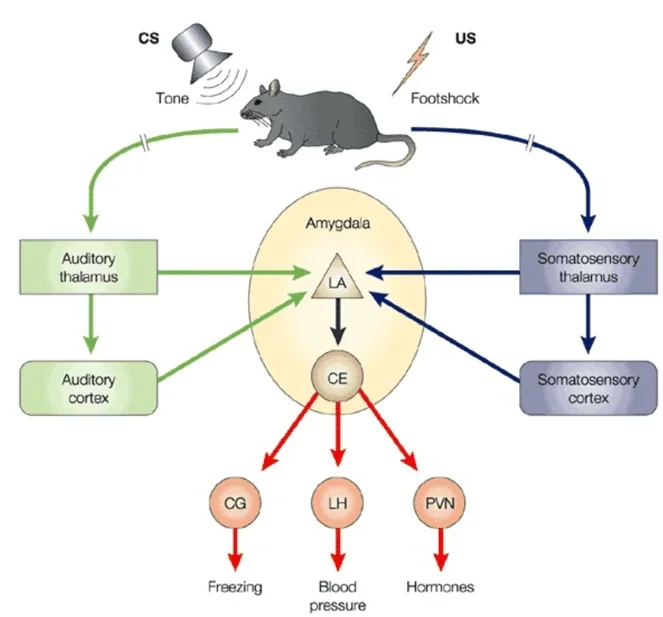 The fear circuit of a mouse as a tone and shock are both given as inputs to a mouse. They then create the responses seen at the bottom of the figure.Copyright Nature Review Neuroscience
- Ask students to write down what specific parts of the brain they think changed in the two animals. (Note: They are not expected to know the exact structures in the brain, but generally what emotions in the brain were changed from Day 1 to Day 3 in each animal, and what the animals learned on Day 2 that caused this change.)
- Slide 7: Neurons connect to each other via synapses
- State: Recall the synapses that connect one neuron to another to create pathways that we talked about last unit. The major takeaway is to be able to understand the drawing on the left. The amygdala is the fear center of the brain, and it receives input from the left side of the figure. Going back to the question of the previous slide, the mouse’s amygdala changed as a result of learning fear.
- Note: This slide re-emphasizes the synapses that connect one neuron to another to create pathways. The major takeaway is for students to be able to understand the drawing on the left. The amygdala is the fear center of the brain, and it receives input from the left side of the figure.
- Slide 8: What is the neural pathway for the tone – reward and fear cases?
- State: This slide then shows the pathway from the tone through the thalamus and into the amygdala. You are not expected to know this in advance, but now that we are covering it, you should start to understand why Pavlov got the results he did.
- Slide 9: What is fear conditioning?
- This slide restates information but emphasizes the name of fear conditioning to it. Students should understand the body of text and put it under the umbrella of fear conditioning.
- Slide 10: How is the brain involved in learning fear?
- This slide defines the specific parts of the brain involved in fear conditioning. These parts of the brain all connect together to form a neural pathway that needs to be understood at a conceptual level. The major term is to know that the amygdala is the fear center of the brain. Other parts in the pathway are good to cover, but not vital. Look at the picture to the right and focus on understanding it. These two pathways are what cause the mouse to learn fear.
- Slide 11: Both tone and shock pathways together
- This slide shows both the tone and shock pathways coming together. One important part to mention is the lines above the bell and shock symbols. You can ask the students what they are. Students might be able to remember action potentials, but if not, this is a good time to review frequency and firing rate from the previous unit. Once they understand they are action potentials, they should be able to determine the shock has a higher frequency, assuming they are the same amount of time. You can then ask the class why this is. They should be able to conclude that it’s because shocks are more harmful and more important for the brain to know about. You can simplify it by giving the example that you’re more likely to get help if you scream a bunch of times instead of just a few.
- Slide 12:
- This slide shows where the amygdala is, to give students a better mental picture of the circuitry.
- This slide shows where the amygdala is.
- Tell students to remember the amygdala and write it down because it will be a part of a future exercise.
- Slide 13: What is FEAR and why do YOU feel scared?
- Optional: Show this video: https://youtu.be/Jk0omMiuYd4 (4:33 minutes)
- Note: This video is an optional addition to the topics covered and summarizes the concept of fear conditioning.
- Slide 14: Activity 2.1 – Sketching neural pathway
- Read through the activity.
- Give students time to complete this sub activity.
- Slide 15: Activity 2.2 - Designing an electrical circuit
- Read through the activity.
- Give students time to complete this sub activity.
- Slide 16: Activity 2.3 - Pavlovian reward conditioning
- Exercise 2.3 requires the use of Colab.
- (Optional) Note: There are various tutorial videos that can help understand how to use Google Colab. If this tool is blocked or inaccessible, these activities can be talked about at a conceptual level instead.
- Give students time to complete this sub activity.
- Slide 17: Activity 2.4 – Pavlovian fear conditioning
- Read through the activity.
- Give students time to complete this sub activity.
- Slide 18: Conclusions
- Read through the slide.
- Slide 19: Why should this interest me?
- Read through the slide.
- (optional) Slide 20: References and additional reading
- (optional) Slide 22: Solution to Activity 2
Post Assessment
- Hand out one Post-Assessment Worksheet (PDF) to each student.
- Give students 10 minutes to answer the Post-Assessment Worksheet (PDF) questions.
- Collect and grade each student’s Post-Assessment Worksheet (PDF).
- neuron
- The basic building block of the nervous system.
- nervous system
- The circuitry that sends messages back and forth between the brain and the body.
- soma
- The part of the neuron that functions as the computational center.
- axon
- The part of the neuron where an action potential is sent down.
- dendrite
- The part of the neuron where signals are received.
- action potential
- A signal generated by a neuron to be sent to other neurons.
- classical conditioning
- The pairing of two different stimuli to create learning in an animal.
- amygdala
- The part of the brain responsible for learning fear.
Pre-Activity Assessment
Pre-Assessment Worksheet: Before the activity begins, students answer general questions about the brain and Pavlov’s experiments in the Pre-Assessment Worksheet (PDF). This will give you a general idea of the students’ knowledge.
Activity Embedded (Formative) Assessment
Google Colab Exercises: Students use Google Colab (Activity 2.4) to understand how the amygdala fires in response to sound. To determine how deep their understanding goes, you can provide different situations for the student to model.
Post-Activity (Summative) Assessment
Post-Assessment Worksheet: The Post-Assessment Worksheet (PDF)includes questions based on the activity to gauge student learning.
The IT department in a school may not permit Colab on student computers. It is important to try to access the website well in advance to contact IT and give them time to possibly unblock the website or prepare an alternative plan of projecting your screen. As mentioned, students can run these on their personal computers, either in school or at home.
For upper level students: As mentioned before, different scenarios can be given, and students can be asked to respond. Students can also be asked to use the concepts of action potentials to create an electrical circuit that is analogous to the fear circuit.
Mobbs D, et al., On the nature of fear (Oct 10, 2019) Scientific American. https://www.scientificamerican.com/article/on-the-nature-of-fear/
Joseph LeDoux, Redefining fear APS William James Fellow Lecture 2015) https://www.psychologicalscience.org/observer/redefining-fear
Insel T, Faulty Circuits, Scientific American, 2010. https://www.scientificamerican.com/article/faulty-circuits/
- Exploring Our Brain’s Learning Process
- Wired to Think: Exploring the Brain as an Electrical Circuit
- Learning Fear: Exploring Pavlovian Conditioning and Neural Pathways
- Connecting the Circuits of Fear: Understanding Neural Pathways and Conditioning
Contributors
Alisha Hill (Biology Teacher, St. Louis); Harmon Colvett; Sachin Nair; Gregory Glickert; Hend Rasheed (Computer Science Teacher); Satish S Nair
Supporting Program
Research Experience for Teachers (RET), University of Missouri Columbia
Acknowledgements
This work is based on work supported in part by the National Science Foundation under grant no. EEC-1801666—Research Experiences for Teachers at the University of Missouri. Any opinions, findings and conclusions or recommendations expressed in this material are those of the authors and do not necessarily reflect the views of the National Science Foundation.
Copyright
2025 by Regents of the University of Colorado; original © 2024 University of Missouri