
Hare and Snail Challenges
Legacy Curriculum
Hey there! This curriculum is no longer being curated or supported. It may contain materials that are no longer available or outdated information. Please use this document for reference.
Students engage in the second design challenge of the unit, which is an extension of the maze challenge they solved in the first lesson/activity of this unit. Students extend the ideas learned in the maze challenge with a focus more on the robot design. Gears are a very important part of any machine, particularly when it has a power source such as engine or motor. Specifically, students learn how to design the gear train from the LEGO® MINDSTORMS® servomotor to the wheel to make the LEGO taskbot go faster or slower. A PowerPoint® presentation, pre/post quizzes and a worksheet are provided.
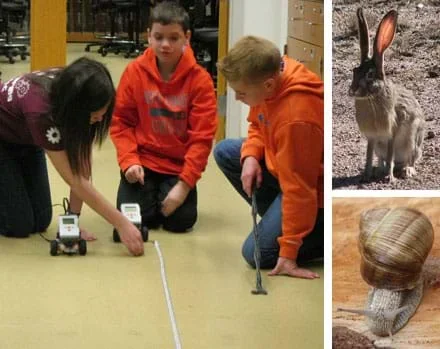 Engineers alter vehicle designs to move very fast, like hares, or much slower, like a snails.Copyright (jackrabbit) 2007 Ancheta Wis, Wikipedia; (snail) 2013 Derzsi Elekes Andor, Wikimedia Commons http://en.wikipedia.org/wiki/File:JackRabitt,OldFtBliss.JPG http://commons.wikimedia.org/wiki/File:%C3%89ti_csiga_(Helix_pomatia).JPG
Some vehicles (such as race cars) travel very fast, while other vehicles (such as tractors and earth moving equipment) travel slowly. Engineers are responsible for designing all these types of vehicles, and so must consider the very different desired outcomes in performance. What might be different in these two cases? While the associated lesson provides students with an understanding of how the arrangement of gears can be used to design these differently in order to meet each vehicle type's desired performance outcomes, this activity's challenge provides insights into how engineers can help provide flexibility to change speeds and torque in a vehicle using the engineering design process.
After this activity, students should be able to:
- Explain the terms "gear" and "gear ratio."
- Using a LEGO MINDSTORMS Education EV3 Core Set, assemble two gears on a beam to provide motion in a given gear ratio.
- Relate gear ratios to speed and torque of the LEGO MINDSTORMS EV3 robot.
- CCSS.Math.Content.6.EE.A.2 Write, read, and evaluate expressions in which letters stand for numbers.
Grade 6
Do you agree with this alignment? - CCSS.Math.Content.6.NS.B.2 Fluently divide multi-digit numbers using the standard algorithm.
Grade 6
Do you agree with this alignment? - CCSS.Math.Content.6.RP.A.1 Understand the concept of a ratio and use ratio language to describe a ratio relationship between two quantities.
Grade 6
Do you agree with this alignment?
- Students will develop an understanding of the attributes of design.
Grades K-12
Do you agree with this alignment? - Students will develop an understanding of engineering design.
Grades K-12
Do you agree with this alignment? - Students will develop abilities to apply the design process.
Grades K-12
Do you agree with this alignment? - Students will develop an understanding of the characteristics and scope of technology.
Grades K-12
Do you agree with this alignment? - Students will develop an understanding of the relationships among technologies and the connections between technology and other fields of study.
Grades K-12
Do you agree with this alignment?
- CCSS.Math.Content.6.EE.A.2 Write, read, and evaluate expressions in which letters stand for numbers.
Grade 6
Do you agree with this alignment? - CCSS.Math.Content.6.NS.B.2 Fluently divide multi-digit numbers using the standard algorithm.
Grade 6
Do you agree with this alignment? - CCSS.Math.Content.6.RP.A.1 Understand the concept of a ratio and use ratio language to describe a ratio relationship between two quantities.
Grade 6
Do you agree with this alignment?
- Designed objects are used to do things better or more easily and to do some things that could not otherwise be done at all
Grades K-5
Do you agree with this alignment? - Design and construct a machine, using materials and/or existing objects, that can be used to perform a task
Grade 5
Do you agree with this alignment?
- 3-5-ETS1-1 Define a simple design problem reflecting a need or a want that includes specified criteria for success and constraints on materials, time, or cost.
Grades 3-5
This resource focuses on the following Three Dimensional Learning aspects of NGSS:
Science & Engineering Practices- Define a simple design problem that can be solved through the development of an object, tool, process, or system and includes several criteria for success and constraints on materials, time, or cost.Do you agree with this alignment?
Disciplinary Core Ideas- Possible solutions to a problem are limited by available materials and resources (constraints). The success of a designed solution is determined by considering the desired features of a solution (criteria). Different proposals for solutions can be compared on the basis of how well each one meets the specified criteria for success or how well each takes the constraints into account.Do you agree with this alignment?
Crosscutting Concepts- People's needs and wants change over time, as do their demands for new and improved technologies.Do you agree with this alignment?
Do you agree with this alignment? - Define a simple design problem that can be solved through the development of an object, tool, process, or system and includes several criteria for success and constraints on materials, time, or cost.
- 3-5-ETS1-2 Generate and compare multiple possible solutions to a problem based on how well each is likely to meet the criteria and constraints of the problem.
Grades 3-5
This resource focuses on the following Three Dimensional Learning aspects of NGSS:
Science & Engineering Practices- Generate and compare multiple solutions to a problem based on how well they meet the criteria and constraints of the design problem.Do you agree with this alignment?
Disciplinary Core Ideas- Research on a problem should be carried out before beginning to design a solution. Testing a solution involves investigating how well it performs under a range of likely conditions.Do you agree with this alignment?
- At whatever stage, communicating with peers about proposed solutions is an important part of the design process, and shared ideas can lead to improved designs.Do you agree with this alignment?
Crosscutting Concepts- Engineers improve existing technologies or develop new ones to increase their benefits, to decrease known risks, and to meet societal demands.Do you agree with this alignment?
Do you agree with this alignment? - Generate and compare multiple solutions to a problem based on how well they meet the criteria and constraints of the design problem.
- 3-5-ETS1-3 Plan and carry out fair tests in which variables are controlled and failure points are considered to identify aspects of a model or prototype that can be improved.
Grades 3-5
This resource focuses on the following Three Dimensional Learning aspects of NGSS:
Science & Engineering Practices- Plan and conduct an investigation collaboratively to produce data to serve as the basis for evidence, using fair tests in which variables are controlled and the number of trials considered.Do you agree with this alignment?
Disciplinary Core Ideas- Tests are often designed to identify failure points or difficulties, which suggest the elements of the design that need to be improved.Do you agree with this alignment?
- Different solutions need to be tested in order to determine which of them best solves the problem, given the criteria and the constraints.Do you agree with this alignment?
Do you agree with this alignment? - Plan and conduct an investigation collaboratively to produce data to serve as the basis for evidence, using fair tests in which variables are controlled and the number of trials considered.
- MS-ETS1-1 Define the criteria and constraints of a design problem with sufficient precision to ensure a successful solution, taking into account relevant scientific principles and potential impacts on people and the natural environment that may limit possible solutions.
Grades 6-8
This resource focuses on the following Three Dimensional Learning aspects of NGSS:
Science & Engineering Practices- Define a design problem that can be solved through the development of an object, tool, process or system and includes multiple criteria and constraints, including scientific knowledge that may limit possible solutions.Do you agree with this alignment?
Disciplinary Core Ideas- The more precisely a design task's criteria and constraints can be defined, the more likely it is that the designed solution will be successful. Specification of constraints includes consideration of scientific principles and other relevant knowledge that is likely to limit possible solutions.Do you agree with this alignment?
Crosscutting Concepts- The uses of technologies and any limitations on their use are driven by individual or societal needs, desires, and values; by the findings of scientific research; and by differences in such factors as climate, natural resources, and economic conditions.Do you agree with this alignment?
- All human activity draws on natural resources and has both short and long-term consequences, positive as well as negative, for the health of people and the natural environment.Do you agree with this alignment?
Do you agree with this alignment? - Define a design problem that can be solved through the development of an object, tool, process or system and includes multiple criteria and constraints, including scientific knowledge that may limit possible solutions.
- MS-ETS1-2 Evaluate competing design solutions using a systematic process to determine how well they meet the criteria and constraints of the problem.
Grades 6-8
This resource focuses on the following Three Dimensional Learning aspects of NGSS:
Science & Engineering Practices- Evaluate competing design solutions based on jointly developed and agreed-upon design criteria.Do you agree with this alignment?
Disciplinary Core Ideas- There are systematic processes for evaluating solutions with respect to how well they meet the criteria and constraints of a problem.Do you agree with this alignment?
Do you agree with this alignment? - Evaluate competing design solutions based on jointly developed and agreed-upon design criteria.
- MS-ETS1-4 Develop a model to generate data for iterative testing and modification of a proposed object, tool, or process such that an optimal design can be achieved.
Grades 6-8
This resource focuses on the following Three Dimensional Learning aspects of NGSS:
Science & Engineering Practices- Develop a model to generate data to test ideas about designed systems, including those representing inputs and outputs.Do you agree with this alignment?
Disciplinary Core Ideas- Models of all kinds are important for testing solutions.Do you agree with this alignment?
- The iterative process of testing the most promising solutions and modifying what is proposed on the basis of the test results leads to greater refinement and ultimately to an optimal solution.Do you agree with this alignment?
Do you agree with this alignment? - Develop a model to generate data to test ideas about designed systems, including those representing inputs and outputs.
Each group needs:
- LEGO MINDSTORMS EV3 robot, such as EV3 Core Set (5003400) at https://education.lego.com/en-us/products/lego-mindstorms-education-ev3-core-set/5003400#lego-mindstorms-education-ev3 (includes programmable EV3 intelligent brick; three 2 interactive servo motors; sound, color, ultrasonic and 2 touch sensors; and many other components and instructions)
- LEGO MINDSTORMS Education EV3 Software 1.2.1, free online, you have to register a LEGO account first; at https://www.lego.com/en-us/mindstorms/downloads/download-software
- computer, loaded with EV3 1.2.1 software
- Hare and Snail Challenges Pre-Quiz (PDF), one per student
- Hare and Snail Challenges Worksheet (PDF), one per student
- Hare and Snail Challenges Post-Quiz (PDF), one per student
Alternative: LEGO MINDSTORMS NXT Set:
Note: This activity can also be conducted with the older (and no longer sold) LEGO MINDSTORMS NXT set instead of EV3; see below for those supplies:
- LEGO MINDSTORMS NXT robot, such as the NXT Base Set
- computer, loaded with NXT 2.1 software
To share with the entire class:
- Hare and Snail Challenges Presentation (PPTX), Microsoft® PowerPoint® file
- computer and projector, to show the presentation
- measuring tape or ruler, to measure the track
- black tape, to mark the track on the floor
- stopwatch
- Hare and Snail Challenges Presentation (EV3 version) (pptx)
- Hare and Snail Challenges Presentation (EV3 version) (pdf)
- Hare and Snail Challenges Presentation (NXT version) (pptx)
- Hare and Snail Challenges Presentation (NXT version) (pdf)
- Hare and Snail Challenges Pre-Quiz (docx)
- Hare and Snail Challenges Pre-Quiz (pdf)
- Hare and Snail Challenges Pre-Quiz Answer Key (docx)
- Hare and Snail Challenges Pre-Quiz Answer Key (pdf)
- Hare and Snail Challenges Worksheet (docx)
- Hare and Snail Challenges Worksheet (pdf)
- Hare and Snail Challenges Worksheet Answer Key (docx)
- Hare and Snail Challenges Worksheet Answer Key (pdf)
- Hare and Snail Challenges Post-Quiz (docx)
- Hare and Snail Challenges Post-Quiz (pdf)
- Hare and Snail Challenges Post-Quiz Answer Key (docx)
- Hare and Snail Challenges Post-Quiz Answer Key (pdf)
Complete the previous units (1-4) of the series prior to this one, especially the Master Driver activity.
You have already learned how to successfully program a robot to go through a maze. Now you will learn how the selection of gear ratios, the robot's weight, and the power setting, can help in the design of a robot; specifically how these design elements affect the robot's speed.
As you work to find a solution to today's challenges, you will iterate (test and revise) your designs many times, which is an important step of the engineering design process!
Before the Activity
- Gather materials and make copies of the Hare and Snail Challenges Pre-Quiz (PDF), Hare and Snail Challenges Worksheet (PDF) and Hare and Snail Challenges Post-Quiz (PDF), one each per student. The quizzes and their answers are also embedded in the presentation so they can be presented to the class as a whole, if desired.
- Do not assemble the LEGO taskbots; students will assemble them as part of the activity challenges. To assist them, have handy the core set instructions and/or the Five Minute Bot instructions at https://www.youtube.com/watch?v=Dhe2jXi3Fc4.
- Prepare a simple track for the challenges. Use black tape to mark the track boundaries on the floor. Make the track a straight path on the floor, 3 feet wide and 5-15 feet in length. Make one end of the track the "start" and the other the "finish" (see slide 4).
- Use the Hare and Snail Challenges Presentation (PPTX), a PowerPoint® file, to teach and conduct the activity. Set up a computer/projector to show the presentation to the class.
- Arrange for enough computers so you have one for each student group. Make sure each computer has the LEGO software loaded.
With the Students: Day 1 Hare Challenge (slides 1-9)
- Administer the pre-quiz (also on slide 2 with answers on slide 3) and discuss the answers as a class after students have filled out the sheets. Slide 4 shows the challenge track specifications.
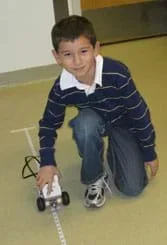 Copyright 2013 Computational Neurobiology Center, College of Engineering, University of Missouri
 - Use slide 5 to introduce the hare challenge: To construct a LEGO robot and program it to travel the given track as fast as possible. The fastest robot wins! Then show students the track and clarify the objectives. Inform them that the snail challenge will be on Day 2.
- Provide a quick review of the key concepts related to gears that were covered in the associated lesson. For this purpose, the next four slides (slides 6-9) repeat from the previous lesson.
- Divide the class into groups of three students each. Give the groups 30 minutes to assemble and program their robots in preparation for the hare challenge.
- Remind groups of the design goal: To make a robot that goes as fast as possible from the "start" line to the "finish" line.
- Hand out worksheets to each student. Hand out to each group a LEGO base set that includes the taskbot building instructions.
- Inform students that they have the instructions to build a LEGO robot, but they must alter the basic robot design in order to meet the challenge requirements—to construct the fastest possible robot.
- Direct groups to brainstorm and sketch their robot designs and program logic on their worksheets before building the robots and creating the programs. Remind them to consider the robot power setting and how this design element might be used to help meet the design criteria.
- Once robots are constructed and programs are created and downloaded to the EV3 intelligent bricks, direct students to use the track to practice and iterate their designs until every group is ready. This practice time serves as the testing and redesign steps of the engineering design process—the time to make changes to improve the robot designs and programs, if desired.
- Race time: Once all teams are ready, use a stopwatch to time the race for each group. The group whose robot completes the course with the fastest time is the winning team. Once the winner is declared by timing, if space permits, it is fun to have all groups race their robots at the same time; if you do this, watch to make sure the robots do not collide with each other.
- As a class, measure the length of the course. This number will be used in the students' velocity calculation.
- As a class, discuss the activity, particularly what students learned and any issues or problems they encountered. Ask students to explain the constraints to their designs. Did they encounter a limit to how fast the robot could go? What design elements constrain the robot speed? Refer to slide 13 for the recommended approach for success in the hare challenge.
With the Students: Day 2 Snail Challenge (slides 10-15)
- Have students form into their same groups from the hare challenge and have handy their worksheets from the hare challenge.
- Use slide 10 to introduce the snail challenge: To design and program a LEGO robot to travel the same track as slowly as possible. The slowest robot wins! Explain the objectives and answer any questions.
- Give the groups 30 minutes to build and program their robots in preparation for the snail challenge.
- Hand out to each group a LEGO base set that includes the taskbot building instructions.
- Direct the groups to brainstorm and sketch their robot designs and program logic on their worksheets before building the robots and creating the programs.
- Remind them to modify the basic robot design in order to meet the challenge requirements—to construct the slowest possible robot.
- Remind students that the robot weight and the motor power setting are two factors that are important in this challenge. Their designs must include what to do for these factors, and numerous design and testing iterations may be necessary.
- Again, have students practice and iterate their designs until every group is ready.
- Race Time: Once everyone is ready, use a stopwatch to time the race for each group. The group whose robot completes the course the slowest is the winning team.
- Have students calculate the velocity of their robot (v = length of race course / time to complete the race).
- As a class, discuss the activity, particularly what students learned and any issues or problems. Again, ask students to explain the constraints of their designs. Did they encounter a limit to how slow the robot could travel? What design elements constrain the robot speed? Which steps of the engineering design process did they participate in? Refer to slide 14 for the recommended approach for success in the hare challenge.
- Administer the post-quiz (also on slide 11 with answers on slide 12) and review the answers as a class. Slides 13-14 provide the solution tips for the challenges. Slide 15 presents vocabulary words and definitions.
- design
- Loosely defined, the art of creating something that does not exist.
- gear
- A rotating machine part with cut teeth that mesh with another toothed part in order to transmit torque; in most cases, the teeth on both gears are identical in shape.
- torque
- The tendency of a force to rotate an object about its axis or pivot.
Pre-Activity Assessment
Pre-Quiz: Before starting the activity, administer the two-question Hare and Snail Challenges Pre-Quiz (PDF) by handing out paper copies (also on slide 2). Students' answers reveal their prior knowledge about factors that affect how machines are designed for speed. The answers are provided on the Hare and Snail Challenges Pre-Quiz Answer Key (PDF) (and slide 3).
Activity Embedded Assessment
Worksheet: As students work through the activity, have them record their brainstorming and designs on the Hare and Snail Challenges Worksheet (PDF). Observe students to make sure they are engaged and making progress testing, revising and troubleshooting their robots and programs. Collect the worksheets at activity end and review students' designs to individually gauge their depth of understanding.
Hare and Snail Challenges: Assess each group's performance in the two challenges using the following rubric (maximum 30 points). Refer to slides 13-14 for the recommended approaches for success in the challenges.
- The LEGO robot design was appropriate, that is, light weight for the hare challenge and somewhat heavy for the snail challenge. (10 points maximum) (Note: Students are typically creative in adding and removing weights, and they learn by iteration how to optimize their designs.)
- Used suitable/appropriate gear ratio. (10 points maximum) (Note: Again, this involves trial and error and no one design is optimal, which is an important engineering design point to make.)
- The group iterated several times, and this resulted in an improved design. (10 points maximum)
Post-Activity Assessment
Concluding Discussions: After each challenge race is over, lead a class discussion so students can share their observations, difficulties, questions and conclusions. What were the constraints to their designs? What limited how fast a robot could go? What design elements constrained the robot speed? Which steps of the engineering design process did you participate in? (Possible answers: All of them! Brainstorming possible solutions, deciding on the best solution, planning/designing, prototyping/testing, revising/improving/iterating/troubleshooting.) Use this opportunity to gauge student comprehension.
Post-Quiz: At activity end, administer the two-question Hare and Snail Challenges Post-Quiz (PDF) by handing out paper copies (also slide 11). Review students' answers to assess their understanding of the design elements responsible for impacting the robots' speeds (gear ratios, motor power, robot weight), as well as constraints in the design of the fast robot. Answers will vary; example answers are provided on the Hare and Snail Challenges Post-Quiz Answer Key (PDF) (and slide 12).
- For more advanced students, add more explanatory material on the topics of gears and torque.
EV3 robots and sensors: https://www.lego.com/en-us/themes/mindstorms/about
Instructions to assemble the LEGO "Five Minute Bot" at https://www.youtube.com/watch?v=Dhe2jXi3Fc4
Contributors
Sachin Nair; Pranit Samarth; Satish S. Nair
Supporting Program
GK-12 Program, Computational Neurobiology Center, College of Engineering, University of Missouri
Acknowledgements
This curriculum was developed under National Science Foundation GK-12 grant no. DGE 0440524. However, these contents do not necessarily represent the policies of the National Science Foundation, and you should not assume endorsement by the federal government.
Copyright
2014 by Regents of the University of Colorado; original © 2013 Curators of the University of Missouri