
What Are Gears and What Do They Do?
Legacy Curriculum
Hey there! This curriculum is no longer being curated or supported. It may contain materials that are no longer available or outdated information. Please use this document for reference.
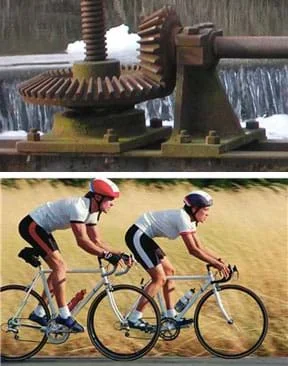 Students learn about gears and their many functionsCopyright (gears) 2006 Audrius Meskauskas, Wikimedia Commons; (cyclists) 2004 Microsoft Corporation, One Microsoft Way, Redmond, WA 98052-6399 USA. All rights reserved. http://en.wikipedia.org/wiki/File:Bevel_gear.jpg http://office.microsoft.com/en-us/images/results.aspx?qu=bicycle&ex=1#ai:MP900407440|mt:2|
Students are introduced to an important engineering element—the gear. Different types of gears are used in many engineering devices, including wind-up toys, bicycles, cars and non-digital clocks. Students learn about various types of gears and how they work in machines. They handle and combine LEGO spur gears as an exercise in gear ratios. They see how gears and different gear train arrangements are used to change the speed, torque and direction of a power source. This prepares them to apply this knowledge in four associated activities in order to create successful solutions to design challenges that use LEGO® MINDSTORMS® EV3 robots. A PowerPoint® presentation, pre/post quizzes and a worksheet are provided.
Gears represent an important component of many mechanical devices and are usually identified with mechanical engineers (who are sometimes called "gear heads"). Gears are simple machines made up of a wheel and axle. Although it may not be obvious to students before this lesson, gears are pervasive in our world. They are found in the mechanisms of cars, trucks, bikes, pumps, analog watches, wind turbines, bull dozers and most engineering machines.
After this lesson, students should be able to:
- Explain the role of gears in mechanical devices.
- CCSS.Math.Content.6.NS.B.2 Fluently divide multi-digit numbers using the standard algorithm.
Grade 6
Do you agree with this alignment? - CCSS.Math.Content.6.RP.A.1 Understand the concept of a ratio and use ratio language to describe a ratio relationship between two quantities.
Grade 6
Do you agree with this alignment? - CCSS.Math.Content.6.RP.A.2 Understand the concept of a unit rate a/b associated with a ratio a:b with b ≠ 0, and use rate language in the context of a ratio relationship.
Grade 6
Do you agree with this alignment?
- Students will develop an understanding of the attributes of design.
Grades K-12
Do you agree with this alignment? - Students will develop an understanding of the characteristics and scope of technology.
Grades K-12
Do you agree with this alignment? - Students will develop an understanding of the relationships among technologies and the connections between technology and other fields of study.
Grades K-12
Do you agree with this alignment?
- CCSS.Math.Content.6.NS.B.2 Fluently divide multi-digit numbers using the standard algorithm.
Grade 6
Do you agree with this alignment? - CCSS.Math.Content.6.RP.A.1 Understand the concept of a ratio and use ratio language to describe a ratio relationship between two quantities.
Grade 6
Do you agree with this alignment? - CCSS.Math.Content.6.RP.A.2 Understand the concept of a unit rate a/b associated with a ratio a:b with b ≠ 0, and use rate language in the context of a ratio relationship.
Grade 6
Do you agree with this alignment?
- Designed objects are used to do things better or more easily and to do some things that could not otherwise be done at all
Grades K-5
Do you agree with this alignment?
- SEP.9.3 Science knowledge is based upon logical and conceptual connections between evidence and explanations.
Grades 6-8
Do you agree with this alignment? - SEP.11.3 Laws are regularities or mathematical descriptions of natural phenomena.
Grades 6-8
Do you agree with this alignment?
- What Are Gears? What Do They Do? Presentation (pptx)
- What Are Gears? What Do They Do? Presentation (pdf)
- Gears Pre-Quiz (docx)
- Gears Pre-Quiz (pdf)
- Gears Pre-Quiz Answer Key (docx)
- Gears Pre-Quiz Answer Key (pdf)
- Get in Gear Worksheet (docx)
- Get in Gear Worksheet (pdf)
- Get in Gear Worksheet Answer Key (docx)
- Get in Gear Worksheet Answer Key (pdf)
- Gears Post Quiz (docx)
- Gears Post-Quiz (pdf)
- Gears Post-Quiz Answer Key (docx)
- Gears Post-Quiz Answer Key (pdf)
Prior to this lesson, it is recommended that students complete the previous unit in the series, How Do Sensors Work?
This second lesson in the unit introduces students to the concept of gears, which prepares them for the unit's subsequent design challenges that use LEGO MINDSTORMS EV3 taskbots. Have students work individually or in small groups, depending upon the availability of LEGO robot supplies.
Be ready to show students the 17-slide What Are Gears? What Do They Do? Presentation (PPTX), a Microsoft® PowerPoint® file, to teach the lesson. Have ready a computer/projector with Internet access to also show two online videos and an animation at a website. In advance, make copies of the Gears Pre-Quiz (PDF) and Gears Post-Quiz (PDF) (one each per student), provided as both as attachments and slides, and the Get in Gear Worksheet (PDF) (one per student).
During the lesson, each group needs the following materials:
- one 1/16 beam
- two #6 axles with a bushing on the back side
- 8-tooth gear
- 40-tooth gear
- one additional gear of any size
- LEGO MINDSTORMS EV3 robot, such as EV3 Core Set (5003400) at https://education.lego.com/en-us/products/lego-mindstorms-education-ev3-core-set/5003400#lego-mindstorms-education-ev3. Note: This activity can also be conducted with the older LEGO MINDSTORMS NXT set. You’ll need a computer loaded with the NXT 2.1 software.
- LEGO MINDSTORMS Education EV3 Software 1.2.1, free online, you have to register a LEGO account first; at https://www.lego.com/en-us/mindstorms/downloads/download-software
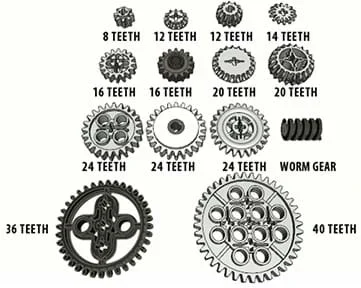 Example LEGO spur gears and an axle from the core set.Copyright Pinterest https://www.pinterest.com/pin/58687601365962501
What Are Gears? What Do They Do? Presentation Outline (slides 1-17)
- Administer the pre-quiz by handing out paper copies; the quiz is also on slide 2. The answers are provided for the teacher on slide 3 for discussion after students have completed the quiz.
- (slide 4) Introduce the lesson objective: What are gears and what do they do? Motivate students to pay attention by pointing out that the concepts in today's presentation are important to learn and understand in order do well in the design challenges that they will participate in during the next class.
- Describe what a gear is using slide 5 and an excellent 11-minute "Gear Basics" video (link on slide 6 and in the Additional Multimedia Support section). Gears come in various sizes and types; they are used to change the speed, torque and direction of a power source. Topics covered in the video: gear types, gear rotation, gear ratio, rates of rotation, mechanical advantage and examples of use (river locks and bicycles).
- (slide 7) Provide an overview of the various types of gears, including spur gears, worm gears, bevel gears and pulleys, as shown in the pictures.
- Either individually or in small groups (depending on the number of supplies available), have students participate in the following simple hands-on exercise to reinforce the concept of gears. Give each group a 1/16 beam, two #6 axles with a bushing on the back side, one 8-tooth gear, one 40-tooth gear and one additional gear of any size (such as a 24-tooth gear).
- Direct students to assemble two gears of different sizes using a simple beam, as shown on slide 8, and then explain gear ratios. A gear ratio tells us how many turns of one gear cause how many turns of the other gear. So with the given gears, the gear ratio is 8:40 or 1:5, meaning that 5 turns of the small gear cause 1 turn of the large gear. (Refer to the associated activity Hare and Snail Challenges for more hands-on exploration to understand the concept of gear-ratios)
- Then make a minor modification, as shown on slide 9, to introduce the concept of idler gears. To do this, students add between the first two gears a third gear of any number of teeth (a 24-tooth gear is shown on slide 9).
- After this exercise, hand out the worksheets and ask students to write answers to its two questions (also on slide 10). Review their answers to check their understanding of gear ratios. As a class, volunteers share their responses and then discuss the answers (provided on slide 11).
- Once students understand the concept of gear ratios, introduce the concept of torque (slide 12). The key point is that at a particular power setting on the LEGO (or any machine), power = torque x speed. If power is constant, explain that torque and speed are inversely related. This means that increasing torque decreases speed, and vice versa.
- Complete the discussion on gear types with the concept of worm gears (slide 13) and belts/pulleys (slide 14). This includes showing students an online worm gear description, animation and 1:43-minute video (links on slide 14 and in the Additional Multimedia Support section).
- Administer the post-quiz by handing out paper copies; the quiz is also on slide 15. The answers are provided on slide 16. Vocabulary terms and definitions are provided on slide 17. Next, conduct the associated activities.
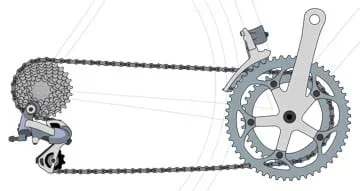 Many students are familiar with bicycle "gears."Copyright 2009 Keithonearth, Wikimedia Commons http://commons.wikimedia.org/wiki/File:Derailleur_Bicycle_Drivetrain.svg
How many of you have bicycles? When you ride a bike, how is the energy that your legs generate used to push the bike forward? Any ideas? (Listen to student ideas.) The pedals on the bike turn a gear (looks like a disk with teeth on it), which turns another gear (actually, a pulley), via the chain. Taken together, we generally refer to these parts as "bike gears." How does this arrangement work?
In today's lesson, we will look at different arrangement of gears, called "gear trains," and learn how geared devices can change the speed, torque and direction of a power source. These concepts are important for you to understand so you are ready to tackle the upcoming engineering challenges in this unit! Following the lesson, students can apply their new knowledge of gears and incorporate it into designing a LEGO sumobot with the associated activity design challenge Sumobot Challenge. Then for an added challenge, students can conduct the associated activities Line-Follower Challenge where they are challenged to program LEGO robots with color sensors to follow a black line, and Robot Soccer Challenge where they learn how two LEGO EV3 bricks can be programmed to send and receive messages from each other and respond accordingly.
(Continue by showing the presentation and delivering the content in the Lesson Background section.)
- design
- Loosely defined, the art of creating something that does not exist.
- gear
- A rotating machine part with cut teeth that mesh with another toothed part in order to transmit torque; in most cases, the teeth on both gears are identical in shape.
- pulley
- A wheel on an axle that is designed to support movement and change in direction via a cable/belt/chain along its circumference.
- torque
- The tendency of a force to rotate an object about its axis or pivot.
Pre-Lesson Assessment
Pre-Quiz: Before starting the lesson, administer the two-question Gears Pre-Quiz (PDF) by handing out paper copies (also on slide 2). The pre-quiz assesses students' prior knowledge about gears and machines with gears. The answers are provided on the Gears Pre-Quiz Answer Key (PDF) (and slide 3).
Post-Introduction Assessment
Understanding Check: Have students respond to the two-questions provided on the Get in Gear Worksheet (PDF) (also on slide 10) to check for their comprehension on gear train arrangements and the corresponding effect on the speed of the output gear. Refer to the answers on the Get in Gear Worksheet Answer Key (PDF) (and slide 11).
Lesson Summary Assessment
Post-Quiz: At lesson end, administer the two-question Gears Post-Quiz (PDF) by handing out paper copies (also on slide 15). Review students' answers to measure how their knowledge of gears changed during the lesson and assess whether they understand how to apply their knowledge. The answers are provided on the Gears Post-Quiz Answer Key (PDF) (and slide 16).
During the lesson presentation, show students the excellent 11-minute "Gear Basics" video to provide an introduction to gears, suitable for grades 4 to 9. Topics covered: gear types, gear rotation, gear ratio, rates of rotation, mechanical advantage and examples of use (river locks and bicycles). https://www.youtube.com/watch?v=odpsm3ybPsA
During the lesson presentation, show students a worm gear description and animation at https://en.wikipedia.org/wiki/Worm_drive, and its application in a 1:43-minute video, Worm Gear Speed Reducer, at https://www.youtube.com/watch?v=S3XAeMCeZr0.
"Gear." Last updated December 2013. Wikipedia, The Free Encyclopedia. Accessed December 2013. http://en.wikipedia.org/wiki/Gear
"Torque." Last updated December 2013. Wikipedia, The Free Encyclopedia. Accessed December 2013. http://en.wikipedia.org/wiki/Torque
Contributors
Sachin Nair; Pranit Samarth; Satish S. Nair
Supporting Program
GK-12 Program, Computational Neurobiology Center, College of Engineering, University of Missouri
Acknowledgements
This curriculum was developed under National Science Foundation GK-12 grant no. DGE 0440524. However, these contents do not necessarily represent the policies of the National Science Foundation, and you should not assume endorsement by the federal government.
Copyright
2014 by Regents of the University of Colorado; original © 2013 Curators of the University of Missouri