
Robot Design Challenges
Legacy Curriculum
Hey there! This curriculum is no longer being curated or supported. It may contain materials that are no longer available or outdated information. Please use this document for reference.
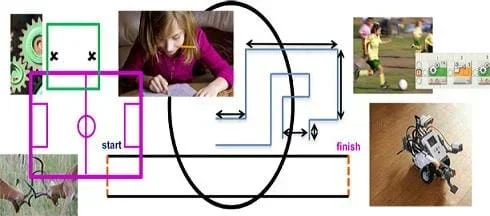 Students explore the various robot design challengesCopyright (gears) 2002 Jared C. Benedict, Wikimedia Commons; (impalas) 2011 Muhammad Mahdi Karim, Wikimedia Commons; (girl with pencil, girl on field) Microsoft clipart; (screen capture) authors; (LEGO robot) 2006 Eirik Refsdal, Wikimedia Commons; (line drawings) authors. http://commons.wikimedia.org/wiki/File:Gears_large.jpg
http://commons.wikimedia.org/wiki/File:Fighting_impalas_edit2.jpg
http://office.microsoft.com/en-us/images/results.aspx?qu=thinking&ex=1#ai:MP900442219|mt:2|
http://office.microsoft.com/en-us/images/results.aspx?qu=soccer&ex=1#ai:MP900422170|
http://commons.wikimedia.org/wiki/File:Lego_Mindstorms_Nxt-FLL.jpg
Students explore the various robot design challengesCopyright (gears) 2002 Jared C. Benedict, Wikimedia Commons; (impalas) 2011 Muhammad Mahdi Karim, Wikimedia Commons; (girl with pencil, girl on field) Microsoft clipart; (screen capture) authors; (LEGO robot) 2006 Eirik Refsdal, Wikimedia Commons; (line drawings) authors. http://commons.wikimedia.org/wiki/File:Gears_large.jpg
http://commons.wikimedia.org/wiki/File:Fighting_impalas_edit2.jpg
http://office.microsoft.com/en-us/images/results.aspx?qu=thinking&ex=1#ai:MP900442219|mt:2|
http://office.microsoft.com/en-us/images/results.aspx?qu=soccer&ex=1#ai:MP900422170|
http://commons.wikimedia.org/wiki/File:Lego_Mindstorms_Nxt-FLL.jpg
This unit is composed of two lessons and five activities related to the integration of sensors and motors with programming logic in LEGO robots to perform complex tasks. The unit is the fifth in a series and follows Humans Are Like Robots (unit 1), Our Bodies Have Computers and Sensors (unit 2), What Is a Computer Program? (unit 3) and How Do Sensors Work? (unit 4).
Throughout this unit, each group of (2-4) students requires all or portions of the following items:
- LEGO MINDSTORMS EV3 robot, such as the EV3 Core Set (5003400) at https://education.lego.com/en-us/products/lego-mindstorms-education-ev3-core-set/5003400#lego-mindstorms-education-ev3 (includes programmable EV3 intelligent brick; 2 interactive servo motors; color, ultrasonic and 2 touch sensors; and many other components and instructions)
- LEGO MINDSTORMS Education EV3 Software 1.2.1, free online, you have to register a LEGO account first; at https://www.lego.com/en-us/mindstorms/downloads/download-software.
- computer, loaded with EV3 1.2.1 software
Alternative: LEGO MINDSTORMS NXT Set:
Note: This activity can also be conducted with the older (and no longer sold) LEGO MINDSTORMS NXT set instead of EV3; see below for those supplies:
- LEGO MINDSTORMS NXT robot, such as the NXT Base Set (includes programmable NXT intelligent brick; 3 interactive servo motors; sound, light, ultrasonic and 2 touch sensors; and many other components and instructions)
- LEGO MINDSTORMS Education NXT Software 2.1
- computer, loaded with NXT 2.1 software
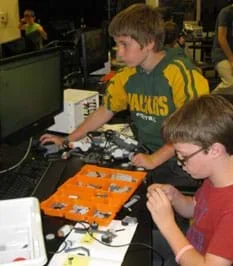 Copyright 2012 Computational Neurobiology Center, College of Engineering, University of Missouri
Our world would be a different place without engineers and all of the technologies, devices, structures and systems they create—vehicles, phones, bridges, medical devices, factories, appliances and software apps—just to name a few. The best way to learn about design and engineering is to take on a design challenge, following the steps of the engineering design process. In order to develop optimal solutions, engineers must identify criteria and specifications for the problem, recognize constraints to solving the problem and then use math and science principles to come up with solutions. Engineers design and test their solutions to evaluate how well they address the problem, an iterative process until success is achieved. In this unit, students apply the information they gathered from previous units and the two lessons in this unit to design solutions for a number of engaging challenges.
- Students will develop an understanding of the attributes of design.
Grades K-12
Do you agree with this alignment? - Students will develop abilities to apply the design process.
Grades K-12
Do you agree with this alignment? - Students will develop an understanding of the characteristics and scope of technology.
Grades K-12
Do you agree with this alignment? - Students will develop an understanding of the relationships among technologies and the connections between technology and other fields of study.
Grades K-12
Do you agree with this alignment?
- Designed objects are used to do things better or more easily and to do some things that could not otherwise be done at all
Grades K-5
Do you agree with this alignment?
- 3-5-ETS1-1 Define a simple design problem reflecting a need or a want that includes specified criteria for success and constraints on materials, time, or cost.
Grades 3-5
This resource focuses on the following Three Dimensional Learning aspects of NGSS:
Science & Engineering Practices- Define a simple design problem that can be solved through the development of an object, tool, process, or system and includes several criteria for success and constraints on materials, time, or cost.Do you agree with this alignment?
Disciplinary Core Ideas- Possible solutions to a problem are limited by available materials and resources (constraints). The success of a designed solution is determined by considering the desired features of a solution (criteria). Different proposals for solutions can be compared on the basis of how well each one meets the specified criteria for success or how well each takes the constraints into account.Do you agree with this alignment?
Crosscutting Concepts- People's needs and wants change over time, as do their demands for new and improved technologies.Do you agree with this alignment?
Do you agree with this alignment? - Define a simple design problem that can be solved through the development of an object, tool, process, or system and includes several criteria for success and constraints on materials, time, or cost.
- 3-5-ETS1-2 Generate and compare multiple possible solutions to a problem based on how well each is likely to meet the criteria and constraints of the problem.
Grades 3-5
This resource focuses on the following Three Dimensional Learning aspects of NGSS:
Science & Engineering Practices- Generate and compare multiple solutions to a problem based on how well they meet the criteria and constraints of the design problem.Do you agree with this alignment?
Disciplinary Core Ideas- Research on a problem should be carried out before beginning to design a solution. Testing a solution involves investigating how well it performs under a range of likely conditions.Do you agree with this alignment?
- At whatever stage, communicating with peers about proposed solutions is an important part of the design process, and shared ideas can lead to improved designs.Do you agree with this alignment?
Crosscutting Concepts- Engineers improve existing technologies or develop new ones to increase their benefits, to decrease known risks, and to meet societal demands.Do you agree with this alignment?
Do you agree with this alignment? - Generate and compare multiple solutions to a problem based on how well they meet the criteria and constraints of the design problem.
- 3-5-ETS1-3 Plan and carry out fair tests in which variables are controlled and failure points are considered to identify aspects of a model or prototype that can be improved.
Grades 3-5
This resource focuses on the following Three Dimensional Learning aspects of NGSS:
Science & Engineering Practices- Plan and conduct an investigation collaboratively to produce data to serve as the basis for evidence, using fair tests in which variables are controlled and the number of trials considered.Do you agree with this alignment?
Disciplinary Core Ideas- Tests are often designed to identify failure points or difficulties, which suggest the elements of the design that need to be improved.Do you agree with this alignment?
- Different solutions need to be tested in order to determine which of them best solves the problem, given the criteria and the constraints.Do you agree with this alignment?
Do you agree with this alignment? - Plan and conduct an investigation collaboratively to produce data to serve as the basis for evidence, using fair tests in which variables are controlled and the number of trials considered.
- MS-ETS1-1 Define the criteria and constraints of a design problem with sufficient precision to ensure a successful solution, taking into account relevant scientific principles and potential impacts on people and the natural environment that may limit possible solutions.
Grades 6-8
This resource focuses on the following Three Dimensional Learning aspects of NGSS:
Science & Engineering Practices- Define a design problem that can be solved through the development of an object, tool, process or system and includes multiple criteria and constraints, including scientific knowledge that may limit possible solutions.Do you agree with this alignment?
Disciplinary Core Ideas- The more precisely a design task's criteria and constraints can be defined, the more likely it is that the designed solution will be successful. Specification of constraints includes consideration of scientific principles and other relevant knowledge that is likely to limit possible solutions.Do you agree with this alignment?
Crosscutting Concepts- The uses of technologies and any limitations on their use are driven by individual or societal needs, desires, and values; by the findings of scientific research; and by differences in such factors as climate, natural resources, and economic conditions.Do you agree with this alignment?
- All human activity draws on natural resources and has both short and long-term consequences, positive as well as negative, for the health of people and the natural environment.Do you agree with this alignment?
Do you agree with this alignment? - Define a design problem that can be solved through the development of an object, tool, process or system and includes multiple criteria and constraints, including scientific knowledge that may limit possible solutions.
- MS-ETS1-2 Evaluate competing design solutions using a systematic process to determine how well they meet the criteria and constraints of the problem.
Grades 6-8
This resource focuses on the following Three Dimensional Learning aspects of NGSS:
Science & Engineering Practices- Evaluate competing design solutions based on jointly developed and agreed-upon design criteria.Do you agree with this alignment?
Disciplinary Core Ideas- There are systematic processes for evaluating solutions with respect to how well they meet the criteria and constraints of a problem.Do you agree with this alignment?
Do you agree with this alignment? - Evaluate competing design solutions based on jointly developed and agreed-upon design criteria.
- MS-ETS1-3 Analyze data from tests to determine similarities and differences among several design solutions to identify the best characteristics of each that can be combined into a new solution to better meet the criteria for success.
Grades 6-8
This resource focuses on the following Three Dimensional Learning aspects of NGSS:
Science & Engineering Practices- Analyze and interpret data to determine similarities and differences in findings.Do you agree with this alignment?
Disciplinary Core Ideas- There are systematic processes for evaluating solutions with respect to how well they meet the criteria and constraints of a problem.Do you agree with this alignment?
- Sometimes parts of different solutions can be combined to create a solution that is better than any of its predecessors.Do you agree with this alignment?
- Although one design may not perform the best across all tests, identifying the characteristics of the design that performed the best in each test can provide useful information for the redesign process—that is, some of the characteristics may be incorporated into the new design.Do you agree with this alignment?
Do you agree with this alignment? - Analyze and interpret data to determine similarities and differences in findings.
- MS-ETS1-4 Develop a model to generate data for iterative testing and modification of a proposed object, tool, or process such that an optimal design can be achieved.
Grades 6-8
This resource focuses on the following Three Dimensional Learning aspects of NGSS:
Science & Engineering Practices- Develop a model to generate data to test ideas about designed systems, including those representing inputs and outputs.Do you agree with this alignment?
Disciplinary Core Ideas- Models of all kinds are important for testing solutions.Do you agree with this alignment?
- The iterative process of testing the most promising solutions and modifying what is proposed on the basis of the test results leads to greater refinement and ultimately to an optimal solution.Do you agree with this alignment?
Do you agree with this alignment? - Develop a model to generate data to test ideas about designed systems, including those representing inputs and outputs.
Each lesson and activity is designed to take one to two 50-minute sessions, for a total of ten 50-minute sessions for the unit. See Table 1 for the suggested order to conduct the lessons and activities.
- Lesson 1: What Is Engineering and What Is Design? (1 session - 50 mintues)
- Activity 1: Maze Challenge (2 sessions - 100 minutes)
- Lesson 2: What Are Gears and What Do They Do? (1 session - 50 mintues)
- Activity 2: Hare and Snail Challenges (2 sessions - 100 minutes)
- Activity 3: Sumobot Challenge (1.5 sessions - 75 minutes)
- Activity 4: Line-Follower Challenge (1.5 sessions - 75 minutes)
- Activity 5: Robot Soccer Challenge (1 session - 50 mintues)
Contributors
Sachin Nair; Riaz Helfer; Pranit Samarth; Satish S. Nair
Supporting Program
GK-12 Program, Computational Neurobiology Center, College of Engineering, University of Missouri
Acknowledgements
This curriculum was developed under National Science Foundation GK-12 grant no. DGE 0440524. However, these contents do not necessarily represent the policies of the National Science Foundation, and you should not assume endorsement by the federal government.
Copyright
2014 by Regents of the University of Colorado; original © 2013 Curators of the University of Missouri