
How Do Sensors Work?
Legacy Curriculum
Hey there! This curriculum is no longer being curated or supported. It may contain materials that are no longer available or outdated information. Please use this document for reference.
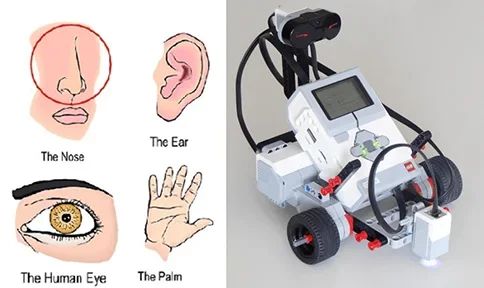 Human senses (left) and some LEGO sensor equivalents (right).Copyright (left) 2004 Microsoft Corporation, One Microsoft Way, Redmond, WA 98052-6399 USA. All rights reserved. (right) Robot Square http://robotsquare.com/2015/10/06/explor3r-building-instructions/
This unit is composed of six lesson/activity pairs related to the functioning of human senses and robot sensors. The unit is the fourth in a series and follows Humans Are Like Robots (unit 1), Our Bodies Have Computers and Sensors (unit 2) and What Is a Computer Program? (unit 3).
Throughout this unit, each group of (2-4) students requires all or portions of the following items:
- LEGO MINDSTORMS EV3 robot, such as EV3 Core Set (5003400) at https://education.lego.com/en-us/products/lego-mindstorms-education-ev3-core-set/5003400#lego-mindstorms-education-ev3
- LEGO MINDSTORMS Education EV3 Software (most recent version), free online, you have to register a LEGO account first at https://www.lego.com/en-us/mindstorms/downloads/
- computer, loaded with EV3 Software (most recent version)
Specific and/or additional required materials are indicated in the individual lessons and activities.
Note: This activity can also be conducted with the older (and no longer sold) LEGO MINDSTORMS NXT set instead of EV3; see below for those supplies:
- LEGO MINDSTORMS NXT Base Set
- computer loaded with the NXT 2.1 software
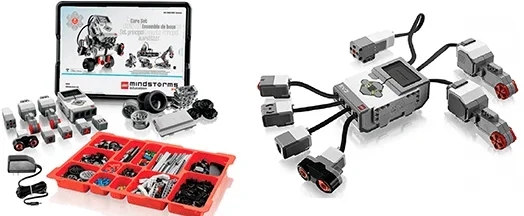 (left) The LEGO MINDSTORMS EV3 core set and (right) some of its components.Copyright (left) LEGO MINDTSORMS https://education.lego.com/en-us/products/lego-mindstorms-education-ev3-core-set-/5003400; (right) my Robot Center https://www.myrobotcenter.eu/en/lego-mindstorms-ev3-basis-set-45544
The studies of neuroscience and engineering show us how the human brain and sensors are similar to human-made computers and robots, in a functional sense. New findings show us that mathematical principles similar to those used in human brains and systems are useful for electrical, mechanical and biological engineers as they continue to devise better robots, computers and sensors. Engineer-designed sensors are used in a wide variety of applications, examples include speedometers, touchscreens, microphones, baby monitors, nightlights and medical ultrasound imaging. In growing fields such as biological engineering and systems neurobiology, engineers are becoming increasingly involved in human body research and efforts to replicate the functioning of its many systems. For instance, engineers are designing walking robots with sensors, artificial organs such as hearts and livers, and bio-sensors that monitor sugar levels for diabetics.
Computer programming is a component of many modern engineering designs. As students design robot programs throughout this unit, they start with a "goal" or "concept" of what the program solution needs to do and how, before they begin writing the code. Then, the process of working on the code and "debugging" it inherently constitutes "revising and improving their designs based on the results of testing." Thus, the thought processes required to code programs that meet problem constraints are very similar, if not identical, to the thought processes required for traditional engineering design of physical objects and products.
- Various relationships exist between technology and other fields of study.
Grades 3-5
Do you agree with this alignment? - Knowledge gained from other fields of study has a direct effect on the development of technological products and systems.
Grades 6-8
Do you agree with this alignment?
- Describe how new technologies have helped scientists make better observations and measurements for investigations (e.g., telescopes, electronic balances, electronic microscopes, x-ray technology, computers, ultrasounds, computer probes such as thermometers)
Grade 5
Do you agree with this alignment? - Explain the interactions between the nervous and muscular systems when an organism responds to a stimulus
Grade 8
Do you agree with this alignment?
- 4-PS3-2 Make observations to provide evidence that energy can be transferred from place to place by sound, light, heat, and electric currents.
Grade 4
This resource focuses on the following Three Dimensional Learning aspects of NGSS:
Science & Engineering Practices- Make observations to produce data to serve as the basis for evidence for an explanation of a phenomenon or test a design solution.Do you agree with this alignment?
Disciplinary Core Ideas- Energy can be moved from place to place by moving objects or through sound, light, or electric currents.Do you agree with this alignment?
- Energy is present whenever there are moving objects, sound, light, or heat. When objects collide, energy can be transferred from one object to another, thereby changing their motion. In such collisions, some energy is typically also transferred to the surrounding air; as a result, the air gets heated and sound is produced.Do you agree with this alignment?
- Light also transfers energy from place to place.Do you agree with this alignment?
- Energy can also be transferred from place to place by electric currents, which can then be used locally to produce motion, sound, heat, or light. The currents may have been produced to begin with by transforming the energy of motion into electrical energy.Do you agree with this alignment?
Crosscutting Concepts- Energy can be transferred in various ways and between objects.Do you agree with this alignment?
Do you agree with this alignment? - Make observations to produce data to serve as the basis for evidence for an explanation of a phenomenon or test a design solution.
- MS-LS1-3 Use argument supported by evidence for how the body is a system of interacting subsystems composed of groups of cells.
Grades 6-8
This resource focuses on the following Three Dimensional Learning aspects of NGSS:
Science & Engineering Practices- Use an oral and written argument supported by evidence to support or refute an explanation or a model for a phenomenon.Do you agree with this alignment?
Disciplinary Core Ideas- In multicellular organisms, the body is a system of multiple interacting subsystems. These subsystems are groups of cells that work together to form tissues and organs that are specialized for particular body functions.Do you agree with this alignment?
Crosscutting Concepts- Systems may interact with other systems; they may have sub-systems and be a part of larger complex systems.Do you agree with this alignment?
- Scientists and engineers are guided by habits of mind such as intellectual honesty, tolerance of ambiguity, skepticism, and openness to new ideas.Do you agree with this alignment?
Do you agree with this alignment? - Use an oral and written argument supported by evidence to support or refute an explanation or a model for a phenomenon.
- MS-LS1-8 Gather and synthesize information that sensory receptors respond to stimuli by sending messages to the brain for immediate behavior or storage as memories.
Grades 6-8
This resource focuses on the following Three Dimensional Learning aspects of NGSS:
Science & Engineering Practices- Gather, read, and synthesize information from multiple appropriate sources and assess the credibility, accuracy, and possible bias of each publication and methods used, and describe how they are supported or not supported by evidence.Do you agree with this alignment?
Disciplinary Core Ideas- Each sense receptor responds to different inputs (electromagnetic, mechanical, chemical), transmitting them as signals that travel along nerve cells to the brain. The signals are then processed in the brain, resulting in immediate behaviors or memories.Do you agree with this alignment?
Crosscutting Concepts- Cause and effect relationships may be used to predict phenomena in natural systems.Do you agree with this alignment?
Do you agree with this alignment? - Gather, read, and synthesize information from multiple appropriate sources and assess the credibility, accuracy, and possible bias of each publication and methods used, and describe how they are supported or not supported by evidence.
Each lesson and each activity is designed to take one 50-minute session, for a total of twelve 50-minute sessions for the unit. The suggested order to conduct the lesson/activity sets is shown below.
Lesson 1: What Is a Sensor? | --> | Activity 1: Robot Sensors and Sound |
--> | Activity 2: Master Driver | |
Lesson 3: How Does a Touch Sensor Work? | --> | |
Lesson 4: How Does a Sound Sensor Work? | --> | Activity 4: Control Using Sound |
Lesson 5: How Does a Color Sensor Work? | --> | Activity 5: Follow the Light |
Lesson 6: How Does an Ultrasonic Sensor Work? | --> |
Contributors
Nishant Sinha; Trisha Chaudhary; Srijith Nair; Pranit Samarth; Satish S. Nair
Supporting Program
GK-12 Program, Computational Neurobiology Center, College of Engineering, University of Missouri
Acknowledgements
This curriculum was developed under National Science Foundation GK-12 grant no. DGE 0440524. However, these contents do not necessarily represent the policies of the National Science Foundation, and you should not assume endorsement by the federal government.
Copyright
2013 by Regents of the University of Colorado; original © 2013 Curators of the University of Missouri