
How Does a Color Sensor Work?
Legacy Curriculum
Hey there! This curriculum is no longer being curated or supported. It may contain materials that are no longer available or outdated information. Please use this document for reference.
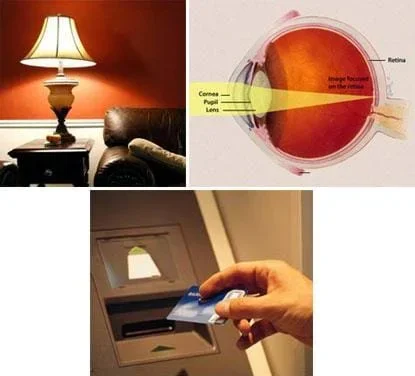 Engineers have used their understanding of how the human eye works to design electronic color sensors.Copyright (left, bottom) 2004 Microsoft Corporation, One Microsoft Way, Redmond, WA 98052-6399 USA. All rights reserved; (right) National Eye Institute
http://office.microsoft.com/en-us/images/results.aspx?qu=lamp&ex=1#ai:MP900448314|mt:2|
http://www.nei.nih.gov/healthyeyes/problems.asp
http://office.microsoft.com/en-us/images/results.aspx?qu=credit+card&ex=1#ai:MP900149068|mt:2|
Engineers have used their understanding of how the human eye works to design electronic color sensors.Copyright (left, bottom) 2004 Microsoft Corporation, One Microsoft Way, Redmond, WA 98052-6399 USA. All rights reserved; (right) National Eye Institute
http://office.microsoft.com/en-us/images/results.aspx?qu=lamp&ex=1#ai:MP900448314|mt:2|
http://www.nei.nih.gov/healthyeyes/problems.asp
http://office.microsoft.com/en-us/images/results.aspx?qu=credit+card&ex=1#ai:MP900149068|mt:2|
Students learn more about how color sensors work, reinforcing their similarities to the human sense of sight. They look at the light sensing process—incoming light converted to electrical signals sent to the brain—through the human eye anatomy as well as human-made electrical color sensors. A mini-activity, which uses LEGO® MINDSTORMS® EV3 intelligent bricks and color sensors gives students a chance to investigate how color sensors function in preparation for the associated activity involving the color sensors and taskbots. A PowerPoint® presentation explains stimulus-to-response pathways, sensor fundamentals, and details about the LEGO color sensor, including its two modes of gathering data and what its numerical value readings mean. Students take pre/post quizzes and watch a short online video. This lesson and its associated activity enable students to gain a deeper understanding of how robots can take sensor input and use it to make decisions via programming.
Biological engineers and neuroscientists perceive the human body as a functioning, controlled system, similar to a robot. More and more findings show that mathematical principles similar to those used in robotics are extremely useful or even necessary for a complete understanding of the human body. Through comparison of their similarities, students strengthen their understanding of the functioning of both human and robotic sensors. Color sensors are being used in all sorts of devices. For instance, when you scan your credit card to buy groceries, a color sensor reads the credit card numbers. Cameras continuously monitor activity in stores and banks. The cameras on cell phones are color sensors, too.
After this lesson, students should be able to:
- Describe how color sensors work.
- Compare electrical color sensors to human eyes.
- Program the LEGO MINDSTORMS EV3 robot with the color sensor.
- Provide a basic explanation of how sensors are integrated into robots via careful programming.
- STEL-3D Explain how various relationships can exist between technology and engineering and other content areas.
Grades 3-5
Do you agree with this alignment? - STEL-3G Explain how knowledge gained from other content areas affects the development of technological products and systems.
Grades 6-8
Do you agree with this alignment?
- Describe how new technologies have helped scientists make better observations and measurements for investigations (e.g., telescopes, electronic balances, electronic microscopes, x-ray technology, computers, ultrasounds, computer probes such as thermometers)
Grade 5
Do you agree with this alignment? - Explain the interactions between the nervous and muscular systems when an organism responds to a stimulus
Grade 8
Do you agree with this alignment?
- MS-LS1-3 Use argument supported by evidence for how the body is a system of interacting subsystems composed of groups of cells.
Grades 6-8
This resource focuses on the following Three Dimensional Learning aspects of NGSS:
Science & Engineering Practices- Use an oral and written argument supported by evidence to support or refute an explanation or a model for a phenomenon.Do you agree with this alignment?
Disciplinary Core Ideas- In multicellular organisms, the body is a system of multiple interacting subsystems. These subsystems are groups of cells that work together to form tissues and organs that are specialized for particular body functions.Do you agree with this alignment?
Crosscutting Concepts- Systems may interact with other systems; they may have sub-systems and be a part of larger complex systems.Do you agree with this alignment?
- Scientists and engineers are guided by habits of mind such as intellectual honesty, tolerance of ambiguity, skepticism, and openness to new ideas.Do you agree with this alignment?
Do you agree with this alignment? - Use an oral and written argument supported by evidence to support or refute an explanation or a model for a phenomenon.
- MS-LS1-8 Gather and synthesize information that sensory receptors respond to stimuli by sending messages to the brain for immediate behavior or storage as memories.
Grades 6-8
This resource focuses on the following Three Dimensional Learning aspects of NGSS:
Science & Engineering Practices- Gather, read, and synthesize information from multiple appropriate sources and assess the credibility, accuracy, and possible bias of each publication and methods used, and describe how they are supported or not supported by evidence.Do you agree with this alignment?
Disciplinary Core Ideas- Each sense receptor responds to different inputs (electromagnetic, mechanical, chemical), transmitting them as signals that travel along nerve cells to the brain. The signals are then processed in the brain, resulting in immediate behaviors or memories.Do you agree with this alignment?
Crosscutting Concepts- Cause and effect relationships may be used to predict phenomena in natural systems.Do you agree with this alignment?
Do you agree with this alignment? - Gather, read, and synthesize information from multiple appropriate sources and assess the credibility, accuracy, and possible bias of each publication and methods used, and describe how they are supported or not supported by evidence.
- How Does the Color Sensor Work? Presentation (pptx)
- How Does the Color Sensor Work? Presentation (pdf)
- Color Sensor Pre-Quiz (docx)
- Color Sensor Pre-Quiz (pdf)
- Color Sensor Pre-Quiz Answer Key (docx)
- Color Sensor Pre-Quiz Answer Key (pdf)
- Color Sensor Post-Quiz (docx)
- Color Sensor Post-Quiz (pdf)
- Color Sensor Post-Quiz Answer Key (docx)
- Color Sensor Post-Quiz Answer Key (pdf)
- An understanding of the primary five senses of the human body: sight, hearing, smell, taste and touch.
- Completion of the previous units in the series: Humans Are Like Robots (unit 2), Our Bodies Have Computers and Sensors (unit 2) and What Is a Computer Program? (unit 3).
- Completion of the previous lessons and activities in this unit, especially the What Is a Sensor? lesson.
Present the lesson using the content provided in the slide presentation, as described below. The quizzes are embedded in the presentation if you wish to go through them as a class. During the lesson, students engage in a mini-activity (slides 13-14) that requires the following for each student pair:
- LEGO MINDSTORMS EV3 Intelligent Brick, which is included in the LEGO MINDSTORMS Education EV3 Core Set that is used throughout this unit and available at https://education.lego.com/en-us/products/lego-mindstorms-education-ev3-core-set/5003400#lego-mindstorms-education-ev3 or purchased separately at https://education.lego.com/en-us/products/lego-mindstorms-education-ev3-intelligent-brick/45500
- LEGO MINDSTORMS EV3 Color Sensor, which is also included in the LEGO core set or can be purchased separately at https://shop.lego.com/en-US/EV3-Color-Sensor-45506
How Does the Color Sensor Work? Presentation Outline (Slides 1-8)
- Administer the pre-quiz by handing out paper copies; the quiz is also on slide 2. The answers are provided for the teacher on slide 3 for discussion after students have completed the quiz.
- Tell students that after a brief review of the "stimulus-sensor-coordinator-effector-response" framework using the human eye as a sensor, they will do a mini-activity that shows them how color sensors function.
- (slide 4) Explain the "stimulus-sensor-coordinator-effector-response" framework. Expect students to be able to understand the idea of a sensing element (eye), and then the transmission of the signal to the brain (via the nervous system).
- Give students a few minutes to think of and write down how a stimulus-to-response sequence might be implemented in a robot. An example answer is provided on the post-quiz answer key on slide 16. Review student answers as a class.
- Using slides 5-7, explain the eye anatomy and function of the human sense of sight. Talk specifically about the sensing elements in the eye—the rods and cones—and how signals from the rods and cones are sent to the brain, which integrates all of the signals to make sense of what is being seen (slide 6).
- Make sure students understand the human sensing process of the eye: Incoming light is refracted or made to change direction by the cornea, the outermost part of the eye. This light is directed through the pupil, which is a hole through which it can pass. The surrounding muscular tissue in the iris (the colored part of the eye) controls the pupil size. The light that enters the back of the eye through the pupil is redirected by the eye's lens, to receptors in the back of the eye that convert light into electrical signals. The two main types of sensing elements in the eyes, or photoreceptors, are rods and cones. Rods are concentrated in the sides of the eye and detect the presence of objects in poor light. Cones are concentrated in the middle of the eye and detect details and colors in good light. The rods and cones send electrical signals through the optic nerve to the brain.
- Emphasize the "conversion" or "transduction" function of this human sensor, that is, converting light to electrical impulses that are sent via the nerves (optic nerve in this case). This is a key concept in sensing, so make sure students grasp it.
- As a summary, have students watch a two-minute video, "Sense of Sight—How Human Eyes Work," (link provided on slide 8).
What Is the Structure of the Color Sensor? Presentation Outline (Slides 9-17)
- (slide 9) Review how robotic sensors work in general.
- (slide 10) Explain briefly the principle behind color sensors.
- (slide 11-12) Hold up a LEGO EV3 color sensor to show students how it looks.
- Go on to explain how the EV3 color sensor works in three modes: 1) Reflected light intensity mode 2) Ambient light intensity mode 3) Color mode. For the light intensity modes, the sensor uses a scale of 0 (very dark) to 100 (very light).
- For the mini-activity, divide the class into pairs and give each pair a LEGO intelligent brick connected to a LEGO color sensor.
- Direct student pairs to follow the instructions on slides 13-14 to experiment with the 1) reflected light mode, 2) ambient light mode. Have them test the brightness of various colors and surfaces that they can find in the classroom. Have them test the ambient light in different areas of the classroom. Have them write down their observations and take notes about what they learn about how the sensor works. Doing this gives students an idea of how the sensor is calibrated. Understanding the different modes and how to read the color sensor measurements is helpful for students to know when programming LEGO robots. Wrap up the mini-activity by asking the class the questions provides in the Assessment section.
- Administer the post-quiz by handing out paper copies; the quiz is also on slide 15. The answers are provided on slide 16. This concludes the lesson. Slide 17 contains vocabulary terms and definitions. Next, conduct the associated activity, Follow the Light.
(Be ready to show students the 17-slide How Does a Color Sensor Work? Presentation (PPTX), a Microsoft® PowerPoint® file, to teach the lesson, as well as a computer/projector with Internet access to show a short online video. In advance, make copies of the Color Sensor Pre-Quiz (PDF) and Color Sensor Post-Quiz (PDF), one each per student, provided as attachments and slides. For a mini-activity, student pairs use LEGO robot components to experiment with color sensors.)
How do we see using our eyes? How do you think a robot color sensor works? Let us consider these questions in detail. We will explore the principles that make color sensors work.
This will prepare you for an activity during the next class. You will program a LEGO robot with a color sensor to follow a flashlight. This means that as the flashlight moves, the robot follows it! Let's get started.
(Continue by showing the presentation and delivering the content in the Lesson Background section.)
Our human eyes detect light and convert information from the light into electrical signals that are sent to our brains. Similarly, the LEGO MINDSTORMS EV3 color sensor detects the brightness of light it receives. Then it sends this signal to the intelligent brick, which is the equivalent of a brain. We looked at both of these in a "stimulus-sensor-coordinator-effector-response" framework, which is used commonly in engineering for a variety of systems. So, you have learned some basics of engineering now!
- peripheral
- Surrounding.
- sensor
- A device that converts one type of signal to another; for instance, the speedometer in a car collects physical data and calculates and displays the speed the car is moving.
- transducer
- Another term for a sensor.
- visual
- Related to sight.
Pre-Lesson Assessment
Pre-Quiz: Administer the three-question Color Sensor Pre-Quiz (PDF) (also on slide 2) to gauge students' prior knowledge about the color sensor in humans, as well as engineered systems that use color sensors. Have students answer as best as they can. Answers are provided in the Color Sensor Pre-Quiz Answer Key (PDF) (and on slide 3).
Post-Introduction Assessment
Hands-On Learning: Observe students as they engage in the mini-activity described on slides 13-14. Make sure all pairs are following the slide instructions to experiment with the color sensor and its different modes. Question individual students to verify that they understand how the color sensor works. Ask the students: Which mode are you using now? What happens in this mode? How is it different from the other mode? What does a higher number indicate? A lower number? Zero?
Investigation Wrap-Up: Wrap up the mini-activity by asking the class some questions to verify their knowledge gained in preparation for the associated activity:
- What does the EV3 color sensor measure? (Answer: The brightness or intensity of light.)
- What does the color sensor do with this information? (Answer: The sensor uses a scale of 0 (very dark) to 100 (very light). Then it sends this signal to the intelligent brick/computer.)
- Which is the brighter light—one that measures a higher number or a lower number? (Answer: Higher numbers indicate brighter lights, as a percentage of the maximum light that the sensor can read.)
- What are some of the readings you obtained for different colors and surfaces you tested? (Listen to student answers. Different colors reflect light differently.)
- What are some of the readings you obtained in different areas of the room? (Listen to student answers.) What were readings by the window, under a table, in a corner?
- What can the color sensor detect? (Answers: It can distinguish between light and darkness, read the light intensity in a room, detect color, and measure the light intensity on colored surfaces.)
Lesson Summary Assessment
Post-Quiz: Administer the Color Sensor Post-Quiz (PDF) (also on slide 15) to assess student understanding, as well as how much they learned during the course of the lesson. Quiz answers for the teacher are provided on the Color Sensor Post-Quiz Answer Key (PDF) (and on slide 16).
EV3 robots and sensors: https://www.lego.com/en-us/themes/mindstorms/about
What is a transducer? http://en.wikipedia.org/wiki/Transducer
What is a sensor? http://en.wikipedia.org/wiki/Sensors
List of sensors http://en.wikipedia.org/wiki/List_of_sensors
Compare the parts of a camera to the human eye, WikiAnswers: http://wiki.answers.com/Q/Compare_the_parts_of_a_camera_to_the_human_eye
How Your Eyes Work (interactive eye anatomy diagram), American Optometric Association: https://www.aoa.org/patients-and-public/resources-for-teachers/how-your-eyes-work
How Your Eyes Work, Kids' Health, Women's and Children's Health Network: http://www.cyh.com/HealthTopics/HealthTopicDetailsKids.aspx?p=335&np=152&id=1730
Contributors
Srijith Nair; Pranit Samarth; Satish S. Nair
Supporting Program
GK-12 Program, Computational Neurobiology Center, College of Engineering, University of Missouri
Acknowledgements
This curriculum was developed under National Science Foundation GK-12 grant no. DGE 0440524. However, these contents do not necessarily represent the policies of the National Science Foundation, and you should not assume endorsement by the federal government.
Copyright
2013 by Regents of the University of Colorado; original © 2013 Curators of the University of Missouri