
How Does a Touch Sensor Work?
Legacy Curriculum
Hey there! This curriculum is no longer being curated or supported. It may contain materials that are no longer available or outdated information. Please use this document for reference.
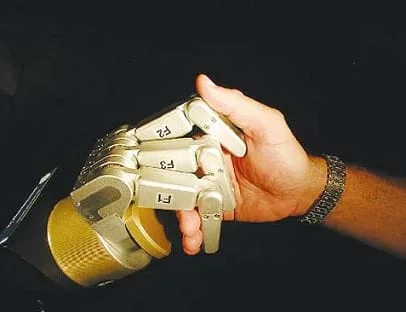 Our hands use the sense of touch to inform us of our surroundings. Do you think engineers have been able to replicate the sense of touch in robots?Copyright Barrett Technology Inc. via NASA http://spinoff.nasa.gov/Spinoff2008/hm_1.html
Students learn about how touch sensors work, while reinforcing their similarities to the human sense of touch. They look at human senses and their electronic imitators, with special focus on the nervous system, skin and touch sensors. A PowerPoint® presentation explains stimulus-to-response pathways, how touch sensors are made and work, and then gives students a chance to handle and get familiar with the LEGO touch sensor, including programming LEGO® MINDSTORMS® EV3 robots to use touch sensor input to play music. Students take pre/post quizzes and watch a short online video. The mini-activities prepare students for the associated activity. This lesson and its associated activity enables students to appreciate how robots can take input from sensors, and use that to make decisions to move.
Touch sensors—called tactile sensors by engineers—are part of many devices that we use every day. Tactile sensors are sensitive to touch, force or pressure, and are made using light (optical), electricity or magnetism. The stimulus-to-response pathways seen in electronic touch sensor operation mimics the human body process that involves our skin, signal transmission via the nervous system, and brain. For instance, computer keys are touch sensors that inform the computer which keys are being pressed. All keypads have touch sensors. Similarly, you can open a car door using a touch sensor that generates an infrared signal that goes to the car's computer informing it to unlock the door. Touchscreens on phones and computer tablets enable even more exquisite communication between people and machines. The use of sensors has exploded into the design of uncountable every day tools, equipment, appliances and devices.
After this lesson, students should be able to:
- Describe how touch sensors work.
- Compare the touch sensor to the human sense of touch.
- Program a LEGO MINDSTORMS EV3 robot with a touch sensor.
- Provide a basic explanation of how sensors are integrated into robots via careful programming.
- STEL-3D Explain how various relationships can exist between technology and engineering and other content areas.
Grades 3-5
Do you agree with this alignment? - STEL-3G Explain how knowledge gained from other content areas affects the development of technological products and systems.
Grades 6-8
Do you agree with this alignment?
- Describe how new technologies have helped scientists make better observations and measurements for investigations (e.g., telescopes, electronic balances, electronic microscopes, x-ray technology, computers, ultrasounds, computer probes such as thermometers)
Grade 5
Do you agree with this alignment? - Explain the interactions between the nervous and muscular systems when an organism responds to a stimulus
Grade 8
Do you agree with this alignment?
- MS-LS1-3 Use argument supported by evidence for how the body is a system of interacting subsystems composed of groups of cells.
Grades 6-8
This resource focuses on the following Three Dimensional Learning aspects of NGSS:
Disciplinary Core Ideas- In multicellular organisms, the body is a system of multiple interacting subsystems. These subsystems are groups of cells that work together to form tissues and organs that are specialized for particular body functions.Do you agree with this alignment?
Crosscutting Concepts- Systems may interact with other systems; they may have sub-systems and be a part of larger complex systems.Do you agree with this alignment?
- Scientists and engineers are guided by habits of mind such as intellectual honesty, tolerance of ambiguity, skepticism, and openness to new ideas.Do you agree with this alignment?
Do you agree with this alignment? - In multicellular organisms, the body is a system of multiple interacting subsystems. These subsystems are groups of cells that work together to form tissues and organs that are specialized for particular body functions.
- MS-LS1-8 Gather and synthesize information that sensory receptors respond to stimuli by sending messages to the brain for immediate behavior or storage as memories.
Grades 6-8
This resource focuses on the following Three Dimensional Learning aspects of NGSS:
Science & Engineering Practices- Gather, read, and synthesize information from multiple appropriate sources and assess the credibility, accuracy, and possible bias of each publication and methods used, and describe how they are supported or not supported by evidence.Do you agree with this alignment?
Disciplinary Core Ideas- Each sense receptor responds to different inputs (electromagnetic, mechanical, chemical), transmitting them as signals that travel along nerve cells to the brain. The signals are then processed in the brain, resulting in immediate behaviors or memories.Do you agree with this alignment?
Crosscutting Concepts- Cause and effect relationships may be used to predict phenomena in natural systems.Do you agree with this alignment?
Do you agree with this alignment? - Gather, read, and synthesize information from multiple appropriate sources and assess the credibility, accuracy, and possible bias of each publication and methods used, and describe how they are supported or not supported by evidence.
- How Does a Touch Sensor Work? Presentation (EV3 version) (pptx)
- How Does a Touch Sensor Work? Presentation (EV3 version) (pdf)
- How Does a Touch Sensor Work? Presentation (NXT version) (pptx)
- How Does a Touch Sensor Work? Presentation (NXT version) (pdf)
- Touch Sensor Pre/Post Quiz (EV3 version) (pdf)
- Touch Sensor Pre/Post Quiz (EV3 version) (docx)
- Touch Sensor Pre/Post Quiz (NXT version) (pdf)
- Touch Sensor Pre/Post Quiz (NXT version) (docx)
- Touch Sensor Pre/Post Quiz Answer Key (EV3 version) (pdf)
- Touch Sensor Pre/Post Quiz Answer Key (EV3 version) (docx)
- Touch Sensor Pre/Post Quiz Answer Key (NXT version) (pdf)
- Touch Sensor Pre/Post Quiz Answer Key (NXT version) (docx)
- Experience using and programming the LEGO MINDSTORMS EV3 intelligent brick.
- An understanding of the primary five senses of the human body: sight, hearing, smell, taste and touch.
- Completion of the first unit in the series: Humans Are Like Robots (unit 1)
- It is also recommended that the previous lessons and activities in this unit have been completed.
Present the lesson using the content provided in the slide presentation, as described below. During the lesson, students engage in two mini hands-on activities that require the following for each student pair:
- LEGO MINDSTORMS EV3 robot, such as the EV3 Core Set (5003400) at https://education.lego.com/en-us/products/lego-mindstorms-education-ev3-core-set/5003400#lego-mindstorms-education-ev3 (includes programmable EV3 intelligent brick; 2 interactive servo motors; color, ultrasonic and 2 touch sensors; and many other components and instructions)
- LEGO MINDSTORMS Education EV3 Software 1.2.1, free online, you have to register a LEGO account first; at https://www.lego.com/en-us/mindstorms/downloads/download-softwar
- computer, loaded with EV3 1.2.1 software
- LEGO MINDSTORMS EV3 taskbot, assembled using the base set materials and instructions at https://www.youtube.com/watch?v=Dhe2jXi3Fc4
- 2 LEGO MINDSTORMS EV3 Touch Sensors; 2 touch sensors are provided in each LEGO core set or can be purchased separately at https://shop.lego.com/en-US/EV3-Touch-Sensor-45507
Alternative: LEGO MINDSTORMS NXT Set:
Note: This can also be conducted with the older (and no longer sold) LEGO MINDSTORMS NXT set instead of EV3; see below for those supplies:
- LEGO MINDSTORMS NXT robot, such as the NXT Base Set
- computer, loaded with NXT 2.1 software
How Does the Touch Sensor Work? Presentation Outline (Slides 1-10)
- Administer the pre-quiz by handing out paper copies; the quiz is also on slide 2. The answers are provided for the teacher on slide 3 for discussion after students have completed the quiz.
- (slide 4) Describe what is meant by a sensor, emphasizing that the human hand has millions of highly sensitive nerve endings (touch sensors) that are able to detect several different types of stimulation. These include pressure, temperature and pain. When these specialized receptors are stimulated, they send signals through the nervous system to the brain, which interprets them.
- To provide more information about the skin as a sensory organ, show students a one-minute YouTube video on "How the Body Works: The Sensory Cortex and Touch" (link provided on slide 5).
- Ask students: How is the sense of touch transmitted from the hand to the brain? Write student responses on the board, but do not give them any help. Expect them to be able to get the idea of a sensing element, and then the transmission of the signal to the brain. Then use slide 6 to explain how our brains do it.
- (slide 7) After a brief review, give students a few minutes to come up with the components of a "stimulus-sensor-coordinator-effector-response" pathway using the human touch sensor. After students have thought about it and written their answers, explain the concept using slides 8-10; slide 8 shows an image of the body's nervous system. The answer is on slide 17.
- Before explaining the robot sensors listed in slide 10, ask students: How many and which sensors do you think have been replicated in robots? (Answer: eyes [color sensor, ultrasonic sensor], ears [sound sensor], skin [touch, temperature, pressure sensors]; smell [electronic nose] are being used in industry; taste [electronic tongue] are not very common and still being developed.) Briefly explain the various sensors provided with the EV3 taskbot: sound, touch, color and ultrasonic.
Touch Sensor Details and Mini-Activities Presentation Outline (Slides 11-19)
- Hold up a LEGO touch sensor and show students its orange button. Ask students: What might happen when the button on the touch sensor is pressed? Write their answers on the classroom board.
- (slides 11–13) Explain briefly how touch sensors are made and how they work. Help them to understand that it is similar to turning on a switch to light a lamp—moving the switch completes a circuit, permitting a current to go to the lamp to light it. Closing the loop on the touch sensor enables a current to be sent to the LEGO brick, which informs it that the button was pressed.
- Give students a chance to use a touch sensor attached to a LEGO brick to see for themselves what happens when they touch the sensor's button, as directed on slide 13 (or do this as a teacher demo). The brick registers a "1" when the sensor is pressed and "0" otherwise. Also have students use the "Try Me" option on the brick.
- To reinforce this further, have student pairs complete a simple mini-activity that is described on slide 14. Have groups use computers to program the brick to use touch sensors to play music, and then document their observations and explain how the program works step-by-step. This involves students programming the computer, and then running it with the music button in the Functions Palette. The answer is on slide 18 for the teacher.
- Administer the post-quiz by handing out paper copies; the quiz is also on slide 15. The answers are provided on slide 16. Slide 19 lists some vocabulary words and definitions. This concludes the lesson. Next, conduct the associated activity, Music by Touch: Programming Robot Tactile Sensors to Play Sounds.
(Be ready to show students the 19-slide How Does a Touch Sensor Work? Presentation (PPTX), a Microsoft® PowerPoint® file, to teach the lesson, as well as a computer/projector with Internet access to show a short online video. In advance, make copies of the Touch Sensor Pre/Post Quiz (PDF), two each per student, provided as attachments and slides. For the mini-activities, student pairs use LEGO robots to experiment with touch sensors.)
Do you know how your sense of touch works? Today, we will start with a brief review of sensors, and then focus specifically on the touch sensor, in both humans and robots. Then we'll do some mini-activities so you can get familiar with the touch sensor and see how it can be used to activate a motor using the LEGO brick. After this, you will be ready for a more involved hands-on activity in our next class—you will program the LEGO robot to play more complex music and respond to touch through changes in turning a wheel.
(Continue by showing the presentation and delivering the content in the Lesson Background section.)
Robots use the information received from sensors to make decisions about movement and actions in much the same manner as we do when our brains uses signals from our senses to decide how to control our muscles and bodily functions.
Engineers are always trying to improve sensors to be more like the senses in our bodies. Our skin measures many subtle physical quantities and a variety of robotic sensors have been designed to mimic human skin. In addition to simple touch sensors like we just experimented with, other sensors measure temperature and pressure, similar to what we sense through skin.
Have you noticed the similarities? Engineers are inspired by the extraordinary capabilities of the human body and brain and get many good ideas from how it functions, so I'm sure that you have noticed that the design of sensors and robots often have a lot of similarities to humans.
- sensor
- A device that converts one type of signal to another; for instance, the speedometer in a car collects physical data and calculates and displays the speed the car is moving.
- stimulus
- A thing or event that causes a reaction, such as a specific functional reaction in an organ or tissue.
- tactile
- Related to touch.
- transducer
- Another term for a sensor.
Pre-Lesson Assessment
Pre-Quiz: Administer the four-question Touch Sensor Pre/Post Quiz (PDF) by handing out paper copies (also on slide 2). Students' answers reveal their base understanding of the topic of touch sensors, both human and robotic. Answers are provided on the Touch Sensor Pre/Post Quiz Answer Key (PDF) (and on slide 3). Administer the same quiz at lesson end.
Post-Introduction Assessment
Mini-Activity: Have students complete a simple programming mini-activity (as explained on slide 14). Observe students while they work to assess whether they understand how the touch sensor conveys the information (whether the sensor has been pressed or not) to the LEGO computer (brick). Go from group to group and ask students to explain the activity, their progress and any solutions they have found. The mini-activity answer is provided for the teacher on slide 15 as a guide to assess student progress and understanding.
Lesson Summary Assessment
Post-Quiz: Administer the Touch Sensor Pre/Post Quiz (PDF) again (also on slide 15), comparing students' answers with their pre-quiz answers to assess what they learned during the lesson. Quiz answers are provided in the Touch Sensor Pre/Post Quiz Answer Key (PDF) (and slide 16).
Show students the "How the Body Works: The Sensory Cortex and Touch" YouTube video about the skin as a sensory organ for the brain (1:07 minutes): https://www.youtube.com/watch?v=IC3YTJNu0Ec&feature=related
EV3 robots and sensors: https://www.lego.com/en-us/mindstorms/?domainredir=mindstorms.lego.com
What is a transducer? http://en.wikipedia.org/wiki/Transducer
What is a sensor? http://en.wikipedia.org/wiki/Sensors
List of sensors http://en.wikipedia.org/wiki/List_of_sensors
The Skin (structure, epidermis, dermis, general features) on MedIndia: http://www.medindia.net/know_ur_body/anatomy-of-skin.asp
Contributors
Trisha Chaudhary; Pranit Samarth; Satish S. Nair
Supporting Program
GK-12 Program, Computational Neurobiology Center, College of Engineering, University of Missouri
Acknowledgements
This curriculum was developed under National Science Foundation GK-12 grant no. DGE 0440524. However, these contents do not necessarily represent the policies of the National Science Foundation, and you should not assume endorsement by the federal government.
Copyright
2013 by Regents of the University of Colorado; original © 2013 Curators of the University of Missouri