
Robot Sensors and Sound
Legacy Curriculum
Hey there! This curriculum is no longer being curated or supported. It may contain materials that are no longer available or outdated information. Please use this document for reference.
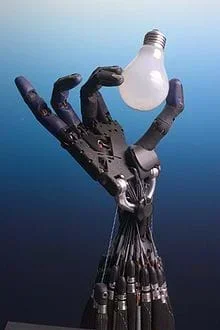 Robots are capable of performing human tasks because of their use of sensors.Copyright 2007 Richard Greenhill and Hugo Elias, Wikimedia Commons http://commons.wikimedia.org/wiki/File:Shadow_Hand_Bulb_large.jpg
Students continue to build a rigorous background in human sensors and their engineering equivalents by learning about electronic touch, light, sound and ultrasonic sensors that measure physical quantities somewhat like eyes, ears and skin. Specifically, they learn about microphones as one example of sound sensors, how sounds differ (intensity, pitch) and the components of sound waves (wavelength, period, frequency, amplitude). Using microphones connected to computers running (free) Audacity® software, student teams experiment with machine-generated sounds and their own voices and observe the resulting sound waves on the screen, helping them to understand that sounds are waves. Students take pre/post quizzes, complete a worksheet and watch two short online videos about "seeing" sound.
**Note: This activity uses the retired LEGO NXT robot which is no longer available for purchase.
Biological engineers and neuroscientists perceive the human body as a functioning, controlled system, similar to a robot. Research is showing that mathematical principles similar to those used in robotics are extremely useful or even necessary for a complete understanding of the human body. Engineer-designed sensors are used in a wide variety of applications, everything from nightlights to touchscreens to navigation by sonar and radar By relating the functioning of human senses to human-made equivalent sensors used in robots, students heighten their understanding of both.
After this activity, students should be able to:
- List some human-made sensors that are the electronic equivalents to human sensory organs.
- Explain the operational principles of electronic sensors.
- Compare how a sound sensor (such as a microphone) works, compared to human ears.
- Describe sound in terms of pitch, as well as in the form of a sound wave.
- STEL-3D Explain how various relationships can exist between technology and engineering and other content areas.
Grades 3-5
Do you agree with this alignment? - STEL-3G Explain how knowledge gained from other content areas affects the development of technological products and systems.
Grades 6-8
Do you agree with this alignment?
- Make qualitative observations using the five senses
Grade 5
Do you agree with this alignment? - Describe how new technologies have helped scientists make better observations and measurements for investigations (e.g., telescopes, magnifiers, balances, microscopes, computers, stethoscopes, thermometers)
Grade 4
Do you agree with this alignment? - Describe how new technologies have helped scientists make better observations and measurements for investigations (e.g., telescopes, electronic balances, electronic microscopes, x-ray technology, computers, ultrasounds, computer probes such as thermometers)
Grade 5
Do you agree with this alignment? - Identify receivers of visible light energy (e.g., eye, photocell)
Grade 6
Do you agree with this alignment? - Explain the interactions between the nervous and muscular systems when an organism responds to a stimulus
Grade 8
Do you agree with this alignment?
- 4-PS4-1 Develop a model of waves to describe patterns in terms of amplitude and wavelength and that waves can cause objects to move.
Grade 4
This resource focuses on the following Three Dimensional Learning aspects of NGSS:
Science & Engineering Practices- Develop a model using an analogy, example, or abstract representation to describe a scientific principle.Do you agree with this alignment?
- Science findings are based on recognizing patterns.Do you agree with this alignment?
Disciplinary Core Ideas- Waves, which are regular patterns of motion, can be made in water by disturbing the surface. When waves move across the surface of deep water, the water goes up and down in place; there is no net motion in the direction of the wave except when the water meets a beach. (Note: This grade band endpoint was moved from K-2.)Do you agree with this alignment?
- Waves of the same type can differ in amplitude (height of the wave) and wavelength (spacing between wave peaks).Do you agree with this alignment?
Crosscutting Concepts- Similarities and differences in patterns can be used to sort and classify natural phenomena.Do you agree with this alignment?
Do you agree with this alignment? - Develop a model using an analogy, example, or abstract representation to describe a scientific principle.
- MS-LS1-8 Gather and synthesize information that sensory receptors respond to stimuli by sending messages to the brain for immediate behavior or storage as memories.
Grades 6-8
This resource focuses on the following Three Dimensional Learning aspects of NGSS:
Science & Engineering Practices- Gather, read, and synthesize information from multiple appropriate sources and assess the credibility, accuracy, and possible bias of each publication and methods used, and describe how they are supported or not supported by evidence.Do you agree with this alignment?
Disciplinary Core Ideas- Each sense receptor responds to different inputs (electromagnetic, mechanical, chemical), transmitting them as signals that travel along nerve cells to the brain. The signals are then processed in the brain, resulting in immediate behaviors or memories.Do you agree with this alignment?
Crosscutting Concepts- Cause and effect relationships may be used to predict phenomena in natural systems.Do you agree with this alignment?
Do you agree with this alignment? - Gather, read, and synthesize information from multiple appropriate sources and assess the credibility, accuracy, and possible bias of each publication and methods used, and describe how they are supported or not supported by evidence.
- MS-PS4-1 Use mathematical representations to describe a simple model for waves that includes how the amplitude of a wave is related to the energy in a wave.
Grades 6-8
This resource focuses on the following Three Dimensional Learning aspects of NGSS:
Science & Engineering Practices- Use mathematical representations to describe and/or support scientific conclusions and design solutions.Do you agree with this alignment?
- Science knowledge is based upon logical and conceptual connections between evidence and explanations.Do you agree with this alignment?
Disciplinary Core Ideas- A simple wave has a repeating pattern with a specific wavelength, frequency, and amplitude.Do you agree with this alignment?
Crosscutting Concepts- Graphs and charts can be used to identify patterns in data.Do you agree with this alignment?
Do you agree with this alignment? - Use mathematical representations to describe and/or support scientific conclusions and design solutions.
Each group needs:
- Audacity software, for recording and editing sound; free download at http://audacity.sourceforge.net/
- computer with the Audacity software installed
- computer microphone, available at electronics stores such as RadioShack® or Best Buy®
- Sound Pre-Quiz (PDF), one per student
- Sound Worksheet (PDF), one per student
- Sound Post-Quiz (PDF), one per student
To share with the entire class:
- Robot Sensors and Sound Presentation (PPTX), Microsoft® PowerPoint® file
- computer and projector to show the presentation
- (optional) 4 LEGO® robot sensors: light, touch, sound and ultrasonic, as provided in the LEGO MINDSTORMS® Education NXT Base Set (for this activity, the sensors are only needed to show students; photos of the sensors are also pictured in the slide presentation)
- Robot Sensors and Sound Presentation (pptx)
- Robot Sensors and Sound Presentation (pdf)
- Sound Pre-Quiz (docx)
- Sound Pre-Quiz (pdf)
- Sound Pre-Quiz Answer Key (docx)
- Sound Pre-Quiz Answer Key (pdf)
- Sound Worksheet (docx)
- Sound Worksheet (pdf)
- Sound Worksheet Answer Key (docx)
- Sound Worksheet Answer Key (pdf)
- Sound Post-Quiz (docx)
- Sound Post-Quiz (pdf)
- Sound Post-Quiz Answer Key (docx)
- Sound Post-Quiz Answer Key (pdf)
- A basic understanding of the primary five senses of the human body: sight, hearing, smell, taste and touch.
- Completion of the previous unit in the series: Our Bodies Have Computer and Sensors.
How many sensors like those found in humans have been duplicated in robots? Can you name some? What sensors can detect sound? On the topic of sounds, what exactly is sound? How is it formed and how do we describe different sounds? We will answer all these questions today!
First let's review some different robot sensors and how they work, and then we'll do on a fun hands-on activity in which you'll use software to record sounds and look at their waveforms. Let's get started!
Background
Audacity is free, open source, cross-platform software for recording and editing sounds. Audacity shows sound waves on the screen as a person speaks into a microphone.
Before the Activity
- Gather materials and make copies of the Sound Pre-Quiz (PDF), Sound Worksheet (PDF) and Sound Post-Quiz (PDF), one each per student. The quizzes and worksheet are provided as separate attachments, and also embedded in the presentation so they can be presented to the class as a whole, if desired.
- Prior to class, review the references listed in the Additional Multimedia Support section on the topics of NXT robots and sensors, brain parts, and Audacity software and tutorial.
- Use the 28-slide Robot Sensors and Sound Presentation (PPTX), a PowerPoint file, to teach and conduct the activity. Set up a computer/projector to show the presentation to the class.
- Arrange for enough computers so you have one for each student group. Make sure each computer has the Audacity software loaded.
With the Students
- Ask the class: How many human senses have been duplicated in robots? Write students' ideas on the classroom board and inform them that you will return to this question after a few slides.
- Spend about 20 minutes reviewing robot sensors with the class (slides 1-7). Introduce the microphone (slide 5) one commonly used sound sensor, since it will be used in the activity. Summarize and emphasize the similarities between robot sensors and human sensors (slide 7). A robot's light and ultrasonic sensors are like eyes; its sound sensors are like ears; its touch sensors are like skin.
- Proceed to conduct the What Is Sound? Activity, starting at slide 8. Expect the activity to take 30 minutes.
- Administer the pre-quiz by handing out paper copies (also on slide 9). Answers are on slide 10.
- (slides 11-12) Review the science of sound that students learned from the associated lesson. Show them the five-minute "Science of Sound" video (if they haven't already seen it as part of the associated lesson; link provided on slide 11). Then present more detail (slides 13-16) about how sounds differ (intensity, pitch), the components of sound waves (wavelength, period, frequency, amplitude), and foreshadow the experiment. If time permits, show students to two short online videos about "seeing" sound (links on slide 17).
- Divide the class into groups of three students each. Have student groups assemble at the computers with microphones. The entire activity is described on slides 18-25.
- (slides 18-19) Begin by introducing the hands-on activity.
- Then distribute the worksheet (also on slide 20), which provides questions for students to answer as they go through the activity.
- Slides 21-25 provide more detailed activity instructions, including screen captures and steps for using the Audacity application. Show students how to start Audacity and open a file to record sounds (slides 21-22).
- First, have students try different sounds generated by the software itself (slide 23), and then record their own sounds (slides 24-25).
- At activity end, lead a class discussion about the activity. Give students a chance to share their observations, questions and conclusions. Guide the discussion with the questions provided in the Assessment section.
- Administer the post-quiz by handing out paper copies (also on slide 26). Answers are on slide 27. Vocabulary are provided on slide 28.
- auditory
- Related to hearing.
- olfactory
- Related to smell.
- peripheral
- Surrounding.
- sensor
- A device that converts one type of signal to another; for instance, the speedometer in a car collects physical data and calculates and displays the speed the car is moving.
- ultrasonic
- A sound at a frequency that humans cannot hear, but dogs and bats can.
Pre-Activity Assessment
Pre-Quiz: Administer the Sound Pre-Quiz (PDF) (also on slide 9) to assess students' prior knowledge about sound, pitch and sound waves. Answers are provided on the Sound Pre-Quiz Answer Key (PDF) (and slide 10).
Activity Embedded Assessment
Worksheet: As students work through the activity, have them answer the questions provided on the Sound Worksheet (PDF) (also on slide 20). Observe students to make sure they are engaged and completing their worksheets. Collect the worksheets at activity end and review their observations and answers to gauge their depth of comprehension.
Post-Activity Assessment
Concluding Discussion: At activity end, lead a class discussion so students can share their observations, questions and conclusions. Example discussion questions:
- What did you learn about robot sensors?
- What types are available? What do they do?
- How are they similar and different from human sensors?
- What did you lean about sound sensors?
- Specifically, how does a sound sensor (such as a microphone) work, compared to human ears.
- What did you learn about sound waves? (wavelength, period frequency, amplitude)
- What do we mean by sound intensity and pitch?
- How would you explain what sound is to someone in your family?
Post-Quiz: At activity end, administer the Sound Post-Quiz (PDF) (also slide 26). Answers are provided on the Sound Post-Quiz Answer Key (PDF) (and slide 27). Review students' answers to assess their understanding of the concepts of sound, sounds waves, and pitch that they explored in the activity.
- Adjust the slide presentation by editing and removing some slides for lower grades, and editing and adding additional slides for upper grades.
Audacity software: http://audacity.sourceforge.net/download/
Audacity tutorial: http://audacity.sourceforge.net/manual-1.2/tutorials.html
NASA Connect video on the "Science of Sound" explores the basics of sound including how it works and how it travels, as well as how the ear works. (5:04 minutes; video in presentation): https://www.youtube.com/watch?v=_ovMh2A3P5k
NXT robots and sensors: http://mindstorms.lego.com/eng/Overview/default.aspx
Show students the "Acoustic Water Dance" video of water moving due to sound waves from a speaker (4:44 minutes; optional video in presentation): http://www.youtube.com/watch?v=tI6S5CS-6JI
Show students the "Sound Waves" video of sand patterns that form at different pitches (2:10 minutes; optional video in presentation): http://www.youtube.com/watch?v=s9GBf8y0lY0
Contributors
Srijith Nair; Pranit Samarth; Satish S. Nair
Supporting Program
GK-12 Program, Computational Neurobiology Center, College of Engineering, University of Missouri
Acknowledgements
This curriculum was developed under National Science Foundation GK-12 grant no. DGE 0440524. However, these contents do not necessarily represent the policies of the National Science Foundation, and you should not assume endorsement by the federal government.
Copyright
2013 by Regents of the University of Colorado; original © 2013 Curators of the University of Missouri