
What Soundproofing Material Works Best?
Students first explore different materials to see what types reduce the most amount of sound when placed in a box. Each group is assigned a different material and they fill their box with that specific material. Students measure the sound level of a tone playing from inside the box using a decibel reader from outside the box. Students share this data with the class and analyze which types of materials absorb the most sound and which reflect the most sound.
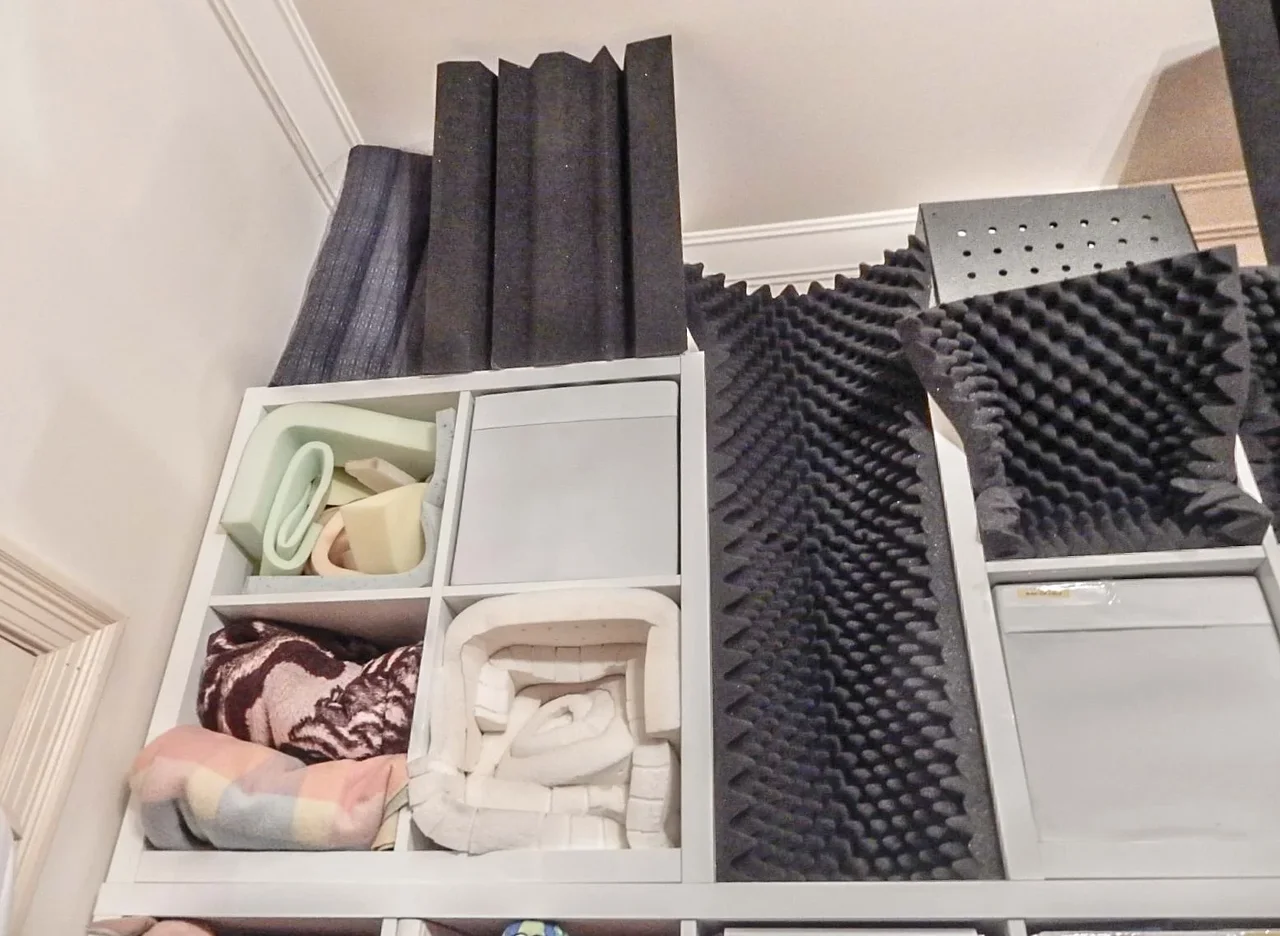 Foam is an excellent soundproofing material. What other kinds of material absorb sound?Copyright 2017 Michael Coghlan, CC-BY-SA-2.0, Flickr, https://www.flickr.com/photos/mikecogh/24743359237
Students use the engineering design process to design and create soundproof rooms that use only one type of material. They learn and explore about how these different materials react to sound by absorbing or reflecting sound. By doing so, students act as acoustical engineers. Acoustical engineers are primarily concerned with sound; they often work with other engineers and construction professionals to design rooms and buildings to reduce or enhance sounds, such as designing a classroom with sound-damping walls or a concert hall with a sound-reflecting ceiling.
After this activity, students should be able to:
- Demonstrate and explore which materials absorb sound.
- Demonstrate and explore which materials reflect sound.
- Communicate testing results with their classmates.
- Apply their knowledge of sound to real-life situations.
- CCSS.Math.Content.5.MD.B Represent and interpret data.
Grade 5
Do you agree with this alignment? - CCSS.Math.Content.5.NBT.B.7 Add, subtract, multiply, and divide decimals to hundredths, using concrete models or drawings and strategies based on place value, properties of operations, and/or the relationship between addition and subtraction; relate the strategy to a written method and explain the reasoning used.
Grade 5
Do you agree with this alignment? - CCSS.Math.Content.6.SP.B.4 Display numerical data in plots on a number line, including dot plots, histograms, and box plots.
Grade 6
Do you agree with this alignment?
- Students will develop an understanding of the attributes of design.
Grades K-12
Do you agree with this alignment? - Students will develop an understanding of engineering design.
Grades K-12
Do you agree with this alignment? - Students will develop an understanding of the role of troubleshooting, research and development, invention and innovation, and experimentation in problem solving.
Grades K-12
Do you agree with this alignment? - STEL-7H Illustrate that there are multiple approaches to design.
Grades 3-5
Do you agree with this alignment?
- MS-PS4-2 Develop and use a model to describe that waves are reflected, absorbed, or transmitted through various materials.
Grades 6-8
This resource focuses on the following Three Dimensional Learning aspects of NGSS:
Science & Engineering Practices- Develop and use a model to describe phenomena.Do you agree with this alignment?
Disciplinary Core Ideas- A sound wave needs a medium through which it is transmitted.Do you agree with this alignment?
- When light shines on an object, it is reflected, absorbed, or transmitted through the object, depending on the object's material and the frequency (color) of the light.Do you agree with this alignment?
- The path that light travels can be traced as straight lines, except at surfaces between different transparent materials (e.g., air and water, air and glass) where the light path bends.Do you agree with this alignment?
- A wave model of light is useful for explaining brightness, color, and the frequency-dependent bending of light at a surface between media.Do you agree with this alignment?
- However, because light can travel through space, it cannot be a matter wave, like sound or water waves.Do you agree with this alignment?
Crosscutting Concepts- Structures can be designed to serve particular functions by taking into account properties of different materials, and how materials can be shaped and used.Do you agree with this alignment?
Do you agree with this alignment? - Develop and use a model to describe phenomena.
- 5.MD.B Represent and interpret data.
Grade 5
Do you agree with this alignment? - 5.NBT.7 Solve real-world problems by adding, subtracting, multiplying, and dividing decimals using concrete models or drawings and strategies based on place value, properties of operations, and/or the relationship between addition and subtraction, or multiplication and division; relate the strategy to a written method and explain the reasoning used.
Grade 5
Do you agree with this alignment? - 6.SP.4 Display numerical data in plots on a number line, including dot plots (line plots), histograms, and box plots.
Grade 6
Do you agree with this alignment?
Assign each group to use one type of material such as fabric, wood, plastic, paper, metallic, stone or polymer.
Each group needs:
- roll of tape
- glue
- scissors
- shoebox or tissue box with the top removed (note: each group’s boxes should be roughly the same size, so have the students determine this during the Decibels and Acoustical Engineering lesson)
- one type of material from the list below:
- 8 felt pieces
- 1 bag cotton balls
- 8 fleece pieces (10 cm x 15 cm)
- 4 toothpick boxes
- 2 popsicle stick packs
- 1 packing peanuts box
- 1 bag of Styrofoam plate
- 1 bag of Styrofoam cups
- 8 note cards (10 cm x 15 cm)
- 1 newspaper
- 2 copy paper sheets (20 cm x 27 cm; standard 8.5 x 11 in)
- 1 box of aluminum foil
- 1 package of plastic plates
- 1 package of plastic cups
To share with the entire class:
- portable speaker and two smart phones (for decibel testing and sound generation)
- Two apps from the App store:
Students should complete the Decibels and Acoustical Engineering lesson prior to doing the activity.
(Reintroduce the Decibels and Acoustical Engineering Presentation (PPTX) that was used in the associated lesson as an opener to this activity. Slide 11 provides an overview of this activity and group material assignments and slide 12 gives some tips and tricks for creating a soundproof shoebox.)
In the previous lesson we learned about the properties of sound. We know sound travels in waves and that it can be absorbed or reflected. We also discussed the nature of acoustical engineering and how this discipline contributes to designing instruments and structures that harness sound. Acoustical engineers use their knowledge of sound to design buildings and rooms so that we can hear the sounds we want to hear as well as those sounds that we don’t want to hear. Think for a moment about what kind of rooms are or should be soundproof? (Answers may include: a movie theater, a music practice room, school classrooms, libraries, recording studios, etc.)
Today, you will take on the roles of acoustical engineers! Your task: to design a soundproof room using one type of material. Your room should absorb the most amount of sound, so that the room’s noise does not disturb the other rooms. (Show the Decibels and Acoustical Engineering Presentation (PPTX), slide 11.) Each group will get a shoebox and one type of material to explore. (Show slide 12.) To measure which group’s material helped decrease sound the most, we will use a speaker within the shoebox and an app to measure the sound decibels from outside your test box.
Background
The associated lesson, Decibels and Acoustical Engineering should provide students with sufficient background knowledge to perform the activity. As a summary, the teacher may reinforce the concept that sound is energy and has the ability to do work. Students need to know that sound is produced as a result of a vibration, which occurs when an object or molecule moves back and forth. When a vibration occurs, it produces a sound. When the vibration stops, the sound stops as well. Sound travels in waves from one place to another, which might be compared to when a person drops a rock in a pond. The impact of the rock on the surface of the water produces a ripple effect; sound waves “ripple” through a medium such as air in a similar fashion. Sound waves need a medium to travel through. This medium can be a solid, liquid, or gas. When a sound hits a specific medium it can either be absorbed, reflected, transmitted, or a combination of these things. When a sound is absorbed, a material takes in the impact of the sound waves and causes the sound to dissipate. When a sound is reflected, the waves bounce off the material and comes back to the person or object making the sound. When a sound is transmitted, it is passed through one medium to another; the sound may also be either amplified or dampened during transmission.
Before the Activity
- Download two apps from the App store:
- Purchase all necessary materials.
- Set up materials into groups; it helps to have each type of material in piles so groups can easily gather their assigned material.
- Optional: you can assign groups in the main part of the activity, or ahead of time during the Decibels and Acoustical Engineering lesson.
With the Students
- Introduce the activity and explain that each group will be testing a different material to see how well it acts in soundproofing (Refer to slide 11 of the Decibels and Acoustical Engineering Presentation (PPTX)).
- Review with students how to set up their boxes (Refer to slide 12 of the Decibels and Acoustical Engineering Presentation (PPTX)).
- Place students into groups of three or four students (about six groups total, depending on class size).
- Test the decibel reading for each groups’ box without any material to record baseline data by going to each station. Make sure the room is quiet while testing to avoid background noise. Have students write the decibel reading on Soundproofing Material Handout (PDF).
- App to test: Tone Generator, found at the (App Store for free)
- Decibel meter: Decibel X: dB, dBA Noise Meter (App store for free)
- Test with the boxes facing down on the table.
- Put one phone inside the box with the Tone Generator on; place the box face-down on the table.
- Use Decibel X outside the box to measure the sound generated from the Tone Generator.
- Assign each group a different material to test. Each group will cover the inside of their box with one layer of their material.
- Group 1: fabric
- Group 2: wood
- Group 3: Styrofoam
- Group 4: paper
- Group 5: metallics
- Group 6: plastic
- Repeat step 4 to test the decibel reading for each groups’ box WITH material to get data. Have students write the decibel reading on Soundproofing Material Handout (PDF).
- One student from each group will write their change in decibel data on the board or in a Google doc to share with the class.
- Subtract their original decibel reading from the decibel reading after materials were added
- Students will fill out their data and other groups’ data from the board or Google doc in the (Soundproofing Material Handout (PDF), page 1).
- Guide the class into filling out a bar graph by graphing which material had the largest change in decibels from testing on the Soundproofing Material Handout (PDF).
- y-axis = decibel reading (in amps)
- x-axis = material used
- Title: For example, “Decibel readings of different materials” (can create with class)
- Change in decibel reading; subtract the initial reading of an empty box from a reading with a box that contains material.
- Have students analyze the data present on the graph to answer the following analysis questions. Teacher can have students answer the questions within groups, individually, or with the entire class in the Soundproofing Material Handout (PDF).
- absorption
- The process by which a material, structure, or object takes in sound energy when sound waves are encountered, as opposed to reflecting the energy.
- acoustic
- The branch of physics that deals with the study of all mechanical waves in gases, liquids, and solids including vibration, sound, ultrasound, and infrasound.
- decibel
- A unit of measurement used to express the intensity of a sound, or the power level of an electrical signal by comparing it with a given level on a logarithmic scale.
- medium
- A material substance that can help move energy waves (such as sound) along. Also known as a transmission medium.
- oscillation
- The repetitive variation, typically in time, of some measure about a central value (often a point of equilibrium) or between two or more different states. The term vibration is precisely used to describe mechanical oscillation.
- reflection
- The change in direction of a wave at the fact of a medium so that the wave returns to where it originated.
- sound
- A vibration that manifests itself as a wave of pressure and can be perceived by humans (depending on the frequency) via the ear. Humans can hear soundwaves when the frequency lies between 20Hz and 20 kHz.
Pre-Activity Assessment
Pre-quiz: Administer the Soundproofing Pre-Quiz (PDF) to determine what students gained from the associated lesson.
Activity Embedded Assessment
Handout: Students complete the Soundproofing Material Handout (PDF). Ensure each group shares their data with the class; students may work independently or in groups.
Post-Activity Assessment
Rubric: Use the Soundproof Rubric (PDF) to grade students on their work during the activity. Focus on Topics that include Soundproofing Material Handout data table and Group Consideration.
- Remind students about the importance of using scissors properly in the classroom.
- Ask students and teachers to collect boxes prior to the activity.
- Have materials store set up prior to starting the activity with materials labeled.
- Teacher will be the official “tester” (place the phone flat on the side of the box; choose the exact same orientation for each test to reduce the variables added into testing).
- Use two phones; one to play the Tone Generator and the other to measure the decibel reading.
Lead a class discussion using the following questions. If time permits, have students explore the questions by using different shaped boxes or by swapping materials between groups and then repeat testing the decibel reading of their boxes.
- How would different sizes and shapes affect results?
- How would different materials affect results?
- What places will this design be useful?
- What are other factors besides sound that go into architect design?
- For lower grades: simplify the rubric when grading the soundproof room challenge. Complete the bar graph of data and results as a class instead of individually. Go over post-activity assessment questions orally as a class.
- For higher grades: have students take multiple test readings (5-10 tests recommended) and figure out the mean, median, mode and range.
- Decibels and Acoustical Engineering
- What Soundproofing Material Works Best?
- Design a Soundproof Room
Contributors
Emma Cipriani; Natalie Jackson; Geanna Schwaegerle; La’Nise Gray
Supporting Program
Collaborative RET Program, University of Dayton, Central State University, and Wright State University in Ohio
Acknowledgements
This material is based upon work supported by the National Science Foundation under grant no. EEC 1405869—a collaborative Research Experience for Teachers Program titled, “Inspiring Next Generation High-Skilled Workforce in Advanced Manufacturing and Materials,” at the University of Dayton, Central State University and Wright State University in Ohio. Any opinions, findings, and conclusions or recommendations expressed in this material are those of the authors and do not necessarily reflect the views of the National Science Foundation.
Copyright
2019 by Regents of the University of Colorado; original © 2016 University of Dayton, Central State University, and Wright State University in Ohio