
Decibels and Acoustical Engineering
In this lesson, students learn that sound is energy and has the ability to do work. Students discover that sound is produced by a vibration and they observe soundwaves and how they travel through mediums. They understand that sound can be absorbed, reflected or transmitted. Through associated activities, videos and a PowerPoint presentation led by the teacher, students further their exploration of sound through discussions in order to build background knowledge.
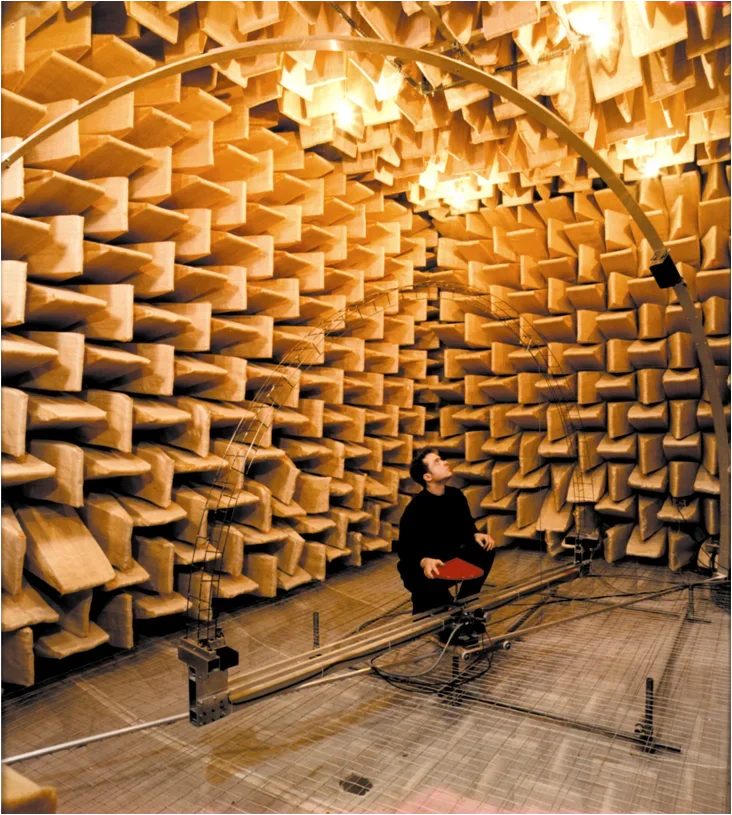 Acoustical engineers are experts in the properties of sound as well as understanding acoustic concepts such as decibels.Copyright 2013 Trevor Cox, CC-BY-SA-3.0, Wikimedia Commons, https://commons.wikimedia.org/wiki/File:Measuring_a_diffuser_in_an_anechoic_chamber.png
An acoustical engineer studies, designs, and applies the science of sound and vibration in practical settings. Acoustical engineers must be able to analyze sound so they can design structures and technology to control it, and they also must understand the underlying concepts (such a decibels) that allow them to quantitatively measure sound and vibration effects on structures. Acoustical engineers may work with engineers and other construction professionals where sound improvement or noise reduction is a priority.
Acoustical engineers help create environments in which we can hear the sounds that we actually want to hear and omit the sounds that we have no desire to hear. For instance, symphony halls are designed to optimize sound for the audience while a seminar hall may offer acoustics that benefit both the speaker and the listener. Recording studios may employ certain designs that optimize sound output and minimize ambient noise.
After this lesson, students should be able to:
- Demonstrate and explain what type of materials absorb sound.
- Communicate the results of their research with their classmates.
- Students will develop an understanding of the core concepts of technology.
Grades K-12
Do you agree with this alignment? - STEL-1H Design solutions by safely using tools, materials, and skills.
Grades 3-5
Do you agree with this alignment? - STEL-3D Explain how various relationships can exist between technology and engineering and other content areas.
Grades 3-5
Do you agree with this alignment?
- DCI.PS4.A.6-8.5 A sound wave needs a medium through which it is transmitted.
Grades 6-8
Do you agree with this alignment? - DCI.PS3.A.3-5.2 Energy can be moved from place to place by moving objects or through sound, light, or electric currents.
Grade 4
Do you agree with this alignment?
- 5.MD.B Represent and interpret data.
Grade 5
Do you agree with this alignment?
- Decibels and Acoustical Engineering PowerPoint Presentation (pptx)
- Decibels and Acoustical Engineering PowerPoint Presentation (pdf)
- Decibels Pre-Quiz (docx)
- Decibels Pre-Quiz (pdf)
- Decibels Pre-Quiz Answer Key (docx)
- Decibels Pre-Quiz Answer Key (pdf)
- Vocabulary Homework Sheet (docx)
- Vocabulary Homework Sheet (pdf)
- Vocabulary Homework Sheet Answer Key (docx)
- Vocabulary Homework Sheet Answer Key (pdf)
Students need to have experience with adding and subtracting decimals to the hundredths place. Students should have experience with bar graphs or be able to identify a bar graph.
Distribute the Decibels Pre-Quiz (PDF) to the class and assign the class to complete as much as they can of the pre-quiz. After the students are finished completing the pre-quiz, lead the class into an engaging discussion about sound energy referring to the Soundproof Challenge PowerPoint Presentation (PPTX) to give the students the necessary background knowledge for the two associated activities. The presentation covers a range of topics, including:
- What is Sound? (slide 2)
- How do we visually represent sound? (slide 3)
- How sound is created by vibrations. (slide 4)
- Sound travels in waves. (slide 5)
- Sound needs a medium through which to travel. (slide 6)
- Sound can be absorbed and reflected. (slides 7-8)
- An explanation of decibels. (slide 9)
Acoustical Engineers
Another key concept to consider (one that will serve to involve students further in the associated activities, What Soundproofing Material Works Best? and Design a Soundproof Room) is how we build structures in order to manipulate sound. Acoustical engineering is a field dedicated to understanding the science of sound and vibration. Engineers in this field, usually called acoustical engineers, apply acoustic in technology and typically work on projects design to analyze and control sound.
Acoustic engineers may work in a range of fields that help amplify sound or make sound more clearer, such as designing a symphonic hall or improving ultrasound devices. However, they may also deal with sound reduction or noise control, particularly for human and animal benefit. There are a range of sub-discplines associated with acoustical engineering. Examples include: aeroacoustics, or how sound moves through the air; electroacoustics, a discipline concerned with the design of sound amplification through technology; and ultrasonics, which deals with how sound waves move through solids, liquids, and gases at high frequencies.
Acoustical engineers should not be confused with audio engineers (or sound or recording engineers), even though sometimes the two designations overlap. Audio engineers work in a specific field designed to produce a live performance using a range of technology such as microphones, speakers, and amplifiers.
Before doing this lesson, ask the students to bring in boxes about two weeks prior. Tennis shoe or tissue boxes will work fine, and the boxes should be generally the same size.
- To prepare for the associated activities, the teacher will need to download the following apps on their smart phone: Tone Generator (found at the App Store for free) and Decibel meter: Decibel X: dB, dBA Noise Meter (also found at the App store for free).
- The teacher should also assign the students into six separate groups.
(Have students complete the Decibels Pre-Quiz (PDF) to assess what they already know or have learned about sound energy.)
In this lesson, we will learn that sound is energy and has the ability to do work. So, what exactly is sound? Sound is produced by a vibration, and a vibration is when objects or air molecules rapidly move back and forth. When a vibration occurs, it produces sound. When the vibration stops, the sound produced stops as well. Sound travels in waves from one place to another. You can visualize this by imagining a person dropping a rock in a pond. The impact of the rock upon the surface of the water produces a ripple effect. Sound waves “ripple” from a vibration in a similar way. Sound waves need a medium or material to travel through and this material can be a solid, liquid, or gas. When a sound hits a material, it is either absorbed, reflected, transmitted, or a combination of all three. When a sound is absorbed, the waves are essentially disrupted by the material, making the sound dissipate. When a sound is reflected, it bounces off of the material and comes back to the person or object making the sound. When a sound is transmitted, the sound travels through the object.
(Use the first 10 slides of the Soundproof Challenge PowerPoint Presentation (PPTX) to build background knowledge. Lead the class into a discussion using the PowerPoint with the linked (and vetted) videos to learn and engage the students more about sound.)
- absorption
- The process by which a material, structure, or object takes in sound energy when sound waves are encountered, as opposed to reflecting the energy.
- acoustic
- The branch of physics that deals with the study of all mechanical waves in gases, liquids, and solids including vibration, sound, ultrasound, and infrasound.
- decibel
- A unit of measurement used to express the intensity of a sound, or the power level of an electrical signal by comparing it with a given level on a logarithmic scale.
- medium
- A material substance that can help move energy waves (such as sound) along. Also known as a transmission medium.
- oscillation
- The repetitive variation, typically in time, of some measure about a central value (often a point of equilibrium) or between two or more different states. The term vibration is precisely used to describe mechanical oscillation.
- reflection
- The change in direction of a wave at the fact of a medium so that the wave returns to where it originated.
- sound
- A vibration that manifests itself as a wave of pressure and can be perceived by humans (depending on the frequency) via the ear. Humans can hear soundwaves when the frequency lies between 20Hz and 20 kHz.
- transmit
- In acoustics, sound passing from one area to another, normally through air or through a material constructed by some other medium.
- soundproof
- The means of preventing sound by constructing material that prevents its passage and reflection.
- vibration
- In mechanics, an oscillation of the parts of a fluid or an elastic solid whose equilibrium has been disturbed, or of an electromagnetic wave.
- wave
- A wave of compression by which sound is propagated in an elastic medium such as air.
Pre-Lesson Assessment
Pre-Quiz: Have students complete the Decibels Pre-Quiz (PDF) to assess their knowledge on sound and reading a graph.
Homework
Homework: Students complete the Vocabulary Homework Sheet (PDF) to practice using words relating to sound.
Tone Generator: https://itunes.apple.com/us/app/tone-generator/id457003837?mt=8
Decibel X: dB, dBA Noise Meter: https://itunes.apple.com/us/app/decibel-x-db-dba-noise-meter/id448155923?mt=8
- Decibels and Acoustical Engineering
Contributors
Emma Cipriani; Natalie Jackson; Geanna Schwaegerle; La’Nise Gray
Supporting Program
Collaborative RET Program, Central State University, University of Dayton, and Wright State University
Acknowledgements
This material is based upon work supported by the National Science Foundation under grant no. EEC 1405869—a collaborative Research Experience for Teachers Program titled, “Inspiring Next Generation High-Skilled Workforce in Advanced Manufacturing and Materials,” at the University of Dayton, Central State University and Wright State University in Ohio. Any opinions, findings, and conclusions or recommendations expressed in this material are those of the authors and do not necessarily reflect the views of the National Science Foundation.
Copyright
2019 by Regents of the University of Colorado; original © 2016 Central State University, University of Dayton, and Wright State University