
Building an Electromagnet
Students design and construct electromagnets that must pick up 10 staples. They begin with only minimal guidance, and after the basic concept is understood, are informed of the properties that affect the strength of that magnet. They conclude by designing their own electromagnets to complete the challenge of separating scrap steel from scrap aluminum for recycling, and share it with the class.
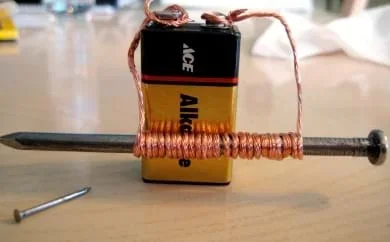 Building an ElectromagnetCopyright Wikimedia Commons http://commons.wikimedia.org/wiki/File:Homemade_Electromagnet.jpg
This activity encompasses the design and testing phases of the engineering design process. Students only have the knowledge of the scientific principles at work and a specific goal to achieve and no one correct way exists to solve the problem. Multiple solutions may work, depending on which factors affecting the design are deemed more important.
After this activity, students should be able to:
- Describe how the magnetic field of an electric current can be used to create a magnetic field similar to that of a permanent magnet.
- Build an electromagnet.
- Identify the properties of an electromagnet that affect its strength.
- Explain what engineers would have to do to build an electromagnet for use to separate metal for recycling.
- Students will develop an understanding of the attributes of design.
Grades K-12
Do you agree with this alignment? - Energy can be grouped into major forms: thermal, radiant, electrical, mechanical, chemical, nuclear, and others.
Grades 9-12
Do you agree with this alignment?
- HS-ETS1-2 Design a solution to a complex real-world problem by breaking it down into smaller, more manageable problems that can be solved through engineering.
Grades 9-12
This resource focuses on the following Three Dimensional Learning aspects of NGSS:
Science & Engineering Practices- Design a solution to a complex real-world problem, based on scientific knowledge, student-generated sources of evidence, prioritized criteria, and tradeoff considerations.Do you agree with this alignment?
Disciplinary Core Ideas- Criteria may need to be broken down into simpler ones that can be approached systematically, and decisions about the priority of certain criteria over others (trade-offs) may be needed.Do you agree with this alignment?
Do you agree with this alignment? - Design a solution to a complex real-world problem, based on scientific knowledge, student-generated sources of evidence, prioritized criteria, and tradeoff considerations.
- HS-PS3-5 Develop and use a model of two objects interacting through electric or magnetic fields to illustrate the forces between objects and the changes in energy of the objects due to the interaction.
Grades 9-12
This resource focuses on the following Three Dimensional Learning aspects of NGSS:
Science & Engineering Practices- Develop and use a model based on evidence to illustrate the relationships between systems or between components of a system.Do you agree with this alignment?
Disciplinary Core Ideas- When two objects interacting through a field change relative position, the energy stored in the field is changed.Do you agree with this alignment?
Crosscutting Concepts- Cause and effect relationships can be suggested and predicted for complex natural and human designed systems by examining what is known about smaller scale mechanisms within the system.Do you agree with this alignment?
Do you agree with this alignment? - Develop and use a model based on evidence to illustrate the relationships between systems or between components of a system.
- 3231.5.1 Create a simple electromagnet.
Grades 9-12
Do you agree with this alignment? - 3237.4.8 Create a simple electromagnet.
Grades 9-12
Do you agree with this alignment? - CLE 3202.2.4 Probe the fundamental principles and applications of electricity.
Grades 9-12
Do you agree with this alignment? - CLE 3231.5.6 Understand magnetic poles, magnetic fields, and investigate electromagnetic induction.
Grades 9-12
Do you agree with this alignment?
Each group needs:
- 1 6-V Zn-C battery (US$1.30)
- 1 compass (diameter 16 mm; US$1.00)
- 1 75-cm length wire
- 1 6.2 V, 0.5 A incandescent light bulb (US$1.30)
- 1 light bulb receptacle (US$1.98)
- 10 staples
- 1 iron/steel nail or other long cylindrical object
- 1 pencil or other long cylindrical wooden object
- other student requested objects that are available in the classroom
An understanding of the magnetic field produced by an electric current and the general properties of an electric current.
(Have staples ready) To simulate your mess of a recycling plant, you will have 10 staples that your magnet must pick up to be considered successful (show students the staples). Since we know your magnet requires electricity to control it—turn it on or off—you will also have the same supplies from the previous activity. The magnet you are building is called an electromagnet; it is a magnet made from the magnetic field produced by an electric current. Your job is to find the right design and orientation of the wire so that its magnetic field works just like a regular magnet, but you can turn it on and off, and it must be strong enough to pick up these 10 staples. You're on your own; good luck!
Building an ElectromagnetCopyright Wikimedia Commons http://commons.wikimedia.org/wiki/File:Homemade_Electromagnet.jpg
Background
An electromagnet takes advantage of the induced magnetic field of an electric current to mimic a permanent magnet with the advantage that it can be shut off. An electromagnet requires a continuous supply of electrical energy in order to maintain a magnetic field, which differs from a permanent magnet that doesn't require power. In an electromagnet, the battery's chemical energy transforms to electrical energy in the wire. Additionally, electromagnetic energy in the nail transforms to heat energy.
Setup
- Have ready the first six materials for each group.
- Have ready the remaining materials in a location from which students may browse and choose.
With the Students
- Divide the class into groups of four students each.
- Present the Introduction/Motivation section.
- Give teams time to build an electromagnet. Provide hints about the basic orientation of the wire, but do not give away the looping technique or importance of an iron core until students have begun experimenting with these ideas themselves.
- Test the performance of the electromagnets using the 10 staples.
- Ask students to analyze their results as an engineer would. What worked well in the design? What could be improved? What are some other aspects of the design that would be necessary for use at a recycling plant? (Example ideas: An easy switch, some way to move the magnet around so the steel could be dropped elsewhere, safety systems, a durable surface to attract the scrap steel, etc.)
- As an engineer would, ask each group to document its design as a product description to be presented to the recycling company.
- electromagnet
- A magnet made from the magnetic field produced by an electric current.
- core
- An object around which the loops of an electromagnet are wound.
The summative assessment is a quiz conducted either after step 4 or after step 5 and is found in the accompanying lesson.
Contributors
Justin Montenegro
Supporting Program
VU Bioengineering RET Program, School of Engineering, Vanderbilt University
Acknowledgements
The contents of this digital library curriculum were developed under National Science Foundation RET grant nos. 0338092 and 0742871. However, these contents do not necessarily represent the policies of the NSF, and you should not assume endorsement by the federal government.
Copyright
2011 by Regents of the University of Colorado; original © 2011 Vanderbilt University