
Electromagnet Design Challenge: Clean Up This Mess
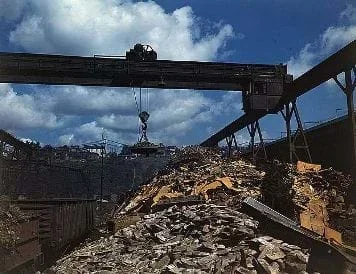 An electromagnet moves scrap steel.Copyright 1941 Alfred T. Palmer Wikimedia Commons http://commons.wikimedia.org/wiki/File:Allegheny_Ludlum_Steel_Corp_Scrap_Piles.jpg
This "legacy cycle" unit is structured with a contextually-based Grand Challenge followed by a sequence of instruction in which students first offer initial predictions (Generate Ideas) and then gather information from multiple sources (Multiple Perspectives). This is followed by Research and Revise as students integrate and extend their knowledge through a variety of learning activities. The cycle concludes with formative (Test Your Mettle) and summative (Go Public) assessments that lead students towards answering the Challenge question. See below for the progression of the legacy cycle through the unit. Research and ideas behind this way of learning may be found in How People Learn, (Bransford, Brown & Cocking, National Academy Press, 2000); see the entire text at https://www.nap.edu/read/9853/chapter/1.
The "legacy cycle" is similar to the "engineering design process" in that they both involve identifying an existing societal need, combining science and math to develop solutions, and using the research conclusions to design a clear, conceived solution to the original challenge. Though the engineering design process and the legacy cycle depend on correct and accurate solutions, each focuses particularly on how the solution is devised and presented. See an overview of the engineering design process at https://www.teachengineering.org/engrdesignprocess.php.
Grand Challenge to Students: "You have been hired to run a recycling plant and put in charge of the valuable steel processing division. Unfortunately for you, the previous manager did not know the difference between aluminum and steel—he piled the room for valuable steel products full of considerably less valuable aluminum cans. You must come up with a method for retrieving the steel from the aluminum cans so that it can be properly processed and earn the money you were hired to bring into the recycling plant and conserve the earth's natural resources."
In lesson 1, Magnetic Materials, students are presented the Grand Challenge and then Generate Ideas and compare them to ideas from Multiple Perspectives. They then begin to Research and Revise.
In lesson 2, Magnetic Fields, students continue to Research and Revise their understanding of magnetic fields.
In lesson 3, Circuits and Magnetic Fields, students continue to Research and Revise their understanding of magnetic fields, completing the lesson with a formative assessment to Test Your Mettle.
In lesson 4, Building an Electromagnet, students finish complete the cycle with the construction of their electromagnet, with which they Go Public. Students develop important knowledge in lessons 2 and 3 that they use in lesson 4 to design their solutions.
The overall process pertains to engineering design limitations: students must perform cost-benefit analyses both in their initial brainstorming for solutions and in their ultimate product. The final product is completed using an engineering design process of testing and refining. Throughout the unit, students play the role of engineers researching information to design a device to solve the problem presented in the grand challenge.
- Inventions and innovations are the results of specific, goal-directed research.
Grades 9-12
Do you agree with this alignment?
Day 1: Establishes the challenge and begins exploring the properties of magnetism through Activity 1. Lesson 2 continues exploring magnetic fields with Activity 2.
Day 2: Lesson 3 explores the relationship between electricity and magnetic fields in Activity 3, concluding with a formative assessment "Check" over magnetism and magnetic fields.
Day 3: Lesson 3 concludes by readdressing any misconceptions identified in the Check. Lesson 4 begins the design and construction of the electromagnet in Activity 4.
Day 4: Lesson 4 continues with the construction and testing of the electromagnet, and an explanation of how the designs will be shared the next day.
Day 5: Lesson 4 concludes as students "Go Public" with their designs.
- Electromagnet Design Challenge: Clean Up This Mess
Contributors
Justin Montenegro
Supporting Program
VU Bioengineering RET Program, School of Engineering, Vanderbilt University
Acknowledgements
The contents of this digital library curriculum were developed under National Science Foundation RET grant nos. 0338092 and 0742871. However, these contents do not necessarily represent the policies of the NSF, and you should not assume endorsement by the federal government.
Copyright
2013 by Regents of the University of Colorado; original © 2011 Vanderbilt University