
Can You Resist This?
 Students explore Ohm's lawCopyright 2004 Microsoft Corporation, One Microsoft Way, Redmond, WA 98052-6399 USA. All rights reserved.
This lab demonstrates Ohm's law as students set up simple circuits each composed of a battery, lamp and resistor. Students calculate the current flowing through the circuits they create by solving linear equations. After solving for the current, I, for each set resistance value, students plot the three points on a Cartesian plane and note the line that is formed. They also see the direct correlation between the amount of current flowing through the lamp and its brightness.
The concept of Ohm's law is the basis for explaining the relationship between resistance, current, and voltage. Electrical engineers use the equation everyday in the analysis of electrical circuits. Engineers have developed programs to do the work of predicting and optimizing the efficiency of the circuits. All electronic devices are composed of circuits, which engineers must design or debug making it essential to understand Ohm's Law. Students are asked to think about this in the post-activity assessment.
After this activity, students should be able to:
- State Ohm's law V=IR and explain the relationship between resistance, voltage and electric current.
- Calculate the electric current flowing through a circuit.
- Set-up a circuit using the correct circuit components and a breadboard.
- CCSS.Math.Content.8.F.B Use functions to model relationships between quantities.
Grade 8
Do you agree with this alignment? - CCSS.Math.Content.8.SP.A.1 Construct and interpret scatter plots for bivariate measurement data to investigate patterns of association between two quantities. Describe patterns such as clustering, outliers, positive or negative association, linear association, and nonlinear association.
Grade 8
Do you agree with this alignment? - CCSS.Math.Content.HSA-CED.A.4 Rearrange formulas to highlight a quantity of interest, using the same reasoning as in solving equations.
Grades 9-12
Do you agree with this alignment? - CCSS.Math.Content.HSS-ID.B.6 Represent data on two quantitative variables on a scatter plot, and describe how the variables are related.
Grades 9-12
Do you agree with this alignment?
- Students will develop an understanding of the relationships among technologies and the connections between technology and other fields of study.
Grades K-12
Do you agree with this alignment?
- make conjectures about possible relationships between two characteristics of a sample on the basis of scatterplots of the data and approximate lines of fit
Grades 6-8
Do you agree with this alignment?
- MS-PS2-3 Ask questions about data to determine the factors that affect the strength of electric and magnetic forces.
Grades 6-8
This resource focuses on the following Three Dimensional Learning aspects of NGSS:
Science & Engineering Practices- Ask questions that can be investigated within the scope of the classroom, outdoor environment, and museums and other public facilities with available resources and, when appropriate, frame a hypothesis based on observations and scientific principles.Do you agree with this alignment?
Disciplinary Core Ideas- Electric and magnetic (electromagnetic) forces can be attractive or repulsive, and their sizes depend on the magnitudes of the charges, currents, or magnetic strengths involved and on the distances between the interacting objects.Do you agree with this alignment?
Crosscutting Concepts- Cause and effect relationships may be used to predict phenomena in natural or designed systems.Do you agree with this alignment?
Do you agree with this alignment? - Ask questions that can be investigated within the scope of the classroom, outdoor environment, and museums and other public facilities with available resources and, when appropriate, frame a hypothesis based on observations and scientific principles.
- CCSS.Math.Content.8.SP.A.1 Construct and interpret scatter plots for bivariate measurement data to investigate patterns of association between two quantities. Describe patterns such as clustering, outliers, positive or negative association, linear association, and nonlinear association.
Grade 8
Do you agree with this alignment? - CCSS.Math.Content.HSA-CED.A.4 Rearrange formulas to highlight a quantity of interest, using the same reasoning as in solving equations.
Grades 9-12
Do you agree with this alignment? - CCSS.Math.Content.HSS-ID.B.6 Represent data on two quantitative variables on a scatter plot, and describe how the variables are related.
Grades 9-12
Do you agree with this alignment?
Each group needs:
- battery pack or battery holder for 4 AA batteries
- 3, 1.5V batteries
- lamp
- wires
- breadboard
- 10 Ω, 15 Ω, 22 Ω resistors
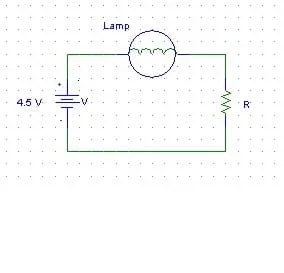 Figure 1. Circuit for this activity.Copyright Alison Douglas. Used with permission.
We have been learning all about linear functions, including important characteristics and how to graph them from a variety of forms. Recall our guiding grand challenge question in which we're trying to figure out the best equation that fits the data from the research lab. In this activity, you will learn about real-world applications, such as the research where the challenge question data comes from. We will focus on Ohm's law and investigate the relationship between voltage, resistance and current. We will analyze a simple circuit as if we were electrical engineers. Engineers use their knowledge of Ohm's law to design circuits to go in devices we use every day. By knowing certain defined values within the circuit, we will be able to solve for the current flowing through the circuit using Ohm's law V=IR, or I=V/R. (Students will find that the value of current found through the calculations has a direct correlation with the brightness of the lamp.)
Figure 1 shows a diagram of the basic circuit we will be learning about within this activity. The symbol with the V next to it is the battery, because it creates the voltage. The symbol with the R next to it is a resistor, which is an item that has resistance. The symbol with lamp above it represents the light bulb that will allow us to see if current is flowing through the circuit or not.
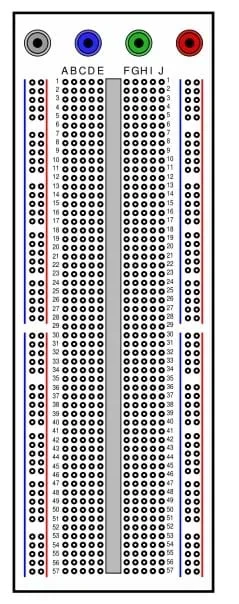 Figure 2. A typical breadboard used by electrical engineers.Copyright 2006 jjbeard Wikimedia Commons {PD} http://en.wikipedia.org/wiki/Image:Breadboard.svgBefore the Activity
Gather materials and make copies of the student handout. (PDF)
Set up the activity following these steps:
- Attach the battery back to the three 1.5 V batteries to create a 4.5 V battery.
- Obtain a lamp and press and hold the wires to the battery pack to the lamp.
- Once the lamp is illuminated, note the brightness level.(This demonstrates the supposed circuit with no resistor with the maximum amount of current flowing through the lamp.)
With the Students
- Divide the class into groups of two or three students at each set-up.
- Have students take turns setting up each circuit and make sure that each person solves for the current in each set-up and creates a linear graph.
- Obtain a breadboard (the square white plastic device with lots of holes in it). It has a grid labeled on it with letters and numbers. Row X is electrically connected across the entire row. Row Y is also electrically connected. For example, A1, B1, C1, D1, and E1 are electrically connected as are F6, G6, H6, I6, and J6. The breadboard is designed this way in order to make circuit building easier by using fewer wires.
- Connect a black wire to the negative end of the battery pack and put the other end in X1 on the breadboard. Insert one end of the 10Ω resistor in X4 and the other in H4.
- Insert one end of the 15Ω resistor in X7 and the other in H7.
- Place one end of the 22Ω resistor in X9 and one end in H9.
- Once all the circuit elements are in place, connect one end of the lamp wire to the positive end of the battery and insert the other end into J4.
- What happens? Does the lamp glow as brightly as it did the first time you saw it?
- Notice that now, the electrical current is flowing from the battery, through the wires to the lamp, through the 10Ω resistor, through the black wire and back into the negative side of the battery. Refer to Figure 1 for a diagram of the circuit where R= 10Ω.
- Use Ohm's law to figure out how much current is flowing through the resistor. Don't forget units!
- Now, move the wire from the lamp to J7. The circuit that is now formed can be referenced to Figure 1 where R=15Ω.
- Does the lamp burn as brightly?
- How much current flows through the resistor now? Use Ohm's law again and don't forget units!
- Now, move the wire from the lamp to J9. The circuit that is now formed can be referenced to Figure 1 where R=22Ω.
- Does the lamp burn as brightly? What about in comparison to the last trial?
- How much current is flowing through the resistor now? Use Ohm's law again and don't forget units!
- Once you have solved all three circuits for the flow of current through the resistor, use the grid on the handout to plot a point from each circuit. The x-coordinate represents resistance and the y-coordinate represents current. Describe your results. What type of relationship is formed?
- circuit
- The complete path of electrical current through wire including any additional components including the generating apparatus, resistor(s), capacitor(s), etc.
- voltage
- The difference in electrical potential between two points in an electrical circuit. Or, the rate at which energy is drawn from a power source which produces a flow of electricity in a circuit.
- resistance
- The ratio of the degree to which an object resists electrical current through it.
- current
- The time rate flow of an electric charge (electrons) having a magnitude equal to the quantity of charge per unit of time. (units = amperes)
- ohm's law
- Defined as the equation, V=IR, where V is voltage in volts, I is current in amperes, and R is resistance in ohms.
- breadboard
- A perforated block of plastic that is a reusable device used to build prototypes of electrical circuits. (See Figure 2)
Activity Embedded Assessment
- Have students answer the questions that are placed within the procedure on the separate handout provided.
Post-Activity Assessment
- Ask students to think about when they could use a resistor and Ohm's law in real life? One example would be to dim a light bulb. If students use this example, they would be correct, but this would also waste power because the resistor takes energy. For that reason, real dimmers on lights use more energy efficient circuitry. See HowStuffWorks.com for more information on dimmers.
Dictionary.com. Lexico Publishing Group, LLC. Accessed July 30, 2008. (Source of some vocabulary definitions, with some adaptation)
Contributors
Aubrey McKelvey
Supporting Program
VU Bioengineering RET Program, School of Engineering, Vanderbilt University
Acknowledgements
The contents of this digital library curriculum were developed under National Science Foundation RET grant nos. 0338092 and 0742871. However, these contents do not necessarily represent the policies of the NSF, and you should not assume endorsement by the federal government.
Copyright
2013 by Regents of the University of Colorado; original © 2007 Vanderbilt University