
Spring Away!
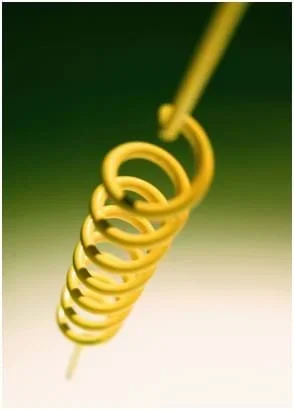 Let's apply what we learn about Hooke's law and springs to the design of a toy that uses springs.Copyright 2004 Microsoft Corporation, One Microsoft Way, Redmond, WA 98052-6399 USA. All rights reserved.
This lab demonstrates Hooke's law with the use of springs and masses. Students attempt to determine the proportionality constant, or k-value, for a spring. They do this by calculating the change in length of the spring as different masses are added to it. The concept of a spring's elastic limit is also introduced, and students test to makes sure the spring's elastic limit has not been reached during their lab tests. After compiling their data, they find an average value of the spring's k-value by measuring the slopes between each of their data points. Then they apply what they've learned about springs to how engineers might use that knowledge in the design of toys that enable kids to jump 2-3 feet in the air.
The concept of Hooke's law relates to many interesting applications of mechanical engineering and safety engineering. In this activity, students are prompted to think about a type of toy they've learned about which Hooke's law could relate to. The pogo stick comes to mind because of the spring. Engineers must consider the weight of the user and the spring constant to create the most bounce that is still safe.
After this activity, students should be able to:
- Explain the equation of Hooke's law.
- Calculate the slope of a line between two points.
- Describe how engineering concepts apply to Hooke's law.
- CCSS.Math.Content.8.F.B Use functions to model relationships between quantities.
Grade 8
Do you agree with this alignment? - CCSS.Math.Content.8.SP.A.1 Construct and interpret scatter plots for bivariate measurement data to investigate patterns of association between two quantities. Describe patterns such as clustering, outliers, positive or negative association, linear association, and nonlinear association.
Grade 8
Do you agree with this alignment? - CCSS.Math.Content.8.SP.A.2 Know that straight lines are widely used to model relationships between two quantitative variables. For scatter plots that suggest a linear association, informally fit a straight line, and informally assess the model fit by judging the closeness of the data points to the line.
Grade 8
Do you agree with this alignment? - CCSS.Math.Content.8.SP.A.3 Use the equation of a linear model to solve problems in the context of bivariate measurement data, interpreting the slope and intercept.
Grade 8
Do you agree with this alignment? - CCSS.Math.Content.HSA-CED.A.4 Rearrange formulas to highlight a quantity of interest, using the same reasoning as in solving equations.
Grades 9-12
Do you agree with this alignment? - CCSS.Math.Content.HSA-SSE.A.1a Interpret parts of an expression, such as terms, factors, and coefficients.
Grades 9-12
Do you agree with this alignment? - CCSS.Math.Content.HSF-IF.B.6 Calculate and interpret the average rate of change of a function (presented symbolically or as a table) over a specified interval. Estimate the rate of change from a graph.
Grades 9-12
Do you agree with this alignment? - CCSS.Math.Content.HSS-ID.C.7 Interpret the slope (rate of change) and the intercept (constant term) of a linear model in the context of the data.
Grades 9-12
Do you agree with this alignment?
- STEL-3G Explain how knowledge gained from other content areas affects the development of technological products and systems.
Grades 6-8
Do you agree with this alignment? - STEL-8J Use devices to control technological systems.
Grades 6-8
Do you agree with this alignment?
- Use mathematical models to represent and understand quantitative relationships
Grades -1-12
Do you agree with this alignment?
Each group needs:
- large table clamp ($79)
- 120 cm rod ($29)
- hooked mass set ($43)
- equal length spring set ($35)
- pendulum clamp ($20)
These materials are available on PASCO's website under the high school physics section within the simple harmonic motion set-up. See http://www.pasco.com/physhigh/
Note: If not enough sets of equipment are available for groups of two or three students each, divide the class into a number of groups that matches the number of equipment sets available. If only one set of equipment is available, have students take turns taking measurements and then have everyone compile and calculate the k-values using the same data.
To share with the entire class:
- rulers, for measuring length of springs
Abilitly to find the slope of a line.
In this unit we have been learning all about linear functions, including important characteristics and how to graph them from a variety of forms. Recall our guiding grand challenge in which we are trying to figure out the best equation that fits the data from the research lab. In this activity, you will learn about real-world applications, such as the research where the challenge question data comes from.
We can figure out the elastic spring constant of a spring by adding hanging masses to the end of a spring and measuring the change in length of the spring. Then, we will explore the possibilities of engineering applications with mechanical engineers using Hooke's law to build fun and safe toys.
Before the Activity
Prepare the activity set-up by following these instructions:
- Attach the large table clamp securely to a table.
- Tighten the 120 cm rod into the large table clamp.
- Use the pendulum clamp and attach it to the top of the 120 cm rod.
- Hang the springs from the pendulum clamp in order to measure their changes in length when hanging masses are added to them.
With the Students
- Divide the clss into groups of two or three students each at each set-up. Alternatively, adjust group size to match the number of sets of equipment available.
- Have students take one of the three springs and attach it to the pendulum clamp.
- Measure the initial length of the spring when no hanging masses are attached.
- Attach one hanging mass at a time to the end of the spring.
- Measure the new length of the spring.
- Record your data in a table similar to the one below.

- For each of the three springs, record about 5 or 6 data points. Start with the smallest masses and work up to the larger masses so the data points have increasing mass.
- After compiling data for the three springs within each group, have students within the groups work individually on calculating the slope between each point and the initial point.
- After they have calculated the slope values for the five or six points have students find the average slope value. This is the average k-value, proportionality constant, for the spring based off of Hooke's law: y = k x.
- Have the students create a graph of Mass vs. Length of the spring. After graphing, have students add a line of best fit to their plot. How does the slope of this best fit line compare to the previously calculated slope (k)?
- Prompt students to consider the following questions about the exercise they have completed.
- What is k and what does it represent? How do you solve for it?
- Imagine this real-world engineering scenario: You are an invention engineer in a toy factory and want to design a toy that enables kids to jump 2-3 feet in the air. How does what you have learned in the activity help you solve this problem?
- How does the size of the child affect the design of your toy?
- Conclude with a class discussion to review student results and conclusions.
Activity Embedded Assessment
- Have students follow the procedure and show their work of calculating slopes from their data points gathered during the experiment. Require that they provide (for each spring tested) a data table, the slopes of each data point with respect to the initial measurement, and an average k-value.
Post-Activity Assessment
- What is k and what does it represent? How do you solve for it?
- Imagine this real-world engineering scenario: You are an invention engineer in a toy factory and want to design a toy that enables kids to jump 2-3 feet in the air. How does what you have learned in the activity help you solve this problem?
- How does the size of the child affect the design of your toy?
Note: If students have a hard time, guide them towards thinking about a pogo stick (F = k x), so the greater the force, the greater the change in spring length.
Contributors
Aubrey Mckelvey
Supporting Program
VU Bioengineering RET Program, School of Engineering, Vanderbilt University
Acknowledgements
The contents of this digital library curriculum were developed under National Science Foundation RET grant nos. 0338092 and 0742871. However, these contents do not necessarily represent the policies of the NSF, and you should not assume endorsement by the federal government.
Copyright
2013 by Regents of the University of Colorado; original © 2007 Vanderbilt University