
Matching the Motion
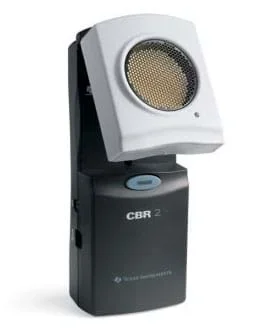 A Vernier CBR2 motion detector device.Copyright Vernier https://www.vernier.com/products/sensors/motion-detectors/cbr2/
Students learn about slope, determining slope, distance vs. time graphs through a motion-filled activity. Working in teams with calculators and CBR2 motion detectors, students attempt to match the provided graphs and equations with the output from the detector displayed on their calculators.
Understand the slope of a line is important to mathematics and all sorts of engineering applications. Slope can be viewed as the rate of change motion, and in this activity it is seen as walking motion. Mechanical engineers deal with the motion of vehicles, such as cars, planes, spacecraft and motor scooters. It is important for them to be able to read and understand graphs that show displacement, velocity and acceleration, and then to analyze test data to learn how to design their products to be efficient and safe.
After this activity, students should be able to:
- Determine the slope of a line given a graph.
- Explain the idea of slope as well as distance vs. time graphs.
- Provide definitions for velocity and acceleration.
- Describe which types of lines have slopes of zero or undefined, and why.
- CCSS.Math.Content.8.F.B.5 Describe qualitatively the functional relationship between two quantities by analyzing a graph (e.g., where the function is increasing or decreasing, linear or nonlinear). Sketch a graph that exhibits the qualitative features of a function that has been described verbally.
Grade 8
Do you agree with this alignment?
- STEL-3G Explain how knowledge gained from other content areas affects the development of technological products and systems.
Grades 6-8
Do you agree with this alignment? - STEL-8J Use devices to control technological systems.
Grades 6-8
Do you agree with this alignment?
- Use mathematical models to represent and understand quantitative relationships
Grades -1-12
Do you agree with this alignment?
- calculator, such as such as TI-83 Plus or TI-84 Plus, with the EasyData app (see note below)
- Calculator-Based Ranger 2 (CBR2); available for $99 at Vernier, https://www.vernier.com/products/sensors/motion-detectors/cbr2/
- meter stick
- masking tape (~$3)
- Matching the Motion Activity Handout (PDF), one per student
Note: Graphing calculators are typically preloaded with a number of software applications, including the EasyData App. Press APPS to see what apps are installed on your calculator. If EasyData is not installed, find and download the latest version at education.ti.com.
Familiarity with the coordinate plane, coordinates, graphing equations, and finding the slope of a line.
We have learned in class about how to graph points on a Cartesian plane and how to graph lines on a Cartesian plane. We have also learned about the slope of a line and how to calculate it. Recently, we have learned the different ways we can write the equations of a line. We have learned direct variation, point-slope form, standard form and slope-intercept form. The most applicable form to this activity is the direct variation form.
The CBR2 motion detector uses ultrasound to measure the distance of an object. The device releases an ultrasonic signal towards a target, the signal is reflected off of the target, and then received by the device. Distance, velocity and acceleration can be calculated by the time it takes for the device to detect each signal. Distance is the linear extent of space between two things. Velocity is the rate of time change (speed) of an object, but in a specified direction. Acceleration is the rate of time change of velocity with respect to magnitude or direction (the rate at which an object speeds up). We will most closely be looking at the linear relationships provided with distance vs. time graphs, as opposed to velocity or acceleration vs. time graphs.
From this, the distance, speed and acceleration of the object over time can be calculated. (Ask a student to come to the front of the room to help demonstrate how the motion detector device works.)
(Have the student walk at a constant speed to show the class what constant speed looks like on a graph. Explain how the CBR2 records the data in a distance vs. time graph. Switch the CBR2 to produce a velocity vs. time graph and have the student walk at a constant speed. Let students view the straight line of constant velocity. Then have the student walk and speed up gradually to show the change in the velocity graph. Switch to an acceleration vs. time graph and have the student walk at a constant speed. Have the class notice that the graph stays plotting at zero. Then have the student start out slowing and speed up gradually. Show students how this produces a straight line on the acceleration vs. time graph, because it is constant acceleration. If the student walks and speeds up and then slows down, but not gradually at the same rates, a non-constant acceleration vs. time graph results.)
(Divide the class into groups to experiment with the CBR2. Once they understand the device, have them begin working on the handout.)
Background
The following lab was adapted from Vernier's Graph Matching Lab. Vernier's complete lab may be found in the sample labs section at https://www.vernier.com/products/books/pwv/.
Before the Activity
- Gather materials and make copies of the handout.
- Prepare the motion detector set-up in front of the classroom.
- Position the motion detector so it points towards a 4 m long open space. Place strips of masking tape on the floor to mark the origin, and 1 m, 2 m, and 3 m distances.
- Watch the Vernier “CBR2 Motion Detector Overview” video at https://vnr.st/v58/ to learn exactly how to plug the CBR2 into the calculator and how to use it.
With the Students
- Set up the calculator and CBR2 for data collection.
- Review with students information about slopes of lines and present the information on motion detectors, as provided in the Introduction/Motivation section.
- Begin the activity by passing out a sheet of paper and asking students to brainstorm and answer the preliminary questions on the activity handout.
- Let students run trials with the motion detector and attempt to match each of the graphs on the handout.
- If students run out of time, assign the graph handout to be finished as homework, or have them continue to work on it during the next class period.
Worksheet: Have students use the Matching the Motion Activity Handout (PDF) as a guide to practice with the motion detector as well as to finish as homework (if unable to complete during the class period). Review their answers to gauge their mastery of the subject matter.
Contributors
Aubrey McKelvey
Supporting Program
VU Bioengineering RET Program, School of Engineering, Vanderbilt University
Acknowledgements
The contents of this digital library curriculum were developed under National Science Foundation RET grant nos. 0338092 and 0742871. However, these contents do not necessarily represent the policies of the NSF, and you should not assume endorsement by the federal government.
Copyright
2013 by Regents of the University of Colorado; original © 2007 Vanderbilt University