
Active and Passive Transport: Red Rover Send Particles Over
Students compare and contrast passive and active transport by playing a game to model this phenomenon. Movement through cell membranes is also modeled, as well as the structure and movement typical of the fluid mosaic model of the cell membrane. Concentration gradient, sizes, shapes and polarity of molecules determine the method of movement through cell membranes. This activity is associated with the Test your Mettle phase of the legacy cycle.
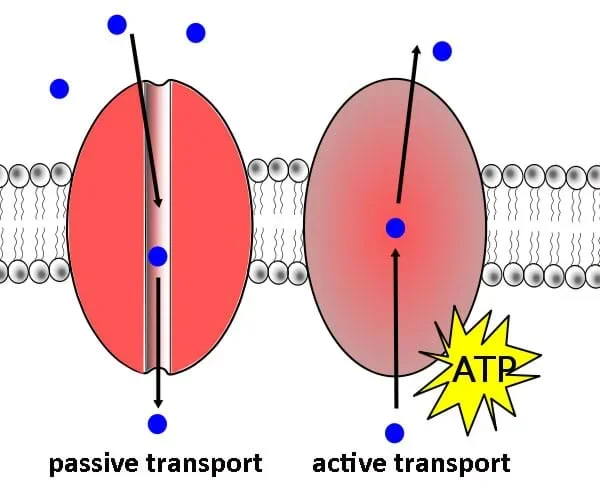 Students model active and passive transport in a cell.Copyright 2008 JrPol, Wikimedia Commons https://commons.wikimedia.org/wiki/File:Passief-actief-transport-in-cel.svg
Engineers use models to represent and better understand the world at various scales. To better understand cells, engineers construct and manipulate models. In this activity, students construct a cell membrane and provide areas for specific transport. A molecule's ability to permeate through a cell membrane is one of the main focuses of intracellular engineering. A great deal of research is being done in the field of biomedical engineering to learn about the inner-workings of cells in order to develop new forms of medical technology.
After this activity, students should be able to:
- Act as a different particle or part of the cell membrane to model active and passive transport.
- Explain how particles are transported from one side of the cell membrane to the other.
- Explain why engineers use models.
- HS-LS1-2 Develop and use a model to illustrate the hierarchical organization of interacting systems that provide specific functions within multicellular organisms.
Grades 9-12
This resource focuses on the following Three Dimensional Learning aspects of NGSS:
Science & Engineering Practices- Develop and use a model based on evidence to illustrate the relationships between systems or between components of a system.Do you agree with this alignment?
Disciplinary Core Ideas- Multicellular organisms have a hierarchical structural organization, in which any one system is made up of numerous parts and is itself a component of the next level.Do you agree with this alignment?
Crosscutting Concepts- Models (e.g., physical, mathematical, computer models) can be used to simulate systems and interactions—including energy, matter, and information flows—within and between systems at different scales.Do you agree with this alignment?
Do you agree with this alignment? - Develop and use a model based on evidence to illustrate the relationships between systems or between components of a system.
- 3216.1.2 Conduct an experiment or simulation to demonstrate the movement of molecules through diffusion, facilitated diffusion, and active transport.
Grades 9-12
Do you agree with this alignment? - CLE 3210.1.5 Compare different models to explain the movement of materials into and out of cells.
Grades 9-12
Do you agree with this alignment?
Materials needed for this activity include:
- yarn (or string)
- scissors
- hole punch
- Types of Transport Activity Page (PDF), one per student
- Red Rover Game Pieces (PDF) (use the hole punch and yarn to make these game cards into student role identification placards; optional: laminate them so they are re-usable)
- Cell Membrane Quiz (PDF), one per student
Today you are all going to participate in a cell membrane game called "Red Rover- Send Particles Over." This kinesthetic learning allows you to model and explore relationships within the cell involving the cell membrane. Active learning helps you to model what is happening on a molecular level so you can better understand processes that you are unable to visualize. You should have a chemical and biological understanding of the fluid mosaic model of the cell membrane and be familiar with the structure and polarity of molecules that will transport across the membrane. The act of modeling processes is a tool used by many engineers as they follow the steps of the design process in to solves problems and find good solutions.
Let's review passive and active transport:
Passive transport is the movement of substances across the membrane without any input of energy from the cell. Osmosis and diffusion (the focus of the previous lesson) are two examples of passive transport.
Active transport refers to movement of materials from an area of lower concentration to an area of higher concentration, against the concentration gradient. To do this, energy is required, usually from ATP. Cell membrane pumps, endocytosis and exocytosis (the focus of the previous lesson) all aid in active transport.
In the red rover game, you will physically "move" your body through a cell with either ease or constraints, depending on the type of transport specified.
Background
Before starting the game, students review the activity sheet to familiarize themselves with the transport types and related topics. The teacher serves as the game facilitator, announcing the type of transport and summing up what has happened at the end of each session. During the activity, remind students about the concentration gradient and dynamic equilibrium.
Before the Activity
- Make copies of the Cell Membrane Quiz (PDF) and Types of Transport Activity Sheet (PDF), one each per student.
- Print out the game cards that illustrate ions, molecules and cell membrane members. Hole-punch the cards on the top two corners and tie yarn through each to make placards for each student to wear during the activity, illustrating their roles. Use the pink atoms as potassium or another ion and write the ion element and charge on each. Have students write the charges on the sodium and chlorine atoms. (Tip: To make these cards re-usable, copy them onto card stock and laminate before punching the holes. Dry erase marker wipes off the laminated surface so the blank atoms can be easily changed.)
- Move aside desks and tables to clear a space to conduct the game. Or arrange to go outside or to the gym.
- Give students the activity sheet prior to the activity so they may familiarize themselves with the various types of transport being studied. Also have students review shape and structure of molecules to determine their polarity and method of movement into and out of the cell membranes.
With the Students
- Offer students the stack of game cards, face down, and have them randomly choose their roles in the game by choosing a card. Have them place the placards around their necks so everyone knows their roles in the game.
- Direct students who have drawn similar cards to group together to talk about their strategy for movement into the cell membrane. Suggest they look over the activity sheet to review what type of transport they are able to participate in each time. Likewise, have members of the lipid bilayer and the proteins discuss placement of their proteins within the membrane.
- Begin the game by announcing which transport type will be illustrated. Similar to playing "Red Rover," the particles try to enter the cell and still be aware of the dynamic equilibrium that takes place in conjunction with the concentration gradient. Have the cell membrane hold hands so as to be "fluid" enough for small particles such as water, carbon dioxide and oxygen gas to enter and exit the cell at will, while charged particles must enter and exit the cell only through their specific channel proteins. Have the channel proteins announce which specific ion they allow to enter and exit. Have the carrier proteins also announce their specific molecule, such as glucose or amino acids.
- Periodically stop to discuss what the students are modeling. Transition to new games by summarizing and discussing what happened. Restart new games, announcing different transport types. Periodically allow students to switch roles during the game so that they gain perspective for different parts of the process. Remind students about the concentration gradient and dynamic equilibrium.
- At activity end, administer the quiz.
- active transport
- The movement of substances through the cell membrane that requires energy.
- passive transport
- The movement of particles through the cell membrane that does not require energy.
Quiz: At activity end, administer the Cell Membrane Quiz (PDF). Review students' answers to gauge their comprehension of the concepts.
- Keepers of the Gate
- The Keepers of the Gate Challenge
- Cell Membrane Structure and Function
- Active and Passive Transport: Red Rover Send Particles Over
- Quantum Dots and the Harkess Method of Critical Reading
- Cell Membrane Experimental Design
Contributors
Melinda M. Higgins
Supporting Program
VU Bioengineering RET Program, School of Engineering, Vanderbilt University
Acknowledgements
The contents of this digital library curriculum were developed under National Science Foundation RET grant nos. 0338092 and 0742871. However, these contents do not necessarily represent the policies of the National Science Foundation, and you should not assume endorsement by the federal government.
Copyright
2013 by Regents of the University of Colorado; original © 2010 Vanderbilt University