
Cell Membrane Structure and Function
Students learn about the different structures that comprise cell membranes, fulfilling part of the Research and Revise stages of the legacy cycle. They view online animations of cell membrane dynamics (links provided). Then they observe three teacher demonstrations that illustrate diffusion and osmosis concepts, as well as the effect of movement through a semi-permeable membrane using Lugol's solution. Lastly, students use the associated activity to test their understanding of the cell structure and membrane.
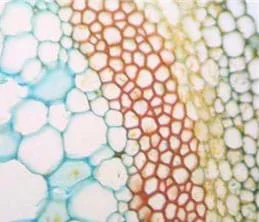 Students learn about cell membrane structure and functionCopyright 2004 Microsoft Corporation, One Microsoft Way, Redmond, WA 98052-6399 USA. All rights reserved. http://office.microsoft.com/en-us/images/results.aspx?qu=cell&ex=1#ai:MP900390238|mt:2|
With the evolution of nanoparticle use for drug delivery and many other applications, the cell has become a main focal point of research, making intracellular engineering a specialized area of biomedical engineering. In order for students to understand what is happening inside cells, they must understand how particles gain entrance to cells. Studying the cell membrane's structure and function provides the details engineers need if they are to facilitate the ease of entrance.
After this lesson, students should be able to:
- Identify organelles in a cell and their function.
- Describe how organisms use physical phenomena to actively transport nutrients.
- Construct and identify cell membrane parts.
- Define osmosis, diffusion and semi-permeable membranes and understand how organisms use them.
- Technological problems must be researched before they can be solved.
Grades 9-12
Do you agree with this alignment?
- HS-LS1-2 Develop and use a model to illustrate the hierarchical organization of interacting systems that provide specific functions within multicellular organisms.
Grades 9-12
This resource focuses on the following Three Dimensional Learning aspects of NGSS:
Science & Engineering Practices- Develop and use a model based on evidence to illustrate the relationships between systems or between components of a system.Do you agree with this alignment?
Disciplinary Core Ideas- Multicellular organisms have a hierarchical structural organization, in which any one system is made up of numerous parts and is itself a component of the next level.Do you agree with this alignment?
Crosscutting Concepts- Models (e.g., physical, mathematical, computer models) can be used to simulate systems and interactions—including energy, matter, and information flows—within and between systems at different scales.Do you agree with this alignment?
Do you agree with this alignment? - Develop and use a model based on evidence to illustrate the relationships between systems or between components of a system.
- 3216.1.2 Conduct an experiment or simulation to demonstrate the movement of molecules through diffusion, facilitated diffusion, and active transport.
Grades 9-12
Do you agree with this alignment?
As part of the Research and Revise phase, students learn about the different structures that comprise the cell membrane. They also relate cell membrane structure with function and how the functions interact with one another.
Begin by either projecting the online animations of cell membrane dynamics (listed on the Cell Membrane Animation Links (PDF) handout) so the entire class can see them, or have students work at individual computers to view them. Work through some of the animations with the students; explain what they are seeing in each animation.
Give an overview of the concepts of diffusion and osmosis, and explain how a semi-permeable membrane works. Describe how transport happens across a cell membrane to maintain homeostasis. Explain solute concentrations: hyperetonic, hypotonic and isotonic. Use the background information provided below.
Then, have students observe three diffusion and osmosis demonstrations, as described on the Teacher Demonstration Instructions (PDF). (Note that one requires 24-hour advance set-up.) Students witness the effect of movement through a semi-permeable membrane using Lugol's solution. Finally, have students complete the Cell Membrane Color Sheet and Build a Cell Membrane activity to solidify their understanding of the cell's anatomy and functions.
Cell Membrane Concepts
Diffusion is a passive transport method of movement of molecules from higher concentration to lower concentration. This difference in concentration is called the concentration gradient.
When the concentrations inside and outside of a cell are the same, the cell maintains dynamic equilibrium.
Cell membranes are selectively permeable, meaning it depends on the size and type of molecule.
It is important to remember that like dissolves like. The phospholipid bilayer that comprise cell membranes are nonpolar; therefore, nonpolar and very small molecules such as carbon dioxide (CO2) and oxygen gas (O2) may pass through a membrane uninhibited.
Osmosis refers specifically to the diffusion of water molecules in a solution. Water diffuses across a cell membrane from an area of higher concentration to an area of lower concentration.
The direction of movement of the water depends on concentration of solute on both sides of the membrane.
Hypotonic solution - occurs when the concentration of solute inside a cell is higher than the concentration of solute outside of a cell. Therefore, water diffuses into the cell.
Hypertonic solution - occurs when the concentration of solute outside of a cell is higher than the concentration of solute inside a cell. Water diffuses out of the cell.
Isotonic solution - occurs when the solute concentration inside a cell is equal to the solute concentration outside a cell. Water diffuses at equal rates into and out of the cell.
Facilitated diffusion - Carrier proteins must assist in the movement of molecules that are not soluble in lipids or too large. Glucose is an example of large molecule that is moved into a cell in this manner.
- Movement of substances in or out of the cell depends upon concentration gradient.
- Carrier proteins that assist in movement of these substances are specific for each type of molecule.
Diffusion through ion channels - Allow movement of ions such as Ca+2, Cl-, through the membrane. Because ions are charged and therefore polar, they may not freely move through the membrane. Some ion channels are always open, allowing free flow of ions. Others have specific stimuli that allow them to open, such as stretching of the cell membrane, electrical signals or chemical signals.
Cell membrane pumps - Carrier proteins assist in moving substances UP the concentration gradient. Protein engulfs and transports the molecule across the membrane to the other side.
Na-K pump - To function well, many types of cells must have a higher concentration of Na+outside and higher K+ inside.
Endocytosis and exocytosis - These refer to active transport that moves molecules that are too large to move through the other processes, such as macromolecules and food particles. Both use membrane-bound sacs to carry substances into and out of cells.
Endocytosis - Movement of particles into the cell
Pinocytosis - Transport of solutes or fluids
Phagocytosis - Movement of large particles or entire cells
Exocytosis - Movement of particles out of the cell; may be used for large particles such as proteins. (Proteins made on ribosomes and packaged into vesicles by the Golgi-vesicles move to cell membrane and move out of the cell.)
Beyond understanding the basic parts of a cell and their functions, what else can get inside of our cells? How about quantum dots and other types of nanoparticles? By understanding the structure and the chemistry of cell membranes, researchers are able to focus on how cells can work for us for medical purposes. Many chemical and biomedical engineers use their understanding of how cells work to develop innovative medical technologies.
Today, you will conduct research that includes viewing online animations of cell membrane dynamics and observing demonstrations of diffusion and osmosis. You will witness the effect of movement through a semi-permeable membrane using Lugol's solution.
- isotonic
- Solute concentration equal on the inside and outside of the cell.
- hypertonic
- Solute concentration higher on the outside of the cell than on the inside of the cell.
- hypotonic
- Solute concentration lower on the outside of the cell than on the inside of the cell.
- semi-permeable
- Allows certain substances access to the inner area of the cell.
Post-Introduction Assessment
Self-Quiz: Administer the Cell Structure and Function Quiz provided at the Biomembranes link at https://www.quia.com/quiz/717688.html.
Lesson Summary Assessment
Modeling: Have students build their sections of the cell membrane and compare to other students' models. Have students put together the different parts of the membrane for a picture of a larger, diverse membrane.
http://www.vivo.colostate.edu/hbooks/cmb/cells/pmemb/osmosis.html
http://hyperphysics.phy-astr.gsu.edu/hbase/kinetic/diffus.html#c1
http://www.biologycorner.com/bio1/diffusion.html
Contributors
Melinda M. Higgins; Amber Spolarich
Supporting Program
VU Bioengineering RET Program, School of Engineering, Vanderbilt University
Acknowledgements
The contents of this digital library curriculum were developed under National Science Foundation RET grant nos. 0338092 and 0742871. However, these contents do not necessarily represent the policies of the NSF, and you should not assume endorsement by the federal government.
Copyright
2013 by Regents of the University of Colorado; original © 2010 Vanderbilt University