
So What Is the Density?
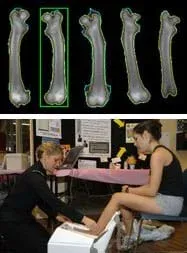 Biomedical engineers must know the density of healthy human bones in order to help people.Copyright (top) 2014 Jplee0203, Wikimedia Commons; (bottom) 2007 Henry Vorderbruggen, U.S. Navy, Wikimedia Commons http://commons.wikimedia.org/wiki/File:Bone_Density.jpg
http://commons.wikimedia.org/wiki/File:US_Navy_071010-N-7157V-001_Hospital_Corpsman_3rd_Class_Katelyn_Wisnoski,_assigned_to_Naval_Hospital_Bremerton,_performs_a_bone_density_test_at_a_Breast_Cancer_Awareness_Event_at_Bangor_Fitness_Center.jpg
Biomedical engineers must know the density of healthy human bones in order to help people.Copyright (top) 2014 Jplee0203, Wikimedia Commons; (bottom) 2007 Henry Vorderbruggen, U.S. Navy, Wikimedia Commons http://commons.wikimedia.org/wiki/File:Bone_Density.jpg
http://commons.wikimedia.org/wiki/File:US_Navy_071010-N-7157V-001_Hospital_Corpsman_3rd_Class_Katelyn_Wisnoski,_assigned_to_Naval_Hospital_Bremerton,_performs_a_bone_density_test_at_a_Breast_Cancer_Awareness_Event_at_Bangor_Fitness_Center.jpg
Students review what they know about the 20 major bones in the human body (names, shapes, functions, locations, as learned in the associated lesson) and the concept of density (mass per unit of volume). Then student pairs calculate the densities for different bones from a disarticulated human skeleton model of fabricated bones, making measurements via triple-beam balance (for mass) and water displacement (for volume). All groups share their results with the class in order to collectively determine the densities for every major bone in the body. This activity prepares students for the next activity, "Can It Support You? No Bones about It," during which they act as biomedical engineers and design artificial bones, which requires them to find materials of suitable density to perform as human body implants.
Biomedical engineering focuses on technological advances that improve human health care. Implants are human-made medical devices that replace missing biological structures or support damaged biological structures; these devices must be able to provide the same function as the body parts they replace. Implants that are made of materials foreign to the body (such as metals and plastics) must mimic the key properties of the original body tissue. In order to design implants, devices and procedures that help patients with broken bones, biomedical engineers must know the different densities of human bones. When biomedical engineers create implant models, they first research the problem and collect data, such as the material properties of biological and artificial tissues. In this activity, students make laboratory measurements and use math to calculate the densities of the bones they have researched.
After this activity, students should be able to:
- Calculate the density of various bones in the human body.
- Name the 20 major bones of the human body and identify where in the body they are located.
- Use water displacement to find the volume of irregularly shaped objects.
- Use a triple beam balance and a graduated cylinder to determine the density of objects.
- CCSS.Math.Content.7.EE.B Solve real-life and mathematical problems using numerical and algebraic expressions and equations.
Grade 7
Do you agree with this alignment? - CCSS.Math.Practice.MP2 Reason abstractly and quantitatively.
Grades K-12
Do you agree with this alignment? - CCSS.Math.Practice.MP5 Use appropriate tools strategically.
Grades K-12
Do you agree with this alignment?
- Students will develop an understanding of the characteristics and scope of technology.
Grades K-12
Do you agree with this alignment? - STEL-8L Interpret the accuracy of information collected.
Grades 6-8
Do you agree with this alignment?
- 7.EE.B Solve real-life and mathematical problems using numerical and algebraic expressions and equations.
Grade 7
Do you agree with this alignment? - MP.2 Reason abstractly and quantitatively.
Grades K-12
Do you agree with this alignment? - MP.5 Use appropriate tools strategically.
Grades -1-12
Do you agree with this alignment?
- Identify the general functions of the major systems of the human body (digestion, respiration, reproduction, circulation, excretion, protection from disease, and movement, control, and coordination) and describe ways that these systems interact with each other.
Grades 6-8
Do you agree with this alignment? - Differentiate between volume and mass. Define density.
Grades 6-8
Do you agree with this alignment?
- MS-LS1-3 Use argument supported by evidence for how the body is a system of interacting subsystems composed of groups of cells.
Grades 6-8
This resource focuses on the following Three Dimensional Learning aspects of NGSS:
Science & Engineering Practices- Use mathematical representations to describe and/or support scientific conclusions and design solutions.Do you agree with this alignment?
Disciplinary Core Ideas- In multicellular organisms, the body is a system of multiple interacting subsystems. These subsystems are groups of cells that work together to form tissues and organs that are specialized for particular body functions.Do you agree with this alignment?
Crosscutting Concepts- Systems may interact with other systems; they may have sub-systems and be a part of larger complex systems.Do you agree with this alignment?
Do you agree with this alignment? - Use mathematical representations to describe and/or support scientific conclusions and design solutions.
Each group needs:
- triple-beam balance or scale
- water
- tub for overflow water
- What Is the Density? Worksheet (PDF), one per group
- completed Triple-Entry Bones Vocabulary Worksheet (homework from the associated lesson), or the Triple-Entry Bones Vocabulary Worksheet Answer Key (PDF), one per group
- calculator
For the class to share:
- disarticulated human skeleton model of fabricated bones; see note below for two options
- graduated cylinders of various sizes to accommodate the various bone sizes; groups select one cylinder at a time, depending on the bone being measured
- rulers and meter sticks
Two options for fabricated bones, both available from Anatomy Warehouse:
- One-half disarticulated budget skeleton anatomy model with skull, SKU# A-102704 for $82.25; see http://www.anatomywarehouse.com/one-half-disarticulated-budget-skeleton-anatomy-model-with-skull-a-102704
- Axis Scientific complete disarticulated human skeleton, SKU# A-104406 for $210; see http://www.anatomywarehouse.com/axis-scientific-complete-disarticulated-human-skeleton-a-104406; this very detailed model has the bony landmarks seen on real bones, making it more realistic than the less-expensive option; it is also a full skeleton, and thus has more bones
Think of all the different bones in the human body. They all have different sizes, shapes and functions. Thus, the structure, composition and densities of the bones vary accordingly. In general, the denser an object, the stronger it is. And it may require much more force to move a denser object and control it. This is the case with our bones. Biomedical engineers must know the different densities of the bones in the human body in order to design suitable replacement implants, devices and procedures to help patients with broken or weakened bones.
Implants are medical devices created to replace missing biological structures or to support damaged biological structures. Medical implants are human-made devices designed to provide the same function as the body parts they replace. Some implants are made of transplanted biological tissue, while others are made of materials foreign to the body such as metals and plastics. Thus, it is important that the implant materials mimic the important properties of the original body tissue. As part of creating an implant model, biomedical engineers research the material properties of biological and artificial tissues, collect data and design solutions that make sense for the given situation.
In the previous lesson, you researched the 20 major bones in the body that provide structure and support to withstand the pressures acting on the human body during the course of everyday activities. Some of the bones must provide more strength than others. Your next task is to find out which bones are the densest and therefore, the strongest. To do this, you will calculate the density of each bone. What information do you need in order to calculate the density of a bone? What tools will you need in order to find the density of each bone?
Background
As if they were biomedical engineers or biomedical researchers, students conduct laboratory research to determine density information about the major human bones, using fabricated bones from a disarticulated human skeleton model. To do this, they use a triple-beam balance (to measure mass) and the water displacement method (to measure volume) to collect data, from which they calculate density (mass divided by volume). Groups record their data and calculations on worksheets, which are further compiled into a class data set covering all 20 major human bones. As necessary, review and refer to the following steps:
Steps to measure mass with a triple-beam balance
- Calibrate the balance to zero (tare).
- Put the bone on the pan.
- Move the largest rider (weight) along the slide until the arrow moves close to level.
- Move the next rider to try and balance the arrow.
- Lastly, move the last rider (ones) until the arrow is balanced.
- Read the measurement.
- Record the mass in grams.
Steps to measure volume with the water displacement method
- Fill with water a large graduated cylinder that is big enough to hold and submerse the bone to be measured.
- Measure the volume of the water added using the scale on the graduated cylinder in milliliters (ml).
- Place the bone into the water so the water level rises to entirely submerge the bone.
- Read the new level of the water.
- Subtract the first level from the new level.
- The difference is the volume of the bone.
- Record the volume in milliliters (ml).
At some point during the activity, clarify to students that the "bone density" measured by medical doctors is NOT the same as the bone density they measure in this activity. See the Investigating Questions section for details.
This activity is a prerequisite for the next activity, during which student pairs follow the steps of the engineering design process as if they were biomedical engineers designing replacement bone implant prototypes for specific bones. They are challenged to create and test prototypes made of materials of similar density to the natural bones they are intended to replace.
Before the Activity
- Gather materials and make copies of the What Is the Density? Worksheet (PDF).
- Make sure students have access to their completed (and correct!) Triple-Entry Bones Vocabulary Worksheets from the homework assignment of the associated lesson. If not, make available copies of the Triple-Entry Bones Vocabulary Worksheet Answer Key (PDF) for their reference during the activity.
- Distribute the major fabricated bones evenly, so that each group has at least one or two of the 20 major bones in the human body. If you use a full skeleton, more than one group may have certain bones; for example, two sets of bones exist for those that comprise the legs, feet, arms and hands. You may also choose to spread the numerous rib bones among multiple groups. The 20 major bones are: cranium, mandible, clavicle, scapula, vertebral column, sternum, ribs, humerus, radius, ulna, pelvic girdle, femur, patella, fibula, tibia, carpus (carpal bones), metacarpus (metacarpus bones), tarsus (tarsal bones), metatarsus (metatarsal bones) and phalanges.
- On the classroom board, draw a blank table like the one provided on the worksheet. This provides one location for groups to share the measured values and density calculations for their bones in order to compile collective class data. Note: if multiple groups have the same bone types, provide room in the table for multiple measurements/calculations for those bones.
- Note that the fabricated bones provided in both suggested human skeleton model options have varying densities, which are not the same densities as found in real human bones, but have the same relative densities. In addition, the calculated densities will vary, depending on the model used. Important note: Make sure students (or the teacher) keeps students' completed What Is the Density? Worksheets, because students need to refer to them when conducting the next activity, Can It Support You? No Bones about It!
With the Students
- Together, as a class, review each of the 20 major bones in the human body and where each is located in the body, as described in the Assessment section. Make sure students also have an understanding of what each bone looks like.
- Present the Introduction/Motivation content to the class.
- As a class, review the concept of density (as necessary). Density is mass per unit volume. That means we can calculate density by dividing an object's mass by its volume. So, to calculate the density of a bone, we measure the mass of the bone and the volume of the bone and divide the results. (Show students the triple-beam balance and the graduated cylinder. Expect students to immediately recognize that they can determine the mass of each bone using the triple-beam balance.) Determining a method for measuring the volume of each bone is more challenging. Since bones are irregular shapes and we only know equations for calculating the volume of regular shapes, such as spheres, rectangular prisms, cubes, pyramids and cylinders, we need a different approach. (Guide students to the solution of a water displacement method to measure volume.) In this method, we add a known quantity of water into a graduated cylinder, enough to cover an entire bone. Then we add the bone and measure the volume of the water plus the bone. The difference in volume between the water alone and the water plus the bone gives us the volume of the bone.
- Divide the class into student pairs. Provide each group with a worksheet and a set of bones for which they are responsible to determine the densities. Have groups identify by name each bone they are given and where all the bones are located in the body (location column on the worksheet).
- Measure and record mass. Direct groups to use the triple-beam balance to measure the mass of each bone. Remind them to zero out (tare) the balance each time. As necessary, review and refer to the steps in the Background section. Have students record the mass measurements on the worksheet in grams.
- Measure and record volume. Direct groups to use the water displacement method to measure the volume of each bone. Remind them to be sure to read the meniscus when determining the volume using the markings on the water container. As necessary, review and refer to the steps in the Background section. Have students record the volume measurements on the worksheet in milliliters.
- Calculate the densities. Direct groups to calculate the densities for each of the bones by using the equation for density: mass divided by volume. Record the calculated densities on the worksheet.
- When done, have groups fill in the shared classroom table (on the board) with the information they recorded on their worksheets.
- Conclude by leading a class discussion to compare results and conclusions, as described in the Assessment section.
- carpus
- AKA carpal bones. The cluster of eight bones making up the wrist.
- clavicle
- AKA collarbone. The bone located between the scapula and sternum; part of the shoulder.
- cranium
- The part of the skull that encloses the brain.
- density
- The amount of mass per unit of volume.
- femur
- The long bone in the human leg; located above the knee; the largest and strongest bone in the human body.
- fibula
- The outer and thinner of the two bones of the human leg, extending from the knee to the ankle.
- humerus
- The long bone in the upper arm, connecting the shoulder and elbow.
- mandible
- The lower jaw bone.
- metacarpus
- AKA metacarpal bones. The five long bones, connecting each finger to the wrist.
- metatarsus
- AKA metatarsal bones. The five long bones, connecting each of the toes to the ankle.
- patella
- AKA kneecap. The flat, movable bone at the front of the knee.
- pelvic girdle
- AKA hip girdle. The skeletal structure to which the lower limbs are attached; this structure transfers the weight of the upper body to the legs.
- phalanges
- The fingers and toes.
- radius
- The smaller, shorter long bone in the lower arm, located between the elbow and the thumb-side of the wrist.
- ribs
- A series of long, curved bones extending from the spine and enclosing the chest cavity.
- scapula
- AKA shoulder blade. The bone that connects the humerus (upper arm bone) with the clavicle (collarbone).
- sternum
- AKA breastbone. A long, flat bone located in the center of the chest, serving as a support for the collarbone and ribs.
- tarsus
- AKA tarsal bones. The cluster of seven bones making up the ankle, heel and arch of the foot.
- tibia
- The larger and stronger bone below the knee in the leg.
- ulna
- The larger, longer long bone in the lower arm, on the side of the pinky finger.
- vertebral column
- The backbone or spine.
Pre-Activity Assessment
Bones! Review: As a class, review the 20 major bones in the human body by going through the Triple-Beam Bones Vocabulary Worksheet, which students should have completed for homework in the associated lesson, or provide them with the Triple-Entry Bones Vocabulary Worksheet Answer Key (PDF). Expect students to know the bone names, be able to describe the bones by shape and function, and identify where they are located in the body.
Activity Embedded Assessment
Data Collection: During the activity, have student pairs record measurements and calculations on the What Is the Density? Worksheet (PDF). Circulate the room to view their worksheets and observe students progress. Expect students to know the equation for calculating the density of objects: density = mass / volume.
Post-Activity Assessment
Data Summary: In a concluding class discussion, have students use the data from their research and filled in What Is the Density? Worksheets (PDF) to answer the following questions. Note that the fabricated bones have varying densities, but are not the same densities as would be found in real human bones.
- Which bone had the greatest density? (Answer: The femur has the greatest density.)
- Which bone had the lowest density? (Answer: The phalanges have the lowest density.)
Apply the Data: Lead a class conversation about the real-world usefulness of this data. How might biomedical engineers who design devices and technology that doctors and surgeons use, make use of the known densities of human bones? Ask students to brainstorm ideas, no matter how "crazy," and share at least one idea with the class.
Advise students to handle with care the triple-beam balances and glass graduated cylinders.
If the triple-beam balance will not zero out, use a pin under the pan to adjust it.
- For lower grades, give students some of the calculation information.
- For upper grades, do not provide students with the worksheet that has the bone names.
- What's Inside Your Bones?
- So What Is the Density?
- Can It Support You? No Bones about It!
Contributors
Michelle Gallagher; Terri Camesano; Jeanne Hubelbank; Kristen Billiar
Supporting Program
Inquiry-Based Bioengineering Research and Design Experiences for Middle-School Teachers RET Program, Department of Biomedical Engineering, Worcester Polytechnic Institute
Acknowledgements
This activity was developed under National Science Foundation RET grant no. EEC 1132628. However, these contents do not necessarily represent the policies of the National Science Foundation, and you should not assume endorsement by the federal government.
Copyright
2014 by Regents of the University of Colorado; original © 2012 Worcester Polytechnic Institute