
What's Inside Your Bones?
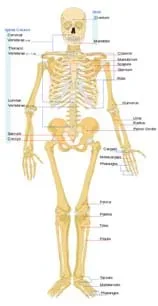 Biomedical engineers must understand the anatomy and physical properties of the human skeleton in order to design devices and implants to help patients with broken bones.Copyright 2007 LadyofHats, Mariana Ruiz Villarreal, Wikimedia Commons http://commons.wikimedia.org/wiki/File:Human_skeleton_front_en.svg
After learning, comparing and contrasting the steps of the engineering design process (EDP) and scientific method, students review the human skeletal system, including the major bones, bone types, bone functions and bone tissues, as well as other details about bone composition. Students then pair-read an article about bones and bone growth and compile their notes to summarize the article. Finally, students complete a homework assignment to review the major bones in the human body, preparing them for the associated activities in which they create and test prototype replacement bones with appropriate densities. Two PowerPoint® presentations, pre-/post-test, handout and worksheet are provided.
The field of biomedical engineering focuses on the human body, human health and health care. Biomedical engineers design devices and procedures to help provide patients with effective treatments. Some biomedical engineers develop implants, which are medical devices designed to replace missing biological structures or support damaged biological structures. When designing implant models, engineers follow the steps of the EDP in order to collect data and create the best solutions possible. As students learn about, discuss and sketch what bones are made of, they are building a foundational understanding of the human body, as do biomedical engineers, and they are preparing for the associated activities by thinking about replicating bones using alternate materials that mimic natural bone densities.
After this lesson, students should be able to:
- List and describe the steps of the engineering design process.
- Compare and contrast the steps of the scientific method and the engineering design process.
- Explain the types of bones and bone tissue in the body, as well as the composition of bones.
- Draw and label a bone from the human body.
- Brainstorming is a group problem-solving design process in which each person in the group presents his or her ideas in an open forum.
Grades 6-8
Do you agree with this alignment? - STEL-7P Illustrate the benefits and opportunities associated with different approaches to design.
Grades 6-8
Do you agree with this alignment? - STEL-7Q Apply the technology and engineering design process.
Grades 6-8
Do you agree with this alignment?
- Identify the general functions of the major systems of the human body (digestion, respiration, reproduction, circulation, excretion, protection from disease, and movement, control, and coordination) and describe ways that these systems interact with each other.
Grades 6-8
Do you agree with this alignment? - Differentiate between volume and mass. Define density.
Grades 6-8
Do you agree with this alignment? - Identify and explain the steps of the engineering design process, i.e., identify the need or problem, research the problem, develop possible solutions, select the best possible solution(s), construct a prototype, test and evaluate, communicate the solution(s), and redesign.
Grades 6-8
Do you agree with this alignment?
- MS-LS1-3 Use argument supported by evidence for how the body is a system of interacting subsystems composed of groups of cells.
Grades 6-8
This resource focuses on the following Three Dimensional Learning aspects of NGSS:
Science & Engineering Practices- Use an oral and written argument supported by evidence to support or refute an explanation or a model for a phenomenon.Do you agree with this alignment?
Disciplinary Core Ideas- In multicellular organisms, the body is a system of multiple interacting subsystems. These subsystems are groups of cells that work together to form tissues and organs that are specialized for particular body functions.Do you agree with this alignment?
Crosscutting Concepts- Systems may interact with other systems; they may have sub-systems and be a part of larger complex systems.Do you agree with this alignment?
- Scientists and engineers are guided by habits of mind such as intellectual honesty, tolerance of ambiguity, skepticism, and openness to new ideas.Do you agree with this alignment?
Do you agree with this alignment? - Use an oral and written argument supported by evidence to support or refute an explanation or a model for a phenomenon.
- Engineering Design Process Presentation (pptx)
- Engineering Design Process Presentation (pdf)
- Engineering Design Process Pre-/Post-Test (docx)
- Engineering Design Process Pre-/Post-Test (pdf)
- Engineering Design Process Pre-/Post-Test Answer Key (docx)
- Engineering Design Process Pre-/Post-Test Answer Key (pdf)
- Inside a Bone Presentation (pptx)
- Inside a Bone Presentation (pdf)
- How Bones Grow Article (docx)
- How Bones Grow Article (pdf)
- Two-Column Notes on Bones Handout (docx)
- Two-Column Notes on Bones Handout (pdf)
- Two-Column Notes on Bones Handout Answer Key (docx)
- Two-Column Notes on Bones Handout Answer Key (pdf)
- Triple-Entry Bones Vocabulary Worksheet (docx)
- Triple-Entry Bones Vocabulary Worksheet (pdf)
- Triple-Entry Bones Vocabulary Worksheet Answer Key (docx)
- Triple-Entry Bones Vocabulary Worksheet Answer Key (pdf)
Engineering Design Process and the Scientific Method
The engineering design process (EDP) is a series of steps that engineers use to come up with the best solution to a given problem. The steps of the EDP are as follows:
- Identify the need (define the problem)
- Do background research
- Specify requirements
- Brainstorm solutions
- Choose the best solution
- Do development work
- Build a prototype
- Test and redesign
- Communicate the results
Guided by this process, engineering teams can create a design, test it, make design changes and numerous prototypes, re-test and analyze data collected in the testing phases. Finally, the process emphasizes the importance of communicating the results of the process. Overall, the EDP is used by engineers to create solutions to problems and is a process that is used continually throughout the professional lives of engineers. This process differs from the scientific method, although many similarities and analogous steps exist. The process guides engineers to create what has never existed before.
The scientific method is used to ask a question and create experiments to answer that question in order to come up with explanations for various phenomena. The steps of the scientific method are as follows:
- State a question
- Do background research
- Formulate a hypothesis, identify variables
- Design an experiment, establish a procedure
- Test the hypothesis, perform experiment(s)
- Analyze the results, make conclusions
- Communicate the results
Mainly, this method guides a scientific researcher to make a formulated hypothesis to an experimental question and perform an experiment to test the hypothesis, from which s/he can make conclusions about the initial question. Often this leads to new questions and opens the door to further experimentation and discovery. This method is widely used and remains the basis to any scientific experiment. The process guides scientists to discover and explain what has never been known before.
For both methods, scientists and engineers identify either an important question or a problem and conduct background research to discover what is already known. They differ in either designing an experiment or a solution prototype, but they both conduct testing and analyze results, and end with some new understanding or solution to share.
Overall, both the EDP and scientific method provide structure for engineers and scientists to make discoveries and develop solutions. The scientific method focuses more on discovering how phenomena occur, while the EDP focuses more on developing and creating solutions for existing problems. In creating their designs, engineers often apply parts of the scientific method as well as scientific principles. Students can conduct their own EDP to learn more about bone structures in the hands-on design activity Can It Support You? No Bones about It! Both the EDP and scientific method are essential in the work of scientists and engineers.
Bones! Bones! Bones!
The human body is composed of 206 bones. Most are located in the hands (54) and feet (52). In the head alone are 29 bones: eight cranial bones, 14 facial bones, six ear bones and one throat bone. Below the head are four shoulder bones, 25 thorax bones and 24 vertebral column bones. In the arms are two upper arm bones and four forearm bones. Additionally, the body has six leg bones and four pelvis bones.
The human body has 20 main bones: cranium, mandible, clavicle, scapula, vertebrae, sternum, ribs, humerus, radius, ulna, pelvis, femur, patella, fibula, tibia, carpus (carpal bones), metacarpus (metacarpal bones), tarsus (tarsal bones), metatarsus (metatarsal bones) and phalanges. Refer to the investigative So What Is the Density? activity to have students better understand the different primary bones.
- The cranium, also known as the skull, supports the face structure and protects the head from injury.
- The mandible makes up the lower jaw and keeps the lower teeth in place.
- The clavicle, also known as the collarbone, is located between the scapula and sternum and makes up part of the shoulder.
- The scapula, also known as the shoulder blade, connects the humerus (upper arm bone) with the clavicle (collarbone).
- The vertebrae make up the vertebral column, which is the backbone or spine.
- The sternum is the long flat bone in the middle of the chest that forms (along with the ribs) the rib cage, which protects the lungs, heart and blood vessels.
- The ribs are long curved bones that help form the rib cage and enable the lung expansion.
- The humerus is the long bone in the upper arm, connecting the shoulder and the elbow.
- The radius is the smaller, shorter long bone in the lower arm, between the elbow and the thumb-side of the wrist.
- The ulna is the larger, longer long bone in the lower arm, on the side of the pinky finger.
- The pelvis rests between the abdomen and the thighs and it bears the weight of the upper body.
- The femur, the thigh bone, is the largest and strongest bone of the body.
- The patella, or kneecap, is a flat triangular bone found at the front of the knee joint. It protects and covers the joints of the knee.
- The fibula is found at the outer side of the lower leg and forms the outer part of the ankle joint.
- The tibia is the larger and stronger bone below the knee in the leg.
- The carpus (carpal bones) is a cluster of eight bones making up the wrist.
- The metacarpus (metacarpal bones) includes the five long bones, connecting each finger to the wrist.
- The tarsus (tarsal bones) is a cluster of seven bones, making up the ankle, heel and arch of the foot.
- The metatarsus (metatarsal bones) includes five long bones, connecting each of the toes to the ankle.
- The phalanges are the bones that make up the toes and fingers.
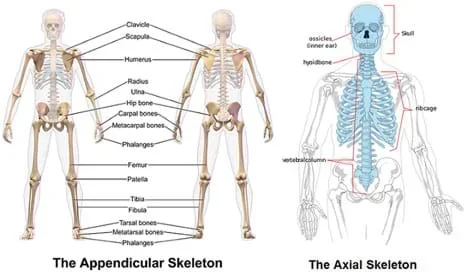 Figure 1. The human skeleton with the main bones of the appendicular skeleton (unfused bones) and axial skeleton (fused bones) labeled. Together, they form the complete skeleton.Copyright (left) Blausen.com staff. "Blausen gallery 2014." Wikiversity Journal of Medicine. DOI:10.15347/wjm/2014.010. ISSN 20018762; (right) 2006 LadyofHats, Mariana Ruiz Villarreal, Wikimedia Commons http://en.wikipedia.org/wiki/Appendicular_skeleton#mediaviewer/File:Appendicular_Skeleton.png http://en.wikipedia.org/wiki/Axial_skeleton#mediaviewer/File:Axial_skeleton_diagram.svg
The many bones in the human body have a variety of functions. Bones provide support, protection and storage as well as aid in movement and blood cell formation. A strong skeleton is necessary to support the human body. Just as a house is built with a supportive frame, the human body relies on bones to keep its shape. Bones also serve as protection for the organs and soft tissue by forming a strong layer around them. Examples of this include the rib cage, which protects the heart and lungs, and skull, which protects the brain. Moreover, bones store various minerals, such as calcium and phosphate. Additionally, they provide energy storage in yellow bone marrow. Bones serve as attachment sites for muscles, and finally, blood cells, which are critical to the body, are produced in red bone marrow. Thus, human bones serve many different purposes and are essential in maintaining the functionality and health of the human body.
Five bone types are found in the human body: Long bones, short bones, flat bones, irregular bones and sesamoid bones. Bones are composed of two types of bone tissue: compact (cortical) bone and trabecular (spongy/cancellous). Compact bone tissue makes up the hard outer layer of bones and is smooth and solid, whereas trabecular bone tissue makes up the interior of bone and is light and porous, similar to a honeycomb. Trabecular bone tissue is less dense, with a higher surface area-to-mass ratio. It is also weaker, softer and more flexible than compact bones. Trabecular bone tissue is typically located at the ends of long bones, within vertebrae interior and proximal to joints. Compact (cortical) bone tissue is stronger, harder, stiffer and much denser; 80% of the human skeleton weight is made of compact bones.
Inside a Bone Presentation Outline
Deliver the nine-slide Inside a Bone Presentation (PPTX), a PowerPoint® file, using the suggested outline below. Topics include: Bone material (mineral salts, water tissue), bone types (long, short, flat, sesamoid and irregular), bone structure/tissue (mineral matrix, collagen fibers, connective tissue), bone composition (compact/hard and trabecular/spongy; bone marrow, blood vessels), properties (lightweight, strong).
(Slide 2) Ask students: What are your bones made of?" Point out that many different elements are found in the long bone (pictured on the slide). Inform them that by the end of the presentation they will know the answer to that question.
(Slide 3) To start off, tell students that three main elements are found inside bones: Mineral salts, water and tissue. The inorganic mineral salts (calcium phosphate and calcium carbonate) provide bone's hardness. Water makes up about 25% of adult bone mass.
(Slide 4) If we classify bones by their shapes, we have five bone types: long bones, short bones, flat bones, sesamoid bones and irregular bones. Have students identify examples in the diagram. A sixth type, sutural bones, are special bone joints in which the space between infant cranium bones slowly closes up and disappears as the child matures.
(Slide 5) Bone tissue, also known as osseous tissue, is the mineral matrix that forms the rigid part of bone. It contains abundant collagen fibers that provide strength as well as some flex. This is the major structural and supportive connective tissue of the body. The two types of bone tissue are compact (cortical) and trabecular (spongy/cancellous).
(Slide 6) Provide more detail about the two types of bone tissue. Compact (cortical) bone tissue makes up the hard outer layer of bones. It is smooth, solid and generally shaped like a cylinder. It is so hard that surgeons must use a saw to cut through it! Trabecular (spongy/cancellous) bone tissue makes up the bone interior. It is light, porous, spongy and mesh-like, having a structure similar to honeycomb. (Point out the compact bone tissue and the trabecular bone tissue in the images.) Which type of bone tissue do you think is denser? (Answer: Compact bone tissue is denser, and trabecular bone tissue is less dense.)
(Slide 7) Let's take a closer look inside the bone. Bone marrow makes up the inside of bones. This jelly like substance resides at the center of the bone and produces blood cells for the body. Blood vessels also run through the center of the bone, delivering food, oxygen and minerals.
(Slide 8) The two types of bone marrow are red and yellow. All new red and white blood cells, as well as platelets, are made in the red bone marrow. This type of bone marrow is found in flat bones such as in the ribs and shoulders. Yellow bone marrow does not produce blood cells and is made mostly of fat. It is typically found in the hollow centers of long bones.
(Slide 9) Here are some fun facts about bones. Living bones are porous. Bones are one of the strongest materials. Bones are extremely light—lighter than steel or concrete—however they are much stronger!
After presenting the second presentation, have students complete the post-introduction assessment and the lesson summary assessment, as described in the Assessment section. At lesson end, assign students the homework assignment, also described in the Assessment section. Completion of the lesson summary assessment and the homework assignment is important so students learn all the material necessary to complete the two associated activities.
What is the scientific method? Can you name the steps? Have you heard of the engineering design process? Can you name the steps of the engineering design process, or EDP? If so, how is the scientific method like the EDP? Let's begin by learning about the EDP, how it is used and the different steps!
(Show students the 10-slide Engineering Design Process Presentation (PPTX), a PowerPoint® file. Background information for this presentation is provided in the Lesson Background & Concepts for Teachers section. The presentation is animated, so clicking brings up the next image, text or slide. Have students take notes on the presentation. Answer student questions throughout the presentation.)
- Scientific method steps: ask a question, do background research, construct a hypothesis, test the hypothesis by doing an experiment, analyze the data, draw a conclusions, communicate the results
- Engineering design process steps: identify the need (define the problem), do background research, specify requirements, brainstorm solutions, choose the best solution, do development work, build a prototype, test and redesign, communicate the results
Now that we know about the engineering design process, let's turn our attention to bones! Yes, bones! What do you think bones and engineering have in common? Here's a better questions: What type of engineer might work with bones? Or other parts of the human body? (Pause to see if students have suggestions.) Biomedical engineers! These are engineers who design devices and procedures that doctors and surgeons use to help their patients. In order for us to understand what biomedical engineers might do with bones, we first need to learn all about bones. So let's get started!
On a piece of paper, list your ideas of what you think bones are composed of. (Expected student responses: Blood, calcium, food and nutrients. Give students three minutes. Then ask each student to share their answer[s] and compile a list on the board. Go over the list as a class. Once finished, present the nine-slide Inside a Bone Presentation (PPTX); see the suggested slide-by-slide outline in the Lesson Background section. Have students take notes and use an overhead projector to sketch and label a bone in their journals.)
As you can see, it is important to have a bone structure that is both strong and spatially accurate because without this, the human body would not be able to withstand the physical pressures encountered in everyday life. Through the associated activities, your team will follow the steps of the engineering design process to begin with a problem and work as a group to come up with ideas, research them, find some solutions, create prototypes for those solutions, test them, modify them and then create your final creation, which you will present to the class. This is how engineers go about solving problems every day.
To solve their own work challenges, scientists and engineers follow two different series of steps: the scientific method and the engineering design process. Even though these processes are different (name, steps, number of steps), they have some similarities.
Engineers who apply their knowledge of science to the human body are called biomedical engineers. We will focus on this type of engineer in the upcoming activities. While working with bones, we will learn about their importance and what considerations we and bioengineers must take into consideration in designing ways to repair them.
- biomedical engineer
- People who design devices and procedures to help physicians provide patients with effective medical treatments.
- biomedical engineering
- A field of engineering focused on the human body, human health and health care.
- density
- The amount of mass per unit volume.
- engineering design process
- A series of steps that guide engineers in designing a solution to an identified problem. The steps include: identifying a problem, brainstorming, designing, building a solution/prototype, testing, analyzing results, and then redesigning and retesting to refine the solution, and finally, sharing the results.
- fiber
- Any thread-shaped structure, such as a nerve.
- marrow
- A soft, fatty, vascular tissue in the interior cavities of bones that are major sites of blood cell production.
- mass
- The amount of matter in an object
- scientific method
- A method of research in which a question is identified, relevant data are gathered, a hypothesis is formulated from these data, and the hypothesis is empirically tested in order to answer the original question.
- volume
- The amount of three-dimensional space an object takes up.
Pre-Lesson Assessment
Pre-Test: Administer the three-question Engineering Design Process Pre-Test (PDF) to assess prior knowledge and pique students' interest about one aspect of the lesson—the engineering design process. Administer the same test at lesson end to assess students' change in understanding about the topic.
Motivating Thinking through Questioning: Ask students questions, such as the following, to get them thinking and motivated about the lesson topics. For each question, have students share responses and compile one list on the board for class discussion. Use the questions to also gauge their base knowledge of the topics. Students will learn the answers during the course of the lesson.
- What is the scientific method? Name the steps. (See if students know the general purpose and any specific steps of the scientific method. If they do not already know the steps, students will learn them later in the lesson.) General answer: The scientific method is a logical and rational order of steps by which scientists and other researchers hypothesize and test in order to arrive at conclusions about the world around them.
- Make a list; what do you think your bones are made of? (See what students know before the lesson begins. Answer for the teacher to know: Bones are made of cells and living parts of your body. They are also made of strong string material called collagen. Bones are a storage place for minerals, and they have a jelly like red and yellow marrow. Yellow bone marrow stores fat and sugar. The outer layer is called compact [cortical] bone tissue and the interior spongy [trabecular/cancellous] bone tissue is a honeycomb of bone cells with spaces between them.)
- What are the 20 main bones in the human body? (See how many bones students can name at this point. Answer for the teacher to know: Cranium, mandible, clavicle, scapula, vertebrae, sternum, ribs, humerus, radius, ulna, pelvis, femur, patella, fibula, tibia, carpus [carpal bones], metacarpus [metacarpal bones], tarsus [tarsal bones], metatarsus [metatarsal bones] and phalanges.)
Post-Introduction Assessment
Post-Test: After delivery of the Engineering Design Process Presentation (PPTX), administer the three-question Engineering Design Process Post-Test (PDF) (same as the pre-test) to assess students' understanding of this process.
Review and Recap: After presenting the Introduction/Motivation content, ask students the following questions to assess their understanding of the material:
- How is the scientific method like the EDP? Name as many steps of the EDP as you can. (Answer: Scientific method steps: ask a question, do background research, construct a hypothesis, test the hypothesis by doing an experiment, analyze the data and draw a conclusion, communicate the results. EDP steps: define the problem, do background research, specify requirements, brainstorm solutions, choose the best solution, do development work, build a prototype, test and redesign, share the solution. These processes are similar in a number of ways. In both cases, the scientists and engineers start by identifying an important question or a problem. Also, in both processes, background research is conducted to discover what is already known. Then the processes differ in either designing an experiment or a solution prototype, but then in both processes, scientists and engineers test and analyze results and end with some new understanding or solution to share with other people.)
- What are the two types of bone tissue? (Answer: Compact [cortical] bone tissue and trabecular [spongy/cancellous] bone tissue.)
- What is the purpose of bone marrow, as described in the Inside of a Bone Presentation? (Answer: Bone marrow produces red blood cells.)
Lesson Summary Assessment
Paired Reading: Have students work in pairs to read the How Bones Grow Article (PDF), summarize it in note form, and interpret the main article points. Have one student in the pair read the first paragraph aloud while the other student listens and marks up the text. When the first student is done reading, the other student explains the main parts on the paragraph in a brief summary. If they both agree, they write this summary in note form on the Two-Column Notes on Bones Handout (PDF). If they feel they need to add more information, they discuss and agree on what to add. Remind students that notes should not be written in complete sentences. The article includes guidance for pronunciation of the bone names.
Once these steps are done, have students switch roles; the reader becomes the listener and the listener becomes the reader. Paragraph by paragraph, have them continue this process until they finish the article and complete the handout.
Homework
Triple-Entry Vocabulary: To familiarize students with the most important words of this lesson, assign them to complete the Triple-Entry Bones Vocabulary Worksheet (PDF), which asks them to define the vocabulary in their own words using knowledge gained from the lesson.
- The first column (optional) asks students to indicate where they may have first heard the word before.
- The second column asks students to define the term in their own words. If students need assistance in defining a word, suggest they refer to the How Bones Grow Article (PDF).
- The third column asks students to draw a memory aid or simple sketch. Sketches need not be colored in or done with great artistry.
The next day (or when the homework is due), pair up students to compare definitions and drawings. Together, have them answer these questions:
- What is the largest bone in the human body? (Answer: The femur.)
- From memory, what are the 20 main bones in the human body? (Answer: Cranium, mandible, clavicle, scapula, vertebrae, sternum, ribs, humerus, radius, ulna, pelvis, femur, patella, fibula, tibia, carpus [carpal bones], metacarpus [metacarpal bones], tarsus [tarsal bones], metatarsus [metatarsal bones] and phalanges.)
The How Bones Grow Article (PDF) is also available online at the KidsHealth from Nemours website: http://m.kidshealth.org/kid/htbw/bones.html.
"Bone Anatomy." Ask A Biologist. N.p., n.d. Web. 04 Nov. 2014. https://askabiologist.asu.edu/bone-anatomy
"Cancellous Bone." Wikipedia, The Free Encyclopedia. 11 Jan. 2014. Web. 04 Nov. 2014. http://en.wikipedia.org/wiki/Cancellous_bone
"Comparing the Engineering Design Process and the Scientific Method." Science Buddies. N.p., n.d. Web. 04 Nov. 2014. (A good description that includes comparative flow charts of the steps.) http://www.sciencebuddies.org/engineering-design-process/engineering-design-compare-scientific-method.shtml
"Cortical Bone." Wikipedia, The Free Encyclopedia. 11 Jan. 2014. Web. 04 Nov. 2014. http://en.wikipedia.org/wiki/Cortical_bone
"List of Bones in the Human Body." Biology for Kids: List of Human Bones. Ducksters. N.p., n.d. Web. 04 Nov. 2014. http://www.ducksters.com/science/list_of_human_bones.php
"The Major Bones of the Human Skeleton." Obsessed with Sculls. N.p., n.d. Web. 04 Nov. 2014. http://obsessedwithskulls.com/downloads/the%20major%20bones.pdf
"Types of Bones in the Human Body." Teach PE. N.p., n.d. Web. 04 Nov. 2014. http://www.teachpe.com/anatomy/types_of_bones.php
- What's Inside Your Bones?
Contributors
Michelle Gallagher; Terri Camesano; Jeanne Hubelbank; Kristen Billiar; Dua Chaker; Carleigh Samson
Supporting Program
Inquiry-Based Bioengineering Research and Design Experiences for Middle-School Teachers RET Program, Department of Biomedical Engineering, Worcester Polytechnic Institute
Acknowledgements
This activity was developed under National Science Foundation RET grant no. EEC 1132628. However, these contents do not necessarily represent the policies of the National Science Foundation, and you should not assume endorsement by the federal government.
Copyright
2014 by Regents of the University of Colorado; original © 2012 Worcester Polytechnic Institute