
Can It Support You? No Bones about It!
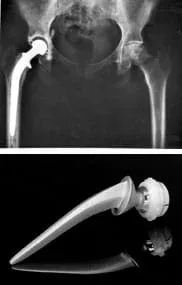 Biomedical engineers design implants for the body to help people to stay healthy and active for as long as possible!Copyright (top) 2006 National Institutes of Health, U.S. Department of Health & Human Services, Wikimedia Commons; (bottom) 2013 Science and Society Picture Library, Science Museum London, Wikimedia Commons http://en.wikipedia.org/wiki/Hip_replacement#mediaviewer/File:Hip_replacement_Image_3684-PH.jpg http://commons.wikimedia.org/wiki/Category:Hip_replacement#mediaviewer/File:Stainless_steel_and_ultra_high_molecular_weight_polythene_hip_replacement_(9672239334).jpg
After completing the associated lesson and its first associated activity, students are familiar with the 20 major bones in the human body—knowing their locations and relative densities. When those bones break, lose their densities or are destroyed, we look to biomedical engineers to provide replacements. In this activity, student pairs are challenged to choose materials and create prototypes that could replace specific bones. They follow the steps of the engineering design process, researching, brainstorming, prototyping and testing to find bone replacement solutions. Specifically, they focus on identifying substances that when combined into a creative design might provide the same density (and thus strength and support) as their natural counterparts. After iterations to improve their designs, they present their bone alternative solutions to the rest of the class. They refer to the measured and calculated densities for fabricated human bones calculated in the previous activity, and conduct Internet research to learn the densities of given fabrication materials (or measure/calculate those densities if not found online).
Biomedical engineers strive to come up with bone implant alternatives to assist people who injure themselves beyond repair of their natural bones, such as hip and knee replacements. Understanding the properties and behavior of materials is vital to the design of human implant materials. Choosing, or inventing, suitable materials to place in the human body is a challenging task faced by biomedical engineers. Biomedical engineers have successfully used a wide range of metal alloys, ceramics, polymers and composites as implantable materials.
After this activity, students should be able to:
- Use a computer to research materials (other than bones) and their densities.
- Determine the mass and volume needed to have the same density as the bone it may replace.
- Follow the steps of the engineering design process to find alternate materials and a design to replace a specific bone.
- Present findings to an audience through an oral and visual five-minute presentation.
- Students will develop an understanding of the attributes of design.
Grades K-12
Do you agree with this alignment? - Students will develop an understanding of engineering design.
Grades K-12
Do you agree with this alignment? - Students will develop an understanding of the role of troubleshooting, research and development, invention and innovation, and experimentation in problem solving.
Grades K-12
Do you agree with this alignment? - Students will develop an understanding of the characteristics and scope of technology.
Grades K-12
Do you agree with this alignment? - Design involves a set of steps, which can be performed in different sequences and repeated as needed.
Grades 6-8
Do you agree with this alignment? - Brainstorming is a group problem-solving design process in which each person in the group presents his or her ideas in an open forum.
Grades 6-8
Do you agree with this alignment? - Modeling, testing, evaluating, and modifying are used to transform ideas into practical solutions.
Grades 6-8
Do you agree with this alignment? - STEL-1J Develop innovative products and systems that solve problems and extend capabilities based on individual or collective needs and wants.
Grades 6-8
Do you agree with this alignment? - STEL-4Q Critue whether existing and proposed technologies use resources sustainably.
Grades 9-12
Do you agree with this alignment? - STEL-5J Design an appropriate technology for use in a different culture.
Grades 9-12
Do you agree with this alignment?
- Identify the general functions of the major systems of the human body (digestion, respiration, reproduction, circulation, excretion, protection from disease, and movement, control, and coordination) and describe ways that these systems interact with each other.
Grades 6-8
Do you agree with this alignment? - Differentiate between volume and mass. Define density.
Grades 6-8
Do you agree with this alignment? - Identify and explain the steps of the engineering design process, i.e., identify the need or problem, research the problem, develop possible solutions, select the best possible solution(s), construct a prototype, test and evaluate, communicate the solution(s), and redesign.
Grades 6-8
Do you agree with this alignment? - Identify appropriate materials, tools, and machines needed to construct a prototype of a given engineering design.
Grades 6-8
Do you agree with this alignment?
- MS-ETS1-1 Define the criteria and constraints of a design problem with sufficient precision to ensure a successful solution, taking into account relevant scientific principles and potential impacts on people and the natural environment that may limit possible solutions.
Grades 6-8
This resource focuses on the following Three Dimensional Learning aspects of NGSS:
Science & Engineering Practices- Define a design problem that can be solved through the development of an object, tool, process or system and includes multiple criteria and constraints, including scientific knowledge that may limit possible solutions.Do you agree with this alignment?
Disciplinary Core Ideas- The more precisely a design task's criteria and constraints can be defined, the more likely it is that the designed solution will be successful. Specification of constraints includes consideration of scientific principles and other relevant knowledge that is likely to limit possible solutions.Do you agree with this alignment?
Crosscutting Concepts- The uses of technologies and any limitations on their use are driven by individual or societal needs, desires, and values; by the findings of scientific research; and by differences in such factors as climate, natural resources, and economic conditions.Do you agree with this alignment?
- All human activity draws on natural resources and has both short and long-term consequences, positive as well as negative, for the health of people and the natural environment.Do you agree with this alignment?
Do you agree with this alignment? - Define a design problem that can be solved through the development of an object, tool, process or system and includes multiple criteria and constraints, including scientific knowledge that may limit possible solutions.
- MS-ETS1-2 Evaluate competing design solutions using a systematic process to determine how well they meet the criteria and constraints of the problem.
Grades 6-8
This resource focuses on the following Three Dimensional Learning aspects of NGSS:
Science & Engineering Practices- Evaluate competing design solutions based on jointly developed and agreed-upon design criteria.Do you agree with this alignment?
Disciplinary Core Ideas- There are systematic processes for evaluating solutions with respect to how well they meet the criteria and constraints of a problem.Do you agree with this alignment?
Do you agree with this alignment? - Evaluate competing design solutions based on jointly developed and agreed-upon design criteria.
- MS-ETS1-4 Develop a model to generate data for iterative testing and modification of a proposed object, tool, or process such that an optimal design can be achieved.
Grades 6-8
This resource focuses on the following Three Dimensional Learning aspects of NGSS:
Science & Engineering Practices- Develop a model to generate data to test ideas about designed systems, including those representing inputs and outputs.Do you agree with this alignment?
Disciplinary Core Ideas- Models of all kinds are important for testing solutions.Do you agree with this alignment?
- The iterative process of testing the most promising solutions and modifying what is proposed on the basis of the test results leads to greater refinement and ultimately to an optimal solution.Do you agree with this alignment?
Do you agree with this alignment? - Develop a model to generate data to test ideas about designed systems, including those representing inputs and outputs.
- MS-LS1-3 Use argument supported by evidence for how the body is a system of interacting subsystems composed of groups of cells.
Grades 6-8
This resource focuses on the following Three Dimensional Learning aspects of NGSS:
Science & Engineering Practices- Use an oral and written argument supported by evidence to support or refute an explanation or a model for a phenomenon.Do you agree with this alignment?
Disciplinary Core Ideas- In multicellular organisms, the body is a system of multiple interacting subsystems. These subsystems are groups of cells that work together to form tissues and organs that are specialized for particular body functions.Do you agree with this alignment?
Crosscutting Concepts- Systems may interact with other systems; they may have sub-systems and be a part of larger complex systems.Do you agree with this alignment?
- Scientists and engineers are guided by habits of mind such as intellectual honesty, tolerance of ambiguity, skepticism, and openness to new ideas.Do you agree with this alignment?
Do you agree with this alignment? - Use an oral and written argument supported by evidence to support or refute an explanation or a model for a phenomenon.
Each group needs:
- access to an assortment of possible materials that might serve as bone replacement, such as modeling clay, plaster, wood (several types, pieces of different sizes), aluminum bars or foil, metal rods (several types, such as aluminum, steel, copper, etc.), Styrofoam sheets, plastic laminate, fabric scraps, string, yarn, etc., and other materials and amounts students may request or bring from home
- access to a variety of fabrication tools and fasteners, such as scissors, tin snips, jig saw, screwdriver, hammer, screws, nails, hot glue guns, sand paper, etc.
- graph paper, for design sketching
- Engineering Design Process Packet (PDF)
- completed What Is the Density? Worksheet from the So What Is the Density? activity
- computer with internet access
To share with the entire class:
- triple-beam balance or scale
- large graduated cylinders of various sizes
- water
- tub for overflow water
- rulers and meter sticks
- calculator
Before conducting this activity, students should have completed the associated lesson, Bones! Bones! Bones!, and its first activity, So What Is the Density?.
Students should have knowledge of:
- The human skeletal system and density, including its definition and how to calculate it.
- The relative density of the major bones in the human skeletal system, and densities for materials used for strength and support.
- The steps of the engineering design process.
Listen to this scenario for your engineering design challenge:
Imagine that you are a biomedical engineer and your friend has broken a bone so badly that you must "replace" the bone. You must find an alternative material to replace the natural bone. Keep in mind that this alternative material must be able to withstand the mass of the body. So, in addition to the material, you must consider its density, weight and size. Follow the steps of the engineering design process to help you find a solution to this challenge. Good luck!
Overview
After completing the associated lesson, Bones! Bones! Bones!, and its first associated activity So What Is the Density?, students are able to make density calculations and are familiar with the relative densities of the major bones of the human body. This prepares them to act as if they are biomedical engineers to find a solution to this activity's engineering design challenge.
In the activity, student pairs are challenged to create prototype bone implants suitable "to replace the damaged bone in a friend's body," especially as it pertains to matching the density of the natural bone so that it is able to withstand the same stress conditions and provide the same support. Students work from an assortment of materials provided by the teacher (or expand the activity to permit students to look for substances within the classroom, recycling center or from home). They refer to the fabricated bone densities they determined in the previous activity. Then they research available material densities (or measure/calculate them, if necessary) and brainstorm to identify the best materials (or combination of given materials) and designs for their assigned bone types. They apply their understanding of specific bone requirements and bone density to hypothesize about what material(s) has a density closest to the density of the specific bone in need of replacement. If the first prototype does not meet the needs of the real bone in their durability tests, students brainstorm again, revising and improving their prototype implants. To conclude, groups summarize their work and present their final prototype designs to the rest of the class.
Before the Activity
- Gather materials and make copies of the four-page Engineering Design Process Packet (PDF), one per group.
- Have handy students' completed What Is the Density? Worksheets from the previous activity. Students need to refer to this listing of the 20 major bones in the human body to obtain the mass, volume and densities of their assigned bones for the design challenge. The densities are based on the fabricated bones students measured in the previous activity, which are not the same as real human bones, but have the same relative densities.
- During the activity, expect students to be able to find on the Internet the densities of the possible implant substances and materials of interest. In case students are unable to find the density of a certain material, have measuring and water displacement tools available for students to perform their own measurements and calculations.
- To show and remind students of the steps of the engineering design process, make copies or display the Engineering Design Process Visual Aids (PDF), or make or obtain a poster of the steps.
- Reserve a computer lab for students to conduct Internet research.
With the Students
- Divide the class into student pairs—the same pairs who worked together in the previous activity.
- Ask students the pre-assessment questions provided in the Assessment section to gauge their baseline understanding of density and human bones.
- Present the engineering design challenge, as described in the Introduction/Motivation section.
- If necessary, review with students the steps of the engineering design process.
- Hand out the engineering design process packet and students' completed What Is the Density? Worksheet from the previous activity.
- From the list of 20 major bones in the human body (on the What Is the Density? Worksheet), assign a different bone to each group (or permit pairs to choose).
- Show students the available materials and tools. Direct them to use the worksheet to guide them through the process to find a solution to the design challenge.
- Define the Problem : Knowing the bones they are aiming to replace, have students fill in page 1 of the handout by defining the problem in detail, describing its required functionality, desired attributes, and all constraints. By constraints, engineers mean all the requirements, restrictions and limitations that apply to the project, including limits on materials, budget and time.
- Research the Problem: Have students determine the mass and the volume needed to replace their specific bones by referring to the mass, volume and density recorded for those bones on the completed What Is the Density? Worksheet.
- Direct students to conduct background research on the Internet to determine the densities of the available materials. Have them answer the page 2 questions and fill in the table. If students are unable to find the density of a material online, have them measure the material's mass and volume, and then calculate its density.
- At this point, double check that students are clear on the concept of density. Ask them: If I have a small piece of Styrofoam and a huge piece of Styrofoam, which has the highest density? (Answer: The density is the same for both pieces.) Expect students to come to the realization that density is a property of matter that remains constant in a given material at any size or amount of that material. Make sure they fully comprehend this concept.
- Generate Ideas: Now that teams have considered the specific needs for their bones and know the available materials' densities, have them brainstorm in their teams what materials and combination of materials make sense to create their specific replacement bones. Since bones are different from each other, it is likely that different materials will be used for different bones. In addition, bone density often varies within a given bone. How might the materials be put together to make your replacement bone? Require that at least three materials be used for each bone.
- Tip: Suggest that students reflect upon what they learned in the associated lesson about compact bone tissue and trabecular bone tissue in terms of their relative densities and where they are located in a given bone. Present this as an example for how groups should construct their artificial bone implant prototypes to reflect the real bones. As necessary, conduct additional research to fully understand the density composition, size and shape of the assigned bone.
- Design a Prototype: Have students complete the Design Solutions section of the handout on the bottom of page 2, which includes sketching on graph paper and describing the agreed-upon prototype plan and materials. Remind students that to be able to take the place of a specific major bone, a successful bone-alternative prototype must have a similar density to the bone it is intended to replace.
- Create and Test the Prototype: Next, have groups choose materials and proceed to build and test their prototype implants. Follow the Test Design instructions on page 3 of the handout to evaluate the prototype designs using a survey system. Part of this process involves designing an evaluation test with pertinent questions and rating scales. This also requires students to help other teams by giving them feedback on their designs.
- Evaluate the Results: Once testing is done, have groups examine the results and draw conclusions about the success or failure of their designs, documenting their analyses on page 3.
- Improve the Prototype: If the prototype does not meet the specific bone requirements and specifications, teams must go "back to the drawing board!" That means returning to an earlier stage of the design process and beginning again. Perhaps the original objectives need to be revisited, or more research is necessary, or more brainstorming to come up with better way to use the materials to meet the objectives. Permit students to continually revise and modify their designs until the final day.
- Finalize the Prototype: On the final day, give groups a few minutes to finish up their designs, sketch their final designs on page 4 of the handout, and prepare five-minute presentations describing their bone implant prototypes. The handout provides suggested topics to cover in the presentations.
- Communicate the Design Solution: Have each student group present its bone implant prototype to the rest of the class, explaining which materials they used, how they used their materials, and their reasoning for their designs.
- Conclude with a class discussion, using questions provided in the Assessment section.
- brainstorming
- A group problem-solving process in which each person contributes his or her ideas in an open forum, building on the ideas of others, with the purpose to generate a large number of potential creative solutions.
- constraint
- For engineers, constraints are the limitations and requirements that must be considered when designing a workable solution to a problem.
- cranium
- The part of the skull that encloses the brain.
- density
- The amount of mass per unit of volume.
- engineering design process
- A series of steps used by engineering teams to guide them as they develop new solutions, products or systems. Typically, the steps include: defining a problem (including identifying criteria and constraints), researching, generating ideas, selecting an approach, creating and testing a prototype, evaluating and refining the design, and communicating the solution.
- femur
- The long bone in the human leg; located above the knee; the largest and strongest bone in the human body.
- fibula
- The outer and thinner of the two bones of the human leg, extending from the knee to the ankle.
- iteration
- Doing something again, like starting over with the design process.
- mandible
- The lower jaw bone.
- patella
- AKA kneecap. The flat, movable bone at the front of the knee.
- pelvis
- The bowl-shaped group of bones connecting the trunk of the body to the legs and supporting the spine. The pelvis includes the hip bones and the lower part of the backbone.
- phalanges
- The fingers and toes.
- prototype
- A first attempt or early model of a new product or creation. May be revised many times.
- ribs
- A series of long, curved bones extending from the spine and enclosing the chest cavity.
- sternum
- AKA breastbone. A long, flat bone located in the center of the chest, serving as a support for the collarbone and ribs.
- vertebrae
- The bones or segments that compose the spinal column (or backbone), through which the spinal cord passes. Vertebrae is plural; vertebra is singular.
Pre-Activity Assessment
Questions: Assess students' baseline understanding of the activity subject matter by asking them the following questions:
- Define density. What is the equation to derive density? What measured values must we know about an object in order to calculate its density? (Answer: Density is mass per unit of volume.)
- How is mass different than volume? (Answer: Mass is the amount of matter an object takes up and volume is the amount of space the object takes up.)
- Why is density important to bone structure? (Answer: Bone density provides strength so a bone is able to withstand the specific pressures and forces it is subjected to in its role to support the body.)
- What are the 20 major bones in the human body? (Answer: Cranium, mandible, clavicle, scapula, vertebrae, sternum, ribs, humerus, radius, ulna, pelvis, femur, patella, fibula, tibia, carpus [carpal bones], metacarpus [metacarpal bones], tarsus [tarsal bones], metatarsus [metatarsal bones] and phalanges.)
Activity Embedded Assessment
Design Loop: Have student pairs use the Engineering Design Process Packet (PDF) to guide them through the steps of the engineering design process to develop a prototype solution to the challenge. To gauge their progress and comprehension, observe their answers, data and sketches throughout the course of the activity, as well as their completed packet answers at activity end.
Post-Activity Assessment
Presentation: Have each group prepare and present a five-minute summary presentation describing its bone implant prototype, sharing its concept, findings and conclusions with the rest of the class. Have groups explain which materials they used, how they used their materials, and their reasoning for their designs. Require both oral and visual components.
Closing Discussion: Ask students the same questions as the pre-activity assessment to gauge their post-activity understanding of density and human bones. In addition, ask them the following questions as an activity recap and an opportunity for student reflection and real-world connections. Alternatively, assign students to answer these questions as a short-answer writing assignment.
- What were your experiences working with the available materials? Which material was easiest to work with? Why? (Student answers will vary. Example answer: Clay was the easiest to mold and to add mass, and we could embed other materials inside the clay.)
- While you were working with the different materials, did you learn anything specific about density of a material? (Answers will vary.)
- What did you learn about density from doing this activity? (Example answer: The density of an object stays the same no matter what the size of the object.)
- If you were to do this activity again, would you go about it in a different way? What would you change? What other materials might you want to explore or invent? (Answers will vary.)
- What did you learn about the engineering design process? Which step of the process did you find the most important/interesting/frustrating/eye-opening? (Answers will vary.)
- What do you think about the challenge biomedical engineers face when designing implants for the human body? (Answers will vary.)
Require students to use safety glasses and protective clothing when using tools such as saws, screwdrivers, hammers and hot glue guns. Also have an adult present to oversee tool use.
Assign students to investigate some of the materials being used for human implants. What materials are used for hip and knee replacement parts? What materials are being invented (such as bioceramic materials)?
Assign students to research and report on bone transplant surgeries that have been done on humans.
Assign students to research and report on bone density and osteoporosis.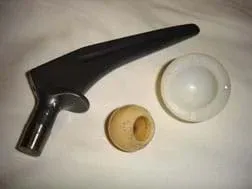 Biomedical human implant products: a titanium hip prosthesis with a ceramic head and polyethylene cup.Copyright 2006 Nuno Nogueira, Wikimedia Commons http://commons.wikimedia.org/wiki/File:Hip_prosthesis.jpg
- What's Inside Your Bones?
- So What Is the Density?
- Can It Support You? No Bones about It!
Contributors
Michelle Gallagher; Terri Camesano; Jeanne Hubelbank; Kristen Billiar
Supporting Program
Inquiry-Based Bioengineering Research and Design Experiences for Middle-School Teachers RET Program, Department of Biomedical Engineering, Worcester Polytechnic Institute
Acknowledgements
This activity was developed under National Science Foundation RET grant no. EEC 1132628. However, these contents do not necessarily represent the policies of the National Science Foundation, and you should not assume endorsement by the federal government.
Copyright
2014 by Regents of the University of Colorado; original © 2012 Worcester Polytechnic Institute