
Air Quality InQuiry (AQ-IQ)
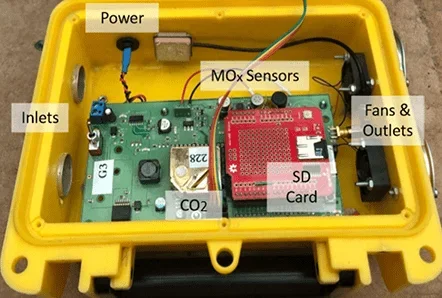 An AQIQ PodCopyright 2020 Hannigan Lab
The unit is comprised of one lesson and five activities. The lesson and the first three activities provide students with background information and skills necessary to conduct their own research projects. The fourth activity walks students through study design and provides a jumping off point for their projects. At the conclusion of the third activity, students should have a research question, a project plan, and a team. Student projects take place in the interim between the fourth and fifth activities. Following the completion of data collection and analysis, the fifth activity guides students through interpreting their data and presenting their results in the form of scientific research posters. Suggested order:
Lesson 1: An Introduction to Air Quality Research (~45 minutes)
Activity 1: Linking Sources and Pollutants (~45 minutes)
Activity 2: Combustion and Air Quality: Emissions Monitoring (~90 minutes)
Activity 3: Study Design for Air Quality Research (~90 minutes)
Activity 4: Understanding the Air through Data Analysis (~90 minutes)
Conduct research: Between activities 3 and 5, the long-term student-directed research projects that student groups planned in activity 3 are conducted (may take days, weeks, months; may or may not require air monitoring equipment) to gather and analyze data, before conducting activity 5.
Activity 5: Communicating Your Project Results with Professional Posters (~90 minutes)
This curriculum is intended to prepare and guide students to take on their own long-term research projects, which is similar to what engineers and scientists do in the real world. For example, it is common for environmental engineers to be tasked with conducting investigations into local environmental issues, for mechanical engineers to design and conduct studies to respond to problems when something doesn’t work, and for all engineers to quickly learn new applications in order to analyze data sets.
Through this unit, students design research studies using available technologies, collect and analyze their own data, and communicate what they learned and what it means. They also are challenged to think of how their projects fit into a broader context, such as public health or climate change, and what actions or next steps they might suggest based on their results. Due to the long-term nature of the projects—several days/weeks to several months, depending on the scope of the project (entirely determined by teachers and students)—students also develop professional skills as they manage their own projects, teams and time.
- The interaction of Earth's surface with water, air, gravity, and biological activity causes physical and chemical changes
Grades 9-12
Do you agree with this alignment? - Analyze and interpret data, maps, and models concerning the direct and indirect evidence produced by physical and chemical changes that water, air, gravity, and biological activity create
Grades 9-12
Do you agree with this alignment?
- CCSS.Math.Content.HSS-ID.A.1 Represent data with plots on the real number line (dot plots, histograms, and box plots).
Grades 9-12
Do you agree with this alignment?
- With the aid of technology, various aspects of the environment can be monitored to provide information for decision-making.
Grades 9-12
Do you agree with this alignment?
- SEP.1.9-12.1 Analyze data using tools, technologies, and/or models (e.g., computational, mathematical) in order to make valid and reliable scientific claims or determine an optimal design solution.
Grades 9-12
Do you agree with this alignment?
The lesson and activities each require 45 to 90 minutes with some additional time spent either in class or as homework to finish assessment or other aspects of the activities. The lesson and first three activities could be completed over approximately one week of class time. Beyond the 450-minute total time estimate for the lesson and five activities, conducting students’ AQ-IQ research studies requires additional time and equipment. The planning, data collection, processing and analysis of these student team projects may span several days, weeks or a few months since they may vary in scope and require coordination among classmates for the use of the technology. (As an alternative to using air quality monitors, the research study projects could take less time if they are designed to take advantage of already-existing data.) This unit is typically most successful as a longer-term project that students work on periodically throughout a semester.
AQ-IQ Air Quality Monitor Information
This curriculum was designed to support high school students’ use of a low-cost air quality monitor developed by the Hannigan Lab at the University of Colorado Boulder called a “Pod.” Pods can be rented and shipped from the university; see below for details. Alternatively, many of the activities, including the long-term project, can be completed with other air quality monitors—or no monitor. For example, students can design research projects that utilize existing air quality data instead of collecting their own, which is highly feasible since a great amount of data from around the planet is publically available. In addition, other low-cost monitors could be used instead of the Pods, ranging from purchasable to DIY; see below for a list of options.
Obtaining an AQ-IQ air quality monitor (Pod) from the University of Colorado Boulder
The air quality monitors—called Pods—are available in AQ-IQ Kits that can be rented from the Natural History Museum at the University of Colorado Boulder.
An AQ-IQ Kit is an easily transportable carry-on suitcase-sized container that holds two portable air quality monitors (= 2 Pods), a small laptop for processing data, a comprehensive user manual, and accessories such as power cords and batteries for portable monitoring. The cost is a $10 per week rental fee that supports museum expenses to store and rent the kits. Generally, if students are completing a long-term project, expect to rent a kit for 3-8 weeks.
To find out about the availability of AQ-IQ Kits and shipping options, or to schedule a rental or to rent the kits, contact the museum’s education office at https://www.colorado.edu/cumuseum/programs/schools-and-groups/outreach-materials (a phone number and email address are provided). After checking out the kits, the museum can connect you to a mechanical engineering lab at the university as a technical support resource for using the air quality monitors, troubleshooting and conducting student air quality research projects (as needed). Sometimes the lab partners with schools and provides university undergraduate students to assist teachers with technical issues and to mentor and assist high school students throughout their projects. See the AQ-IQ Program website to learn more and to contact them: https://www.colorado.edu/aqiq/.
Alternate Low-Cost Air Quality Monitor Options
The curriculum may be conducted using other monitors that may be purchased or built. The following options are listed from low-cost/DIY to high-cost/easy-to-use:
- AirCasting Air Monitor (CO, NO2, temperature, and humidity)
- Note: low-cost, supporting app and website for data sharing and visualization exist
- Availability: DIY, sum of cost of materials ~$250, instructions in 19-page PDF at https://habitatmap.org/assets/HowToBuildAnAirCastingAirMonitor.pdf
- Air Quality Test Box (VOCs, formaldehyde, and dust or particulate matter)
- Note: low-cost, completely DIY (building and programming)
- Availability: DIY, sum of cost of materials ~$150, instructions at https://www.instructables.com/id/Air-Quality-Test-Box/
- Air Quality Egg (CO, NO2, temperature, and humidity)
- Note: low-cost, some supporting software exists
- Availability: purchase at https://airqualityegg.com/shop
- Lascar Data Logger with USB Interface (CO, and temperature)
- Note: relatively low-cost, supporting software exists, easy-to-use
- Availability: estimated cost ~$100 at https://lascarelectronics.com/data-loggers/temperature-data-loggers/
- CairPol miniature air quality monitoring systems (O3, NO2, and VOCs)
- Note: supporting software exists, very easy to use, EPA-tested
- Availability: CairClip estimated cost ~$1000; CairTub is a less portable version of the CairClip that costs more than the clip, and the CairNet is a network of CairTub monitors; purchase at https://envea.global/product/cairnet/
- Aeroqual portable indoor and outdoor air quality monitors (multiple pollutants; every gas we are interested in and more are available)
- Note: supporting software exists, very easy to use, one device can utilize a sensor for a single gas or a multi-sensor adapter, plus other models for indoor and outdoor use, price unknown
- Availability: estimated cost ~$800-$2000, depending on version and sensor adapters chosen; purchase outdoor portable monitor at https://www.aeroqual.com/outdoor-air-quality/outdoor-portable-air-monitors; purchase indoor portable monitor at https://www.aeroqual.com/indoor-air-quality-monitors/portable-monitors
How to Adapt the Curriculum to Not Using an Air Quality Monitor
Lesson: No adaptation needed.
Activity 1: Replace this activity with an AP Environmental Science Air Pollution Lab activity (PDF) in which students combust a range of household materials to generate small quantities of various primary air pollutants and make observations of the by-products, such as smoke, odor, ash and sound. This exercise prompts students to think about the breadth of air pollutants in our atmosphere by making pollutants visually observable in a lab setting.
Activity 2: 1) Review the background information, 2) have students predict how emissions from a car would differ from those of a truck, 3) then discuss the provided sample data, which provides an example of car vs. truck emissions.
Activity 3: While no air monitor is needed for the planning activity itself, students need to find and then plan their subsequent research projects around downloadable existing data. Publicly available data is often available from state health departments such as for the state of Colorado at https://www.colorado.gov/airquality/, or from larger databases such as OpenAQ at https://openaq.org.
Activity 4: No adaptation needed, activity is completed in Excel® using provided data.
Activity 5: No adaptation needed.
How to Adapt the Curriculum to Conduct the Components Individually/Independently
Lesson: This lesson provides a comprehensive introduction to air quality.
Activity 1: This lab activity provides a standalone introduction to and use of low-cost air quality monitors, engaging students as if they were engineers probing the link between sources and pollutants, so that students experience how the work of engineers utilizes science knowledge and math skills.
Activity 2: This activity adapts well for chemistry classes, where the focus can be on the reactions occurring during combustion.
Activity 3: Use the case study to give students “practice” at designing a study and then adapt the template for any type of project—not just air quality.
Activity 4: This activity provides a great introduction to Microsoft® Excel® for students who have not used that spreadsheet application.
Activity 5: Use this activity to help students think about and design comprehensive posters for nearly any project. The Data Interpretation Worksheet/Discussion handouts are specific to air quality, but they could be left out or modified for different project topics because they provide useful approaches to guide data analysis.
References
Collier, A. M., D. W. Knight, K. Hafich, M. P. Hannigan, B. Graves and M. Polmear, “The North Fork Valley Project: A Project-Based Learning Curriculum to Support the Use of Next-Generation Monitoring Technologies in Rural Communities,” American Society for Engineering Education, Rocky Mountain Section Conference, Denver, CO, April 2015.
Collier, A. M., D. W. Knight, K. Hafich, M. P. Hannigan, B. Graves and M. Polmear, “On the Development and Implementation of a Project-Based Learning Curriculum for Air Quality in K-12 Schools,” Frontiers in Education Conference, El Paso, TX, October 2015.
Contributors
Ashley Collier; Katya Hafich; Daniel Knight; Michael Hannigan; Joanna Gordon; Ben Graves; Eric Ambos; Olivia Cecil; Victoria Danner; Erik Hotaling; Eric Lee; Drew Meyers; Hanadi Adel Salamah; Nicholas VanderKolk; Evan Coffey
Supporting Program
AirWaterGas SNR Project Education and Outreach, College of Engineering, University of Colorado Boulder
Acknowledgements
This material is based upon work by the AirWaterGas Sustainability Research Network Education and Outreach Project in the College of Engineering at the University of Colorado Boulder, supported by National Science Foundation grant no. CBET 1240584. However, these contents do not necessarily represent the policies of the National Science Foundation, and you should not assume endorsement by the federal government.
The authors also express their appreciation for the support of the University of Colorado’s Office of Outreach and Engagement.
Copyright
2013 by Regents of the University of Colorado