
Spectroscopy
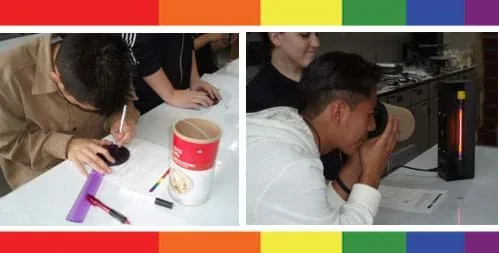 Students create and use spectrographs.
We recommend this eight-activity middle school unit be conducted in the following order:
- Patterns and Fingerprints
- Graphing the Rainbow
- Using Spectral Data to Explore Saturn and Titan
- Building a Fancy Spectrograph
- Using a Fancy Spectrograph
- A Spectral Mystery
- Engineering Your Own Spectrograph
- Designing a Spectroscopy Mission (this last activity is suitable for grades 10-12)
Spectrographs are used in ground-based telescopes and in space to help astronomers answer questions about what makes up the atmospheres of distant planets and stars. Engineers create these spectrographs to advance our knowledge of the universe. Spectrographs are designed very specifically to analyze certain types of light. The type of spectrograph materials used determines which spectral lines can be seen. Creating spectrographs to operate from space satellites is a special challenge, requiring the development of lightweight and durable materials and equipment that can withstand space travel.
- MS-PS4-2 Develop and use a model to describe that waves are reflected, absorbed, or transmitted through various materials.
Grades 6-8
This resource focuses on the following Three Dimensional Learning aspects of NGSS:
Science & Engineering Practices- Develop and use a model to describe phenomena.Do you agree with this alignment?
Disciplinary Core Ideas- A sound wave needs a medium through which it is transmitted.Do you agree with this alignment?
- When light shines on an object, it is reflected, absorbed, or transmitted through the object, depending on the object's material and the frequency (color) of the light.Do you agree with this alignment?
- The path that light travels can be traced as straight lines, except at surfaces between different transparent materials (e.g., air and water, air and glass) where the light path bends.Do you agree with this alignment?
- A wave model of light is useful for explaining brightness, color, and the frequency-dependent bending of light at a surface between media.Do you agree with this alignment?
- However, because light can travel through space, it cannot be a matter wave, like sound or water waves.Do you agree with this alignment?
Crosscutting Concepts- Structures can be designed to serve particular functions by taking into account properties of different materials, and how materials can be shaped and used.Do you agree with this alignment?
Do you agree with this alignment? - Develop and use a model to describe phenomena.
The holographic diffration gratings mentioned in the Summary are available online at many websites, including Edmund Scientifics and the Rainbow Symphony Store, for ~50 cents each.
A note about terminology: In creating the Spectroscopy curricular unit, the Project SPECTRA! program chose to use the term “spectrograph” (as opposed to spectroscope) for the engineering projects activities because a spectrograph is a tool used in spacecraft and modern telescopes, and Project SPECTRA! is an astronomy program. A spectrograph uses a detector, usually a CCD (a charge coupled device, similar to those used in digital cameras), to record the properties of light. Technically, in this unit, students build “spectroscopes,“ which are similar to spectrographs, however, instead of using a detector, the human eye directly observes the light within the scope or projected onto a screen. The primary difference between the two instruments is the method in which the light is detected. A spectrograph enables a person to observe light that cannot be seen with the eye (typically ultraviolet, infrared, and x-rays) because the detector records these wavelengths electronically, enabling the signals to be observed as plots or graphs. In this curricula, when students build their “space-worthy” spectrographs, we consider the students themselves to be the detectors, and leave to their instructors the option of providing students with more in-depth explanation.
Contributors
Laboratory for Atmospheric and Space Physics (University of Colorado Boulder)
Supporting Program
Laboratory for Atmospheric and Space Physics (LASP), University of Colorado Boulder
Acknowledgements
This digital library curricular content was developed with funding from Project SPECTRA!, a NASA-funded program.
Copyright
2007 by Regents of the University of Colorado