
Floppy Heart Valves
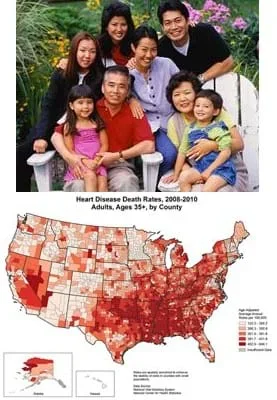 Heart disease is a major cause of death for U.S. adults, affecting many families.Copyright (top) 2004 Microsoft Corporation, One Microsoft Way, Redmond, WA 98052-6399 USA. All rights reserved. (bottom) 2014 National Vital Statistics System and National Center for Health Statistics http://office.microsoft.com/en-us/images/results.aspx?qu=family&ex=1#ai:MP900407131| http://www.cdc.gov/dhdsp/data_statistics/fact_sheets/images/fs_heart_disease.png
This "legacy cycle" unit is structured with a contextually based Grand Challenge followed by a sequence of instruction in which students first offer initial predictions (Generate Ideas) and then gather information from multiple sources (Multiple Perspectives). This is followed by a Research and Revise phase as students integrate and extend their knowledge through a variety of learning activities. The cycle concludes with formative (Test Your Mettle) and summative (Go Public) assessments that lead students towards answering the Challenge question. See below for the progression of the legacy cycle through the unit. Research and ideas behind this way of learning may be found in How People Learn: Brain, Mind, Experience and School (Bransford, Brown & Cocking, National Academy Press, 2000); see the entire text at https://www.nap.edu/read/9853/chapter/1.
The legacy cycle is similar to the engineering design process in that they both involve identifying an existing societal need, applying science and math to develop solutions and using the research conclusions to design a clear, conceived solution to the challenge. Though the engineering design process and the legacy cycle both result in viable solutions, each focuses differently on how the solution is devised and presented. See an overview of the engineering design process in the engineering design handout in the final activity, or at https://www.teachengineering.org/populartopics/designprocess.
In What Do I Need to Know about Heart Valves?(lesson 1), students are introduced to the challenge question and exposed to some basic information relevant to the topic of heart valve tissue. This supplies the Challenge, Generate Ideas, and Multiple Perspective portions of the legacy cycle. Students wrap up the lesson by researching heart valve mechanics and valve tissue anatomy and details. These activities represent the Research and Revise portion of the legacy cycle. In The Mighty Heart associated activity, student groups dissect sheep hearts to see and feel its structure, including valves, and learn more in-depth information about valves.
In Elasticity & Young's Modulus for Tissue Analysis (lesson 2), students learn about the forces that act on heart valve tissue, as well as elasticity, stress, strain, Young's modulus and how to calculate Young's modulus for materials. They complete some practice problems to solidify their understanding. In the Does My Model Valve Stack up to the Real Thing? associated activity, students research materials suitable for their model valves. They test possible materials to evaluate them for similarities to real heart valves. Then they design and test their prototype heart valve models. Students refine their models after testing and before presenting the information to the teacher and class as an information packet. The work accomplished in this activity represents the Test Your Mettle and the Go Public portions of the legacy cycle.
Engineers look into ways to improve problems that humans face by developing solutions, and then researching, building, testing and redesigning those solutions to improve upon the initial design. Often what is needed does not exist, so it is up to engineers to develop novel materials, structures or procedures to solve the problems. Bioengineers perform all of these tasks, but with a focus on biological materials, processes or chemicals. In this case, student groups are challenged to develop a material that mimics the behavior and mechanical properties of aortic valves. To do this, students study the problem, learn as much about heart valves as they can, and apply their knowledge towards the design, building and testing of a material and model that meets the buyer's needs.
- Design problems are seldom presented in a clearly defined form.
Grades 9-12
Do you agree with this alignment? - Technological problems must be researched before they can be solved.
Grades 9-12
Do you agree with this alignment? - Medical technologies include prevention and rehabilitation, vaccines and pharmaceuticals, medical and surgical procedures, genetic engineering, and the systems within which health is protected and maintained.
Grades 9-12
Do you agree with this alignment?
- HS-ETS1-1 Analyze a major global challenge to specify qualitative and quantitative criteria and constraints for solutions that account for societal needs and wants.
Grades 9-12
This resource focuses on the following Three Dimensional Learning aspects of NGSS:
Science & Engineering Practices- Analyze complex real-world problems by specifying criteria and constraints for successful solutions.Do you agree with this alignment?
Disciplinary Core Ideas- Criteria and constraints also include satisfying any requirements set by society, such as taking issues of risk mitigation into account, and they should be quantified to the extent possible and stated in such a way that one can tell if a given design meets them.Do you agree with this alignment?
- Humanity faces major global challenges today, such as the need for supplies of clean water and food or for energy sources that minimize pollution, which can be addressed through engineering. These global challenges also may have manifestations in local communities.Do you agree with this alignment?
Crosscutting Concepts- New technologies can have deep impacts on society and the environment, including some that were not anticipated. Analysis of costs and benefits is a critical aspect of decisions about technology.Do you agree with this alignment?
Do you agree with this alignment? - Analyze complex real-world problems by specifying criteria and constraints for successful solutions.
- HS-ETS1-2 Design a solution to a complex real-world problem by breaking it down into smaller, more manageable problems that can be solved through engineering.
Grades 9-12
This resource focuses on the following Three Dimensional Learning aspects of NGSS:
Science & Engineering Practices- Design a solution to a complex real-world problem, based on scientific knowledge, student-generated sources of evidence, prioritized criteria, and tradeoff considerations.Do you agree with this alignment?
Disciplinary Core Ideas- Criteria may need to be broken down into simpler ones that can be approached systematically, and decisions about the priority of certain criteria over others (trade-offs) may be needed.Do you agree with this alignment?
Do you agree with this alignment? - Design a solution to a complex real-world problem, based on scientific knowledge, student-generated sources of evidence, prioritized criteria, and tradeoff considerations.
- HS-LS1-2 Develop and use a model to illustrate the hierarchical organization of interacting systems that provide specific functions within multicellular organisms.
Grades 9-12
This resource focuses on the following Three Dimensional Learning aspects of NGSS:
Science & Engineering Practices- Develop and use a model based on evidence to illustrate the relationships between systems or between components of a system.Do you agree with this alignment?
Disciplinary Core Ideas- Multicellular organisms have a hierarchical structural organization, in which any one system is made up of numerous parts and is itself a component of the next level.Do you agree with this alignment?
Crosscutting Concepts- Models (e.g., physical, mathematical, computer models) can be used to simulate systems and interactions—including energy, matter, and information flows—within and between systems at different scales.Do you agree with this alignment?
Do you agree with this alignment? - Develop and use a model based on evidence to illustrate the relationships between systems or between components of a system.
- CLE 3251.4.2 Explore the anatomy of the heart and describe the pathway of blood through this organ.
Grades 9-12
Do you agree with this alignment? - CLE 3251.4.3 Describe the biochemical and physiological nature of heart function.
Grades 9-12
Do you agree with this alignment? - CLE 3251.T/E.3 Explain the relationship between the properties of a material and the use of the material in the application of a technology.
Grades 9-12
Do you agree with this alignment?
Plan on the unit taking seven 50-minute class periods, according to the following schedule: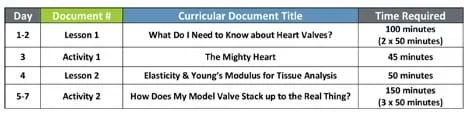
Contributors
Michael Duplessis
Supporting Program
VU Bioengineering RET Program, School of Engineering, Vanderbilt University
Acknowledgements
The contents of this digital library curriculum were developed under National Science Foundation RET grant nos. 0338092 and 0742871. However, these contents do not necessarily represent the policies of the NSF, and you should not assume endorsement by the federal government.
Copyright
2013 by Regents of the University of Colorado; original © 2012 Vanderbilt University