
What Do I Need to Know about Heart Valves?
 The heart is vital to human survival and understanding how it works helps us to be healthy.Copyright 2009 Centers for Disease Control and Prevention http://www.cdc.gov/heartdisease/coronary_ad.htm
Students are presented with the unit's grand challenge problem: You are the lead engineer for a biomaterials company that has a cardiovascular systems client who wants you to develop a model that can be used to test the properties of heart valves without using real specimens. How might you go about accomplishing this task? What information do you need to create an accurate model? How could your materials be tested? Students brainstorm as a class, then learn some basic information relevant to the problem (by reading the transcript of an interview with a biomedical engineer), and then learn more specific information on how heart tissues work—their structure and composition (lecture information presented by the teacher). This prepares them for the associated activity, during which students cement their understanding of the heart and its function by dissecting sheep hearts to explore heart anatomy.
To begin the engineering design process, a number of steps are taken to learn as much as possible about a defined problem before beginning to develop solutions. This involves thinking about what is already known and what is necessary to find out, gathering information from multiple sources, and exploring this information so to gain a deeper understanding of all aspects of the problem.
Biomedical engineering involves developing and testing solutions to problems of the human body, in cells, or other biological systems. The heart is essentially a pump, and its valves act as controls to help ensure the correct direction and pacing of blood flow. If they do not work as intended, then blood flow through the heart is impeded. Thus, biomedical engineers need to understand how the heart and its valves work, including the physical properties of the valves; then they use that information to develop working models that mimic the behavior of human heart valves, and are suitable as artificial replacement valves.
After this lesson, students should be able to:
- Identify major structures of the human heart on diagrams and organic specimens.
- Describe the flow of blood through the human heart.
- Describe the structure and function of heart valves.
- Design problems are seldom presented in a clearly defined form.
Grades 9-12
Do you agree with this alignment? - Technological problems must be researched before they can be solved.
Grades 9-12
Do you agree with this alignment? - Medical technologies include prevention and rehabilitation, vaccines and pharmaceuticals, medical and surgical procedures, genetic engineering, and the systems within which health is protected and maintained.
Grades 9-12
Do you agree with this alignment?
- HS-ETS1-1 Analyze a major global challenge to specify qualitative and quantitative criteria and constraints for solutions that account for societal needs and wants.
Grades 9-12
This resource focuses on the following Three Dimensional Learning aspects of NGSS:
Science & Engineering Practices- Analyze complex real-world problems by specifying criteria and constraints for successful solutions.Do you agree with this alignment?
Disciplinary Core Ideas- Criteria and constraints also include satisfying any requirements set by society, such as taking issues of risk mitigation into account, and they should be quantified to the extent possible and stated in such a way that one can tell if a given design meets them.Do you agree with this alignment?
- Humanity faces major global challenges today, such as the need for supplies of clean water and food or for energy sources that minimize pollution, which can be addressed through engineering. These global challenges also may have manifestations in local communities.Do you agree with this alignment?
Crosscutting Concepts- New technologies can have deep impacts on society and the environment, including some that were not anticipated. Analysis of costs and benefits is a critical aspect of decisions about technology.Do you agree with this alignment?
Do you agree with this alignment? - Analyze complex real-world problems by specifying criteria and constraints for successful solutions.
- HS-ETS1-2 Design a solution to a complex real-world problem by breaking it down into smaller, more manageable problems that can be solved through engineering.
Grades 9-12
This resource focuses on the following Three Dimensional Learning aspects of NGSS:
Science & Engineering Practices- Design a solution to a complex real-world problem, based on scientific knowledge, student-generated sources of evidence, prioritized criteria, and tradeoff considerations.Do you agree with this alignment?
Disciplinary Core Ideas- Criteria may need to be broken down into simpler ones that can be approached systematically, and decisions about the priority of certain criteria over others (trade-offs) may be needed.Do you agree with this alignment?
Do you agree with this alignment? - Design a solution to a complex real-world problem, based on scientific knowledge, student-generated sources of evidence, prioritized criteria, and tradeoff considerations.
- HS-LS1-2 Develop and use a model to illustrate the hierarchical organization of interacting systems that provide specific functions within multicellular organisms.
Grades 9-12
This resource focuses on the following Three Dimensional Learning aspects of NGSS:
Science & Engineering Practices- Develop and use a model based on evidence to illustrate the relationships between systems or between components of a system.Do you agree with this alignment?
Disciplinary Core Ideas- Multicellular organisms have a hierarchical structural organization, in which any one system is made up of numerous parts and is itself a component of the next level.Do you agree with this alignment?
Crosscutting Concepts- Models (e.g., physical, mathematical, computer models) can be used to simulate systems and interactions—including energy, matter, and information flows—within and between systems at different scales.Do you agree with this alignment?
Do you agree with this alignment? - Develop and use a model based on evidence to illustrate the relationships between systems or between components of a system.
- CLE 3251.4.2 Explore the anatomy of the heart and describe the pathway of blood through this organ.
Grades 9-12
Do you agree with this alignment? - CLE 3251.4.3 Describe the biochemical and physiological nature of heart function.
Grades 9-12
Do you agree with this alignment?
- The Heart Pre-Test (pdf)
- The Heart Pre-Test (docx)
- The Heart Pre-Test Answer Key (pdf)
- The Heart Pre-Test Answer Key (docx)
- Floppy Heart Valves Challenge Question Handout (pdf)
- Floppy Heart Valves Challenge Question Handout (docx)
- The Heart Post-Test (pdf)
- The Heart Post-Test (docx)
- The Heart Post-Test Answer Key (pdf)
- The Heart Post-Test Answer Key (docx)
Students should be familiar with the components of the cardiovascular system and the basic structure of the heart, including the names and positions of the four chambers.
Human heart anatomy is important for students to understand as they explore transport through the body. One key concept is how heart structure dictates heart functionality. On a tissue level, heart valves have a specific structure that also determines how they work, and this structure interacts with the various forces that it encounters from blood flow. If students (acting as engineers) are to develop replacement tissue for aortic valves, then they must have a thorough understanding of how organic human heart valves act under these forces. The following information is provided as a lecture guide; it is also provided on the student handout pages 3-4.
Lesson Schedule
Day 1:
- Introduce the challenge problem.
- Students independently work in their journals to answer the challenge problem. Then students share their ideas with the class. Record ideas on the board for all students to see and discuss as a class.
- Administer the pre-test.
- Students read a transcript of an interview with a biomedical engineer and discuss as a class.
- Present a short lecture about basic heart anatomy and functionality.
Day 2:
- Students continue to learn about heart anatomy and specifically about heart valves.
- Administer the post-test.
- Students are ready for the associated activity The Mighty Heart in which teams perform sheep heart dissections.
The Heart and Heart Valves
The heart is a pump that, as cardiac tissues contract, pushes blood from one chamber to the next or from one chamber into a blood vessel. To help ensure that blood only flows in one direction, a series of valves are strategically placed within the heart and in blood vessels immediately outside of the heart. These valves open to permit blood flow, and then close to prevent blood backflow (cardiac regurgitation).
Generally speaking, blood flow through the heart and body follows this path: Deoxygenated blood from the body enters the heart from the superior and inferior vena cava via the right atrium, and then passes through the tricuspid valve into the right ventricle. Then blood is pumped through the pulmonary valve into the pulmonary arteries, which lead to the lungs, where the blood picks up oxygen. The newly oxygenated blood leaves the lungs and returns to the heart via the pulmonary veins. This blood enters into the left atrium, and passes through the bicuspid (mitral) valve into the left ventricle. The pumping action of the heart pushes the blood out of the left ventricle through the aortic valve into the aorta, which is ultimately responsible for leading oxygen rich blood into the body.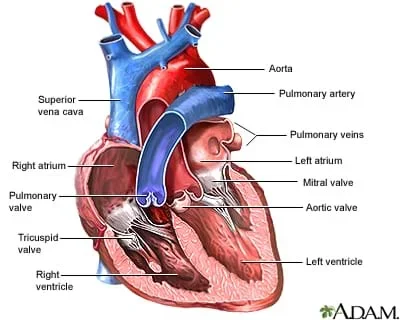 The structure of the human heart.Copyright MedlinePlus, U.S. National Library of Medicine, National Institutes of Health http://www.nlm.nih.gov/medlineplus/ency/imagepages/18092.htm
The two valves within the heart—the tricuspid and mitral valves—prevent blood backflow from the ventricles into the atria. Because of the force of the blood as it is pumped within the heart, the leaflets of each of these valves are anchored into place by strands of mostly collagen and elastin called chordae tendineae. These anchors prevent the valve leaflets from opening in the wrong direction (into the atria).
The two valves that are directly outside of the heart—the pulmonary and aortic valves—are both tricuspid valves (possessing three leaflets each) and are not anchored in place by tissue. Instead, each of the valve leaflets relies on its tissue structure to withstand the pressures exerted by blood flow.
Aortic Valves
Aortic valves are located between the left ventricle of the heart and the aorta. They are semi-lunar valves composed of three leaflets. During diastole (when the ventricles relax), the valve closes to prevent regurgitation (backflow) of the blood back into the heart. In this way, aortic valves play a major role in helping determine the direction of blood flow. During systole (when the heart contracts, moving blood into the blood vessels), the aortic valve opens, permitting blood to move into the aorta. This sequence of events repeats with each cardiac cycle, on average 60 times per minute.
Aortic valves are passive in nature, opening and closing largely because of the flow of blood. When blood is pulsed out of the heart during systole, it forces the valve to open. When the heart relaxes, the change in blood pressure causes the valve to close, allowing all three leaflets to fit snugly together. It is the structure of the aortic valve that enables it to close snugly to prevent cardiac regurgitation.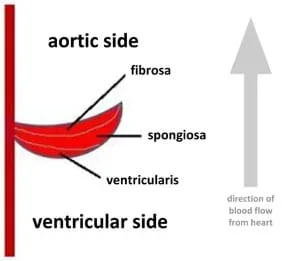 Aortic valves have three layers: ventricularis, spongiosa and fibrosa.Copyright 2012 Michael Duplessis, Vanderbilt University
Human aortic valve leaflets are composed of three distinct tissue layers (trilaminar; see Figure 1). The ventricularis layer faces the left ventricle. The spongiosa layer is the middle valve layer. The aortic side of the leaflet is called the fibrosa layer. Endothelial cells cover these three layers, forming a cell monolayer that protects the valve.
The fibrosa layer is composed of mostly collagen, which aligns in a certain way during the backflow of diastole, allowing the valve to elongate as it closes, forming a complete seal between the left ventricle and the aorta. This aligning of collagen fibers in the fibrosa layer also gives the now closed valves strength to withstand the backward flow of the blood from the aorta, preventing regurgitation.
The ventricularis layer of the aortic leaflet is composed largely of elastin, a protein with the ability to stretch out with stress, but return to its original shape once the stress is removed. When the heart relaxes, blood pressure in the valve forces the leaflets to close. As the collagen in the fibrosa layer aligns to let the valve leaflet stretch and completely seal the blood vessel, the elastin in the ventricularis layer stretches. When the backflow ceases (because the ventricle contracts during systole), the pressure from the backflow eases, permitting the elastin to recoil and thus causing the leaflets to fold up and open the seal so that blood may flow into the aorta.
The spongiosa layer, located between the ventricularis and the fibrosa, is composed of GAGs (glycosaminoglycans), which help to align the collagen and lubricate the movements of the ventricularis and the fibrose during valve leaflet movement.
(In advance, make copies of The Heart Pre-Test (PDF), Floppy Heart Valves Challenge Question Handout (PDF)and The Heart Post-Test (PDF), one each per student. Administer the pre-test either right before or right after introducing the challenge question.)
(Introduce students to this unit's challenge problem.) You are the lead engineer for a biomaterials company that has a cardiovascular systems client who wants you to develop a model that can be used to test the properties of heart valves without using real specimens. How might you go about accomplishing this task? What information do you need to create an accurate model? How could your materials be tested?
What are your initial thoughts on this? What things do you already know about this topic, and what things do you think that you would need to know to successfully complete this task?
(Use these prompts as a starting point for a class brainstorm about the challenge problem. Give each student a handout and a minute to read on his/her own the challenge problem and the questions. Then, as a class, have students answer the prompts and offer their initial ideas about how to approach this challenge. Record all responses on the classroom board, and have students copy down all the ideas on their handouts to help frame their thoughts and discussions for later reference.
Note: At this point, expect students' ideas to be limited regarding how to answer the challenge question, so after hearing initial ideas from students, direct them to read the transcript of an Interview with a Biomedical Engineer, on page 2 of the handout. Then, assist students in learning more about the anatomy and function of the heart by presenting to them the content in the Lesson Background section, which is also provided on page 3 of the handout.)
You have been presented with a challenge problem that asks you to consider the properties of heart valves so that you can develop a material that mimics their properties and behavior. In an effort to gather more information on how the aortic valve works, you have heard an interview from an expert in the field, looked at information on the anatomy of the heart and its valves, and researched information about the tissues and composition of aortic valves. Acting as engineers, you will apply these concepts in the coming lesson to test materials for your valve, and ultimately design, build and test an artificial valve that can be used by the biomaterials company for its work.
- aorta
- The largest artery of the body, which takes blood from the left ventricle and moves it to the body.
- aortic valve
- A semilunar valve found in the aorta.
- atria
- The two chambers of the heart that receive blood from the body.
- biomaterial
- A material that can interact with other tissues and mimic their properties and behavior.
- cardiac regurgitation
- The backflow of blood at a valve because the valves are not closing correctly.
- endocardium
- The innermost layer of the heart, which touches blood that flows through the heart.
- epicaridum
- A tissue layer that covers the myocardium of the heart and makes up the outside borders of the heart.
- mitral valve
- A bicuspid valve located between the left atrium and the left ventricle.
- myocardium
- Thick muscle tissue that composes the middle layer of the heart.
- pericardium
- A membrane that covers and protects the heart.
- pulmonary circulation
- The movement of blood between the heart and the lungs.
- pulmonary valve
- A semilunar valve with three cusps located between the right ventricle and the pulmonary artery.
- systemic circulation
- The movement of blood between the heart and the body (excluding the lungs).
- valve
- In the heart, a flap of tissue that acts as a one-way door to help blood flow in one direction.
- ventricles
- The two chambers of the heart that receive blood from the atria and send blood to the body.
Pre-Lesson Assessment
Pre-Test: Administer the three-question The Heart Pre-Test (PDF)to students either right before or right after introducing the challenge question. Review students' answers to determine how much basic knowledge they have about heart anatomy. If desired, further review as a class the quiz answers to determine how much information about the heart anatomy is necessary to present during the lecture.
Post-Introduction Assessment
Brainstorming: As part of presenting the Introduction/Motivation content, after reading the challenge question to students, provide them with the following prompts: What are your initial thoughts on this? What things do you already know about this topic, and what things do you think that you would need to know to successfully complete this task?
Use these prompts as a starting point for a class brainstorm about the challenge problem. Give students the Floppy Heart Valves Challenge Question Handout (PDF) and a minute to read on their own the challenge problem and the questions. Then, as a class, have students answer the prompts and offer their initial ideas about how to approach this challenge. Record all responses on the classroom board, and have students copy down all the ideas on their handouts to help frame their thoughts and discussions later in the lesson and its associated activity.
Lesson Summary Assessment
Post-Test: At lesson end, administer the eight-question The Heart Post-Test (PDF) to assess students on their understanding of heart anatomy.
Campbell, N., Reece, J., Urry, L., Cain, M., and Wasserman, S. Biology. Eighth edition. San Francisco, CA: Benjamin-Cummings Publishing Co., 2007.
Nagatomi, Jiro. Mechanobiology Handbook. Boca Raton, FL: CRC Press, 2011.
- Floppy Heart Valves
- What Do I Need to Know about Heart Valves?
- Elasticity & Young's Modulus for Tissue Analysis
Contributors
Michael Duplessis
Supporting Program
VU Bioengineering RET Program, School of Engineering, Vanderbilt University
Acknowledgements
The contents of this digital library curriculum were developed under National Science Foundation RET grant nos. 0338092 and 0742871. However, these contents do not necessarily represent the policies of the NSF, and you should not assume endorsement by the federal government.
Copyright
2013 by Regents of the University of Colorado; original © 2012 Vanderbilt University